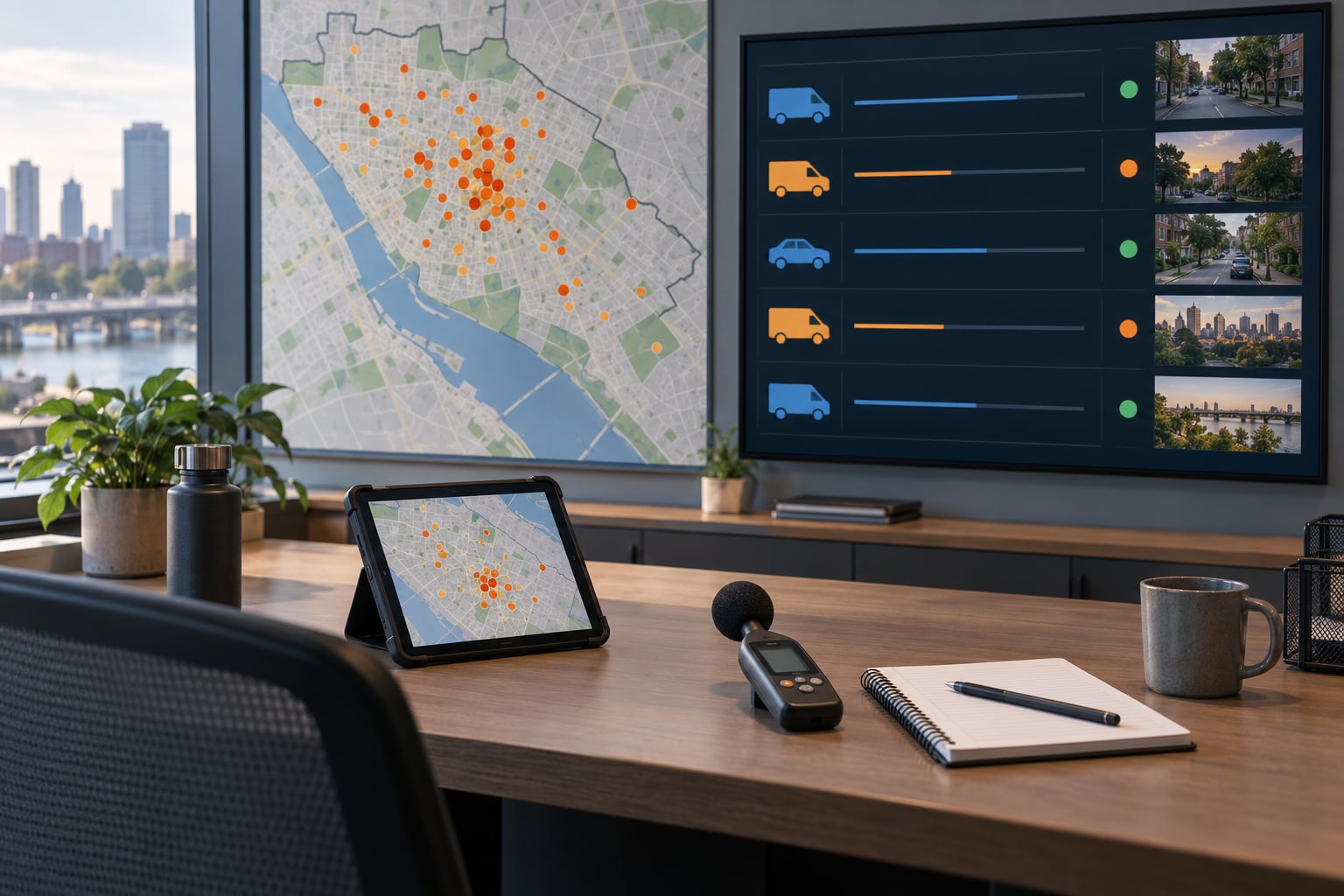
Noise complaints are mapped by turning a phone call, app report or web form into a geocoded 311 service request record with a category, a status and an assigned city agency. That record gets dispatched, inspected and closed, and then plotted as a point on a hotspot map. Here is how noise complaints are mapped and handled end to end, from intake through trend analysis.
The distinction matters more than it sounds. A complaint map is a map of reported problems, not a map of actual sound levels, and a city that reads the two as the same thing ends up policing the wrong blocks. Understanding the pipeline is how civic teams, city staff and developers build something that actually changes conditions on the ground.
Table of Contents
- How Noise Complaints Are Mapped and Handled — the full pipeline
- What information is collected in a noise complaint?
- How are complaint locations turned into map data?
- Which tools are used to map noise complaints?
- How are complaints verified before action is taken?
- How does a complaint move from the map to the responsible team?
- What happens after a noise complaint is reported?
- How do cities measure whether complaint handling works?
- How can a city reduce repeat noise complaints?
- What privacy and accessibility issues should a complaint system address?
- Frequently Asked Questions
- What should a city improve first?
How Noise Complaints Are Mapped and Handled — the full pipeline
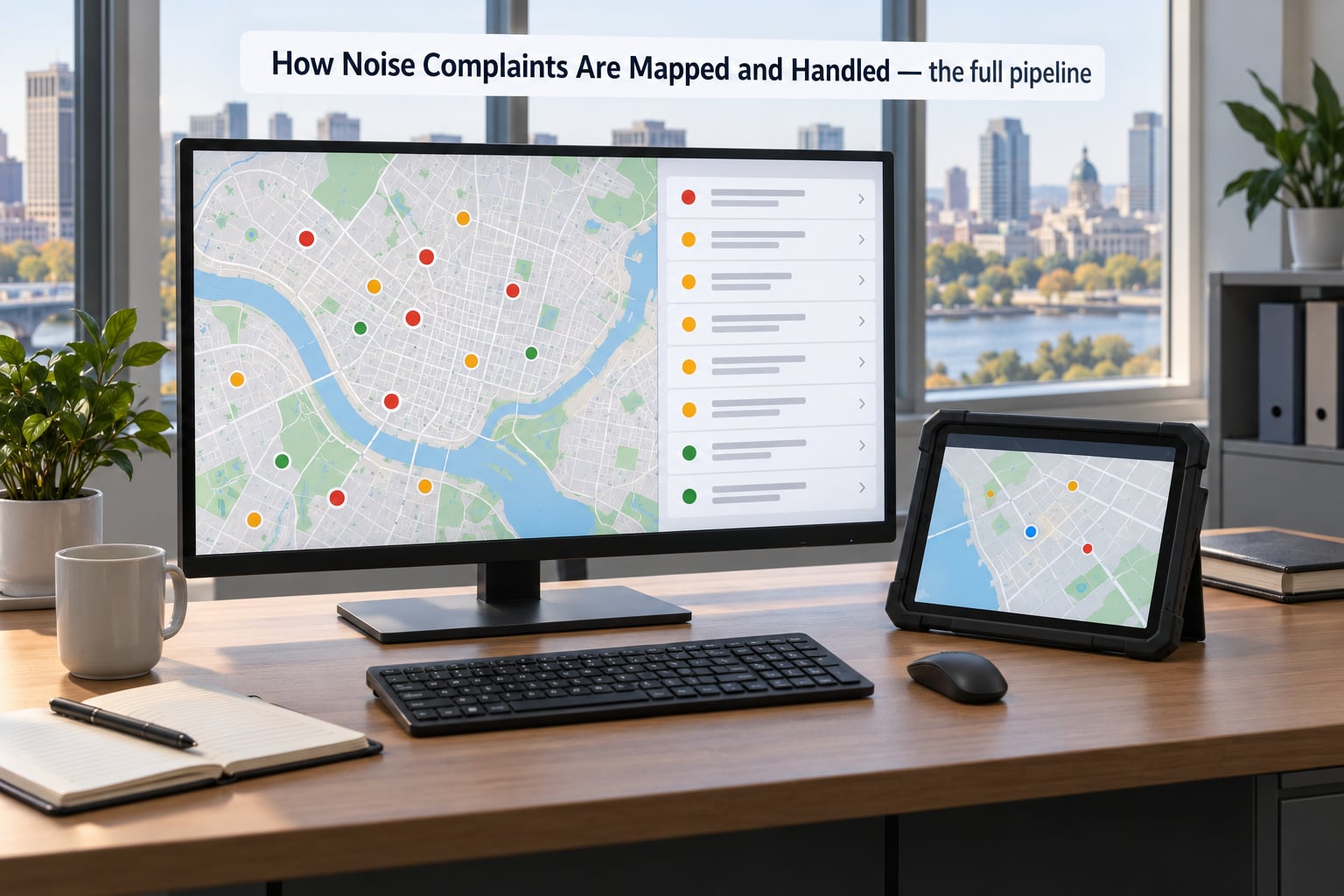
A municipal noise complaint runs through seven stages: intake, categorization, geotagging, routing, dispatch, service-level tracking and closure. Each stage leaves a field on the same record, and that record is what analysts query later to build maps.
The seven stages in order
- Intake. The report arrives by phone, web form, mobile app or an in-person desk, and a service request number is issued immediately.
- Categorization. The intake form assigns a request type such as noise from residential or amplified sound, because that field drives routing.
- Geotagging. The address or coordinates are matched to a street segment or parcel, which is what makes the request mappable.
- Routing. Rules send the request to the agency that owns that category in that location and time window.
- Dispatch. The request enters a queue with a priority based on active disturbance, time of day and repeat history at the location.
- Service-level tracking. The record carries a target date for first response or inspection, and every status change is stamped.
- Closure. An officer closes the request with a resolution code, and the closed point joins the historical dataset.
The Open311 standard is what makes stage three and stage seven comparable across cities. Any city publishing an Open311 feed exposes the same core fields, which is why a complaint map built from one city’s data can be compared with another.
What information is collected in a noise complaint?
The fields are remarkably consistent across municipal systems, because intake forms are built to a shared 311 schema. Most of them are public in the open data feed; a few are withheld for the reporter’s safety.
| Field | What it records | In the open dataset |
|---|---|---|
| Service request number | The unique case identifier used to track status | Yes |
| Created date and time | When the report came in, to the minute | Yes |
| Request type | The category, for example noise from residential or amplified sound | Yes |
| Agency | The department that took ownership | Yes |
| Address, cross streets, ZIP | Where the noise was reported | Yes, sometimes generalized |
| Latitude and longitude | The geocoded point used for mapping | Yes |
| Status | Open, in progress, closed or transferred | Yes |
| Due date | The service-level target for response or inspection | Yes |
| Resolution and resolution date | Outcome code and when the case ended | Yes |
| Free-text description | The reporter’s own words about the source | Varies by city |
| Uploaded photo or audio | Supporting evidence from the reporter | Varies, often withheld |
| Reporter name, phone, email, apartment number | Contact details for follow-up | No |
| Officer internal notes | Inspection findings and enforcement detail | No |
That last group is where most of the frustration in resident forums comes from. A person files a report, gets a case number, never hears anything, and has no way to retrieve the outcome because the note field is closed to the public. Researchers working with open data see exactly the opposite problem: the free-text descriptions are full of identifying detail and occasionally leak apartment numbers into published feeds.
How are complaint locations turned into map data?
Geocoding is the bridge between a spoken address and a dot on a map. The address string is matched against a municipal address point database or a national geocoder, which returns coordinates and a quality score, and the system also records the cross streets the reporter gave as a manual fallback.
What happens to duplicates
Geocoding alone does not de-duplicate a single noisy night. Cities cluster requests by proximity in space and time, so ten calls from one apartment building within a two-hour window become one incident polygon with ten attached reports, not ten separate problems. That clustering step is what turns a scatter of points into a usable complaint layer.
Accuracy has practical limits. Residents report the noise where they hear it, which is rarely the property line where the ordinance is measured, and a complaint placed at a nearby address lands on the wrong parcel. Most systems treat coordinates as a starting point for dispatch rather than as evidence.
Privacy controls sit directly on top of this. Public maps usually show aggregated counts by block or by grid cell, and restricted layers with the exact address and reporter details stay available only to the assigned department.
Which tools are used to map noise complaints?
No single tool does the whole job. Cities run complaint records through a stack, and each layer can and cannot establish something different.
What each layer actually proves
- The 311 platform (a city’s own hub, or vendors like Salesforce or Open311 implementations) stores the case, the category and the status. It proves a report was filed, not that noise occurred.
- GIS software turns coordinates into hotspot maps, buffers and counts by block. It shows where reports concentrate, and nothing about how loud they were.
- Mobile reporting apps improve location accuracy by attaching device GPS at the moment of the report and attaching a photo or audio clip.
- Environmental sensors measure sound continuously and independently of reporting. They establish actual levels and timing, and they cannot tell you whether anyone was disturbed.
- Acoustic cameras and calibrated meters used by noise officers establish a legally usable reading, typically at a defined microphone position during defined hours.
- Dashboards layer complaints over sensor data, zoning and permit records to show where enforcement and exposure overlap.
Sensor networks are the part that fills the gap complaints leave. The Sounds of New York City project, a collaboration between NYU and Ohio State, installed smart microphones across the city to build an aural map of sonic irritants, with short clips classified by machine-listening rather than reviewed by hand. Reporting from 2016 put the lag between a complaint and a noise inspector’s visit at roughly four days, which is a useful illustration of why enforcement trails a live event.
Commercial street-level datasets now offer measured sound levels alongside complaint counts, and the newest pattern is feeding both into a single map layer rather than two separate portals.
How are complaints verified before action is taken?
Verification decides whether a request becomes work. Most cities run four checks: is it a duplicate, is it within the city’s jurisdiction, is there a permit on file, and does a human confirm the source is real.
The permit check is fast and decisive. A festival, a construction site with an after-hours variance or a venue holding a sound permit already has a legal basis for the noise, so the request is closed as permitted activity with no inspection. The duplicate check removes requests already attached to an open incident at the same address.
Sensor corroboration is the newer layer. Where a calibrated sensor sits within range of a complaint point, the recorded levels in the complaint’s time window can confirm or undercut the description before anyone drives out. Officers still make the call, and a sensor reading is usually treated as supporting evidence rather than the finding itself, because a meter on a different street does not meet the ordinance’s measurement standard.
How does a complaint move from the map to the responsible team?
Routing is a rules engine, not a judgement call. Four inputs decide the destination: the request category, the geography, the time of day and the severity flag.
Who takes which kind of complaint
| Owner | Takes it when | Usual action |
|---|---|---|
| Police non-emergency | Noise is happening now, or it is amplified sound disturbing the peace | Warning, citation, occasionally arrest |
| Code enforcement | The source is equipment or property related: HVAC, generators, compressors, ongoing construction | Notice of violation and re-inspection |
| Environmental or public health | A source recurs and affects several households rather than one dispute | Notice to the source, verification visit |
| Dedicated noise control unit | Measurement, permit review, festivals and large events | Calibrated measurement and permit enforcement |
| Parks and recreation | The disturbance is in a park or plaza | Warning, equipment and permit enforcement |
| Housing or licensing inspector | A rental property has repeat, documented violations | Notice to the landlord, administrative citation |
Time of day changes the destination. A loud party at 11 p.m. on a Tuesday routes to police non-emergency because the ordinance is a disturbance-of-the-peace rule, while a commercial rooftop unit running at 3 a.m. routes to code enforcement because the ordinance is a property standard. Residents describe this ambiguity constantly in city forums, and it is the single most common reason a complaint feels like it disappears.
What happens after a noise complaint is reported?
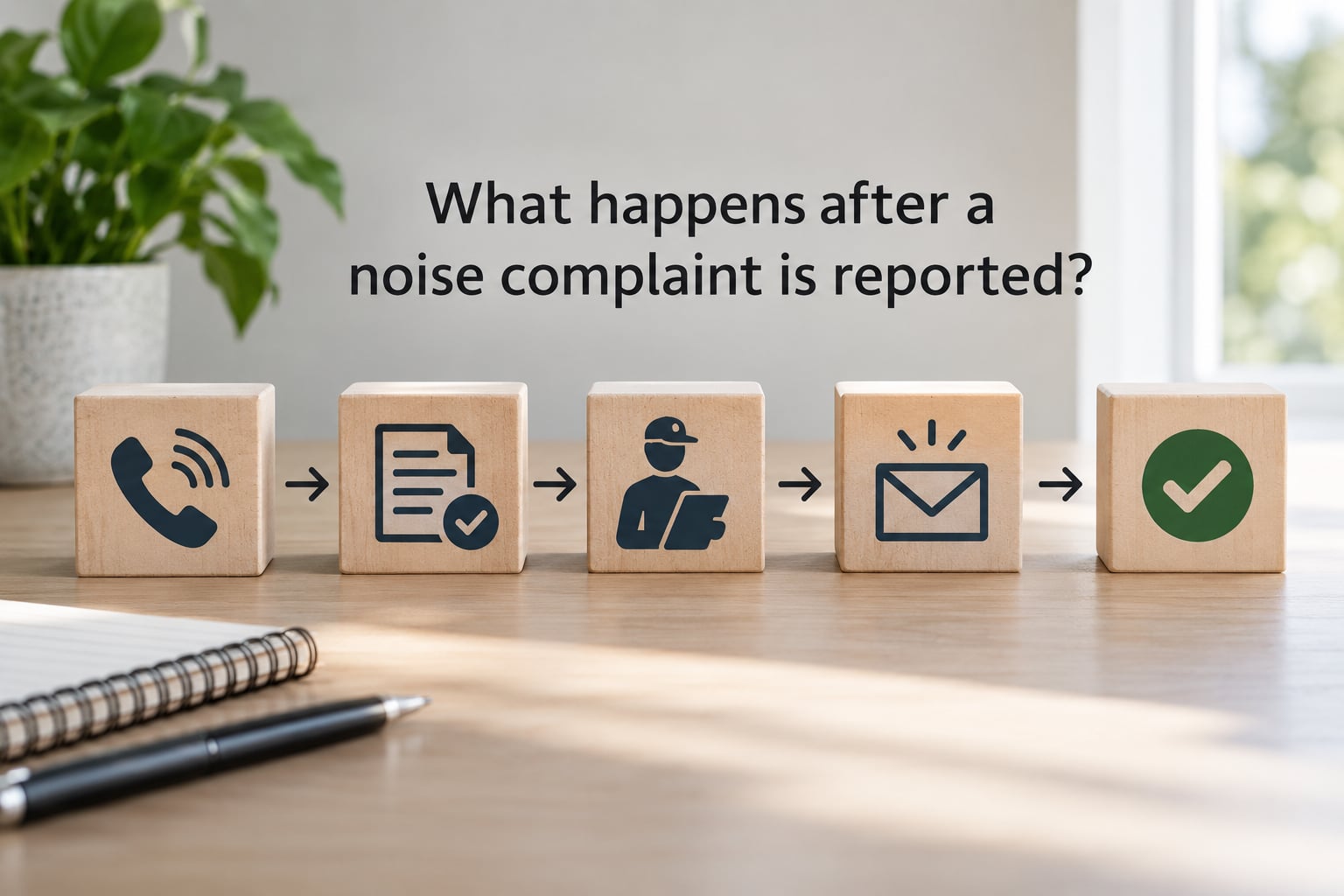
After intake, the case waits in a queue with a due date attached. Dispatch assigns it by priority, active disturbance outranks a retrospective report, and repeat addresses often carry a flag that keeps them near the top.
From first contact to closure
- Triage. The queue manager checks category, jurisdiction and duplicates before assigning.
- Contact attempt. An officer often calls the reporter first, because a live call during the event is the difference between a witnessed violation and an unverifiable description.
- Inspection. An officer or inspector attends, uses a calibrated meter at the required position, and records the reading, duration and source.
- Enforcement. The first visit is usually a warning, with a citation or notice to comply following on if the source continues.
- Correction. The source is fixed, an operating hour changes, or a permit condition is enforced.
- Follow-up measurement. A repeat visit confirms the correction, sometimes days later.
- Closure. The officer records the resolution code and the case closes with a timestamp the resident can look up by case number.
The gap residents complain about is between steps two and seven. Forum threads on ignored complaints, including a case discussed on a Queens community board forum, repeat the same story: nothing came back, the case number was never checked, and the loop closed without anyone telling them the outcome.
Advocacy research offers a modest counterweight. In an informal survey run by a noise advocacy group, filing a formal complaint was the most effective action residents took and resolved 61% of reported nuisances, which is far better than the impression many threads leave.
How do cities measure whether complaint handling works?
Cities track a handful of operational metrics, and each one has a failure mode worth naming.
The metrics and what they hide
- Median time to first response measures speed but not whether anything was enforced.
- Time to closure is the better number, because a closed case with no resolution code is a case someone dismissed.
- Repeat-complaint rate at the same address is the closest thing to an outcome measure, since a source that keeps generating reports after a citation is a source the enforcement model failed.
- Recurrence by location and hour turns individual complaints into a schedule for patrols and sensors.
- Source category mix shows whether a code enforcement rule is working on HVAC or whether police calls are absorbing every report.
- False or unverifiable reports are usually not published, which quietly inflates apparent success.
- Resident satisfaction follow-up surveys are rare, and they are the only metric that captures whether the person who filed felt heard.
Every one of these is a complaint metric, not an acoustic one. A quiet block can generate few reports because nobody lives there, and a loud block can look fine because residents have given up on the system. Both show up as low numbers.
How can a city reduce repeat noise complaints?
Case-by-case enforcement is a treadmill: the same source generates the same reports and the same warnings. Trend analysis is what breaks the cycle, because it points at the specific pattern instead of the individual incident.
Once recurrence is plotted by block and hour, the intervention is usually obvious and rarely dramatic. Persistent 2 a.m. HVAC complaints in one building push toward an equipment standard or a retrofit requirement for that property type. Complaints clustering around a nightlife block on weekend closing hours lead to adjusted closing rules or noise control officers at closing rather than more patrol volume.
Loading and waste collection noise points at route timing. A venue with a permit condition nobody monitors needs scheduled verification against the condition. Complaints that follow a single contractor across multiple sites suggest a licensing conversation instead of individual tickets.
Deploying permanent monitoring only where the map already shows persistence is the efficient version. It also produces the defensible record that a citation later depends on, which is why a few cities have started holding sensor data for enforcement rather than publishing it only as a map.
What privacy and accessibility issues should a complaint system address?
A noise complaint record is unusually sensitive because it describes when a specific household is asleep, working or absent, and who reported it. Collection should be limited to what the responding team needs.
The rules that keep it defensible
- Publish in aggregates. Public map layers show counts by block or grid cell; exact addresses and reporter identity stay restricted.
- Withhold reporter identity from open feeds, and keep the name, phone and apartment number available only to the assigned officer.
- Set a retention period for records containing personal detail. Closure data can live forever; contact data usually cannot.
- Strip identifiers from free text. Descriptions are where apartment numbers and first names leak most often.
- Make anonymous filing possible where the ordinance allows it, while being honest that an anonymous report limits follow-up.
- Keep every channel open. A phone line that works without an app, a bank balance or a credit card is the accessibility floor, and cities that drop it lose the residents most affected by noise.
- Support language access on the intake form and at the hotline, since a 311 system that only works in English misses the loudest neighborhoods.
Accessibility has a second meaning here too: a resident with a hearing impairment experiences the same ordinance breach but often cannot use the live non-emergency call route that works best for everyone else. Those residents need the documented and sensor-corroborated path to actually function.
Frequently Asked Questions
Are noise complaint maps accurate?
They are accurate as a record of reports, not of sound. A complaint map plots what residents chose to report, at the location they chose, clustered by space and time into incidents. Residents usually mark where they heard noise rather than where the ordinance is measured, so individual points can sit on the wrong parcel. Teams that pair complaint data with calibrated sensor data get a much better picture of actual levels.
Do noise complaints stay anonymous?
It depends on the city and the channel. Open data feeds typically exclude reporter names, phone numbers, email addresses and apartment numbers, and public maps show aggregated block-level counts. Phone intake often requires some contact detail so an officer can call back while the noise is still happening, and that detail stays restricted to the assigned department. Anonymous filing is available in some jurisdictions, but it limits follow-up.
What evidence is actually needed for a noise complaint?
Time and place are the strongest evidence, followed by duration and source description. A dated log with approximate times, video or audio recorded during the disturbance, and details of the source outperform a description written the next morning, because nothing can be measured retroactively. A decibel reading from a consumer app helps set expectations but rarely meets the measurement standard an officer needs. Keep the case number and check the closure record afterward.
Can police come inside my apartment for a noise complaint?
Generally no. Officers responding to a disturbance stand at the door or on the sidewalk and document what they can hear from outside, since entering a residence requires consent or a legal exception. If noise is coming from inside the complainant’s own unit, officers usually ask the resident to come outside. Documenting the reading from a shared hallway or stairwell tends to produce a usable record where a bedroom does not.
How long does it take to resolve a noise complaint?
It depends entirely on the city, the category and the channel. Police non-emergency calls during an active disturbance are the fastest route because a response is dispatched while the noise is measurable. Administrative routes through code enforcement or environmental health work against a target date that is published with the case, and repeat-violation inspections often take days. Reporting from 2016 put the lag between a complaint and a noise inspector’s visit in New York City at roughly four days.
What can I do when a 311 noise complaint goes nowhere?
Start by retrieving the case status instead of filing a duplicate, since a second report rarely speeds up the first. Then escalate in order: request the supervisor review or the internal appeal on the agency that handled it, contact your council member or ward office, and take the pattern to the community board as a recurring item. In New York City, the Environmental Commission hears complaints directly. Keep the dated log going, because repetition across months is what turns one ignored case into a documented pattern.
What should a city improve first?
Fix location capture first, because every downstream metric inherits the quality of the point on the map. Then write the routing rules down where dispatchers and residents can both read them, so the police-versus-code-enforcement question stops being a coin flip. Third, close the feedback loop by giving every filer a status page that shows the case number, the current stage and the resolution code.
Fourth, measure recurrence at the same address instead of counting tickets closed, because closed is not the same as solved. Fifth, publish the trend analysis that residents and planners can actually query, so the argument shifts from anecdote to a repeatable pattern.
One caveat to carry through all of it: complaint data describes reported problems, not the acoustic reality of a neighborhood. A serious noise mapping program treats 311 records as one input alongside sensor measurements, permit data and field inspection, and never lets a hotspot map stand alone as proof of what a block sounds like.