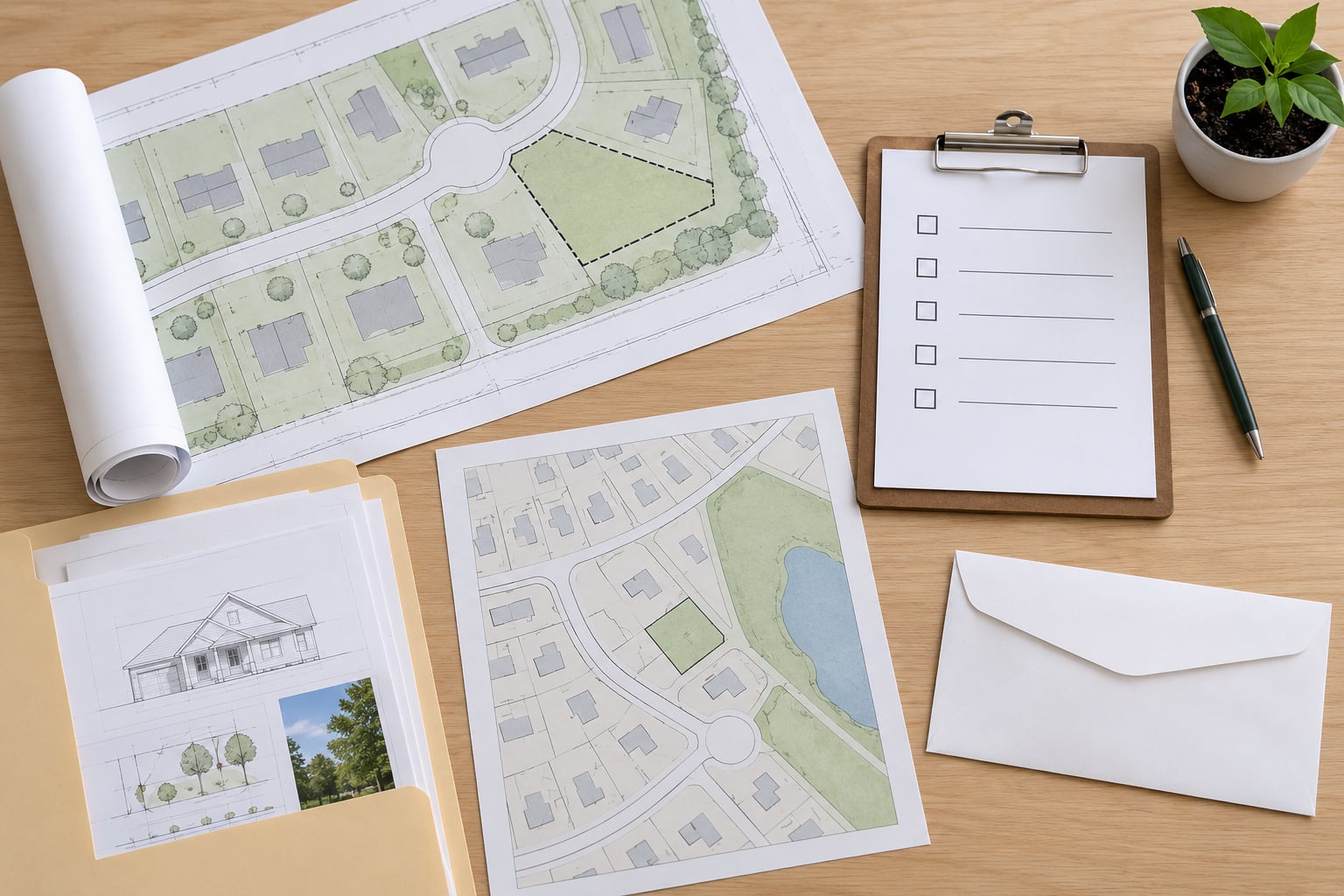
Community gardens get city approval through a land-use permission, not a casual handshake: you file with the city’s planning or parks department, staff review the application for completeness against local zoning rules, and a planning commission or city council votes to authorize the use of a specific parcel. The route, the permit type and the paperwork all depend on who owns the ground and what you plan to build on it.
Budget three to nine months from first call to written approval. Simple gardens on land already zoned for community gardens move fastest; anything with a fence, shed or greenhouse adds a building review, and a council agenda slot can add a quarter on its own.
Table of Contents
- What You Need for How Community Gardens Get City Approval
- How Community Gardens Get City Approval: Step-by-Step
- 1. Find out how community gardens get city approval in your city, and who decides
- 2. Meet with the approving department before you design the garden
- 3. Secure the land and confirm that the use is allowed
- 4. Prepare the site plan and the community proposal
- 5. Submit the complete application through the current portal
- 6. Respond to review, public input and conditions
- 7. Complete final approval and prepare for operation
- Common Mistakes
- Frequently Asked Questions
- Can a nonprofit apply for approval to start a community garden?
- Who approves a community garden on private property?
- Can a homeowners association approve a community garden without city permission?
- Which city department handles community garden applications?
- What should organizers do if the city denies the application?
- Conclusion: Start With the Right City Department
What You Need for How Community Gardens Get City Approval
Requirements shift with jurisdiction, ownership and site type, so the honest first answer is that there is no single national checklist. A garden inside a city park, a garden on a city-owned vacant lot, a garden on leased private land and a garden on school district land each travel through a different chain.
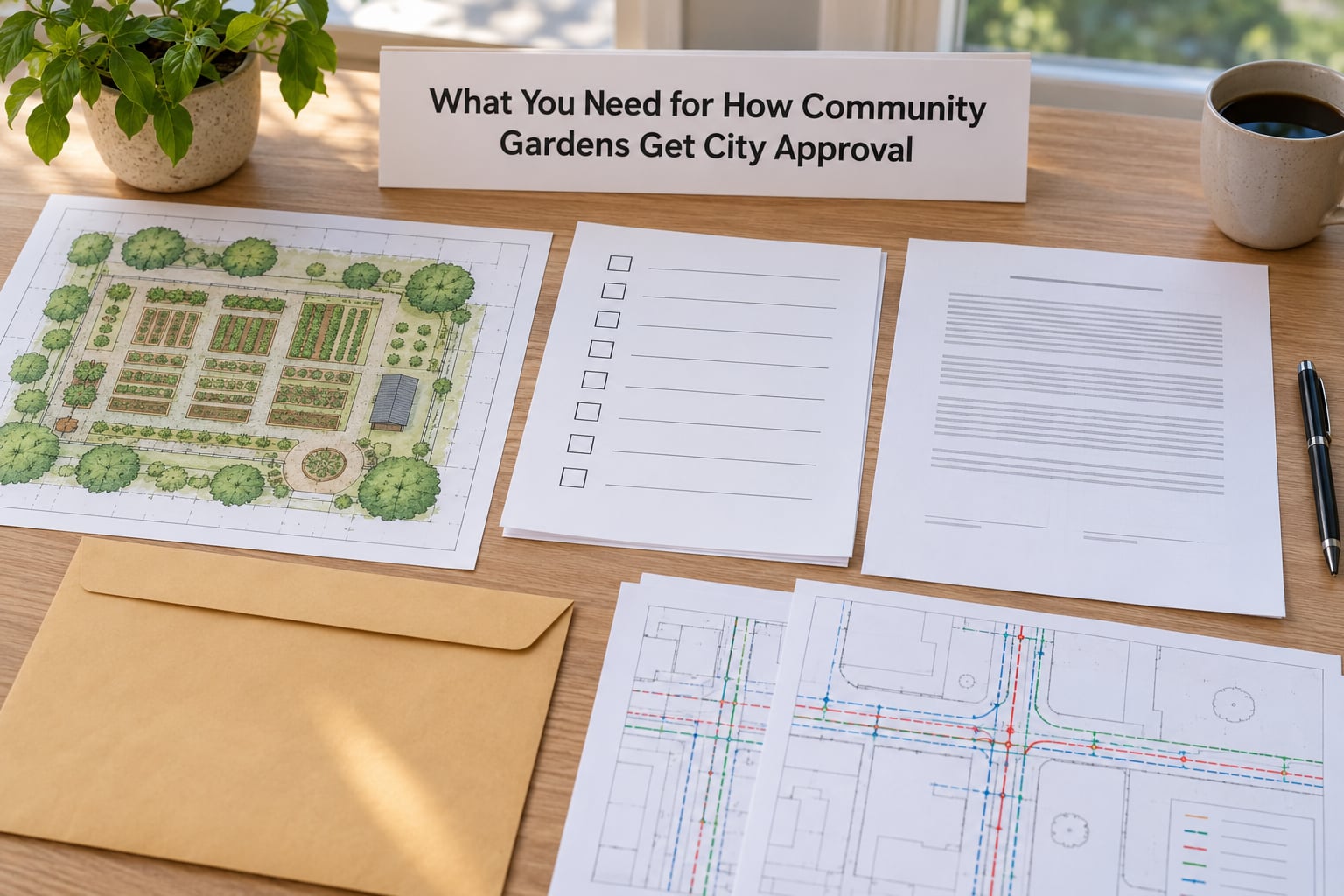
Before you draw a single bed, assemble this working file. Reviewers ask for most of it, and a group that can produce it in one sitting rarely gets a completeness letter back.
| What you prepare | Why the city asks for it |
|---|---|
| Organizer details and contact person | Someone must be answerable for the next twelve months |
| Site address, parcel number and boundaries | Every permit is tied to a specific parcel |
| Ownership or lease evidence | Proves your group can actually control the site |
| Scaled site plan drawing | Shows plot layout, paths, access and structures |
| Soil test results | Flags contamination before anyone eats anything |
| Drainage and water plan | Gardens add irrigation runoff to a neighborhood |
| Proposed uses list | Sharing, donation growing, events, structures |
| Access and safety plan | ADA route, emergency access, tool storage |
| Budget and start-up funding plan | Many cities ask for three cost estimates |
| Liability insurance certificate | Standard condition on public land agreements |
| Maintenance plan and named responsible party | Who mows, waters and repairs when volunteers move on |
| Organizational documents or bylaws | Nonprofit status changes fees and the agreement type |
How Community Gardens Get City Approval: Step-by-Step
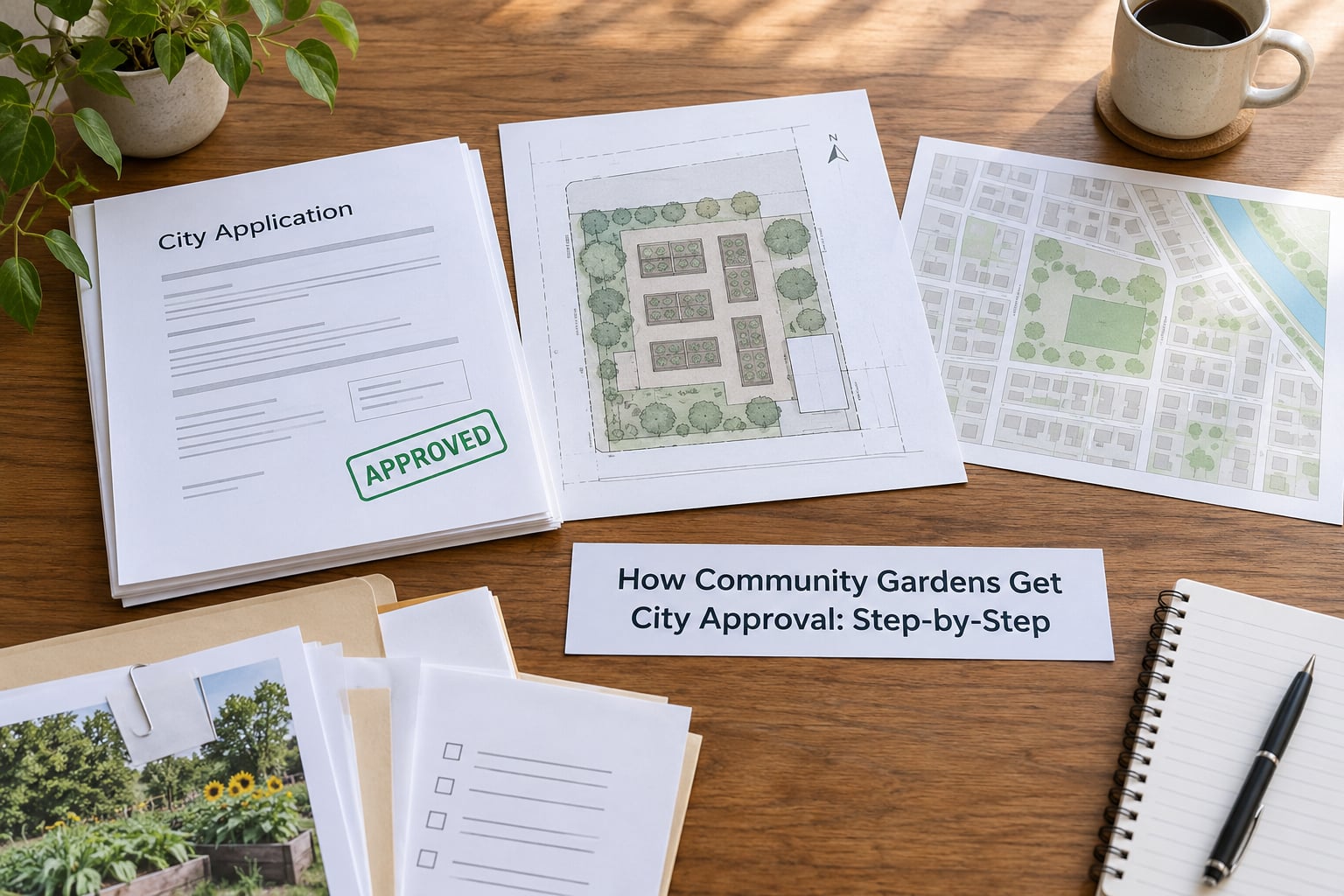
Approval usually lands in three stages: staff review for completeness, a public hearing before a commission or board, then a council vote. Small cities compress these into one meeting. The order never really changes.
1. Find out how community gardens get city approval in your city, and who decides
Start with the parks and recreation department if the site is inside a park, and the planning or zoning department if it is a vacant lot or a rezoning question. Public works may own the water and access. A neighborhood commission can hold a purely advisory hearing that carries real weight with council members.
Outside the city limits, the county planning department decides. On school district land, the district’s own board approves before the city ever sees it. On private land behind an association, the landowner and the HOA may both have to sign off first.
2. Meet with the approving department before you design the garden
Ask for a pre-application meeting and bring a one-page concept, not a finished design. The questions worth asking: which permit category applies, what studies are required, does a public hearing happen, who writes the staff report, what the fee is, how long review takes, and whether the city runs a community garden or urban agriculture program with a shortened application.
Planners will tell you in fifteen minutes whether your idea is workable. Finding that out by email can take a month.
3. Secure the land and confirm that the use is allowed
Vacant land is not available land. Public parcels often carry restrictions, holdouts or pending plans, so confirm availability with the owning department in writing before you spend money on a design.
| Land type | Who signs | Typical permit | Approval body |
|---|---|---|---|
| City-owned park land | Parks director, then agreement | Often none, or an administrative approval | Parks department, sometimes council ratification |
| City-owned vacant lot | Economic development or real estate division | Special use or conditional use permit | Planning commission, then city council |
| Leased private land | Private landowner, possibly HOA | Varies by zoning district | Zoning board if a use permit is needed |
| School or institutional land | District or institution board | Agreement plus city zoning check | Two separate approvals, in sequence |
Check zoning on the parcel before anything else. Cities such as San Diego list community gardens as a limited use in designated zones and require a Neighborhood Use Permit elsewhere, which tells you instantly whether you face an administrative review or a public hearing. Watch for easements, floodplain designations, wetland buffers and future land use plans that could end the garden years later.
4. Prepare the site plan and the community proposal
A reviewer needs to picture the site without visiting it. The plan needs property boundaries, existing conditions, street and driveway access, parking, an accessible route, plot layout, paths, water points and drainage, fencing, tool storage, compost areas, seating, existing trees, emergency access and neighboring properties within a defined radius.
Pair it with a short statement answering three questions: who benefits, who does the work, and what the city gets. Councils tend to support gardens where the neighbors supply the labor and the city supplies the land, and they say so out loud.
Get the outreach done before the hearing, not after. A block of letters of support, a meeting record and a list of neighbors you have spoken with carry more weight than anything in the site plan.
5. Submit the complete application through the current portal
Use the jurisdiction’s live online portal or its office process, select the permit category that matches what you described, pay the fee, collect required signatures and save proof of submission with a date.
Do not assume another city’s menu labels apply. Requirements, forms and fee schedules are rewritten regularly, and an application filed under the wrong category usually comes back unprocessed. Missing one signature can push you back by a full review cycle.
6. Respond to review, public input and conditions
Expect a completeness check first, then technical corrections, then a hearing notice mailed or posted to adjacent property owners. At the hearing, staff present the plan, neighbors speak, and the commission votes to recommend or deny.
Keep a comment log: date, who raised the issue, what changed in the plan as a result, and which deadline it belongs to. Approval conditions commonly include a written maintenance agreement, annual insurance renewal, a schedule of free public programming, soil testing results, a rule that fundraising events need separate written city approval, and restrictions on selling produce on site.
| Stage | Who acts | Typical duration |
|---|---|---|
| Completeness check | Planning or parks staff | Two weeks to a month |
| Technical review and corrections | Staff, sometimes engineering or fire | One to three months |
| Commission or zoning board hearing | Commission, public | One meeting, on the agenda cycle |
| Council vote and agreement execution | City council, city attorney | One to four months |
| Insurance, site prep, opening | Your group | One to two months |
7. Complete final approval and prepare for operation
Get the approval in writing, with every special condition listed. Finalize the lease or land use agreement, obtain insurance naming the correct parties, complete any inspections the permit requires, install the accessibility and safety features, and connect only the utilities that were approved.
Then set up governance while enthusiasm is high: membership rules, plot assignment and fees, a composting protocol, a water schedule, a conflict-of-interest policy, and a named person responsible for each obligation. Long-running gardens fail on handover, not on gardening.
Common Mistakes
Almost every stalled application comes down to one of these, and each has a straightforward correction.
Starting with the wrong agency
A group that drafts a full application before finding out that parks, not planning, holds the authority loses weeks. Call both departments, describe the site in one sentence, and ask who has jurisdiction before you build anything.
Submitting an incomplete site plan
Plans drawn without a scale, without an accessible route or without neighboring properties are returned. Borrow your city’s published application packet and match its sheet requirements exactly.
Treating vacant land as available
City parcels can be earmarked for future development, encumbered by an easement or listed as surplus with a pending disposition. Confirm the parcel’s status and intended future use in writing before you invest effort.
Lacking authority over the land
An informal conversation with a property owner is not a lease. Secure a written agreement with a term long enough to matter, or the group can be asked to leave after a season of work.
Building before approval
Fencing, sheds and greenhouses are structures. Putting up an unapproved fence or pouring a water line can trigger code enforcement and cost you the application’s good standing. Wait for written approval, every time.
Underestimating water and soil problems
Run soil tests early. Contaminated urban soil is common and expensive to remediate, and irrigation needs get scrutinized harder than anything else once neighbors start watching runoff.
Ignoring neighbors
Objections about noise, parking, water use and trespassing surface at the hearing, where they are much harder to answer. Talk to adjacent property owners before you file, and write down what they said.
Leaving maintenance undefined
Reviewers ask who keeps the garden alive when the founding volunteers leave. Name a responsible party, describe the rotation, and attach a written maintenance plan to the application.
One habit worth adopting: pre-screen the parcel yourself before you invest anything. Most cities publish parcel, zoning and ownership layers through an open data portal or GIS viewer, so you can confirm zoning and future land use in an afternoon rather than learning it from a rejection letter.
Frequently Asked Questions
Can a nonprofit apply for approval to start a community garden?
Usually yes, and nonprofit status often helps. Many cities waive or reduce application fees for 501(c)(3) groups and neighborhood associations, and some require the applicant to be a legal entity with bylaws, a board and a named contact before an agreement can be signed. Filing as an informal cluster of volunteers can complicate an insurance certificate and a long-term land agreement. Expect to submit organizational documents, bylaws and proof of status alongside your site plan and budget.
Who approves a community garden on private property?
The landowner signs a lease or land use agreement, but the city still decides whether the use is allowed. If the parcel’s zoning district permits community gardens outright, you may only need a building or administrative permit. If it does not, you need a conditional use permit or special use permit, which normally requires a planning commission hearing and a city council vote. A homeowners association may add a separate approval layer on top of both.
Can a homeowners association approve a community garden without city permission?
No. An association controls its own land use rules, not zoning. Even where every owner agrees, a garden with structures, new water service or commercial activity usually needs city permits, and a fenced growing area or greenhouse is treated as a structure rather than a garden. The association can approve the concept and sign a private agreement, but the city still reviews the site, and school district land needs district board approval on top of that.
Which city department handles community garden applications?
It depends on the site. Gardens inside public parks usually start with parks and recreation. Vacant lots, new water service and zoning questions go to planning or zoning. On school or institutional land, the school district or institution board approves first, then the city reviews the land use. In smaller jurisdictions one planner handles everything. The fastest way to find out is a short call describing the address and the type of land.
What should organizers do if the city denies the application?
Ask for the denial in writing with the specific findings, because a zoning mismatch is fixable while a neighborhood objection may not be. Most cities allow a modified application at the next commission cycle, and some allow a formal appeal to the zoning board or council within a stated window. If the problem is the site, keep the group and the relationships intact and look for a different parcel, a smaller footprint or a simpler proposal. Recreating the group is the expensive part.
Conclusion: Start With the Right City Department
How community gardens get city approval comes down to five moves in order: find your jurisdiction’s community garden or urban agriculture guidance, contact the department that holds authority over the parcel, confirm zoning and your legal control of the land, book a pre-application meeting, then draft the site plan and community proposal with the outreach already done.
Everything else is detail. Get the first call made this week.