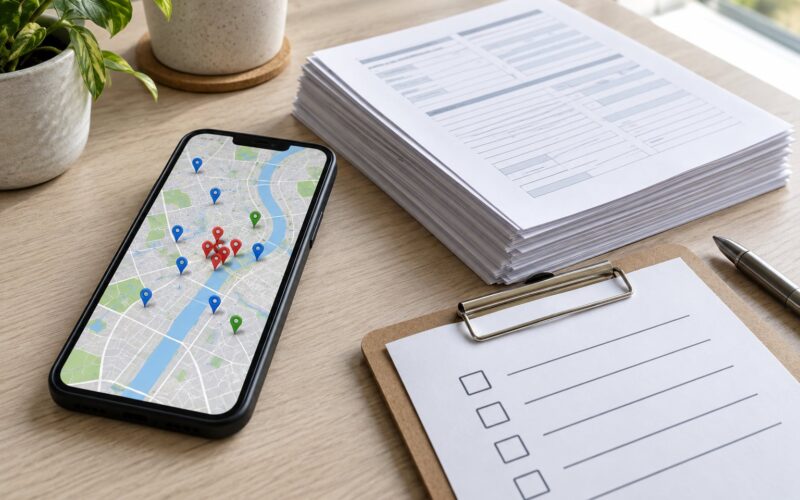
Civic apps lose people for one dominant reason: the need is episodic and the feedback loop is missing. A resident opens the app, reports a pothole or pulls a building permit, gets a confirmation screen, and has no reason to come back — because nothing told them whether the report was assigned, when a crew was coming, or whether it was ever fixed. Commercial apps are built around daily habits, streaks, and rewards. Civic apps have none of those mechanics by default, so they decay on a completely different curve and get measured with the wrong ruler. Here is what actually drives the drop-off, and what city teams can do about it.
One more thing worth saying up front. Download counts and cost per resident can look healthy while active use collapses a month later, and almost nobody in the public sector publishes retention numbers at all. That silence has barely changed as of 2026, which is part of why the same failure keeps repeating across cities.
Table of Contents
- What Does Retention Mean for Civic Apps?
- Retention, engagement and activation are not the same thing
- Why Do Civic Apps Lose Users After the First Download?
- The Main Causes of Poor Civic App Retention
- The need is episodic, not habitual
- Reporting runs one way and the loop never closes
- Onboarding asks for everything before it gives anything
- Services are fragmented across too many apps
- Alerts train people to ignore the app
- The product stops shipping after launch
- There is no community layer, so nothing pulls a second person in
- The app is treated as a campaign rather than a service
- How Low Trust Makes People Avoid a Civic App
- Privacy uncertainty, not just privacy policy
- Accuracy doubts spread faster than they should
- General institutional skepticism gets inherited
- When the App Does Not Deliver a Reason to Return
- How to create recurring value without adding noise
- How Onboarding and Accessibility Affect Retention
- Devices, data and language decide who is left out
- How to Improve Civic App Retention Without More Notifications
- 1. Close the loop with a reference number and a status history
- 2. Consolidate instead of launching another app
- 3. Cut the form down to what the service actually needs
- 4. Show the outcome, not just the receipt
- 5. Add saved and personalised state
- 6. Publish a maintenance commitment and keep it
- How to Measure Retention in a Civic App
- Frequently Asked Questions
- What is app retention?
- What is a good retention rate for an app?
- How to boost retention rate?
- What retention should a government app target?
- Why do residents uninstall city apps?
- How much is an app with 100,000 users worth?
- Conclusion: Start With the First Repeat Use
What Does Retention Mean for Civic Apps?
Retention is the share of residents who keep coming back after their first session, usually measured as the percentage of installers still active 30 and 90 days later, or the rate at which a first-time reporter submits a second service request.
That definition matters because it is deliberately narrower than engagement. A resident who opens the app twice in a year to check their permit status and then never again may be a perfectly served user, while someone who checks a leaderboard every morning is not necessarily getting public value. Session count alone tells you almost nothing about whether a municipal service app is working.
The default commercial metric, the DAU/MAU stickiness ratio, is close to useless here. A city that issues boil-water notices during a freeze will see daily active users spike hard for three days, then collapse. That curve is not a retention problem; it is the service working as designed.
There is also a population difference worth keeping in mind. A commercial app competes for time against every other app on the phone. A civic app competes for nothing — residents do not get more utility by spending an evening in it, and there is nothing to unlock. That makes returning use rarer and, in many cases, still worth a great deal.
Retention, engagement and activation are not the same thing
Activation in a civic context is the first completed task: a report filed, a permit status checked, a meeting agenda downloaded. Engagement is any return visit. Retention is coming back after the point where you could have served that person entirely through the web.
Teams routinely report activation as a success and then wonder why month two is empty. A resident who filed one report was not retained. They were acquired.
Why Do Civic Apps Lose Users After the First Download?
Civic apps struggle with retention because the value is one-time, the loop is one-way, the experience is heavy, and the product stops changing. Below are the problems that show up repeatedly, drawn from what practitioners in r/civictech report and what service teams see after launch.
- The underlying need is episodic, so there is no natural second visit.
- Reports and requests go in, and status updates never come back out.
- Onboarding asks for an account, permissions and personal details before it gives anything useful.
- The service is fragmented, so residents need five apps to do one city task.
- Safety alerts and civic notices train people to swipe everything away or opt out entirely.
- The product stops shipping after the launch announcement and slowly rots.
- There is no community or neighbourhood layer, so nothing pulls a second person in.
- The app is treated as a campaign or a press artifact rather than an operating service.
None of these are technology problems. They are decisions about what the product is for, who pays for it, and whether anyone is accountable for it a year later.
The Main Causes of Poor Civic App Retention
The causes below expand a five-point failure taxonomy that has circulated in the civic tech community — limited scope, one-way communication, cumbersome UX, no innovation, low social interaction — and add the institutional and structural forces that sit on top of it. Use them as a diagnostic: most struggling civic apps fail on at least three at once.
The need is episodic, not habitual
Some civic services are genuinely rare events, and no amount of product polish changes the underlying frequency of a pot-holing report. A city whose entire app is permit renewal has a retention ceiling set by how often residents build, not by how good the interface is.
That is not a reason to give up. It is a reason to broaden the surface until the app touches more than one kind of day in a resident’s life — parking, transit, waste collection, meetings, alerts — so that each individual task is rare but the app as a whole is not.
Reporting runs one way and the loop never closes
This is the single most cited complaint from practitioners and the most damaging one. A resident reports a problem, sees a thank-you screen, and disappears. No reference number, no assigned crew, no status change, no photo of the repaired street.
Reporting into a black hole teaches people a rational lesson: this channel does not work. The next time something breaks, they call the phone line instead, or they do nothing. From the app’s point of view, that is a permanent loss of a channel that had already proven it could get a resident’s attention.
Onboarding asks for everything before it gives anything
Forced account creation with no guest mode is a deal breaker that people name repeatedly in civic tech forums. So is demanding a driver’s licence scan or a credit card for a basic query.
Every field in a signup form is a decision point where someone leaves. Government-style forms, long lists of required fields, and a wall of permissions before the first useful screen all push the drop-off rate up, and none of them buy the city anything the resident actually wanted.
Services are fragmented across too many apps
Ask a resident to install separate apps for 311 requests, parking, transit, permits, and waste collection, and a large share simply will not. The city’s own fragmentation becomes the retention barrier. Consolidation efforts — unified civic engagement platforms, single sign-on across departmental services — exist precisely because app sprawl defeats adoption.
Framing matters too. If a city launches a polished app for potholes and calls it its new civic platform, residents will assume the parking app is next, and then the next one, and they will not install anything until the whole set exists.
Alerts train people to ignore the app
Notification fatigue is usually treated as a fix lever — send more alerts, win people back. For civic apps it is more often a cause of churn. Once a mandatory-sounding stream of road closures and council notices starts arriving with no utility filter, people disable push for the whole app, and they do not selectively re-enable it later.
Opting out of notifications is the fastest exit a resident can take, and it is the one most likely to be invisible in a dashboard that only counts sessions.
The product stops shipping after launch
Practitioners in r/civictech describe civic tools that mostly look like they belong in the 2010s, and they connect that to abandonment. Apps get announced, downloaded by staff and early adopters, and then sit for a year while the roadmap waits on the next budget.
After the first release, the hardest version of the problem is institutional rather than technical. Apps outlive political cycles and procurement terms, and the sponsor who understood the service often moves on to a different department.
There is no community layer, so nothing pulls a second person in
Commercial products benefit from other people being present. Civic apps usually do the opposite: they are a solo bureaucratic form. A resident sees their own request and nobody else, which means there is no social reason to return, no sense of a neighbourhood being watched, and no way to tell whether a problem is common or already known.
Some of the earliest tools residents remember set expectations the newer apps never met. When a successor app cannot show a shared picture of the street, the bar feels lower than people remember it being.
The app is treated as a campaign rather than a service
Plenty of civic apps exist to announce something. A launch, a survey window, a budget season, a bond measure. Demand spikes around that moment and drops to nothing afterwards, so the retention curve looks like a cliff and everyone concludes the app failed.
Sometimes that is the honest read. A survey app that ran its one cycle and stopped was never a service, and treating its post-event drop as a product problem means the next launch repeats the same pattern.
How Low Trust Makes People Avoid a Civic App
Low trust suppresses repeat use more reliably than poor design does. People will tolerate an ugly form if the thing works. They will not keep handing a government app their location and identity if they are not sure what happens to it.
The recurring questions in civic tech forums are unusually concrete, and every one of them is a retention question. Does the app tell me whether my report was received, assigned, and fixed? Is my location or identity data shared with anyone? Is it in my language and readable by a non-technical person? Does it work on an old phone with poor mobile data? Can I use the web instead without installing anything?
Privacy uncertainty, not just privacy policy
People often cannot tell whether a government app is collecting more than a commercial one. A parking enforcement or noise complaint tool that geotags your home feels different from a delivery app that already has your address, even when the technical footprint is identical. The uncertainty itself is the deterrent.
The remedy is unglamorous: state what is collected, in plain language, at the moment of collection rather than behind a link. Say who else can see a report and for how long.
Accuracy doubts spread faster than they should
A single wrong status — a request marked resolved while the problem is still there — does more damage than a month of silence. Residents talk about it, and the story becomes “the app is wrong” rather than “the app is slow.” A visible correction process matters more than never making the mistake.
General institutional skepticism gets inherited
Contact tracing made this concrete at scale. The 2020 and 2021 push for digital contact tracing apps produced very large download numbers that never converted into sustained active use, and published research from that period tied the resistance to doubts about efficacy, privacy handling, and a broader sense that the effort existed to serve institutions rather than people. Treat that as dated precedent rather than a current benchmark, but the pattern travels: a government app inherits the trust position of the institution that ships it, and it has to earn its own back.
When the App Does Not Deliver a Reason to Return
Some apps have no recurring value loop at all. The user completes a task, the task is done, and the app becomes clutter on the home screen.
Missing integrations cause this more often than missing features. If a transit app cannot tell you whether a service alert affects your saved commute, and a waste app cannot remind you the night before collection, the resident has to remember to open each app at the right moment, which defeats the purpose of having them installed.
Benefits that are hard to see also weaken the loop. A city might quietly reduce response time by 30 percent and never tell the reporter, so the person whose experience improved has no idea that the app worked. Visible outcomes are what convert a one-time transaction into a habit of checking in.
How to create recurring value without adding noise
Recurring value comes from state the resident already cares about: what is happening on their street, when their bin goes out, whether their permit cleared, when the next council vote lands. Surfacing that on open, or on a schedule the resident sets, is different from pushing everything at them.
Saved and personalised state is the cheapest durable mechanic available. A resident who configures an address, a route, a collection day, or a meeting topic has invested enough that deleting the app feels like a loss — and that investment is not coercive, which is exactly the point.
How Onboarding and Accessibility Affect Retention
Onboarding friction is the highest-leverage thing most civic apps can change, because it decides whether the first session ever happens. Let someone file a report or check a status before asking them to create an account, then offer to save it.
Authentication deserves particular care. Government apps inherit single sign-on and identity verification rules that are not optional, and those rules are where guest mode usually dies. Where verification is legally required, say so before the form appears, keep the steps to the minimum, and make progress saveable so a dropped connection does not mean starting over.
Accessibility is a retention issue rather than a compliance checkbox, because a resident who cannot complete a request will not raise their voice about it. That means plain language, full keyboard and screen reader support, adequate contrast, and forms that work on the phone people actually own.
Devices, data and language decide who is left out
A resident on a four-year-old handset with limited storage or a prepaid data plan is a real and large group. Heavy bundles, background video, and mandatory app updates push them back to the browser or the phone line, and they rarely file a complaint — they just stop appearing in your numbers.
The same goes for language. A monolingual resident using a device configured in another language will abandon a form they cannot read. Machine translation is a starting point, not a substitute, and the fields that need to be right — addresses, permit numbers, legal categories — are the ones a mistranslation ruins fastest.
Offline capture matters for the same reason. A resident standing in a basement or a parking structure with no signal should still be able to attach a photo and describe a problem, then submit when they surface.
How to Improve Civic App Retention Without More Notifications
Six changes account for most of the improvement available, and each one maps directly to a cause above rather than to a growth tactic.
1. Close the loop with a reference number and a status history
Every submission returns a reference number, an expected response window, and a status the resident can check. When the status changes, the resident hears about it once. This is the single highest-return change, because it converts an abandoned channel into a channel with a visible outcome.
2. Consolidate instead of launching another app
Extend the platform you have. A separate parking app for a small parking market creates two abandoned installs instead of one retained one.
3. Cut the form down to what the service actually needs
Remove fields the back office never reads. Defer account creation until after the first completed task. Report submission should never require payment or identity documents for a routine request.
4. Show the outcome, not just the receipt
Close requests with a resolution notice that says what was done and when. If a request was merged into an existing one, say that and link to it. Silence and non-answers feel identical to the resident, and only one of them is honest.
5. Add saved and personalised state
Addresses, routes, collection days, watched projects, followed agendas. This is the closest thing a civic app has to a habit loop, and it works without a single extra notification.
6. Publish a maintenance commitment and keep it
Residents judge an app by whether it still works in two years. A visible release cadence, a public status page, and a plan for what happens when the sponsoring team leaves all cost less than the trust they buy back.
There is also a legitimate option the industry avoids saying out loud. When a service is genuinely finished — a completed consultation, a closed grant cycle — retiring the app cleanly and pointing residents to the archive is better than leaving a broken one installed on their phone.
How to Measure Retention in a Civic App
Measure whether the service worked, not whether the app was opened. For a public-sector product, retained residents and completed outcomes are the honest numbers.
Track first-time report completion rate, since an abandoned form is a lost resident and a lost work order. Then track the share of first-time reporters who submit a second request within 90 days, which is the closest civic equivalent of a retention curve and the number most often missing from public reporting.
Notification opt-out rate deserves its own line on the dashboard. It rises quietly and is usually the first sign that an alert policy is eroding the channel, and it does not show up in session counts at all.
Resolution satisfaction — a simple question after a request closes, usually a one-tap rating — tells you whether the closed loop is landing. Pair it with 30 and 90-day return rates, but read them against the service calendar, since tax season, budget cycles, the school year, and permit season all produce legitimate spikes that look identical to growth or collapse.
Finally, break every metric down by neighbourhood, language, device age, and connection type. Aggregate civic engagement numbers routinely hide exactly the residents the app was failing, and a city-wide average improvement can coexist with a specific group being left behind.
Frequently Asked Questions
What is app retention?
Retention is the share of users who return after their first session, usually measured as the percentage of installers still active after 30 or 90 days. In a civic app, repeat reporter rate is the more useful version: the share of people who submit a second service request. Activation means a first completed task, not a return visit, so a resident who files one report has been acquired rather than retained.
What is a good retention rate for an app?
Commercial benchmarks assume near-daily use, so they do not transfer. A civic service with genuinely seasonal demand will never match them. Judge against your own cohort instead: a 90-day repeat reporter rate that climbs year over year, a falling notification opt-out rate, and rising resolution satisfaction together indicate real progress, even if absolute monthly active users stay modest.
How to boost retention rate?
Close the feedback loop first, since almost nothing else helps as much. Return a reference number, a status history, and a resolution notice for every request. Then reduce friction at the first session, consolidate fragmented services into one install, add saved state such as addresses and routes, and cut alerts that carry no utility. Increasing notification volume is usually a symptom of the problem rather than a fix.
What retention should a government app target?
Target the recurring civic moment instead of a percentage: a tax deadline, a collection day, a permit renewal, an election, a council vote. Measure return rate against that calendar, and set the goal around completed service outcomes. Also watch repeat reporter rate and opt-out rate, which reveal whether residents trust the channel enough to use it again.
Why do residents uninstall city apps?
Usually because the app asked for effort and gave nothing back. Residents report government-style forms, forced account creation, and submission with no confirmation or reference number as the turning points. App sprawl adds a second reason: being asked to install separate apps for requests, parking, transit, and permits. Optional notification opt-out is the quiet third, and it rarely appears in session dashboards.
How much is an app with 100,000 users worth?
That framing belongs to commercial app valuation, where audience size drives advertising and subscription revenue. A government app’s users are not a monetizable audience, and public-sector value shows up as completed service requests, shorter resolution times, and residents who can self-serve without visiting a counter. The same questions are better asked as cost per completed request and cost per resolved case.
Conclusion: Start With the First Repeat Use
If retention is the problem, start with the second use, not the next download. Pick the one resident need that genuinely recurs, remove the trust and access barriers standing in front of it, and make sure the service closes the loop every single time with a reference number, a status, and an outcome.
Then measure the thing that matters: completed requests, returning reporters, resolution satisfaction, and opt-out rate, read against the civic calendar and broken down by neighbourhood, language, and device. A civic app that a small, well-served group returns to for something real is doing its job, whatever the stickiness ratio says.