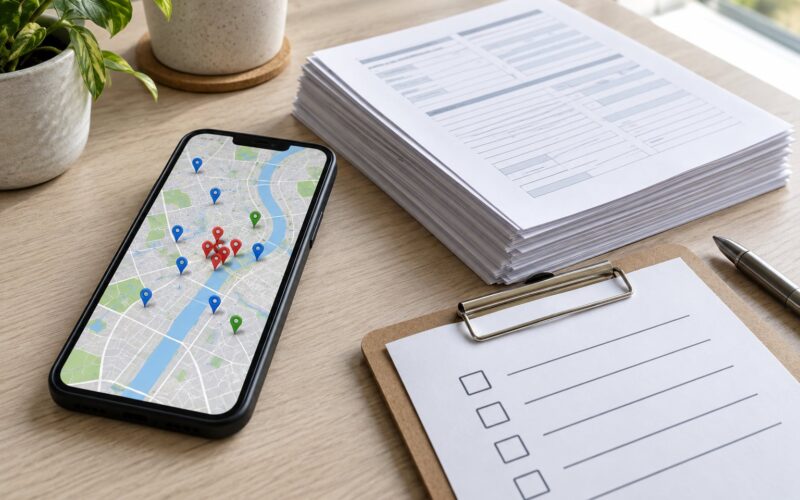
To increase turnout for a community survey, fix the survey itself, reach people through channels and messengers they already trust, give them several easy ways to respond, and remind them a few times without nagging. Most low-turnout campaigns are not outreach failures; they are friction failures. People meant to answer, could not, or did not see a reason to spend five minutes on you.
One thing to clear up before anything else, because search engines and residents alike tend to conflate them: survey turnout is the share of people you invited who actually complete your survey. Voter turnout is the share of eligible citizens who cast a ballot. This guide is about the first one, and it borrows a few proven mobilization habits from the second, such as segmented outreach and deadline pressure.
That distinction matters because the cost of getting this wrong is quiet. A survey that draws mostly from the people already most engaged online produces a self-selected sample, and decisions get made on it anyway. Renters, young adults, residents working multiple jobs, and households without reliable internet tend to vanish from the data exactly when they are most relevant to the decision.
Table of Contents
- What You Need
- How to Increase Turnout for a Community Survey: Step-by-Step
- Set a specific participation goal
- Make the survey quick, relevant, and easy to complete
- Choose incentives that fit the community
- Use trusted messengers and multiple outreach channels
- Schedule reminders at useful moments
- Remove common participation barriers
- Make responding feel safe and socially valuable
- Track response patterns and improve the campaign
- Common Mistakes
- How to Increase Turnout for a Community Survey Without Repeated Reminders
- Frequently Asked Questions
- What is a good response rate for a community survey?
- Should I offer an incentive to increase survey responses?
- How many reminders should I send for a community survey?
- How can I get responses from people who are not active online?
- When should I close a community survey?
- What should I do with the survey results afterward?
- Conclusion
What You Need
Six things should be in place before the survey opens, and a seventh gets you most of the way. Having them ready turns outreach from a scramble into a plan.
- A written participation goal. A number, a date, and the segments you need represented. Without it you cannot tell a good campaign from a busy one.
- An audience list with contact details. Email addresses, phone numbers, mailing addresses for households, and your best estimate of how many residents each represents.
- A fielding window. Open and close dates, plus the reminder dates in between. Pick them before launch and hold them.
- A survey platform that works on a phone. Test it on an older Android device, not just your laptop.
- At least three ways to respond. Online, paper, and phone or in-person, with a plan for how paper responses get entered.
- An outreach budget and calendar. Even a small one, spent on printing, postage, and a few paid placements in the channels your residents actually use.
- Trusted partners. Neighborhood associations, tenant groups, faith communities, schools, clinics, and the local businesses people already talk to.
The partner list is the item teams most often skip and most often regret skipping. A flyer on a library bulletin board reaches whoever is standing there. A flyer handed out by a tenant association at a building meeting reaches the exact households the online form is missing.
How to Increase Turnout for a Community Survey: Step-by-Step
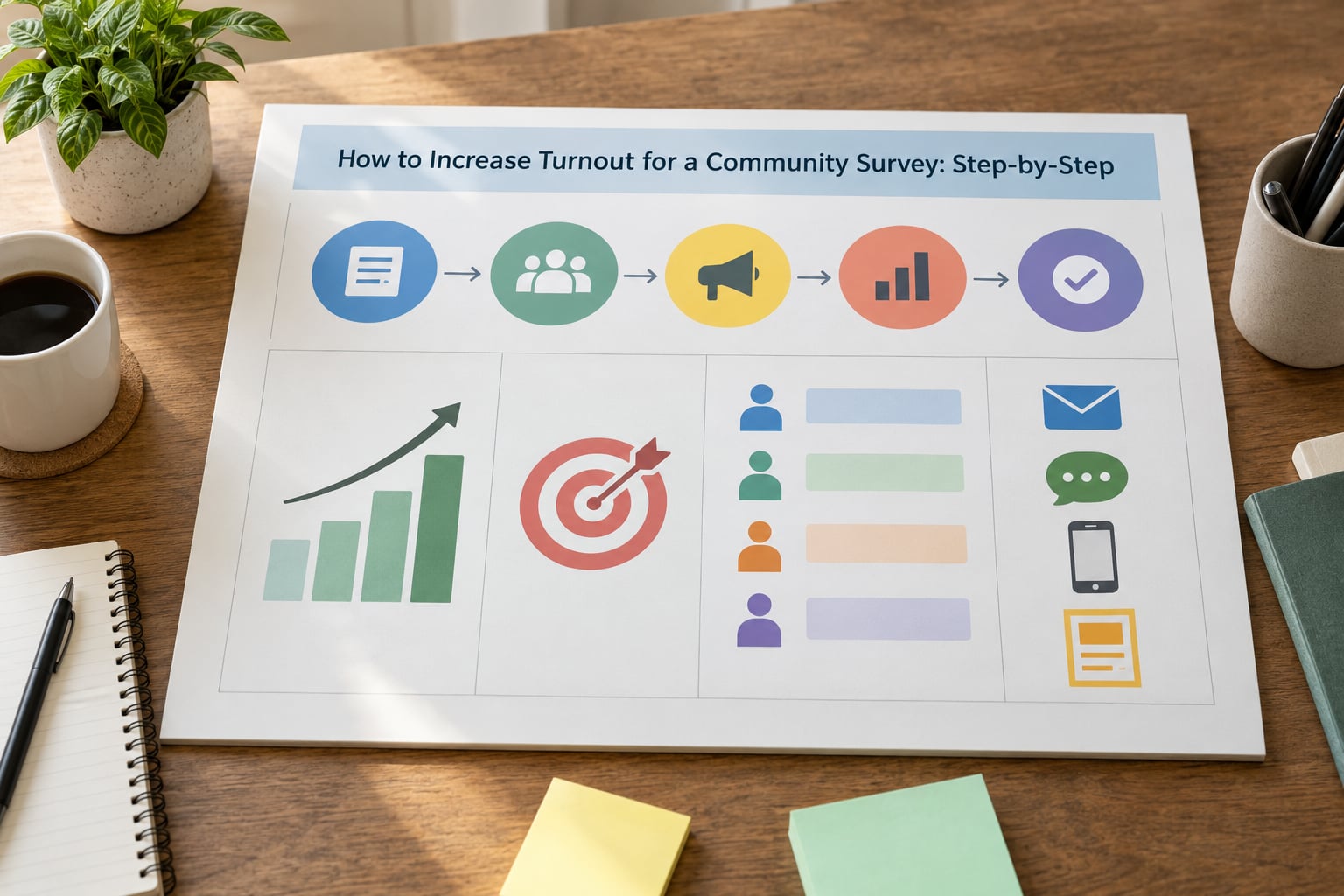
Set a specific participation goal
A good goal names a number, a group, and a date: for example, 1,200 completed responses by the close of the field window, including at least 300 from renter households and 150 from households where English is not the primary language at home.
Work out the denominator before you launch, because it changes everything downstream. Divide your target completions by your realistic contact base and you get the rate you need to hit.
| Planning input | What to put in it |
|---|---|
| Contactable households | Count of unique households or residents you can actually reach, not your total population |
| Target completions | The number your analysis actually needs to say something useful |
| Implied response rate | Target completions divided by contactable households |
| Segment representation goal | The minimum from renters, older adults, non-English speakers, and each neighborhood |
Judge the campaign on representation, not just volume. Two hundred responses that skew almost entirely toward homeowners with college degrees are worth less for planning than one hundred spread across the groups a decision will affect.
Make the survey quick, relevant, and easy to complete
A community survey should take under five minutes. Long enough to ask the four or five things you genuinely need, short enough that a parent with a sleeping kid and a twenty-minute bus ride will still finish it.
Cut anything that does not change a decision. Every extra question costs you completions, and the cost compounds on a phone with a cracked screen in bad light. Lead with the purpose, not the agency logo: state plainly what the survey is about, who will read the results, and what happens next.
A few rules that consistently help. Use plain language and aim for roughly a grade 8 reading level. Make closed-ended options mutually exclusive and exhaustive, so nobody forces a choice that does not fit. Use skip logic sparingly and test it, because a broken branch produces data you cannot interpret. Pilot the survey with eight to ten real residents before it goes live, ideally a mix of your most and least engaged participants.
Choose incentives that fit the community
Incentives raise turnout, but only when they are useful, fairly distributed, and simple to explain. A drawing for a grocery gift card works better than a vague promise of influence, and a prepaid card delivered to everyone who completes the survey works better than a raffle for most neighborhood campaigns.
Two rules protect you. Eligibility first: state who can enter, tie entry to survey completion rather than an email address where you can, and never require contact details you do not need for analysis. Fraud control second: raffles draw people from outside your target area, so keep the window short, limit entries per person, and screen entries against your contact list before drawing.
Some residents dislike incentives on principle, and a few will answer differently to earn a prize. Keep the amount modest, make it clear that quality matters more than volume, and check your results separately for incentives-related response patterns.
Use trusted messengers and multiple outreach channels
Turnout rises when the request arrives through a channel a person already uses, from a face they already trust. One channel alone will cap you at that channel’s audience, and that audience is rarely representative.
| Channel | Best for | Watch for |
|---|---|---|
| Email to opt-in lists | Engaged residents, staff, partner organizations | Needs a warm sender; cold blasts land in spam |
| Text message | Short links, deadline reminders, event alerts | Opt-in rules apply; keep it to a few messages |
| Social media | Younger adults, neighborhood-specific pages | Post in the groups people actually read, not the citywide page |
| Flyers with QR codes | Physical spaces, high-traffic locations | Print the short URL too, for readers without a phone |
| Door-to-door | Renter households, older adults, low-connectivity blocks | Staff for it; hand over a paper copy, not just a pitch |
| Tabling and pop-up intercepts | Two-minute questions, live events, farmers markets | A complement to the survey, not a replacement |
| Phone | Older adults, people with limited literacy or connectivity | Needs a script and staff trained to record answers faithfully |
| Local media and partner networks | Legitimacy and reach into specific communities | Give partners a date and a ready-made post they can copy |
Assign each channel a segment rather than blasting everyone with everything. Parents respond to messages through the school. Older adults respond to a phone call or a printed sheet. Recent arrivals to a neighborhood respond to a faith community or a tenant association that is already handing out the information.
Schedule reminders at useful moments
Three messages usually cover it: the announcement, one reminder around the midpoint, and a final-hours note with the deadline. Each one should say something new. A reminder that repeats the launch email word for word signals that nobody is paying attention.
Midpoint reminders work best when they add proof: how many people have responded so far, what the survey covers, and how long it takes. Final-hour messages should be short, contain the link and the closing time, and mention the last participation option if you have an in-person one.
Schedule reminders for when your segment reads email and messages. Parents tend to open in the evening. Staff and volunteers open during working hours. Text messages outperform email for anything urgent, so reserve them for the deadline.
Remove common participation barriers
Turnout falls when a survey asks something a resident cannot answer, cannot read, or cannot finish. Most of the fixes are cheap and happen before launch.
Offer the survey in the languages spoken in the neighborhood, not just the most common one. Make the form work with a screen reader, with keyboard navigation alone, and at high zoom. Keep the whole thing on one page where possible. Show the estimated completion time before the first question. Provide a paper version and a phone option for people who cannot use the default format, and state clearly whether responses are anonymous.
The residents your online survey misses are predictable: renters, people without smartphones, residents with limited broadband, older adults, and anyone who does not read the dominant language. Reach them with paper copies at building lobbies and clinics, a staffed phone line, and partner organizations who already serve them. Budget staff time for this; it is the least glamorous tactic and often the highest lift.
Make responding feel safe and socially valuable
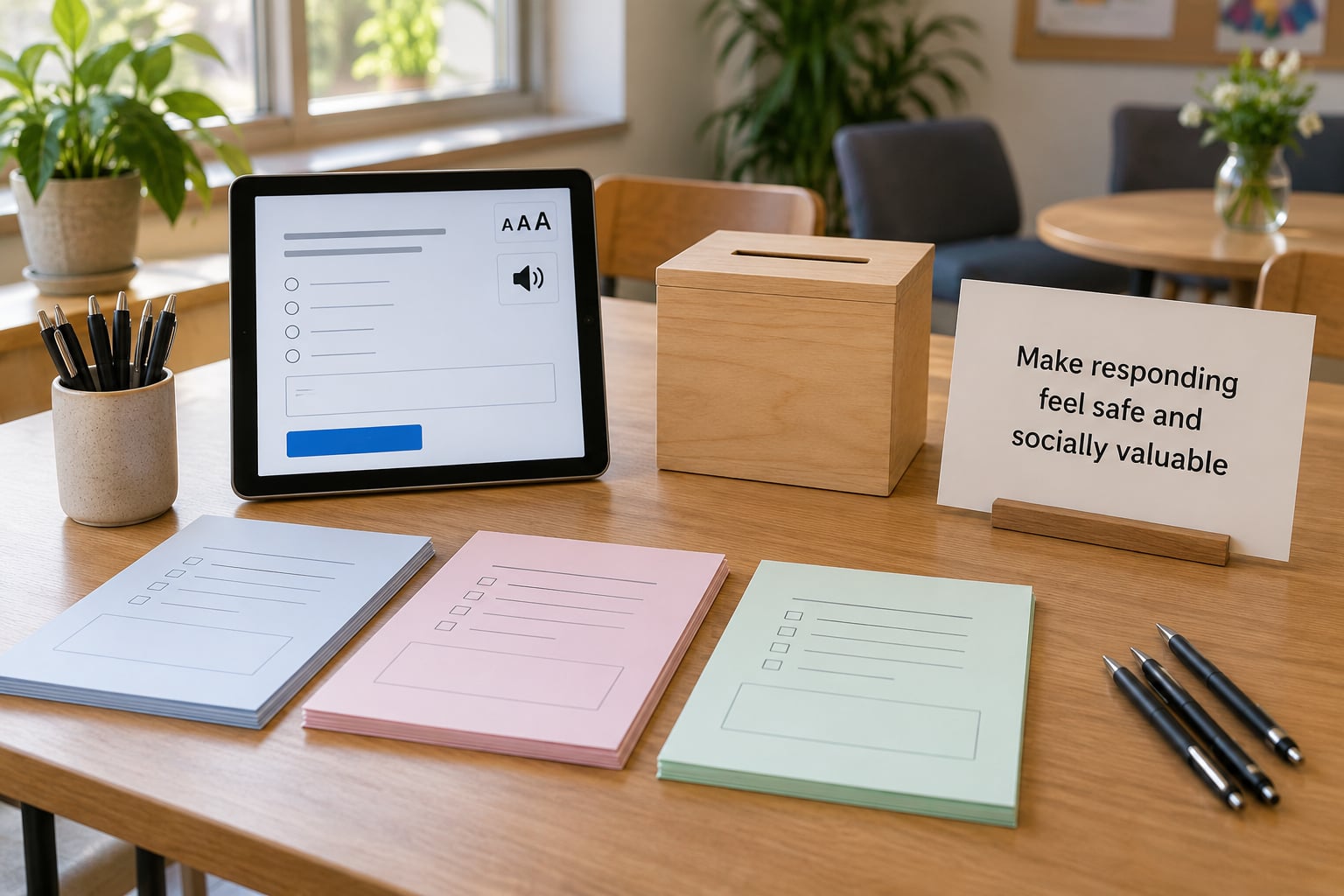
People complete surveys when they trust the organizer and believe the answers will be used. Say both out loud: what happens to the data, who reads it, and when you will publish the results.
Avoid guilt, pressure, and claims you cannot support. “Your input will shape the future of the neighborhood” is a promise; if nothing ever changes, you have spent your credibility and made the next survey harder. Name the concrete decision the survey feeds, and commit in writing to a date for a published “What We Heard” report.
Forum discussions on civic surveys keep surfacing the same thing: residents are willing to spend five minutes when they know exactly what the data is for, and skeptical when a city ran a survey and never mentioned it again. The follow-through is part of the method, not a courtesy.
Track response patterns and improve the campaign
You cannot fix what you do not watch. Check completions daily and look at the shape of the data, not just the count.
Watch four things: the running total against your target, completion time against your estimate, the question where people abandon the form, and which neighborhoods and segments are over- or under-represented. A spike of drop-off at question six usually means the question is confusing, and you can often fix it and re-launch the rest of the window.
Post a public progress counter. Social proof works, and it also puts visible pressure on the neighborhoods that have not responded yet. When the window closes short of target, decide deliberately: extend only if there is a specific gap you can still fill, say so publicly, and set a firm new date. An open-ended extension with no stated goal just trains people to ignore your deadline.
Common Mistakes
Vague goals. “We want more responses” gives a team nothing to aim at. Set a number, a date, and a representation target per segment.
Surveys that run too long. Every question you cannot justify costs you completions. Cut to what changes a decision.
One channel only. Email alone reaches your most engaged residents. Add text, paper, partners, and in-person options.
Too many reminders. A fourth and fifth message is not more outreach, it is harassment. Three well-differentiated messages is the working range.
Inaccessible formats. If the form fails a screen reader, only works on a desktop, or exists in one language, you have decided some residents are not invited.
Vague privacy language. “Responses are confidential” is not reassuring when you are collecting addresses for follow-up. State plainly what you collect, what you publish, and what you never will.
Overlapping asks. Survey fatigue is a coordination problem. If three agencies hit the same blocks in the same quarter, stagger your windows, and check what is already in the field.
Never reporting back. The report you promised is the reason people answered next time. Publish it on the date you committed to, even if the results are inconvenient.
How to Increase Turnout for a Community Survey Without Repeated Reminders
Most campaigns can raise participation without adding message volume. Strong participation value does most of the work: a decision the survey genuinely feeds, a visible commitment to follow through, and a survey short enough to finish in one sitting.
Trusted messengers outperform broadcast sends. Segmentation reduces how many reminders any one person sees. Multiple access modes mean a single reminder reaches a resident who cannot click a link. Moderate length beats incentive spending, since a ten-question survey consistently converts better than a thirty-question one with a prize attached. And a prompt, honest summary of results is the strongest thing you can put in front of the next invitation.
Frequently Asked Questions
What is a good response rate for a community survey?
A rate of roughly 10 to 15 percent of contactable households is a solid result for an open community survey, and 20 percent or more is strong. Rates vary widely by mode: opt-in email lists often convert far higher, while door-to-door and phone canvassing produce different profiles. Compare yourself against your own plan, and judge representation alongside the count. A smaller survey that includes renters, older adults, and non-English speakers is more useful than a larger one drawn only from the most engaged residents.
Should I offer an incentive to increase survey responses?
Often yes, if the incentive is modest, clearly explained, and offered to everyone who completes the survey. A grocery gift card drawing or a prepaid card both work. Keep rules simple: eligibility stated up front, one entry per person, and fraud screening before you draw. Avoid large prizes, which attract people outside your target area, and avoid tying responses to required contact details you do not need for analysis. Some residents prefer no incentive at all, so keep the amount small.
How many reminders should I send for a community survey?
Three works for most campaigns: the announcement, one midpoint reminder that adds proof of participation, and a final message with the deadline and the closing time. Each reminder should say something new rather than repeat the launch. Send at the times your segment actually reads email, which is often the evening for parents and working hours for staff. More than three reminders rarely adds much and starts to read as pressure. If participation stalls, add a channel rather than another message.
How can I get responses from people who are not active online?
Offer more than one way to respond and staff each one. Put paper copies in building lobbies, clinics, libraries, and faith centers. Run a phone line with a short script for older adults and residents with limited connectivity. Have partner organizations distribute printed materials directly, since a tenant association reaches renter households that no online campaign touches. Budget staff time for tabling at markets, events, and community meetings, and count paper and phone responses in your totals so reporting stays honest.
When should I close a community survey?
Close on the date you announced, unless you have a specific gap you can still fill. Common closing windows run two to four weeks for a general public survey, and shorter when the audience is small and well known. If you are short of target, extend only with a stated purpose and a firm new date, such as a push to reach non-English-speaking households, and say publicly that the window moved. An open-ended extension trains people to ignore your deadline.
What should I do with the survey results afterward?
Publish a What We Heard report within the timeframe you promised during the survey. Show headline findings, the questions you asked, how many people responded, who was and was not represented, and which findings you cannot act on and why. Summarize the results in one page and in the languages your community uses, then present them at a meeting where residents can ask questions. Reporting back is the step that makes the next survey easier to launch.
Conclusion
Four things to do this week, before any outreach starts. Write down your response target and the segments that must be represented in it. Cut the survey down to the questions that actually change a decision, then pilot it with ten residents.
Then identify the five organizations and five messengers who already have the attention of the residents your online campaign is missing, and give each of them a date, a link, and copy they can use without editing it. Build the reminder calendar around three differentiated messages, one written for the segment that has not responded yet, and set the date you will publish What We Heard before you announce the survey. That last date is what earns you the next round of responses.