Dialing an emergency number connects you to a public safety answering point, or PSAP: the call center where trained call takers answer, work out what is happening and where, and send police, fire, or medical crews to the scene. The whole sequence, from routing to dispatch, usually takes minutes. Here is how it actually works.
Most people picture a room full of people answering phones. The reality is closer to a control room running several systems at once, where the hard part is not answering the phone but turning a frightened, unclear report into a specific incident that the right responders can act on.
If you build civic software, publish open data, or work on municipal systems, the same sequence matters from the other side of the glass, because every piece of location data, every routing decision, and every dispatch record is a decision point you can design better or worse.
Table of Contents
- What Is a Public Safety Answering Point?
- How Public Safety Answering Points Receive and Route Calls
- How Public Safety Answering Points Handle Calls From the First 30 to 60 Seconds
- How Location Information Is Found and Verified
- How the Right Emergency Resources Are Selected
- How Dispatch Works After a Call Is Completed
- How Public Safety Answering Points Handle Difficult or Unusual Calls
- How Public Safety Answering Points Support Non-Emergency Requests
- What Technology Supports Call Handling?
- How Privacy, Security, and Accessibility Are Protected
- How Public Safety Answering Points Coordinate a Response
- What Can Go Wrong and How the Process Improves
- Frequently Asked Questions
- What does a public safety answering point do?
- How does a public safety answering point find my location?
- What is the difference between a call taker and a dispatcher?
- Can I call emergency services from a mobile phone without a signal?
- What happens if I hang up during an emergency call?
- How do public safety answering points handle calls in different languages?
- Key Takeaways
What Is a Public Safety Answering Point?
A public safety answering point is the facility and its staff that receive emergency calls for a defined geographic area, gather information about the incident, and notify the agencies responsible for responding. In practice, PSAPs range from a two-person desk serving a rural county to a consolidated center that answers for several municipalities and dispatches police, fire, and emergency medical services together.
Most PSAPs go by the more familiar name for the number they answer: the emergency communications center, or simply 911. The term matters in procurement and standards documents, though, so expect to see it in every grant application and technical specification you read.
Centers are organized around who answers, and who holds the radio. A primary PSAP answers calls for its own jurisdiction. A secondary PSAP provides backup and overflow support for primary centers that go down or get overwhelmed. Where several small departments merge, a consolidated PSAP answers for all of them and dispatches to each. Some states run statewide or regional programs that route calls by location rather than by service provider territory.
Beyond the emergency line, some centers also handle police, fire, and EMS non-emergency numbers, and many operate or share a 311 line for city services. The National Emergency Number Association (NENA) and the Association of Public Communications Officers (APCO) set the industry standards most US centers work toward, and the FCC regulates the numbering side.
How Public Safety Answering Points Receive and Route Calls
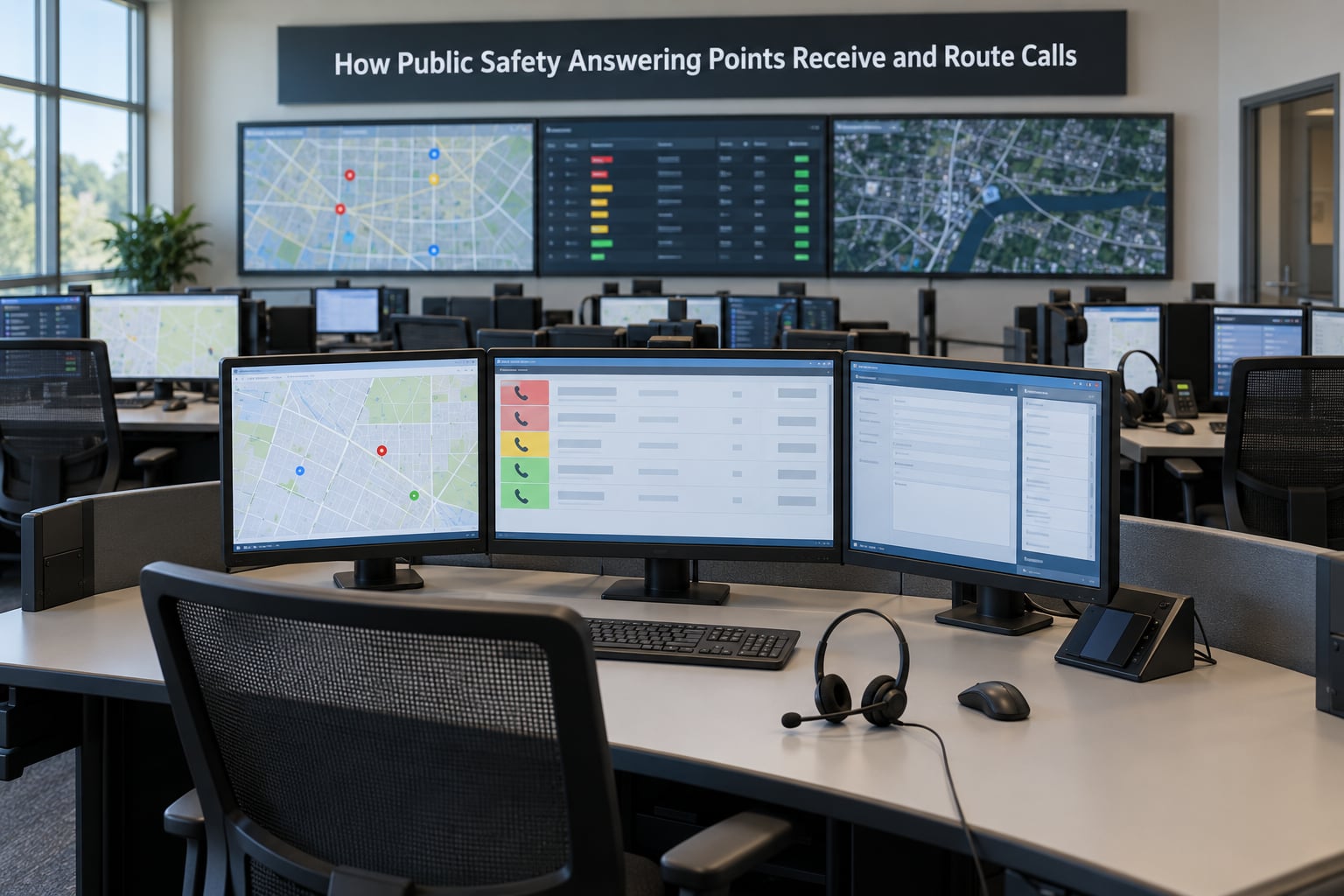
When you dial an emergency number, the telephone network, not the center, decides where your call goes. Under legacy enhanced 911 (E911) rules, the network looks at the number you dialed from and routes to the center assigned to that telephone exchange or landline prefix. It is a telephone-number lookup, not a location lookup, and it has known limits.
Next generation 911 (NG911) replaces that with an IP-based network that can route on where you actually are. Call centers have tested the practical part of this for years: isolating a busy queue for a big school drill or a stadium event with a geofenced area, so that 88 or 800 incoming drill calls do not mix with routine traffic. Policy-based routing lets an administrator say in advance that any call originating inside a defined polygon goes to a specific queue, and a call can be transferred with its data intact between centers that share a regional system.
Because routing is imperfect, a call taker may hand the caller to another center. Transfers pass the location record, notes, and any multimedia along with the call, so the next center does not start from zero. If the call lands somewhere unexpected, a transfer costs a few seconds. A completely wrong routing decision costs minutes, which is why centers spend so much effort on jurisdiction boundaries and why statewide programs keep showing up in modernization plans.
How Public Safety Answering Points Handle Calls From the First 30 to 60 Seconds
The first minute is triage. A call taker is usually listening and typing into computer-aided dispatch at the same time, which changes what you should do on your end.
Call takers working in r/911dispatchers keep returning to one piece of advice: give the street address clearly once you are asked, then stop talking and let them work. The silence feels wrong to callers, and it is not the dispatcher ignoring you. It is the dispatcher typing.
The sequence most call takers follow looks roughly like this:
- Are you safe right now? Some centers open with this, others open with the location question. Either way it establishes urgency before anything else.
- What happened? Police, fire, medical, or a combination. The answer decides which agencies join the call.
- Where exactly are you? Address, cross street, floor, unit, or a landmark if the address will not load.
- Is anyone hurt, and is anyone in danger now? This sets priority and pulls specific resources such as more medical crews.
- What is your name and callback number? Used for callback, for reporting back, and for records.
- Is there anything else responders should know? Hazards, weapons, animals, locked gates, someone trapped upstairs.
Dispatchers describe the job as constant multi-tasking: listening while typing, pulling records, watching a map, and coordinating by radio at once. Nothing about it looks fast from the outside, and that is largely the point. The conversation is designed to produce a few facts that can be typed into a record and read back to a crew en route.
How Location Information Is Found and Verified
The center does not wait for you to say where you are. Two pieces of data usually arrive with the call before anyone picks up: automatic number identification (ANI), which is your calling number, and automatic location information (ALI), which is a database lookup on that number.
How public safety answering points verify what the caller says
ANI and ALI are a starting point, not an answer. A landline number maps to a service address reasonably well. A mobile number maps to a cell tower or sector, which covers an area rather than a building, so accuracy varies from a few hundred metres to several kilometres. A VoIP number, used by many internet and app-based calling services, may map to the address on the account, which can be a billing address in another county entirely.
NG911 improves this considerably. An IP-based network can pass the handset location, and some carriers provide device-native location that is accurate enough to place a caller inside a specific building, unit, or floor. None of it replaces conversation. The call taker compares the automatic location with what the caller says, and when they disagree, the caller’s description usually wins, because a person standing in a doorway knows something a tower does not.
When a caller genuinely does not know where they are, call takers work from what is available: the name of a nearby business, a highway mile marker, a store name on a receipt, a description of the surroundings, the last place you recall, or a callback in a better signal area. When a call cannot be placed at all, an emergency text message can carry a location, though the caller has to send it.
How the Right Emergency Resources Are Selected
Once the call taker has a location and an incident type, the priority decision follows. Priority drives everything downstream: how quickly the phone rings, which radio channel or talkgroup is used, which crews are considered first, and whether agencies are dispatched together or one after another.
A structure fire with people reported trapped, a cardiac arrest, an active shooter, and a fender bender with no injuries all produce different dispatch paths. High-priority incidents typically pull several agencies at once, and lower-priority calls wait for a crew to become available rather than creating a separate response.
Computer-aided dispatch (CAD) does the arithmetic. Given the location, the incident type, the priority, and which crews are available, CAD recommends specific responders and puts their estimated arrival times side by side. The call taker confirms or overrides that recommendation. They override it often, because CAD knows the roster but the call taker knows that the crew two towns over are already at a scene, or that the engine company on this street is out of service today.
Multi-agency incidents make the decision harder. A crash with entrapment is a police, fire, and medical call, and each agency may keep its own dispatch console even when a single center answers the phone. When one jurisdiction runs out of crews, the center requests mutual aid from a neighbouring department through regional channels, which is why dispatch radio interoperability matters as much as phone technology.
How Dispatch Works After a Call Is Completed
Dispatch is the delivery step, and it depends on what got written down. A useful CAD record carries the verified location and any address detail, the incident type and priority, the caller name and callback number, a count of people involved and their condition, hazards, access instructions such as a gate code or which floor, and a timestamp for every action taken.
Crews are sent by radio, generally on a channel assigned to that incident, and the dispatcher watches for acknowledgement. An unacknowledged dispatch is a real problem rather than a formality, so most centers have a timer that triggers a callback or a re-ping after a short interval.
The call does not simply end. The call taker usually stays on the line or keeps the caller available through a hold or a call-back arrangement while responders travel, answering practical follow-up questions. Many centers ask the caller to stay on the line until help arrives, then confirm arrival and sometimes ask a short set of questions before closing the record. The call is recorded, and the record, along with audio and any texts or photos, is archived under retention rules that vary by jurisdiction.
How Public Safety Answering Points Handle Difficult or Unusual Calls
Routine calls are the easy part. The rest of the volume is harder, and handling it well is most of what makes a center competent.
Silent calls. A connection with no speech still creates a record. Call takers try to elicit a response, check for background sound, look up the address, and in many cases send a patrol unit to check on the caller. The decision to dispatch without any information is a judgment call, made per policy and often per shift.
Abandoned calls. If the caller hangs up, the center attempts callback and searches for another number associated with the address. They will often dispatch on a hang-up involving a known risk at the location, since a hang-up in some situations is itself a signal.
Language barriers. Interpreters, including relay services for deaf and hard-of-hearing callers, are used routinely. Call takers are trained to phrase questions in short, simple sentences while an interpreter connects, and to confirm critical details back rather than assume the interpreter relayed them correctly.
Caller cannot give complete information. Small children, people in distress, victims of domestic violence, and callers hiding from whoever caused the emergency may be unable to speak freely. Training covers opening questions that require only a yes or no answer, so a frightened caller can give something usable without speaking at all.
Multiple incidents in one call. One call can contain several. Centers often keep the line open and create separate records, and dispatchers triage each with its own priority rather than tying them together, so a serious problem is never buried inside a long report.
Call flooding during an incident. When word spreads, volume spikes. Call takers hold non-urgent callers on a callback queue rather than losing them, and centers can roll the least urgent call types to a secondary PSAP to keep emergency capacity clear.
VoIP calls and blocked caller ID. A VoIP number can route to the wrong jurisdiction or carry an old address, and a blocked number removes ANI entirely. In both cases the caller becomes the location source, and the record is flagged so responders know the data is caller-reported.
How Public Safety Answering Points Support Non-Emergency Requests
Plenty of emergency-line traffic is not an emergency: a report of a stolen vehicle discovered this morning, a noise complaint, a lost pet, a parking question. Centers handle it without either ignoring it or letting it consume emergency capacity.
The usual approach is to explain and redirect. The call taker records the report if the center takes non-emergency calls, gives the direct number for the right department, or transfers the caller to a 311 line if one is operating. Some centers stay on the line and complete the report for the caller when the person cannot manage the redial. A small share of large centers also handle text-to-911 for reporting, which some people find easier than speaking.
Transfers fail more often than people expect, so a good center confirms the number out loud and tells the caller to call back if nobody answers. Advice in dispatcher forums is blunt about this: if you need the police and the transfer did not connect, hang up and call the emergency number again rather than waiting on hold.
What Technology Supports Call Handling?
A modern center runs several layered systems, and knowing the names makes procurement conversations much easier.
Telecommunications. Legacy E911 uses selective routing and a database of landline addresses. NG911 uses an IP-based network over SIP, which supports text, photos, video, and real-time language translation. Many centers run both during transition, so old and new capabilities coexist for years.
Automatic number and location identification. ANI gives the calling number and ALI runs the location lookup. Where the network can supply better data, such as handset or IP location, the center sees several sources at once and has to judge which is more trustworthy.
CAD and GIS mapping. CAD holds incidents, unit status, and records, and links to a geographic information system so a call is plotted on a map that knows about address ranges, apartment complexes, and mile markers rather than just street lines.
Recording and documentation. Calls are recorded and archived with the CAD record. Every screen action is logged, which is what makes the record usable later for reporting, review, or legal proceedings.
Radio and paging. The dispatch radio system, not the phone, is what actually reaches a patrol car or an engine company. Interoperability across neighbouring agencies is a separate project from the phone system, and one that regularly gets deferred.
Text, photo, and video. Regional guidance on sending video to a PSAP exists because sending it well is not obvious: call takers tell people how to frame what matters, since a video shot at the wrong angle wastes the one thing the responder needed.
None of this runs without backups. Centers keep redundant power, redundant network paths, and a fallback path for taking calls when the primary system is down. They also test it, because an untested backup is a theory.
How Privacy, Security, and Accessibility Are Protected
Call recordings, medical details, and criminal history records sit inside these systems, so access control is part of call handling rather than an add-on. Centers limit who can pull audio or CAD records, log every access, and keep audit trails that show who viewed what and when. Records retention periods are set by state law and vary widely.
Cybersecurity is treated as a public safety issue for a plain reason: 911 infrastructure is a high-value target, and analog legacy equipment is harder to patch and monitor than the IP-based systems replacing it. Securing it means network segmentation, monitoring, prompt patching, and vendor coordination, with incident playbooks that assume the phone system itself may be unavailable.
Accessibility runs through the same process. Relay services, interpreter lines, and accommodations for callers with disabilities have to work under pressure, not only in testing. So does the human judgement layer: software can suggest units, flag a possible address match, or translate a phrase, but a trained call taker confirms it. Turning off a trained person to save seconds is the one optimization nobody in this field supports.
How Public Safety Answering Points Coordinate a Response
For a large incident, dispatch is the start of coordination rather than the end. The center becomes the information hub: responders arrive, radio traffic organizes on the incident channel, and dispatch tracks who is on scene, what resources are still needed, and what has changed.
Callers during a big incident provide updates the original record never had. A separate caller reporting that a second building is involved becomes its own incident, which is the right call rather than editing the first one in place. Dispatchers also handle the awkward coordination between agencies that operate independently but are answering phones through the same center.
Once the incident closes, the record becomes evidence of what happened. Calls, CAD entries, timestamps, and radio traffic get pulled for debriefs, after-action review, and accreditation files. That review is where a center notices something small and fixable, such as an address the database kept getting wrong, and that is usually how the next improvement actually starts.
What Can Go Wrong and How the Process Improves
The failure modes are well known, which is useful, because each one has a standard answer.
Inaccurate location. A VoIP number with a stale address or a mobile fix that lands on the wrong street can send a crew to the wrong place. The fix is a trained call taker confirming the address, faster ALI database updates, and NG911 location that improves on the tower estimate.
Incomplete caller information. People are shaken, in a lift, or unable to speak. Answer sets that need only yes or no, plus callback attempts, recover a surprising share of these.
Miscommunication. Radio traffic gets garbled and handoffs lose detail. Centers counter it with clear terminology standards, plain-language discipline, repeat-back confirmation, and mutual aid agreements that define who is in charge.
Overloaded systems. Staffing shortages compound everything. Industry surveys have consistently reported that a large majority of centers have trouble filling positions, which is why queue priority, rollover to a secondary PSAP, and mutual aid planning are treated as core capability rather than contingency.
Outages. Network failures, power loss, and cyber incidents stop intake. Redundancy, geographically separate backups, regular testing, and a documented manual fallback define how a center keeps answering.
Scale gives some context. US emergency systems handle on the order of 240 million calls a year, and NENA guidance has long used a 15-second answer benchmark. Those two numbers frame why a few seconds of triage work matters, and why a call that is answered fast but mislocated still fails.
Frequently Asked Questions
What does a public safety answering point do?
A public safety answering point receives emergency calls for a defined area, gathers and verifies details about the incident, sets a priority, and alerts the police, fire, and medical agencies responsible for that area. It also handles non-emergency calls, records every call, and stays in contact with the caller until responders arrive.
How does a public safety answering point find my location?
The network sends your calling number and a location lookup with the call, and next generation 911 can supply location from your device or IP connection. Call takers compare that data with what you tell them. For a mobile phone the automatic fix can cover an area rather than an address, so your description of landmarks or a nearby business often decides the accuracy.
What is the difference between a call taker and a dispatcher?
In smaller centers one person does both jobs and the titles blur. In larger agencies a call taker answers the public and creates the incident record, while a dispatcher works inside computer-aided dispatch, sends crews, tracks unit status, and coordinates resources across agencies. Many centers combine the roles, so the distinction is about task rather than headcount.
Can I call emergency services from a mobile phone without a signal?
A call needs network coverage, and a phone with no signal cannot place one. Weak coverage can still work, because a marginal signal may be enough for an emergency call to connect at low quality, and satellite messaging is becoming a common fallback on newer phones. If a call will not go through, move toward a window or outside, or send a text to 911 if your phone supports it.
What happens if I hang up during an emergency call?
The center still holds the record and will call you back from a blocked or withheld number, which is why that number may appear later. Centers also often send a unit to check on the caller, since a hang-up can indicate a silenced phone or an emergency the person could not describe. Answering the callback is the fastest way to cancel the response.
How do public safety answering points handle calls in different languages?
Centers use interpreter services, including telephone interpreters and relay services for deaf and hard-of-hearing callers. Call takers keep questions short while an interpreter connects and confirm critical details such as the address back to the caller. Newer systems add real-time translation, which helps in the first seconds but is treated as a support rather than a replacement for a qualified interpreter.
Key Takeaways
A call travels from a phone to the network, from the network to the PSAP responsible for that location, and then through a short, disciplined sequence: verify the address, work out what happened, set a priority, select and alert the right crews, stay with the caller, and write it all down. Every one of those steps depends on a trained person confirming what a database suggests.
If you are starting work in this space, do one thing first: map the emergency-number arrangement for the jurisdictions you care about. Find out which PSAP answers, who the primary and secondary centers are, how transfers work, and what data you can actually get through open data or a public records request. Most integration and civic app problems in this field turn out to be jurisdiction questions wearing a technology costume.