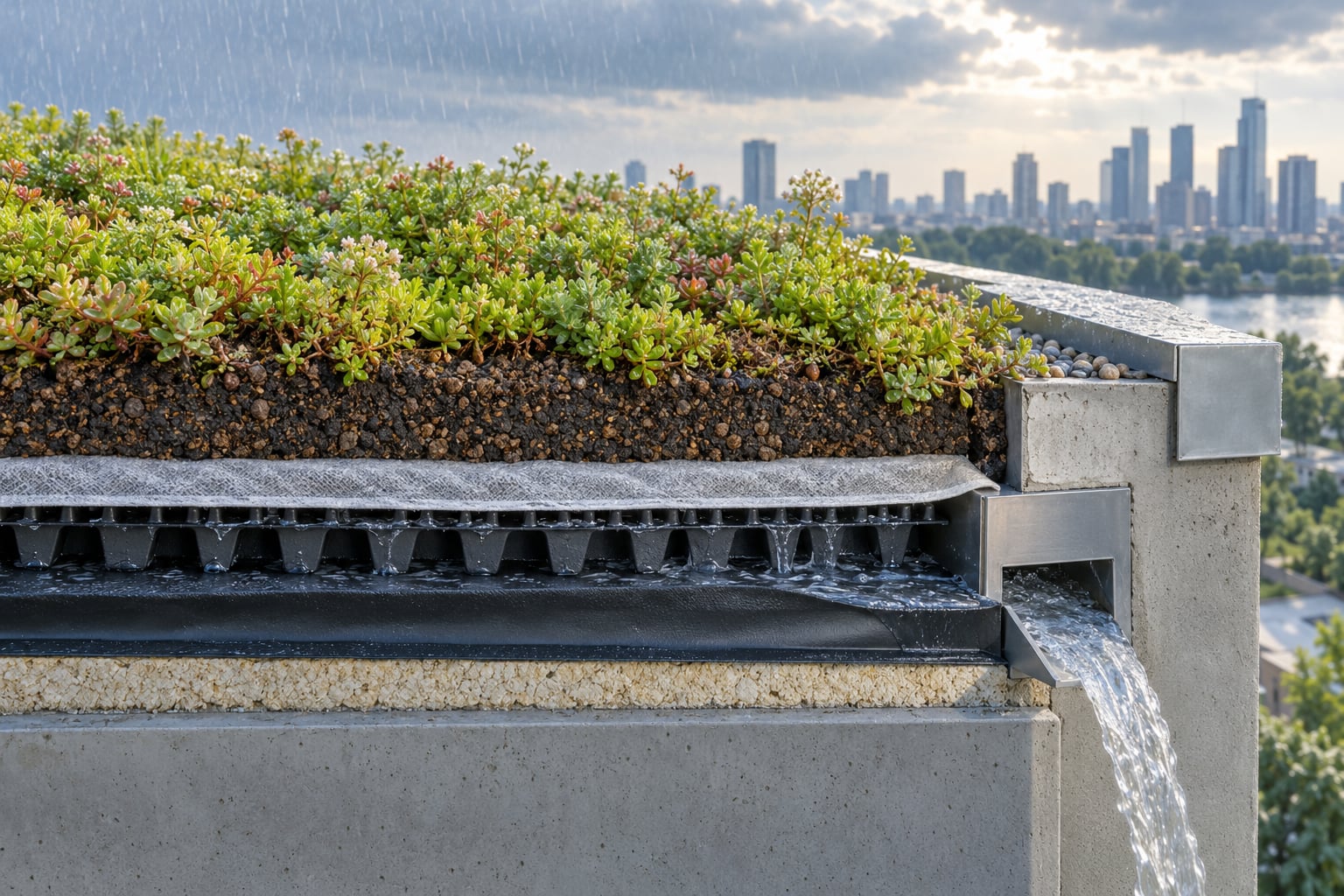
A green roof manages stormwater by catching rain on planted foliage, holding part of it in the pore spaces of a lightweight growing medium, losing another share to evaporation and plant transpiration, and releasing the rest slowly through the roof drains instead of discharging it as a sharp runoff peak. In summer, that process retains roughly 70 to 90 percent of the rain that lands on the roof; in winter the figure falls closer to 25 to 40 percent.
That is why planners keep coming back to it. Cities have almost no bare ground left to trade for a retention basin, and a roof is already there, already sloped toward a drain, already owned by someone with a maintenance budget. The catch is that the retention number is not a property of the roof alone. It depends on how wet the growing medium was before the storm, how deep that medium is, and what the plants were doing that week.
This guide walks through the mechanism, the numbers, the design decisions and the failure modes. It is written for city stormwater staff, developers specifying roofs, architects detailing them, and facility managers who inherited one.
Table of Contents
- What Is the Role of Green Roofs in Stormwater Management?
- How Green Roofs Manage Stormwater Step by Step
- How Much Stormwater Can a Green Roof Hold?
- What changes green roof performance
- How much water is that in gallons?
- Which Green Roof Systems Manage Stormwater Best?
- What Happens When the Green Roof Reaches Capacity?
- How Do Green Roofs Affect Water Quality?
- What Design Features Improve Stormwater Performance?
- How Do Cities Measure Green Roof Benefits?
- What Are the Main Maintenance and Design Challenges?
- Frequently Asked Questions
- How much stormwater can a green roof hold?
- What is the difference between a green roof and a blue roof?
- Do green roofs work in cold climates?
- Are green roofs maintenance free?
- How much does a green roof weigh and can an existing roof take one?
- What drives the cost of a green roof?
- Conclusion
What Is the Role of Green Roofs in Stormwater Management?
A green roof is a building roof covered with vegetation grown in an engineered growing medium over a waterproofing membrane and a drainage layer. That medium is the working part of the system: it is a shallow, light, porous reservoir that soaks up rainfall, holds it, and lets plants draw it out through their roots.
Stormwater matters because of what impervious surface does to a watershed. Streets, parking lots and rooftops seal ground that used to absorb rain, so a heavy storm reaches the sewer faster than the system was designed to carry. The result is street flooding at the low end and combined sewer overflows, streambank scour and warmer, dirtier water at the other.
Green roofs work at the source, which is what separates them from most other controls. A rain garden treats water after it has run off a roof. A detention pond holds it after it has reached a pipe. A green roof slows it before either happens.
Three effects matter to a drainage model: the volume that never leaves the roof, the delay before what does leave arrives, and the peak rate of discharge. A green roof changes all three, and the magnitude of each change is what the rest of this article is about.
How Green Roofs Manage Stormwater Step by Step
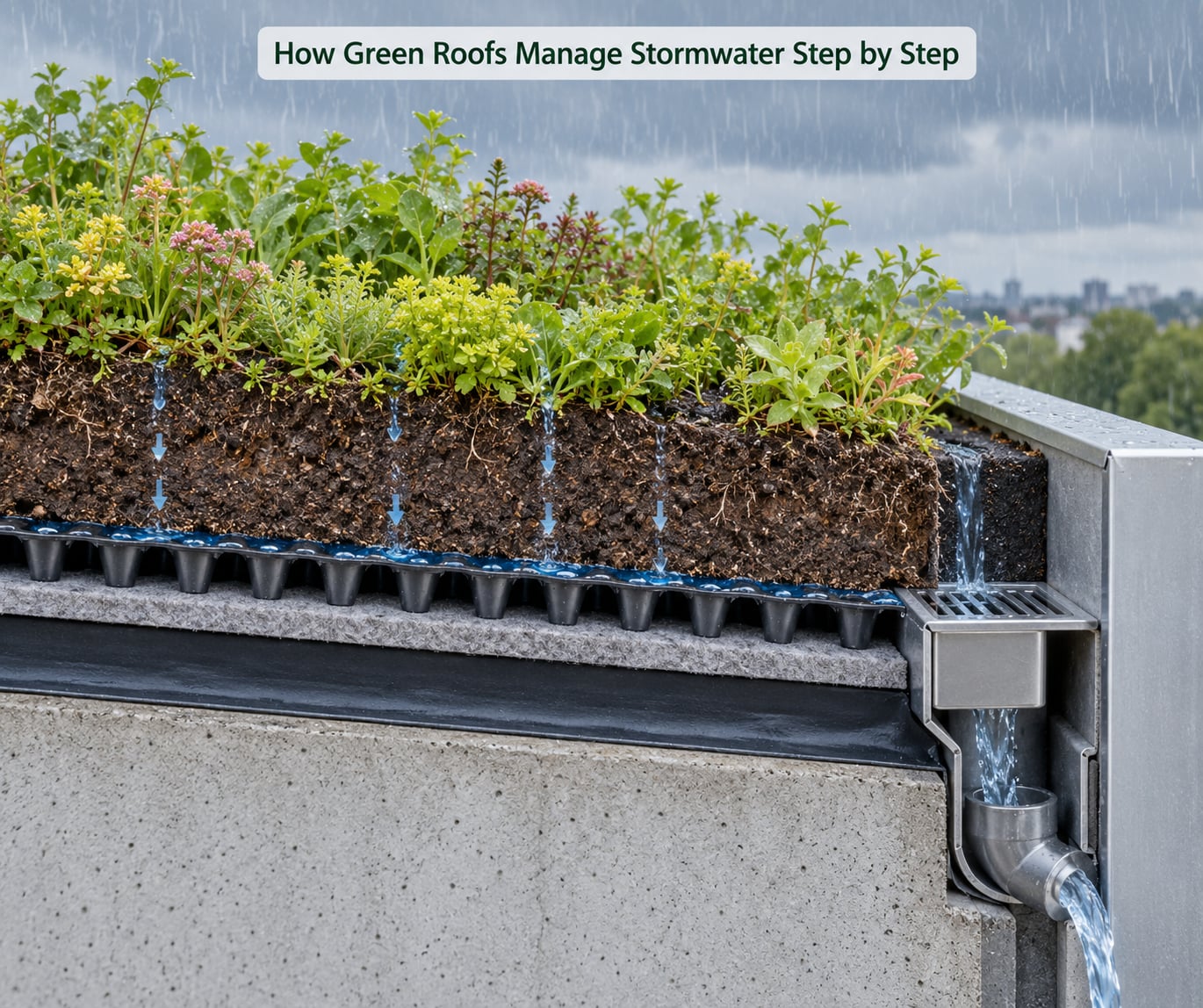
Four processes do the work, and they run in the same order every time rain hits the roof.
- Interception. Rain lands on leaf surfaces, stems and mulch, and a portion never reaches the media at all. Wetter canopies, denser planting and larger leaf area intercept more, which is one reason vegetated cover outperforms a bare gravel surface right after a storm.
- Storage. What does reach the roof soaks into the pore spaces between particles in the growing medium. Storage is roughly the depth of the medium multiplied by the volume of available pore space, so a deeper medium holds meaningfully more water before it saturates.
- Uptake and evaporation. Roots draw stored water into plants and return it to the atmosphere through transpiration, while water at the surface of the media evaporates directly. This is the only path that removes water from the watershed entirely rather than delaying it.
- Delayed, controlled release. The remainder percolates down through the filter and drainage layers and exits the roof drains over hours rather than minutes. The hydrograph flattens even when the total volume barely changes.
Steps three and four pull in opposite directions. The slower the roof releases water, the more time plants have to transpire some of it before it leaves, so drainage design and vegetation work together rather than competing.
Runoff reduction figures in the 90 percent range come from short storms following dry periods, on thick media, with healthy plants. Year after year on a real building, the honest number is lower, and the reason is the variable almost nobody explains.
How Much Stormwater Can a Green Roof Hold?
The answer depends less on rainfall intensity than people expect and much more on the starting condition of the medium. A dry medium has empty pore space waiting to fill. A medium that received an inch of rain yesterday has almost none left, and the next storm of the same size will simply run through.
Antecedent moisture is the single largest variable behind the spread in published retention numbers. It is why one study reports 90 percent and another reports 40 percent for nominally similar roofs, and it is why cities should ask a monitoring report for the conditions attached to the figure rather than the figure alone.
What changes green roof performance
| Condition | Effect on retention | What is happening |
|---|---|---|
| Dry media before the storm | Highest | Full pore space available to absorb the storm |
| Media wet from a recent storm | Lowest | Pore space already occupied, so water bypasses to the drain |
| Warm season, actively growing plants | High | High transpiration and evaporation draw stored water out of the media |
| Cold season or dormancy | Low | Reduced plant uptake, saturated or frozen media, snow cover |
| Thin media, extensive system | Moderate | Less total storage volume before saturation |
| Deep media, intensive system | High | Larger reservoir and deeper root access to stored water |
| Storm larger than typical design event | Falls off sharply | Storage is exceeded and excess bypasses to the drain |
| Bare patches from plant loss | Low, and local | Lost interception and exposed media that erodes and clogs drainage |
That last row is the one that quietly erodes performance. Retention figures in design documents are calculated on a fully vegetated roof. Bare areas reduce both interception and filtering, and the exposed medium they leave behind tends to migrate into the drainage layer.
How much water is that in gallons?
Here is a worked example for a 1,000 square foot extensive roof with four inches of growing medium, using round planning figures rather than lab results.
The roof area is 1,000 square feet. Multiply by four inches of media, convert to cubic feet, then apply an available pore space of roughly 30 percent for a typical lightweight extensive mix. That gives about 10 cubic feet, or roughly 75 gallons of raw storage. A commonly used planning figure for annual retention on a roof in this range is around 50 percent, which lands near 40 gallons held back in an average year. Move to six inches of media and the raw storage rises to about 110 gallons; hold it over a flat roof with deeper, denser media and the annual figure climbs further.
Check that arithmetic against whatever standard your city actually credits. Local stormwater utility guidance, the International Stormwater BMP Database, and state or provincial BMP manuals each publish their own planning values, and they do not agree exactly.
Which Green Roof Systems Manage Stormwater Best?
For stormwater volume, deeper media wins. For many events, a thicker extensive roof performs nearly as well as a semi-intensive one at a fraction of the structural load. The table below compares the main system types.
| System type | Typical media depth | Saturated load | Stormwater performance | Best suited to |
|---|---|---|---|---|
| Extensive | 2 to 6 inches | Lightest | Moderate volume, good delay, lower annual retention | Large flat roofs, retrofits with limited structural capacity, buildings needing little access |
| Semi-intensive | 6 to 10 inches | Moderate | Higher volume and stronger evapotranspiration | Civic, multifamily and commercial roofs with a real maintenance program |
| Intensive | 10 inches and deeper | Heaviest | Highest volume, largest drawdown delay | New construction with amenity lawns, trees and paving |
| Blue-green (controlled release) | Varies | Varies | Volume held is predictable and pre-released before a forecast storm | Combined sewer overflow districts and sites under strict peak flow limits |
| Modular tray | Fixed cell depth | Consistent | Standardized and predictable; limited to cell depth | Fast installation, roofs where a loose-laid system is impractical |
Extensive roofs cover the most area by a wide margin because they are light, cheap per square foot and need less irrigation. Intensive roofs hold more water per square foot but cover a small fraction of the ground. When a city needs volume reduction across a district, area usually matters more than depth.
Blue-green systems sit apart from the rest. A blue roof stores water in a controlled drainage layer and releases it on a schedule set by a valve; a green roof releases according to how wet the medium is. Blue-green adds an active control that a purely passive green roof cannot offer, which matters where a combined sewer system has a hard overflow trigger.
What Happens When the Green Roof Reaches Capacity?
Once the medium saturates and the storage volume is full, additional rain bypasses the system and goes to the roof drains. This is by design. A green roof is not designed to hold a cloudburst.
Stormwater sizing rules usually set a design event such as a 1-inch or 2-inch rainfall over a specified duration, and performance beyond that event is treated as no benefit. Two things follow from this. First, the overflow path must be reliable, because water that cannot drain sits on the roof as a standing pond and loads the membrane. Second, a green roof should never be credited with eliminating a detention requirement on its own.
Roof drains on a vegetated roof clog faster than anyone plans for. Sedum grows over outlets, mulch and fines wash into the drainage mat, and inspection intervals that would be fine on a conventional roof are too slow here. Owners on building forums consistently describe drain blockage as their leading worry after a season or two.
How Do Green Roofs Affect Water Quality?
Not all of the captured water is clean. Rain that runs off a conventional roof carries whatever is on the roof surface: fine particles from shingles and membranes, metals from flashing and gutters, and nutrients from atmospheric deposition. A green roof intercepts part of that load before the water reaches the drainage system.
Four mechanisms do the filtering. Vegetation and mulch physically trap particles. The growing medium itself filters by slow movement through fine pore spaces. Roots and microbial activity in the media bind metals and break down some organics. Roof plants also take up nitrogen and phosphorus for growth, and where plants are replaced or removed that uptake leaves the site with them.
Two realistic expectations to carry into a program. Metals such as copper and zinc from roofing materials, fittings and irrigation components are chemically active and do not biodegrade, so media collected for reuse needs testing before it goes onto another site. And water quality benefits are concentrated in the small fraction that flows through the media. Water that overflows during a large storm bypasses most of the filtration path and arrives with much of its load intact.
Runoff leaving a green roof also tends to be closer to ambient temperature than runoff leaving a bare membrane, which matters for cold-water streams where thermal stress limits salmon and trout.
What Design Features Improve Stormwater Performance?
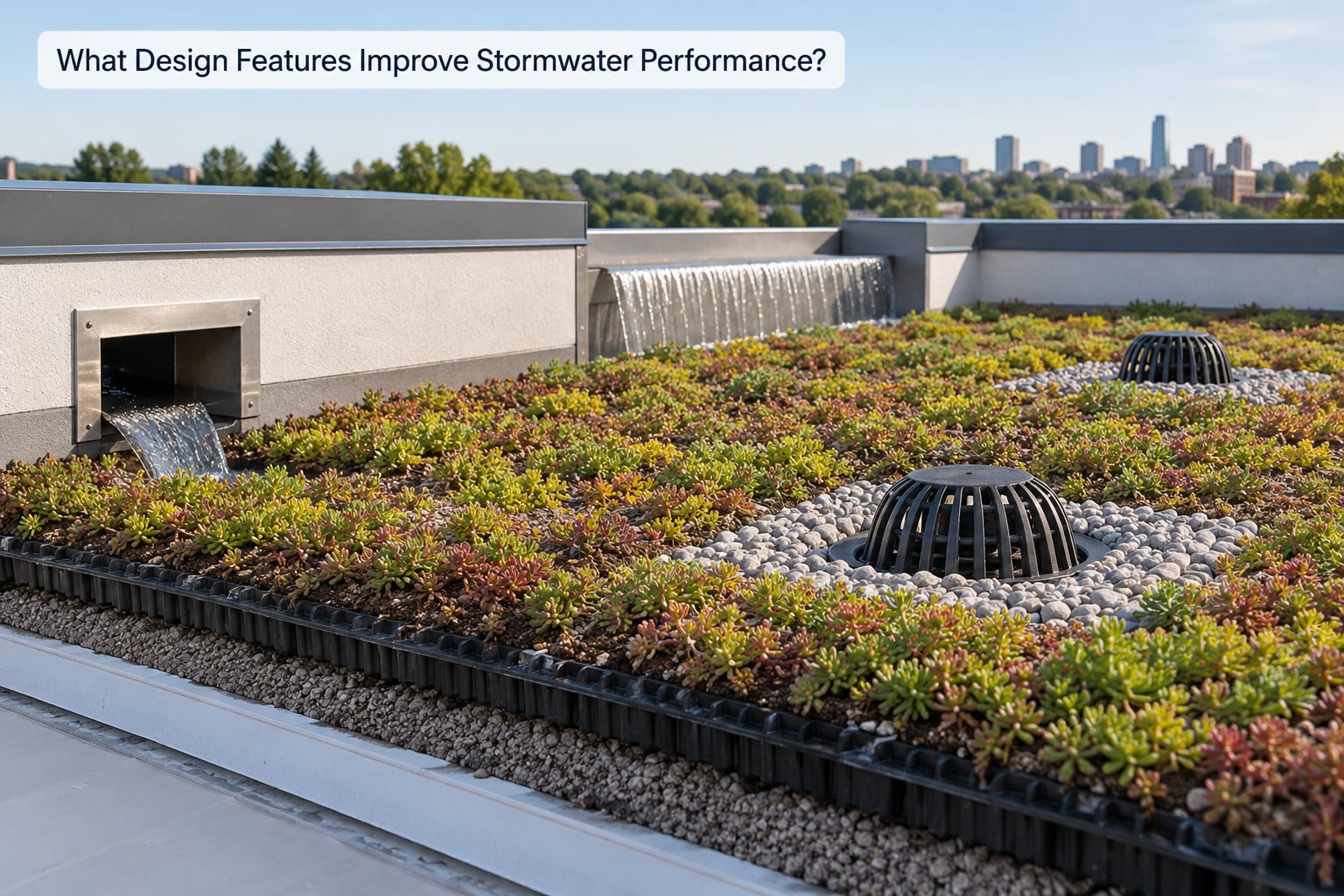
Most performance is decided in the assembly drawings, before a plant is chosen. These are the details that matter.
- Storage media, not just a drainage mat. A thin drainage board moves water off the roof quickly and retains almost nothing. Retention requires a depth of absorptive growing medium with real pore space.
- Separate drainage and storage functions. Well-designed assemblies place an absorbent retention zone above a free-draining layer so the roof holds water while still draining fully between storms.
- Filter fabric between media and drainage. Without it, fines wash downward and clog the drainage path within a few seasons.
- Protected inlets and a real overflow path. Drains should have accessible baskets or grates, and every vegetated roof needs a scupper or secondary overflow set below the finished surface so a blocked primary drain cannot pond the roof.
- Protected waterproofing. A root barrier and a walkable protection layer matter more on a green roof than on a conventional one. The membrane also stays cooler and out of ultraviolet light, which is a genuine service-life benefit.
- Slope to the drains. A small intentional slope keeps water moving toward the outlet and limits the ponding areas where erosion starts.
- Vegetation matched to the depth. Deep, fast-growing species placed in shallow media will not survive the first dry week. Sedums, grasses and native wildflowers in the right mix suit different depths.
- Access routes and safe edges. Someone has to reach every drain and inspect the assembly. A roof nobody can walk is a roof nobody will maintain, and maintenance is what keeps retention working.
How Do Cities Measure Green Roof Benefits?
Two different numbers get called retention, and mixing them up leads to bad policy. Volume reduction is the share of rainfall that never leaves the roof over a year. Peak flow reduction is the drop in discharge rate during a single storm, and it comes from delay rather than from removal. A green roof is usually better at the second than the first.
Monitoring programs typically measure rainfall at a nearby gauge, roof outflow through a flow meter, and sometimes media moisture at depth. From those three, a program can compute retained volume per event, runoff coefficient, lag time, and drawdown rate for the roof as built.
Water quality sampling pairs flow data with laboratory analysis for turbidity, metals, nutrients and conductivity. Because concentration alone can rise while total load falls, a credible program reports both. Temperature logging is cheap and shows the moderation effect clearly.
Long-run reporting matters most. A roof monitored for one summer will overstate itself, because that measurement period probably included a stretch of dry days. Programs that publish two or more years of data, with seasonal breakdowns and the antecedent conditions noted, give practitioners something they can design against.
What Are the Main Maintenance and Design Challenges?
Green roofs are not maintenance free, and the myth causes real failures. Both installers and policy groups push back on that claim directly. A workable regime is roughly quarterly inspections, more often in the first two growing seasons, plus drainage checks before and after the storm season.
The recurring failure points are predictable.
- Clogged drains and outlets. Vegetation growth and washed-in fines are the top problem, and a clogged drain quietly destroys retention long before anyone notices ponding.
- Erosion and exposed media. Bare patches from plant loss channel water, and the channel then widens. Fill small gaps promptly and the system recovers.
- Drought and wind loss. Newly planted extensive roofs need irrigation through establishment. Plants lost to a wind event or a dry spell reduce interception and filtering until they are replaced.
- Weeding and volunteer species. Substrate is a growing medium, so other things try to grow in it. Aggressive grasses and trees can overwhelm drainage.
- Membrane and edge damage. Root intrusion, punctures during maintenance, and edge lifting in wind are the failures with real cost attached.
- Structural capacity, especially on retrofits. Many retrofit projects stall here. The saturated weight of the system, plus people and equipment for access, often exceeds what an existing frame was designed to carry, and a structural engineer has to confirm it before anything else proceeds.
Ownership is the other quiet problem. The waterproofing contractor and the green roof installer are different trades, and when a leak appears years later it is not obvious whose scope it fell under. Naming that responsibility in the contract is cheap insurance.
Frequently Asked Questions
How much stormwater can a green roof hold?
It depends on media depth, available pore space, plant health and how wet the medium was before the storm. An extensive roof with four inches of media has roughly 10 cubic feet, or about 75 gallons, of raw storage. Annual retention commonly lands near 50 percent, though summer events on dry media can perform far better and back-to-back storms far worse.
What is the difference between a green roof and a blue roof?
A green roof stores water in living plants and porous growing medium, and releases it based on how saturated that medium is. A blue roof stores water in a dedicated drainage layer and releases it on a set schedule through a controlled outlet. Blue roofs are predictable and hold more, but they are not biological, do not filter water, and add no habitat or cooling benefit.
Do green roofs work in cold climates?
They work, but performance drops. Published figures from the Green Roofs for Healthy Cities put summer retention at 70 to 90 percent and winter at 25 to 40 percent, because plant uptake falls, media can stay saturated or frozen, and snow covers the surface. Cold-climate designs compensate with deeper media, cold-hardy species, and drain protection against ice.
Are green roofs maintenance free?
No. Installers and policy organizations refute that claim directly. Expect at least quarterly inspections, more often during establishment, with drains and outlets checked before and after storm season. Ongoing weeding, irrigation during dry periods, bare-patch repair and drainage clearing are what keep retention performance intact year after year.
How much does a green roof weigh and can an existing roof take one?
Saturated weight varies widely by system, from a few tens of pounds per square foot for a thin extensive roof to well over a hundred for a deep intensive one. Because that load is permanent, an existing structure needs a structural engineer’s assessment before design begins. Retrofitting an old flat or TPO roof is often where green roof projects fail.
What drives the cost of a green roof?
Media depth, system type, drainage and storage components, root barrier and waterproofing, edge safety, access, and structural work on retrofits dominate. Intensive systems cost far more per square foot than extensive ones because of soil volume and access requirements. Published per-square-foot ranges from industry bodies are a useful starting point, but local structural condition often moves the final number more than material choices.
Conclusion
Green roofs manage stormwater by intercepting rain, storing it in the pore spaces of a shallow growing medium, returning part of it to the atmosphere through evaporation and transpiration, and releasing the rest slowly through controlled drainage. The volume they remove depends on media depth and season, and the delay they create is often the more valuable contribution.
The first practical step is to define the objective precisely, because retention, peak delay and water quality are three different targets. Then walk the roof, or the proposed roof, and look at drainage capacity, overflow provisions, structural load and access. Everything else in the design follows from those four answers.