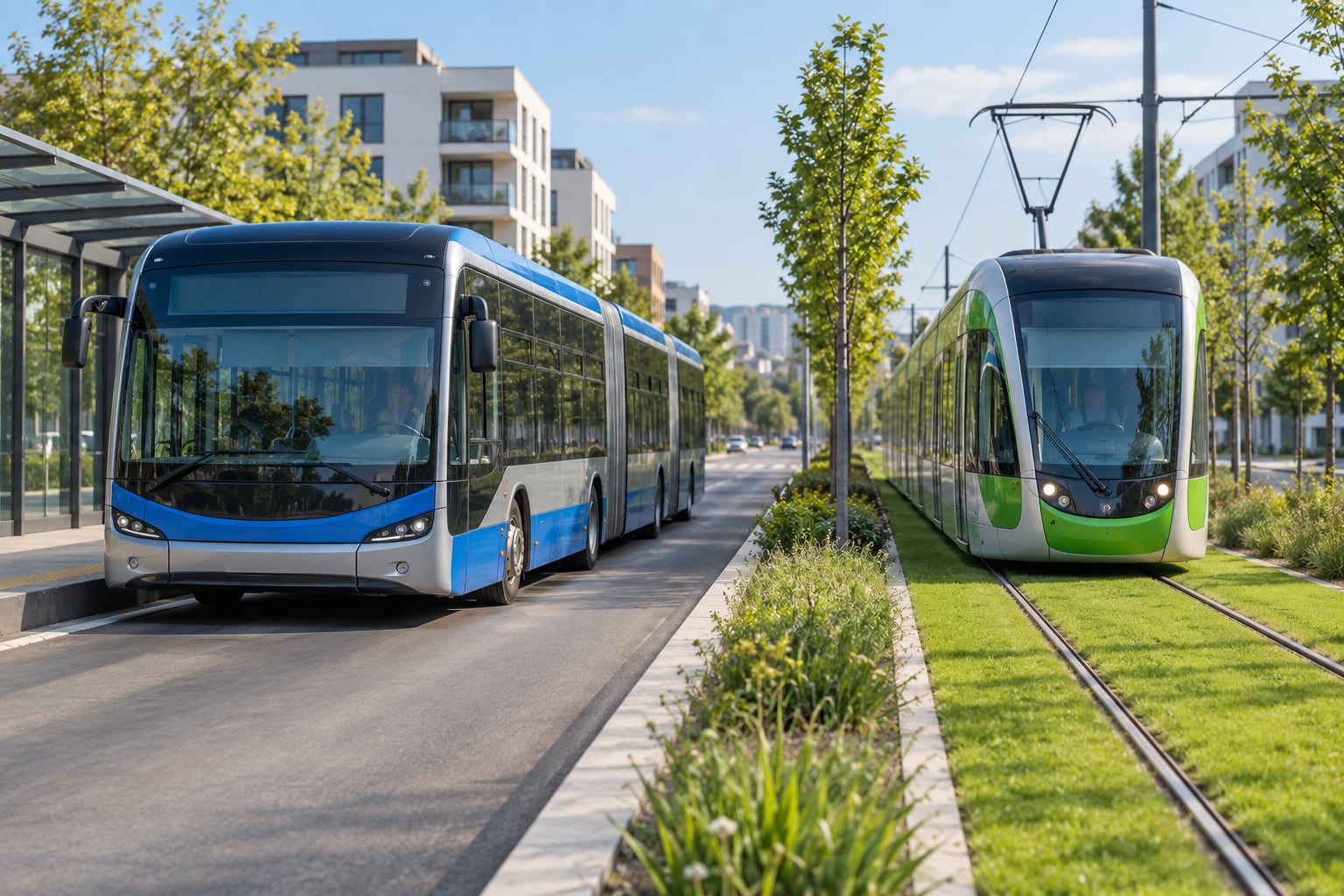
Bus rapid transit differs from light rail in one sentence: BRT is a service design built around buses running in dedicated lanes, while light rail is a fixed rail system with its own vehicles, tracks and power supply. Almost every other difference in this article follows from that one split.
That sounds simple, but the argument between the two modes gets tangled fast, usually because cities use the word “BRT” for anything with a bus and a painted lane. The Institute for Transportation and Development Policy publishes a BRT Standard with Bronze, Silver and Gold tiers, and the honest version of this comparison starts from there: a system only counts as BRT when it has genuinely separated right-of-way, off-board fare collection, level boarding, and priority over general traffic.
Below is the operational and infrastructure reality, corridor by corridor, without the advocacy.
Table of Contents
- How Bus Rapid Transit Differs From Light Rail at a Glance
- Vehicles and Infrastructure
- How Bus Rapid Transit Differs From Light Rail in Speed and Travel Time
- Capacity and Passenger Comfort
- Stops, Stations, and Boarding
- Cost and Construction Requirements
- Route Flexibility and Expansion
- Operations, Safety, and Environmental Impact
- Which Should You Choose?
- Frequently Asked Questions
- Is BRT just a bus with a different name?
- Can light rail be faster than bus rapid transit?
- Which is cheaper to build, BRT or light rail?
- Which carries more passengers, BRT or light rail?
- Is BRT more environmentally friendly than light rail?
- Can a city start with BRT and switch to light rail later?
- Conclusion
How Bus Rapid Transit Differs From Light Rail at a Glance
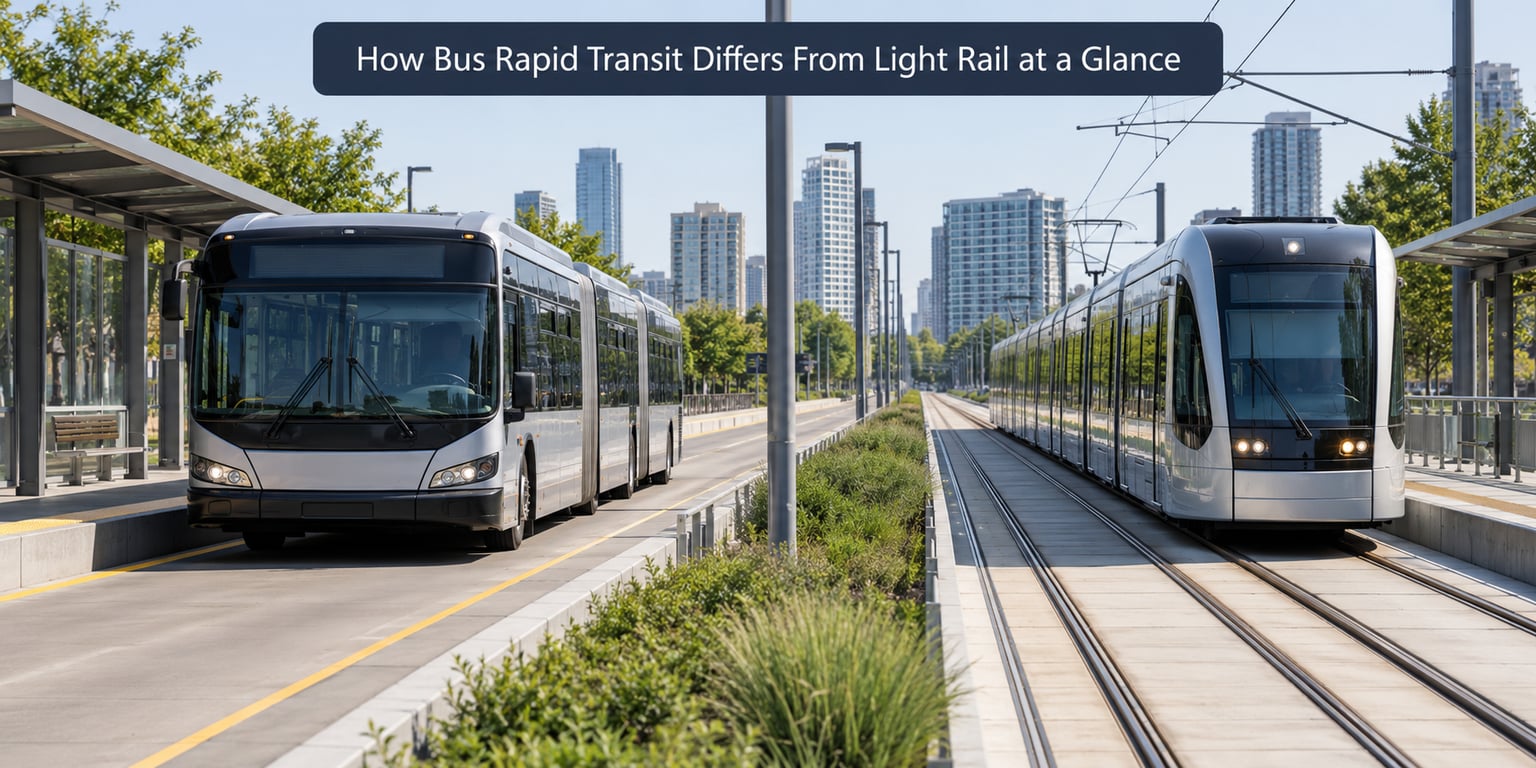
The short version: buses win on cost, speed to build and flexibility; rail wins on capacity per lane, permanence and the way it shapes development around it.
| Criterion | Bus rapid transit | Light rail |
|---|---|---|
| Vehicle | Standard, articulated or biarticulated bus | Rail vehicle (LRV) on steel wheels |
| Right-of-way | Dedicated busway, curb lane or median; sometimes mixed traffic | Embedded, segregated or elevated track |
| Power | Diesel, hybrid, battery-electric, trolleybus or hydrogen | Overhead catenary, mostly |
| Commercial speed | Often 20 to 25 km/h on a well-built corridor | Comparable when stops and signals are managed |
| Typical stop spacing | 400 to 800 m | 500 to 1000 m |
| Planning capacity per direction | Roughly 3,000 to 10,000 passengers per hour | Roughly 5,000 to 20,000 per hour on a single track pair |
| Passengers per vehicle | Around 100 in comfort, more when packed | Around 150 to 200 seated and standing, more when packed |
| Time to open | Roughly 12 to 24 months for a first corridor | Roughly 3 to 7 years including planning and property |
| Land and power needs | Streets it already uses, plus charging or fuel | New or rebuilt corridor, substations, wires |
| Route changes later | Relatively easy, including temporary lanes | Very expensive once track is in the ground |
| Best fit | Emerging or fast-changing corridors, constrained streets, pilots | High-demand trunk corridors with permanent development |
These are planning ranges, not promises. Every one of them moves with local wage levels, land prices, corridor geometry and how well the project was designed.
Five differences account for most of the practical gap between the two modes:
- Service design versus vehicle. BRT describes how buses are run. Light rail describes what they run on.
- Temporary versus permanent. A busway can be re-marked in weeks. Rail alignment is a 60-year decision.
- Separation. A busway is a painted and walled corridor on existing road. Rail needs its own physical space, wires and often its own bridge or tunnel.
- Passengers per hour per lane. Both are heavy, but rail has more floor area to fill, especially once articulated buses reach their practical limit.
- Development and funding. A visible, permanent rail line tends to attract housing and commercial investment in a way buses rarely match, and some funding programmes remain easier to access for rail.
Vehicles and Infrastructure
Bus rapid transit runs on rubber tyres in a corridor set aside from cars. That corridor can be a fully separated busway in the middle of a wide arterial, a pair of curb lanes on a downtown street, or a combination of the two.
Light rail runs on steel wheels over rails laid in the ground, in the street, on a viaduct, or in a tunnel, and it draws power from overhead catenary almost everywhere it operates.
Right-of-way is the honest dividing line, and it is where the labelling fights happen. Planners on urban planning forums keep asking the same question: what counts as real BRT rather than an express bus with new signage? The ITDP BRT Standard answers it, and the tiers are useful shorthand. A Bronze system has some separation and off-board payment. Silver adds substantial right-of-way and better integration. Gold is the full package with high-quality stations, frequent service and a genuine separate way.
Light rail has a comparable grading problem, because the word covers everything from a modern tram on a mixed street to a full metro-quality line on its own private right-of-way. When someone says light rail has a lower capacity than a subway, the comparison is often between Gold-standard BRT on a fully separated corridor and a street-running tram. Neither mode has a fixed capacity; capacity comes from the operating plan.
How Bus Rapid Transit Differs From Light Rail in Speed and Travel Time
Speed differences come from dwell time, signal treatment and stop spacing, not from rubber versus steel. A well-built BRT corridor with all-door boarding, off-board payment and queue-jump lanes can match or beat a street-running tram end to end.
Dwell time is where the bus has to work hardest. All-door boarding, wide doors and off-board fare collection can cut a stop to 10 or 15 seconds per door pair, but only if the bus actually stops in the right place and people are already moving. A single-file queue at a curbside stop in mixed traffic can add a minute per mile.
Signal priority is the other lever, and both modes use it. A BRT corridor typically gets queue jumps and transit signal priority at intersections. Light rail gets the same treatment, plus the ability to run without any traffic at all, which is why grade separation is where rail spends its money.
Stop spacing works the same way in both modes: closer stops are more convenient and slower, wider spacing is faster and less convenient. Roughly 400 to 800 m suits a BRT corridor and roughly 500 to 1000 m suits a light rail line, but comfort, not speed, usually sets the final number.
The honest summary for travellers: on a corridor built to spec, expect similar journey times, and expect the BRT version to open years earlier.
Capacity and Passenger Comfort
Both modes are high-capacity compared with regular buses, and both reach their limit through frequency rather than by making one vehicle enormous.
A standard 40-foot bus carries roughly 40 seated and maybe 75 riders in real peak conditions. An articulated bus adds 15 or so seats and far more standing room, landing around 100 in a busy but survivable load. A biarticulated bus pushes toward 150. A light rail vehicle, usually 30 to 45 m long, seats around 150 to 200 with standing space and can run well past 250 when packed.
Those packed numbers are marketing fiction, and the difference matters more than any table. Realistic peak planning capacity for a BRT corridor lands somewhere around 3,000 to 10,000 passengers per hour per direction, and for light rail roughly 5,000 to 20,000 on a single track pair. A 60 m articulated bus and a 30 m light rail vehicle are not close in floor area, which is why rail carries more per vehicle on the same alignment.
Winter destroys capacity assumptions. Coats, strollers, wheelchairs, mobility devices and bikes all take floor space, and the practical loss is significant. Planners on the UrbanToronto forum make this point repeatedly, and it is the single most useful correction to a capacity table: comfortable capacity is the number that should drive your frequency plan, not crush load.
Comfort follows the same pattern. A BRT bus has one floor, a low step or ramp, and a suspension that feels the road. A light rail vehicle has a smoother ride, more standing room and a bigger interior, but stations that are often a long walk or roll from the street. Level boarding helps both; BRT often does it with a ramp and a raised kerb, light rail with a raised platform.
Stops, Stations, and Boarding
Stations are where the two modes look most alike and behave most differently, because the ticket and the queue move the bottleneck.
A light rail platform is a fixed structure. Passengers wait behind a marked edge, tap before boarding, and flow through wide doors when the vehicle arrives. That design supports very high throughput when the headways are short, and it is one reason light rail attracts development: the platform becomes a visible, permanent piece of the street.
A BRT station is usually a raised platform, a shelter and a boarding island in the middle of a busway. It can look like a rail platform, and the best ones do, because the design is copied from rail. The failure mode is different: without off-board payment and enough doors, a bus station becomes a curbside queue in the rain.
Off-board fare collection matters more than any other single station feature for BRT, and the ITDP tiers require it. Riders pay before the bus arrives, so boarding becomes a fan-out rather than a queue. Light rail does the same thing, which is why both modes need it in order to be rapid.
Stop spacing is the other lever. Dense spacing slows both modes down and improves walk access. Sparse spacing is faster and worse for anyone not living near a station, so the equity question often gets decided here rather than in the cost spreadsheet.
Cost and Construction Requirements
Light rail costs several times as much as BRT for a surface corridor of the same length, and the gap widens where structures, property acquisition or difficult geology are involved. Exact figures belong to a specific project rather than to a mode, so treat any number you see as one city’s reality and not the going rate.
The construction reasons are structural. Rail requires track work or slab track on a prepared formation, overhead catenary, substations, signalling, and usually new vehicles from a small pool of manufacturers. Every one of those items is a long lead time item, which is why rail projects carry years of schedule risk.
A BRT corridor reuses the road. The work is concrete busway paving or lane reallocation, stations, shelters, signals, and charging or fuel infrastructure if the fleet is electric. Repaving an existing arterial is comparatively ordinary construction, and it can be staged so parts of the corridor stay open.
Timelines reflect the same split. A first BRT corridor is a 12 to 24 month project once funding and design are underway. A light rail line typically runs three to seven years from decision to opening, longer when land, environmental review or utilities get involved. The Minneapolis Blue Line Extension is the cautionary case that transit planners here discuss constantly: roughly 15 years of planning, a substantial amount spent, and nothing running.
Land is the sleeper cost. Bogotá’s TransMilenio is the famous warning: the system design is frequently praised, and the later phases ballooned largely because land acquisition and legal process were underestimated. Charlotte’s LRT extension remains the most expensive entry in the ITDP cost database. Jacksonville’s planners noted that BRT could use an existing depot while a rail alternative would have needed an entirely new one.
Operating costs follow labour, and labour is roughly 80 percent of what a transit agency spends to run service. That is the number planners on the UrbanToronto forum keep returning to, and it changes how you read any capital cost comparison. Rail buys more capacity per lane and per vehicle, but a BRT system that needs a bus every five minutes on a corridor where a train every ten minutes would work may operate far more vehicles, and more drivers, over thirty years.
That is why lifecycle comparisons matter more than opening-day cost, and why any analysis that only compares capital cost is incomplete. Vehicle replacement cycles, catenary maintenance, power supply, road maintenance on bus corridors versus track maintenance on rail, and labour escalation all belong in the model.
Route Flexibility and Expansion
BRT can change shape after opening in ways rail cannot, and that is a real operational advantage, not a marketing line.
Bus lanes can be re-marked, temporarily removed for events, extended a few blocks to serve a new development, or redirected while a corridor is rebuilt. Buses can also run out of a downtown transit mall and split into branches, so one trunk corridor can feed several neighbourhoods without new track.
Light rail gains its efficiency precisely because it is fixed. A permanently aligned corridor with simple geometry, level crossings and standardised stations is fast and cheap to operate. The same permanence is the cost: moving a stop, realigning a curve or extending past a junction is expensive and disruptive.
Upgrading later is the question residents ask most often, and the answer is more encouraging than the usual answer suggests. Cities have converted BRT corridors to rail, usually by widening the right-of-way, replacing the busway paving with track and moving substation capacity up a notch. The corridor survives; the busway surface does not. Two cities discussed in planning forums, in Bogotá and in parts of the US, have shown the pattern, so the pavement investment is partly recoverable. What is not recoverable is the assumption that the money was free.
Operations, Safety, and Environmental Impact
Neither mode is more dangerous by default, and both are safer than the road traffic they replace. The differences come down to what the vehicles are doing and what the corridor is made of.
A bus in a dedicated busway has a separated right-of-way but can still cross traffic, driveways and turning movements, and a bus in mixed traffic is fully exposed. A light rail vehicle on segregated track is protected from road traffic along its length, and exposure concentrates at crossings, which is where rail projects spend their safety budget. Both modes reduce collision severity relative to cars, and both depend on how the corridor is designed rather than on the vehicle.
Operating complexity favours rail in one specific way: a fixed line with standardised vehicles is simple to schedule and maintain, and it needs fewer vehicles to deliver a given capacity on a well-used corridor. Bus operations are more variable, with more vehicle types, more break zones and more recovery from traffic.
Emissions depend almost entirely on the propulsion choice, not the mode. A diesel bus in heavy stop-and-go service emits more per passenger-kilometre than an electric train carrying similar load, because a bus spends most of its time accelerating and idling. Battery-electric BRT has matured enough for real deployments and pairs well with charging at one end of a line, which is why it shows up in current planning. Trolleybus and hydrogen options exist for corridors where charging is awkward. Light rail is already electric almost everywhere, though the catenary has to be built and maintained.
The environmental story that rarely gets mentioned is the surface. A conventional asphalt busway behaves like a road, shedding stormwater runoff and absorbing heat. Rail can be laid in grass track, porous pavement or planted medians, which changes both the runoff coefficient and how the street feels in summer. That is one of the strongest urban design arguments for rail, and it is also one of the more legitimate differences between the two modes.
Which Should You Choose?
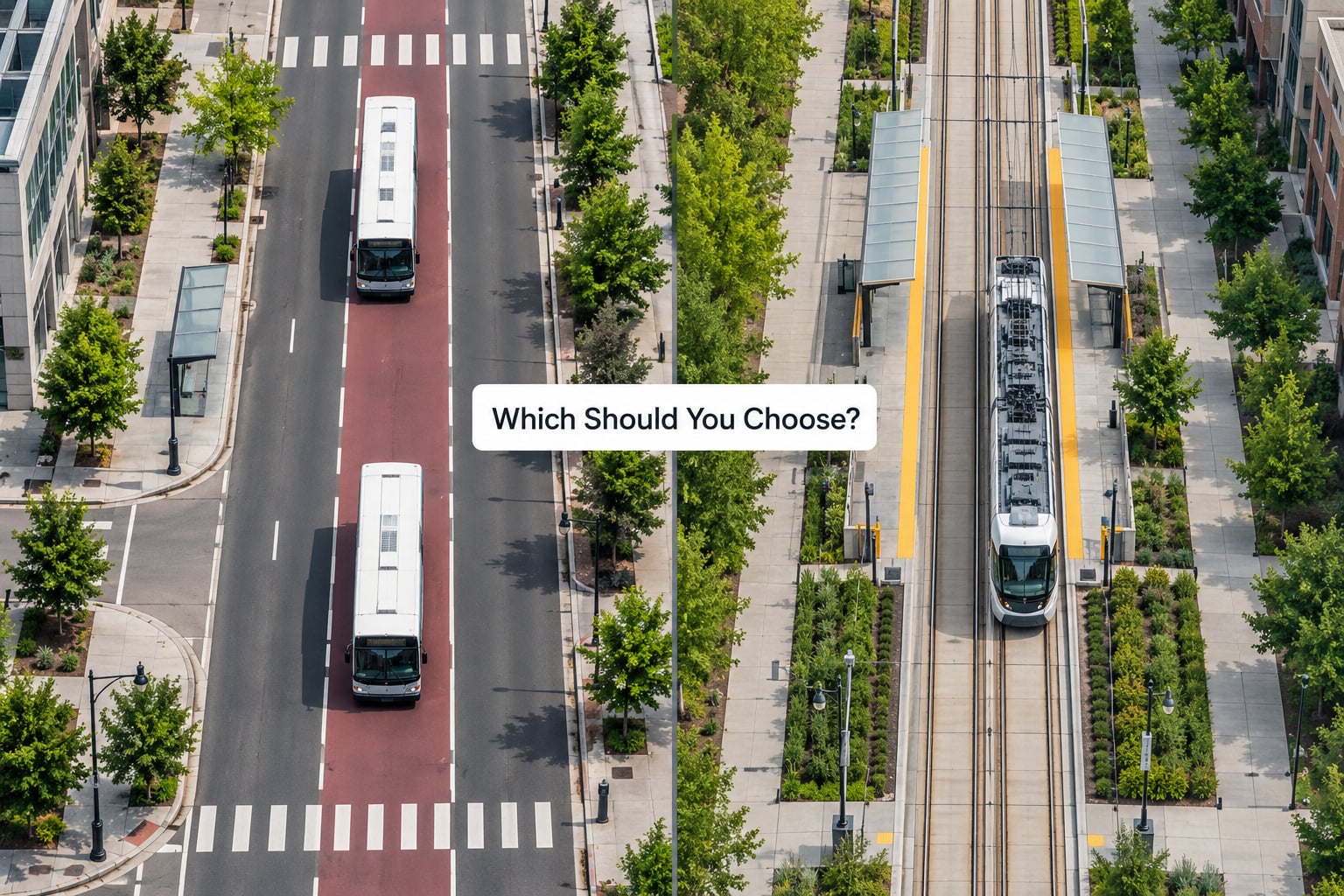
Choose BRT when the corridor is changing, the street network is constrained, or the city needs service before it has committed to a 30-year asset.
BRT fits these situations well:
- A corridor where demand is still uncertain. BRT delivers service in about two years, and if ridership underperforms the city has not sunk decades of capital into track.
- Streets that cannot hold rail. Narrow historic downtowns, congested arterials and bridges all work better with a bus that can turn and merge.
- A pilot or a growing system. The Twin Cities now run several BRT lines, and that build-out happened in a fraction of the time a comparable rail programme would have taken.
- Budgets under real pressure. Where capital is scarce, several corridors can be opened instead of one half-finished line.
- Corridors that may need a different alignment soon. Remote work and flexible schedules have made some downtown demand patterns unsettled, and buses adapt faster when the pattern shifts again.
Light rail fits these situations well:
- A proven high-demand trunk route. Sustained demand approaching the capacity of a busway favours rail, since extra frequency gets expensive fast on a busy corridor.
- A city planning for transit-oriented development. Permanent, visible infrastructure tends to bring housing and commercial investment that a bus corridor rarely delivers, and lenders pay attention to that.
- Long horizons and stable routes. If the alignment will not move for fifty years, spend the capital once.
- Corridors where access and comfort are the priority. A larger vehicle with level boarding serves wheelchairs, strollers and standing riders more comfortably.
- Streets with room to rebuild. Where the city can acquire or reassemble right-of-way, rail delivers a permanent amenity and a different emissions profile.
A practical test: if the corridor’s biggest risk is that demand will not arrive, take the option that lets you change course. If the biggest risk is that demand will exceed what you built, take the option with more capacity per lane.
Frequently Asked Questions
Is BRT just a bus with a different name?
No, and the label gets abused often. Under the ITDP BRT Standard, a real BRT system needs substantially separated right-of-way, off-board fare collection, level boarding at platforms, and priority over traffic at intersections. A bus route with painted lanes and no other changes is an express bus, and calling it BRT sets up the argument you are probably already having.
Can light rail be faster than bus rapid transit?
Yes, on the same corridor. A street-running tram with curbside stops and no priority will be slower than a Gold-standard BRT line with queue jumps and all-door boarding. A grade-separated or fully segregated light rail line, by contrast, runs faster than almost any bus corridor, because it never shares road space at all.
Which is cheaper to build, BRT or light rail?
BRT, and usually by a wide margin. The Institute for Transportation and Development Policy estimates a surface light rail alternative at roughly 3.6 to 3.9 times the cost of a comparable BRT alternative in higher-income countries. The gap comes from track, catenary, substations, signalling and long vehicle lead times, not from the road surface itself.
Which carries more passengers, BRT or light rail?
Light rail per vehicle and per lane, because a rail vehicle has far more floor area than an articulated bus. In planning terms, a BRT corridor handles roughly 3,000 to 10,000 passengers per hour per direction, and a light rail line with a single track pair roughly 5,000 to 20,000. Frequency and corridor design matter more than the mode label.
Is BRT more environmentally friendly than light rail?
Not inherently, and this depends heavily on propulsion. A diesel bus in stop-and-go service can emit more per passenger-kilometre than an electric train. Battery-electric BRT closes much of the gap, and grass track or permeable track construction gives rail a stormwater and heat advantage that a conventional asphalt busway does not have.
Can a city start with BRT and switch to light rail later?
Sometimes, yes. Cities have converted BRT corridors to rail by widening the right-of-way, replacing busway paving with track and adding substation capacity, so the corridor alignment survives. The caveat is that the pavement investment is partly recoverable but not free, and the conversion only makes sense if ridership has outgrown the buses.
Conclusion
To sum up, bus rapid transit differs from light rail because it is a service design built on buses, while light rail is a fixed rail system, and everything else follows from there.
Pick the mode that matches your corridor, your demand and your budget rather than the vehicle alone. If demand is uncertain or the street cannot hold rail, start with BRT and keep the alignment. If demand is proven, the corridor is permanent, and the city can carry the capital, rail pays for itself in capacity and in the streets around it.