
Agile inside a government agency means delivering public services in small, usable increments instead of one big launch years after the requirements were written. A cross-functional team works a prioritized backlog in short sprints, shows working software to real users every two weeks, and folds security, accessibility, procurement and budget checks into the definition of done rather than saving them for the end.
The method itself is not new. What is new is agencies finding that a process built for private-sector software rarely survives contact with a fiscal-year budget, an acquisition office, and a public hearing. The interesting question is not whether agile works in government. It’s how a team actually operates inside those constraints, week by week.
Table of Contents
- What Does Agile Mean in a Government Agency?
- Why fixed-scope waterfall strains in a public agency
- How agile works inside a government agency is not the same as working faster
- How Agile Works Inside a Government Agency
- Citizens as the customer
- How Does an Agile Team Work?
- What Happens During an Agile Delivery Cycle?
- How Do Agile and Government Rules Fit Together?
- Procurement that can survive iterative delivery
- The government definition of done
- How Do You Measure Success in a Public-Sector Agile Team?
- What Can Go Wrong When Government Agencies Adopt Agile?
- Frequently Asked Questions
- Is agile still relevant for government agencies today?
- What is DoD in agile?
- What are the 5 C’s of agile management?
- Why is agile difficult in government?
- Can agile and fixed-price contracts coexist?
- How do government agencies measure agile success?
- Conclusion: Start With One Measurable Public-Service Improvement
What Does Agile Mean in a Government Agency?
Agile in a government agency is a way of organizing delivery: a small cross-functional team plans in short cycles, builds a working slice of a public service, releases it to real users, and uses what it learns to plan the next slice. The team’s authority, scope and reporting stay public-sector. What changes is the feedback loop.
That distinction matters more than most training decks admit. A lot of what gets labeled agile transformation inside government is actually a project management office relabeling its status reports. Real agile changes three things: the team, the cadence, and what counts as evidence of progress.
Traditional government delivery assumed that requirements could be known up front. That assumption came from an era when software was a supporting system for paper processes, and it produced a familiar failure pattern. A large program spends a year documenting requirements, another year building, then discovers at acceptance testing that the workflow changed, the statute was amended, or the citizens using the service were not the ones the agency designed for.
Agile in government absorbs that kind of change on purpose. Instead of one discovery at the end, an agency discovers continuously, and each discovery costs weeks instead of years.
Why fixed-scope waterfall strains in a public agency
- Analysis paralysis. Large programs accumulate committees, reviews and approvals until nobody can start.
- Frozen requirements. Policy shifts and statutory changes land on a team that signed off on a design eighteen months ago.
- Slow decision cycles. A question that needs a policy director’s answer can idle for weeks while a sprint burns down.
- Part-time teams. Staff are pulled into operations and hearings, so nominal capacity and real capacity drift apart.
- Legacy interdependencies. One upstream system with no modern interface can dictate the entire schedule.
- All-or-nothing funding. Money arrives in annual appropriations, which quietly rewards programs that finish inside a single cycle.
None of that goes away because a team calls itself agile. What changes is how much of it the team can absorb without stopping.
How agile works inside a government agency is not the same as working faster
Speed is the most visible outcome, and it is the least important one. A team that ships a wrong service every two weeks has simply built a faster waste machine. The value comes from shortening the distance between a decision and the evidence that the decision was right.
How Agile Works Inside a Government Agency
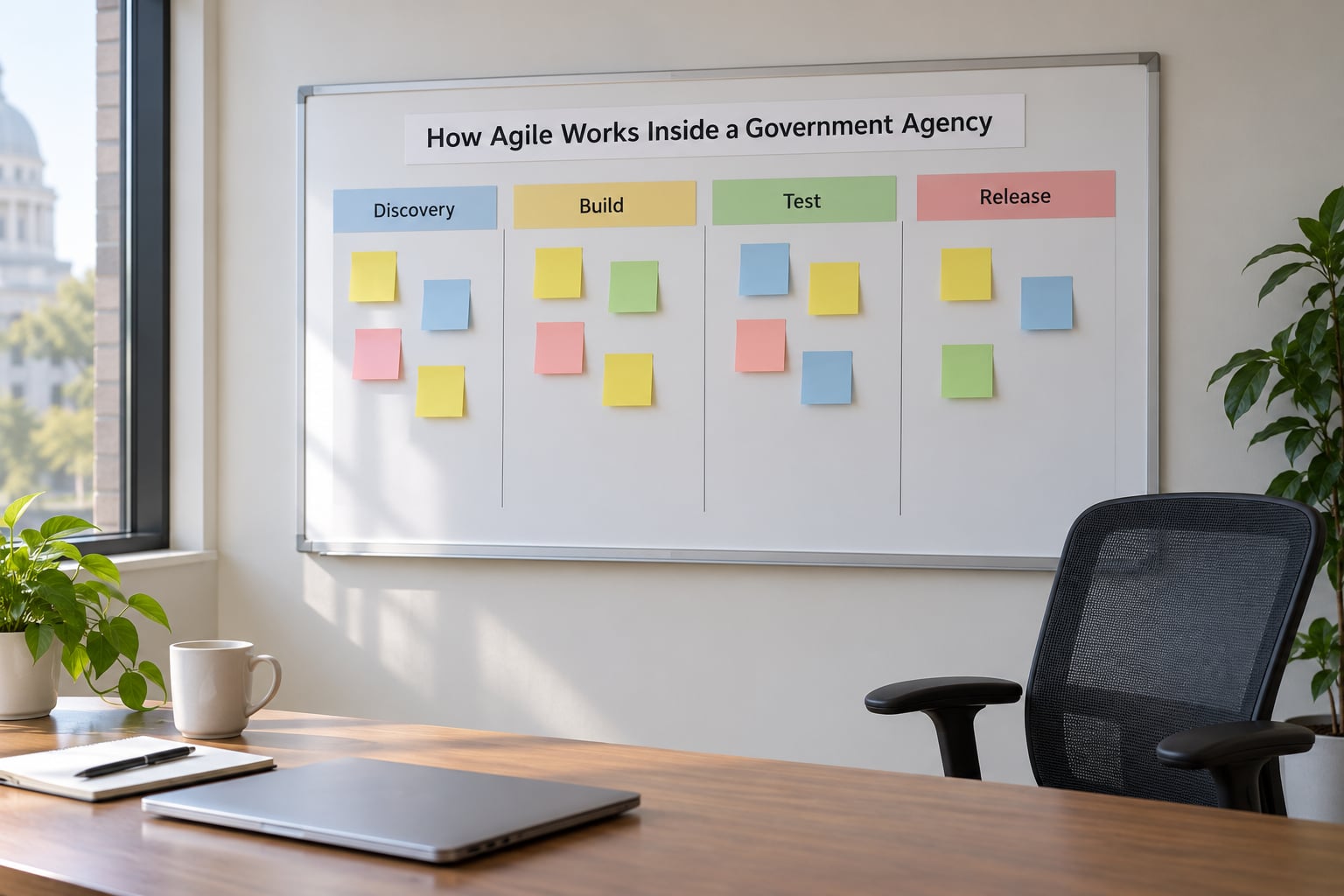
The mechanics look the same in an agency as in a software company, with two substitutions. The customer is usually a citizen, a business, or a caseworker rather than a paying user. And the constraints arrive through procurement, budget authority and records law rather than through a product roadmap.
Here is the operating model in its shortest useful form.
- One accountable product owner. A single person from the program side owns priorities and the backlog, with the authority to say no.
- A cross-functional team that stays together. Product, design, engineering, data, accessibility and operations staff in one team, including contracted vendor staff, rather than passed between departments by phase.
- A prioritized backlog written as user stories. As a person trying to register a business, pay a permit fee, or check an application status.
- Short planning cycles. Two-week sprints are the most common public-sector default, with a planning session and a review at the end of each one.
- Working increments. Each sprint ends with something demonstrable, even if it is rough, rather than a status document.
- Continuous feedback from real users. Structured testing, task sessions and support-desk data feed straight back into the backlog.
- Definition of done that includes compliance. Security review, accessibility conformance, privacy impact, records handling and documentation are part of done, not a gate at the end.
- Regular retrospectives. The team inspects how it worked and changes something concrete before the next sprint.
That last pair is where most public-sector agile quietly fails. If done means the code works, then security and accessibility get bolted on during acceptance, and the team is either blocked for months or pressured to declare victory early.
Citizens as the customer
One of the biggest shifts is who gets a seat. Traditional oversight relies on a stakeholder committee representing internal interests. An agile team spends much of its time with the people who actually use the service: applicants, permit holders, benefit recipients, caseworkers, dispatch staff.
That means recruiting real participants, running moderated task sessions, watching where people get stuck, and feeding what you saw into the next sprint’s priorities. On a city permitting service, an hour of watching an applicant navigate the form routinely outperforms a month of internal requirements review.
How Does an Agile Team Work?
Understanding how agile works inside a government agency starts with who sits on the team and who decides what gets built. Public-sector teams are usually smaller than private-sector ones, and roles are frequently combined. A five-to-nine person core team is common, extended by specialists who join for a sprint or two rather than sitting permanently on it.
The role names differ from the private sector, and that mismatch causes real confusion when an agency writes job descriptions from a training course. Public-sector equivalents usually look like this.
| Agile role | Typical government equivalent | What the role actually owns |
|---|---|---|
| Product owner | Program manager, service owner, product manager | Priorities, backlog, acceptance of increments, the definition of value for citizens |
| Delivery manager | Delivery lead, IT project manager, contractor’s delivery manager | Day-to-day coordination, dependencies across bureaus, vendor management |
| Agile coach | Change lead, delivery coach, embedded coach | Teaches the method locally, coaches the product owner, coaches leaders, not the team’s tasks |
| Technical lead | Architect, agency software engineer, systems engineer | Architecture, build and release pipeline, technical debt, interface decisions |
| Sponsor | Deputy CIO, CIO, IT director, program executive | Funding, decision escalation, removing blockers, absorbing scope changes |
| Governance and oversight | Acquisition officer, PMO, audit, budget office | Contract terms, reporting obligations, funding gates, records and audit requirements |
Two distinctions are worth dwelling on. First, the product owner is a decision role, not a project management role: they decide what gets built next and what does not. Second, the sponsor’s job is mostly subtraction, clearing decisions out of the queue so the team can keep a two-week cadence.
Practitioners on public-sector forums describe the hard part as cultural rather than technical. On a scrum.org thread about agile inside a governmental ministry, the recurring view is that agile is a mindset rather than a silver bullet, and it needs sustained commitment from leadership rather than a one-off training day.
What Happens During an Agile Delivery Cycle?
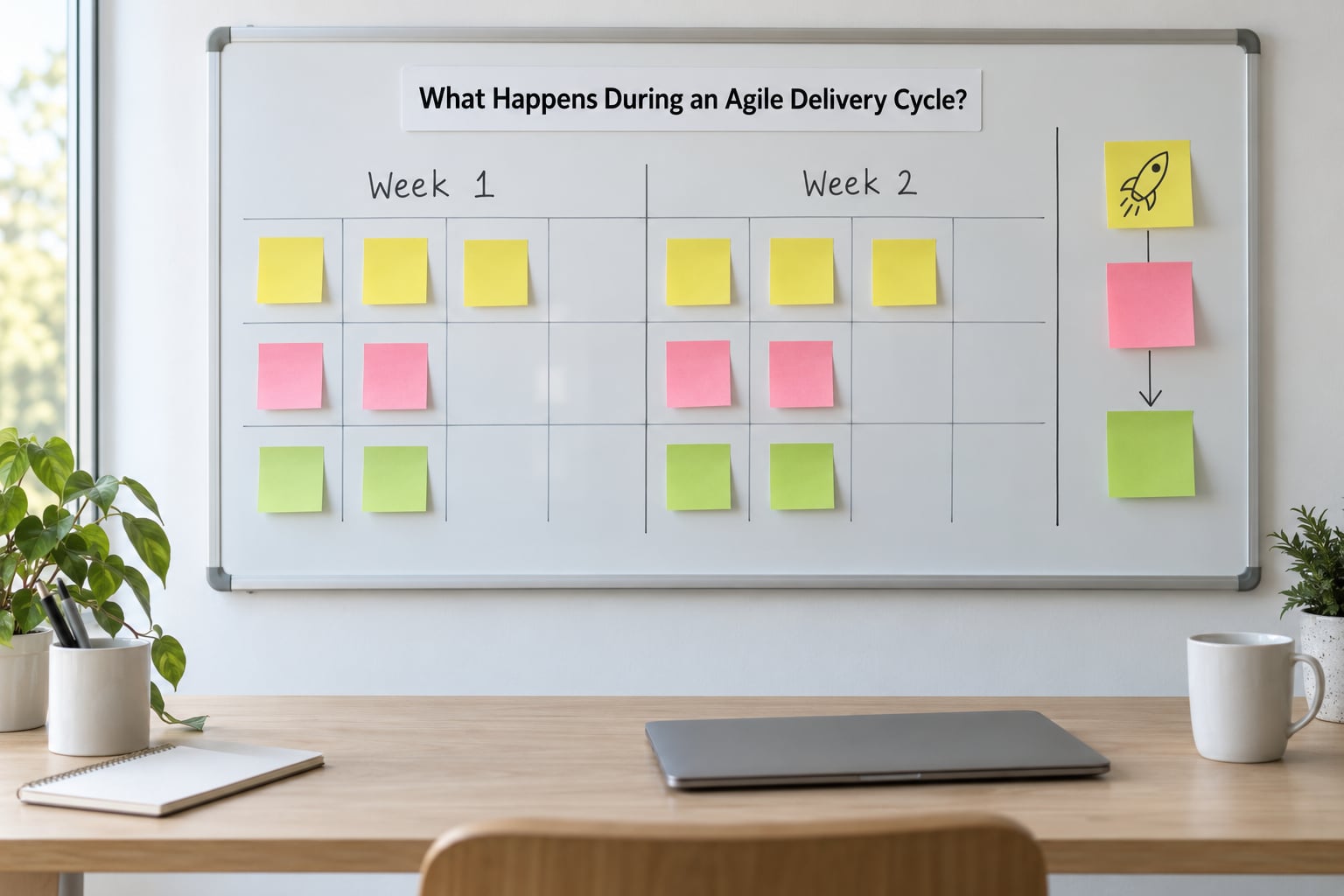
A cycle in an agency is mostly familiar. The government-specific part is that checkpoints nobody in a startup has to think about sit on the same calendar as the team ceremonies.
- Discovery and backlog refinement. Researchers, analysts and designers bring evidence about user needs. The product owner reorders the backlog so the most valuable, most de-risking work is next.
- Sprint planning. The team commits to a slice it believes it can finish. The commitment is on scope for two weeks, not on a date two years out.
- Daily coordination. A short stand-up, usually fifteen minutes, plus a visible board. Blockers like a pending legal opinion or an unavailable test environment get escalated the same day.
- Security, privacy and accessibility review. Run continuously against the increment being built, not queued for the end. Section 508 and WCAG conformance get checked in design, before code lands.
- Sprint review. The team demonstrates a working increment to program staff, partner bureaus and a small number of real users. Feedback is captured directly into the backlog.
- Retrospective. The team agrees on one or two changes to how it works, and someone owns carrying them into the next sprint.
- Release and acceptance. The increment moves to a wider user group. Where the contract permits, acceptance is per increment rather than at the end of the program.
| Day | Team activity | Government checkpoint that lands here |
|---|---|---|
| Day 1 | Backlog refinement | Funding availability confirmed against the current appropriation |
| Day 2 | Sprint planning | Contract vehicle and task order confirmed for this increment |
| Days 3-7 | Build, with daily stand-ups | Privacy impact and security review run in parallel, not after |
| Day 8 | Accessibility conformance pass | Section 508 check on the increment |
| Day 9 | Internal demo | Program staff acceptance recorded per increment |
| Day 10 | User testing session | Feedback written into the backlog for prioritization |
| Day 10 | Retrospective | Fiscal or budget reporting checkpoint reviewed |
| End of cycle | Increment released | Records and audit documentation filed |
The pattern to notice is that the compliance work happens alongside delivery instead of after it. When that coordination is planned, a two-week sprint survives. When it is not, the team spends three weeks in an approval queue and the sprint means nothing.
How Do Agile and Government Rules Fit Together?
Agile does not exempt a team from procurement law, fiscal-year appropriations, records retention, security requirements or accessibility obligations. It changes when those obligations are satisfied and how much of the schedule they control.
The question practitioners argue about most, on procurement and project-management forums, is whether a team can run sprints inside a funding and acquisition process that was designed around fixed scope. It can, and the pattern is usually described as a hybrid: agile delivery inside a waterfall-shaped funding wrapper.
Procurement that can survive iterative delivery
- Write the requirement as outcomes, not screens. A statement of work describes the user problem and the performance the service must hit, rather than a frozen feature list with dates.
- Use contract vehicles that support iteration. Multi-award schedules, indefinite-delivery vehicles and iterative task orders let an agency add increments without competing the whole program again.
- Accept deliverables per increment. Milestone-based payment and per-increment acceptance keep the incentive pointing at working software rather than at a big reveal at the end.
- Bundle security and accessibility into the contract. Section 508 conformance, privacy and security requirements are written as ongoing obligations on the increment, not as a final test event.
- Write the reporting requirement as service metrics. Contracts can require cycle time, release frequency and satisfaction measures, which is more honest than requiring percent complete.
On the budget side, teams typically plan sprints within a single fiscal year and treat the appropriation cycle as a boundary rather than a milestone. Work that is not funded in the coming year goes into a documented backlog for the next one, so nothing disappears silently between budget cycles.
The government definition of done
A usable definition of done for a public-sector increment covers more than working code: tested and deployed to an environment users can reach, accessibility conformance checked, privacy and security review closed, documentation and records updated, support staff briefed, and the increment measured against the service outcome it was meant to move. When done means all of that, “done” stops being a negotiation.
What agile does not change is worth stating plainly. Statutory authority, records law, the appropriations process, the agency’s mission, and whatever procurement rules the jurisdiction operates under all remain exactly where they were. On a scrum.org discussion, the repeated message is that agile is a mindset rather than a shortcut, and that it demands more discipline, not less.
How Do You Measure Success in a Public-Sector Agile Team?
Progress reporting in government has traditionally meant percent complete or earned value, which measure spending against a plan. Those still matter for finance and audit purposes, but they say nothing about whether a service is working for the people who depend on it.
Teams that get this right keep two sets of measures. Delivery measures tell you whether the team is learning fast enough. Service measures tell you whether the learning is going somewhere useful.
- Cycle time from a backlog item being identified to a working increment reaching users.
- Release frequency across the service, compared with the old annual or biennial launch pattern.
- Defects and rework after release, which show whether quality moved earlier or got pushed downstream.
- Adoption and task completion among real users, including the share who finish the task on the first try.
- Wait time for the public, in the unit the citizen experiences: days to a permit decision, hours to a case status answer.
- Satisfaction from user research sessions and support-desk signal, not just an annual survey.
- Equity effects for users who typically fall through service gaps, such as people on older devices or low bandwidth.
Named examples are easier to trust than generic claims. The Danish Business Authority’s corporate registration rebuild is one of the few public-sector agile programs with published figures: support calls fell from around 70 percent to 30 percent of call volume, first-time-right resolution rose from roughly 80 percent to 92 percent, onboarding training dropped from five months to about one, and average call handling time fell from about 16 minutes to 5, alongside reported IT productivity gains. Those numbers describe a service that changed for the public, which is the point.
Federal CIOs at agencies including HRSA, FERC and FEMA describe a related shift in the platform layer: managed cloud services, shared platforms and platform-as-a-service deployments that shorten the path from idea to running service. Agile process without that platform work tends to stall on environment provisioning.
Pairing the two measurement sets also changes budget conversations. Instead of defending a fixed dollar figure against a fixed date, a team can show that release frequency rose, wait time fell, and the remaining risk is smaller because the spend so far produced something usable.
What Can Go Wrong When Government Agencies Adopt Agile?
Practitioner forums return the same handful of complaints, and they are worth naming because most are avoidable.
- Waterfall with agile vocabulary. The roadmap, the budget and the scope are all fixed in advance; only the status meeting is renamed a sprint.
- Ceremonies without authority. A team runs stand-ups and retrospectives but cannot change scope, so the process produces reporting theater.
- Agile treated as a procurement risk. Acquisition staff and PMOs read agile as an unvalidated trend, and the method gets squeezed back into fixed-scope documentation.
- Part-time teams. Members are assigned nominally and pulled into operations and hearings, and every sprint loses capacity mid-cycle.
- Measuring activity, not outcomes. Story points completed and ceremonies held are reported upward because they are easy to count.
- Excluding frontline users. Internal subject-matter experts review the service, and the people actually filing the paperwork never see it.
- Silos between building and running. The team that ships the service is not the team that answers the phone when it breaks, so the first release is also the first incident.
- Slow decisions at the top. Leadership that will not resolve an escalation within days quietly resets the cadence no matter what the team does.
The common thread is that each failure is organizational rather than technical. In a thread on agile in a public service context, the recurring worry is that executive expectations of fixed scope, fixed dates and predictable spend make iteration feel like failure, so the team learns to hide the iteration instead of doing it.
Frequently Asked Questions
Is agile still relevant for government agencies today?
Yes, and the public-sector version has changed. Cloud platforms and managed infrastructure removed a lot of environment setup, and AI-assisted development is shortening the gap between drafting and testing. Continuous compliance practices mean security and accessibility checks now run alongside delivery. The principles have not moved: short cycles, real users early, measurable service outcomes.
What is DoD in agile?
The Definition of Done is the shared checklist an item must clear before it counts as finished. In a government agency it is wider than working code: tested in a reachable environment, accessibility conformance checked under Section 508, privacy and security review closed, records and documentation updated, support staff briefed, and the service outcome measured. Agreeing it once removes most argument about whether something is done.
What are the 5 C’s of agile management?
Change, Continue, Start, Stop, Collaborate. Change means reprioritizing when evidence says the plan is wrong. Continue means keeping what is already working. Start means piloting a small change rather than announcing a transformation. Stop means ending work nobody needs. Collaborate means keeping policy, technology, acquisition and frontline staff in the same room. In an agency the five habits map cleanly onto a delivery team’s weekly cadence.
Why is agile difficult in government?
Most often because of authority, not method. Teams are frequently part-time, decisions need several layers of approval, appropriations arrive annually, and acquisition was written around fixed scope and fixed deliverables. Frontline staff and citizens are often missing from design entirely. Add executives who read iteration as failure and you get a team running ceremonies on a plan it cannot influence.
Can agile and fixed-price contracts coexist?
Yes, and they usually have to. The pattern practitioners call hybrid is agile delivery inside a waterfall-shaped funding wrapper: a multi-award vehicle or indefinite-delivery contract, iterative task orders per increment, milestone-based acceptance, and fixed outcomes with variable scope. The contract fixes what must be true and by when; the team decides how many sprints get there.
How do government agencies measure agile success?
Measuring how agile works inside a government agency takes two sets of measures. Delivery measures cover cycle time, release frequency, defects after release, and how often planned work was actually completed. Service measures cover adoption, task completion on the first try, wait time for the public, satisfaction from user research, and equity for users who usually get missed. Earned value still governs finance and audit reporting; it simply stops being the main story about progress.
Conclusion: Start With One Measurable Public-Service Improvement
The first move is not an agency-wide transformation program. Pick one service problem that is valuable, low-risk and measurable, such as an application status page or a permit fee payment flow, and put a small empowered team on it for a year.
From there the checklist is short. Name one accountable product owner and give that person backlog authority. Agree a definition of done that includes accessibility, security and records. Write the contract or task order so an increment can be accepted on its own. Put one public-facing metric on the wall, such as wait time or first-time completion. Let the team show working software every two weeks, and protect the time to do it.
One funded year of honest evidence buys more than a multi-year roadmap, because it gives the budget office, the acquisition office and the leadership team something they can point at when they decide whether to go bigger.