Government user research is the systematic study of citizens, residents and staff so that public services are designed around real needs rather than assumptions. It works in six repeating stages: framing the decision, recruiting participants, choosing methods, asking neutral questions, analysing patterns, and reporting findings into a service decision that somebody is accountable for.
That last part is the difference. In a commercial product team, research informs a roadmap that a product owner can adjust next quarter. In a public body, the research question often arrives from a directive set several levels up, the timeline runs across a fiscal year, and the findings land in front of elected members or a board with a fixed budget attached. This guide walks through how the work actually runs, including the parts that go wrong and how good teams handle them.
Table of Contents
- What Is User Research in Government?
- Why Governments Use User Research
- How User Research Works in Government: The Main Process
- 1. Frame the Policy or Service Question
- 2. Recruit Participants Who Reflect the Community
- 3. Choose Methods That Match the Question
- 4. Ask Questions Without Leading the Evidence
- 5. Analyze Patterns, Not Just Quotes
- 6. Report Findings for Public Decisions
- How User Research Works in Government When the Decision Is Already Made
- Common Challenges and How to Handle Them
- How to Measure Whether Government Research Helped
- Frequently Asked Questions
- Who do government researchers speak with?
- How is user research in government different from a public survey?
- Does a government department need approval before running user research?
- How do teams protect participants’ privacy?
- What happens to findings after a study ends?
- Do you need a UX research degree to work in government research?
- Conclusion
What Is User Research in Government?
User research in government means watching, listening to and measuring how people actually use a public service, then turning what you learn into a change to that service. A council researching why residents abandon a blue-badge application, a health body studying why people miss appointments, and a transport team observing how passengers navigate a rebuilt station are all doing user research.
The word “user” covers more than the applicant. Service users, people who are eligible but never apply, front-line staff who process the applications, and the voluntary organisations that support residents are all part of the picture. Most teams find that front-line staff and community groups surface constraints that no amount of surveying residents reveals.
It is not the same as public opinion polling, a statutory consultation, or a consultancy slide show. Polling measures support for a direction of travel across a large sample. Consultation is a formal, time-limited exercise with a defined legal or procedural purpose. User research studies specific needs, behaviours and barriers in order to change a design, a process or a policy in a specific way. A team can run all three in a year; they answer different questions.
Why Governments Use User Research
Public services are used by everyone, including the people least comfortable using them. When decisions are made without evidence about real users, the failure shows up as abandonment, call volume, complaints and rework, and it is expensive to fix after a service has already been built.
Consider a council moving a housing application form online. Teams often assume the problem is the form. Research with people who stopped mid-application usually shows something else entirely: the address format rejected their housing history, the reference number lookup failed, and the login required an email address they do not have. Fixing the three specific blockers mattered more than a redesign.
Three benefits show up repeatedly. Services become accessible to people using screen readers, keyboards or translated content, because testing finds the blockers rather than assuming them. Staff get fewer avoidable contacts, because the reason behind each call becomes visible. And trust improves, because residents notice when a service was built with people rather than about them.
How User Research Works in Government: The Main Process
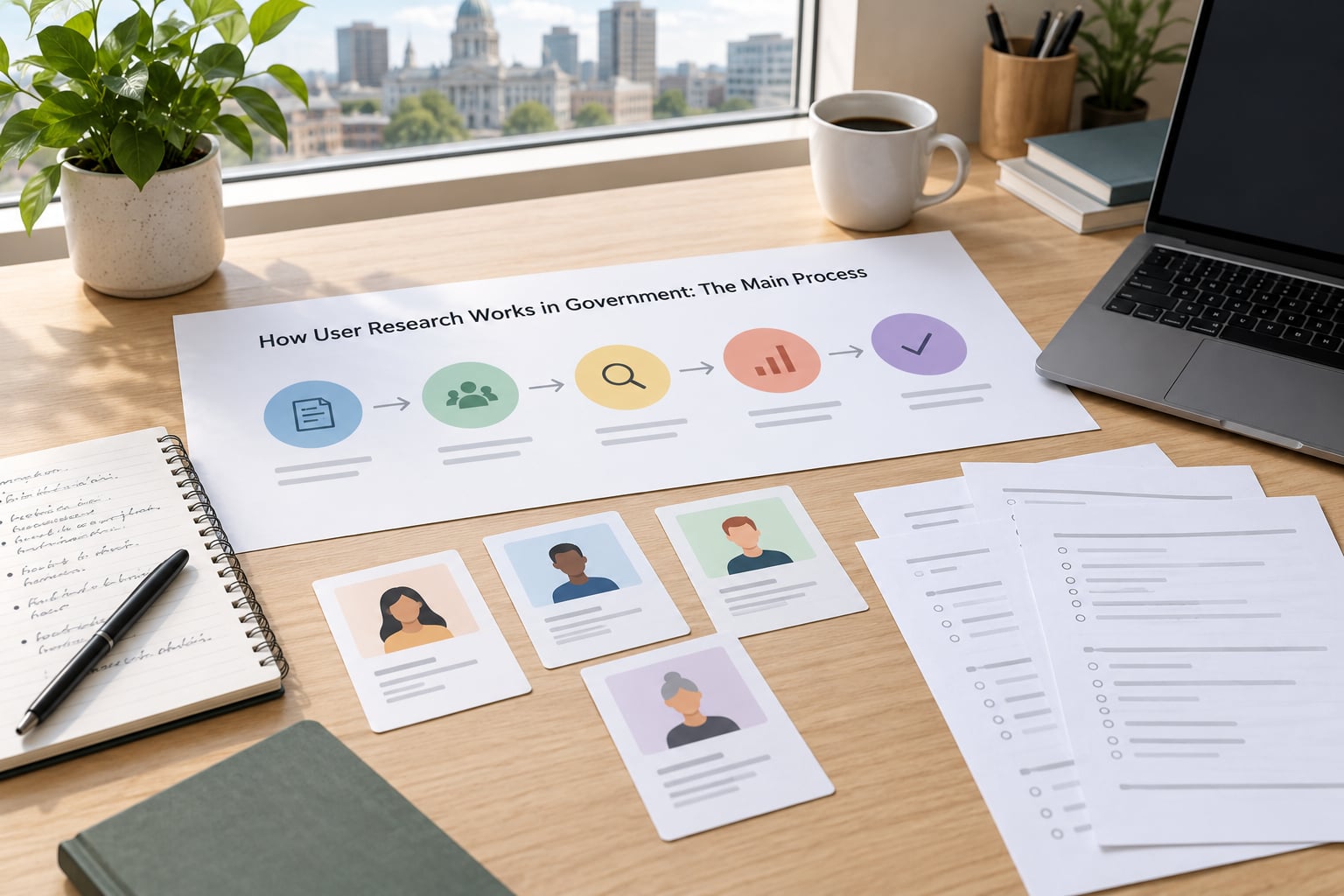
The six stages below apply whether the team is three people in a small authority or a research unit inside a national department. The stage names change, but the logic does not.
| Stage | Question it answers | Common method | Output |
|---|---|---|---|
| Framing | What decision are we trying to make, and who does it affect? | Stakeholder interviews, service data review, journey mapping | A one-page research question with named constraints |
| Recruitment | Who has to be in the study for the answer to be credible? | Sampling plan, community partners, phone and paper routes | A screener and a booked participant list |
| Method choice | What kind of evidence does this decision need? | Interviews, usability testing, surveys, observation | A written research plan with timings and budget |
| Governance | Are we allowed to run this, and how do we protect people? | Data protection review, ethics and safeguarding checks | Approval, consent wording, anonymisation plan |
| Fieldwork | What actually happens when people use the service? | Moderated sessions, remote testing, in-person observation | Recorded sessions, notes, task success data |
| Synthesis and reporting | What will we change, and how will we know? | Thematic analysis, evidence brief, read-back with service teams | A prioritised recommendation with a named owner |
1. Frame the Policy or Service Question
Broad mandates produce vague research. “Improve digital inclusion” cannot be researched, because nobody can say what finding would count as an answer. Good framing converts it into something a team can act on: which residents, facing which barrier, while attempting which task, and what evidence would settle the choice between assisted-digital support and a redesigned self-service route.
At this stage, write down the constraints while they are still cheap to hear: the budget cycle, the policy commitment already made, the procurement rules, the legacy system that cannot change, and the outcome measure the service is judged on. Framing should also name the population the decision affects, not the population the team finds easy to reach.
2. Recruit Participants Who Reflect the Community
Recruitment is where public sector research differs most from commercial work, because the people who most often need a public service are the hardest to reach through an online panel. A recruitment agency screener can find eight smartphone users in a postcode district. It cannot find the residents with no device, no home internet, low confidence or a first language other than English.
Reach them through routes that exist in every community: phone interviews run by contact centre staff, paper surveys offered at libraries with a click-and-collect return, sessions at foodbanks and advice centres, posters in GP surgeries, community groups and faith venues, and lists already held for shielding, benefits or housing support. Welsh authorities working on digital inclusion used exactly this mix, pairing a large survey with interviews run through partners who already trusted locally.
Three practical points matter more than sample size. Pay people for their time where the rules allow, because unpaid sessions with people on low incomes quietly recruit only people with spare hours. Make the session itself accessible, with a phone option, a step-free venue and a British Sign Language interpreter booked in advance. And screen for the specific characteristics that matter to the question rather than a generic demographic form.
3. Choose Methods That Match the Question
Methods get chosen by evidence type. Understanding why people abandon an application is a different problem from checking whether most residents can complete the redesigned one, and each needs a different instrument.
| Method | Best for | Typical output | Watch out for |
|---|---|---|---|
| Depth interviews | Understanding motivations and sensitive experiences | Themes with illustrative accounts | Small samples; not statistically projectable |
| Focus groups | Comparing several perspectives at once | Points of agreement and disagreement | Dominant voices; group conformity |
| Usability testing | Finding blockers in a specific flow or prototype | Task success rates and issue severity | Testing a prototype people cannot yet trust |
| Observation | Seeing assisted-digital journeys in reality | Observed steps and workarounds | Slow and harder to standardise |
| Surveys | Measuring scale and tracking change over time | Segmented percentages | Self-selection and online-only coverage |
| Diary studies | Tracking a process spread over weeks | A chronological account of one journey | Participant drop-off and recall gaps |
Mixed methods are normal in public bodies. A survey establishes how many residents hit a barrier; interviews then explain what that barrier actually feels like. Running one without the other leaves you either with numbers and no causes, or rich stories with no sense of scale.
4. Ask Questions Without Leading the Evidence
Question design decides the quality of everything downstream. A question that names the intended solution, such as “would online appointments be easier for you?”, gets you a polite yes. Asking what someone tried, what happened and what they did next gets you evidence you can act on.
Write questions in plain language at roughly a reading age a fourteen-year-old would follow, test them with a colleague who does not work in the team, and keep the sensitive items separate from the rest. Explain consent before the session rather than inside a dense paragraph of terms, and confirm permission before recording.
Collect only what the study needs. If the decision depends on which step people struggled with, you do not need their address or their medical details. Data minimisation is not paperwork for its own sake: the less personal data a research team holds, the fewer breaches it can suffer and the easier the study is to approve.
5. Analyze Patterns, Not Just Quotes
Three people complaining about the same step is a pattern; one vivid quote is an illustration. Coding transcripts against a framework drawn from the research question keeps analysis tied to the decision rather than to whatever was said most recently.
Group findings by need and by outcome, then compare across participant characteristics carefully, since a small subgroup cannot carry a strong claim. Keep evidence and interpretation in separate columns, and record the cases that contradict your emerging theme. Where two stakeholder groups disagree, document the disagreement rather than averaging it into a sentence that means nothing to either.
6. Report Findings for Public Decisions
A public sector report has to survive two audiences: the people who will act on it and the people who may challenge it later. A useful evidence brief carries the method and recruitment approach, the characteristics of participants, findings ordered by severity and by affected group, an honest limitations section, and recommendations tied to a named owner and a date.
Publish it where the service team, senior leadership and future teams can find it, and keep the raw session notes in an internal repository so a later study can see what has already been asked. That repository is often the single most useful asset a research function owns.
How User Research Works in Government When the Decision Is Already Made
In practice, research questions sometimes arrive as a directive rather than an invitation. Researchers describe this as the difference between setting an agenda and being handed one, and it is the most common source of frustration in public sector research.
The workable response is not refusal. It is negotiation on scope: ask what the team most needs to know, offer to test the decided option so its risks are documented, and use the report to name the assumptions that remain untested. A study that records “we assumed X, and the evidence does not support it” is genuinely useful, even when it does not change the immediate decision.
Common Challenges and How to Handle Them
Public sector research runs into predictable problems. Each has a practical response rather than a slogan.
Political or leadership pressure on findings. Separate the analysis from the recommendation, get the service team to read the evidence before the briefing pack is drafted, and never soften a finding in the version that travels upward. If the recommendation is politically difficult, make the options and their consequences explicit so the decision is taken openly rather than buried in the wording of the report.
Low response rates. Treat response bias as a finding in itself. Compare respondents against the population you expected, publish the gap, and reweight or qualify claims that rest on under-represented groups.
An unrepresentative participant mix. Most often this is a recruitment failure, not a participant failure. Build channels to the groups you missed before you run the next round, and recruit them through organisations they already trust rather than through a single screener.
Confidentiality worries. Residents assume a government researcher is an inspector. Say who you are, who commissioned the work and what will happen to the answers, in that order, at the start of every conversation. Anonymous reporting is a strong incentive to be candid.
Conflicting stakeholder interests. Expect it and design for it. Map who wants what before fieldwork, ask each group the same questions so the comparison is fair, and present the trade-off rather than manufacturing consensus.
Research that is produced and then ignored. This is the failure teams fear most, and it usually has planning causes rather than political ones. Research commissioned after a decision is already made cannot change it. Attach findings to an owner and a roadmap slot at the moment the plan is written, and put the research report into the same review cycle as design and delivery updates, so it is read as part of the work rather than as an aside.
How to Measure Whether Government Research Helped
Traceability is what separates public sector research from a one-off study that ends in a PDF. At the recommendation stage, note what should change, what service measure would move if it did, and when you will look. Completion rate for an online application, average wait time for a call-back, assisted-digital contacts per thousand residents, the share of journeys completed on a mobile device, and satisfaction gaps between demographic groups are all workable measures.
Set a baseline before the change, not after. If a service already handled 40,000 transactions a year, a revised form should be judged against that volume, its completion rate and the error rate on returned applications.
Then guard against the wrong conclusion. User research tells you whether a service works for the people who used it, and it is not a popularity vote. A form that becomes faster and easier for most residents while excluding a small group with low digital confidence may be a net loss, which is why equity measures belong next to volume measures. Equally, a service some people dislike can still be the right choice when the alternative is longer queues and higher cost. Say that out loud in the report.
Frequently Asked Questions
Who do government researchers speak with?
Usually three groups: people who use the service, people who are eligible but do not use it, and the staff who support both. The third group is often skipped and frequently explains why a service fails in practice. Experienced teams also include voluntary and community organisations that already work with the residents a service struggles to reach.
How is user research in government different from a public survey?
A public survey measures opinion across a sample, often for accountability or performance reporting. User research investigates needs, behaviours and barriers so that a specific service, process or policy can change. A survey can show that 33% of residents report low confidence online; interviews are usually what reveal that the confidence gap is created by one broken login step.
Does a government department need approval before running user research?
Usually yes, and often in more than one form. Large digital projects typically require governance sign-off under frameworks such as the Digital Outcomes and Specialists framework, plus a data protection impact assessment before any personal data is collected. Ethics, safeguarding and accessibility reviews add time, but they are usually faster than the rework that follows skipping them.
How do teams protect participants’ privacy?
By collecting the minimum personal data needed, recording sessions only with explicit permission, anonymising notes so no participant can be identified, and reporting findings in aggregate rather than in quotation. Under UK and EU data protection rules the Information Commissioner’s Office expects a lawful basis, a documented assessment and clear consent wording before fieldwork starts.
What happens to findings after a study ends?
Ideally they move into a named recommendation, a roadmap slot and a service measure with an owner and a review date. The best teams also deposit the report and session notes in an internal research repository so future teams can reuse them. Plenty of public sector research is read once and lost, which is the main reason teams end up studying the same question twice.
Do you need a UX research degree to work in government research?
No. Public sector researchers often arrive from sociology, economics, political science, psychology or human factors. What matters is the core skill set: writing a study proposal, choosing methods, collecting and analysing data, and communicating findings to non-researcher stakeholders. Design and technology experience helps, and transferable research experience counts more than job titles.
Conclusion
Government user research follows a repeatable shape: frame one specific decision, recruit the people who actually live with the service, pick methods that match the evidence you need, ask neutral questions, analyse for patterns, and report into a decision with a named owner. The mechanics are learnable in a fortnight. The judgement about who to talk to, and what to do when the decision is already made, is what takes years.
Start small. Pick one service decision due this quarter, name the residents it affects, and choose a single method that would genuinely change your mind.