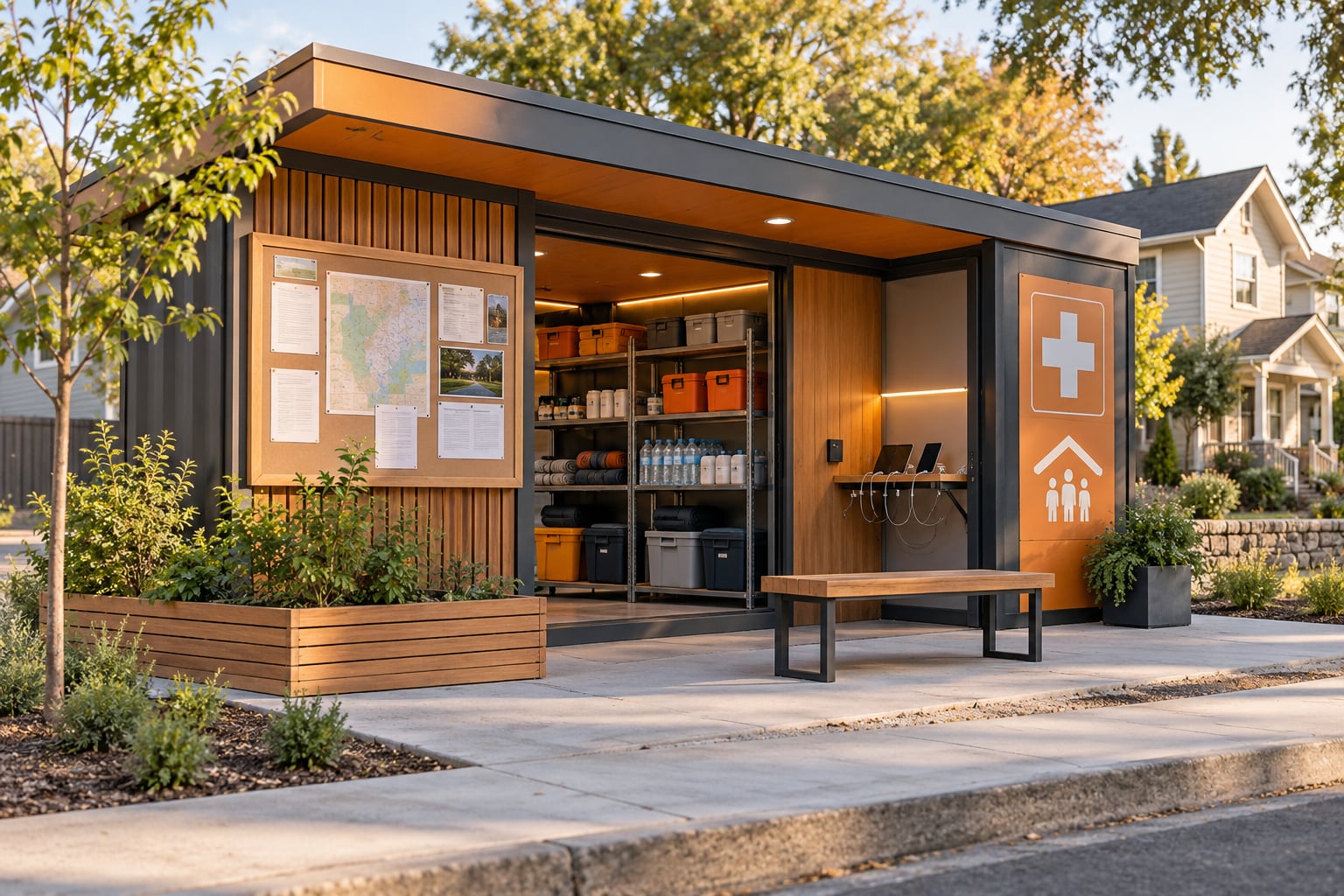
A resilience hub is a community facility that stays open year-round and switches into emergency mode during a disruption, giving neighbors a powered, cooled, connected place to charge a phone, get trusted information, and organize mutual aid. That is the short answer to how resilience hubs serve neighborhoods during emergencies: they fill the gap between a power cut and the arrival of outside help.
Most people notice the gap on the third night without power. A public health or relief agency is good at the big picture, but it is rarely at your door the same evening. Meanwhile a household is dealing with a dead refrigerator, a water pump that will not run, a phone down to single digits, and a CPAP machine that needs power every night.
A hub moves that waiting time down to minutes, because someone nearby already has the equipment, the relationships and the floor space.
What follows is a plain walkthrough of the model: what a hub is, what it does before, during and after a disruption, who runs it, and what goes wrong often enough to plan around.
Table of Contents
- How resilience hubs serve neighborhoods during emergencies: the full model
- What is a resilience hub?
- How do resilience hubs work across the emergency timeline?
- What happens before an emergency?
- What happens when an emergency begins?
- What happens during recovery?
- Which neighborhood needs can a resilience hub address?
- Who should operate and connect with a resilience hub?
- How can residents find and use a local resilience hub?
- What makes a resilience hub effective and inclusive?
- What are the main limits and common mistakes?
- How can communities build a resilience hub from scratch?
- Frequently Asked Questions
- Are resilience hubs the same as emergency operations centers?
- When does a neighborhood resilience hub activate during an emergency?
- What services can residents get from a resilience hub?
- How can someone volunteer at a local resilience hub?
- How do residents receive accurate information when normal communication systems fail?
- Conclusion: Start with a Trusted Local Network
How resilience hubs serve neighborhoods during emergencies: the full model
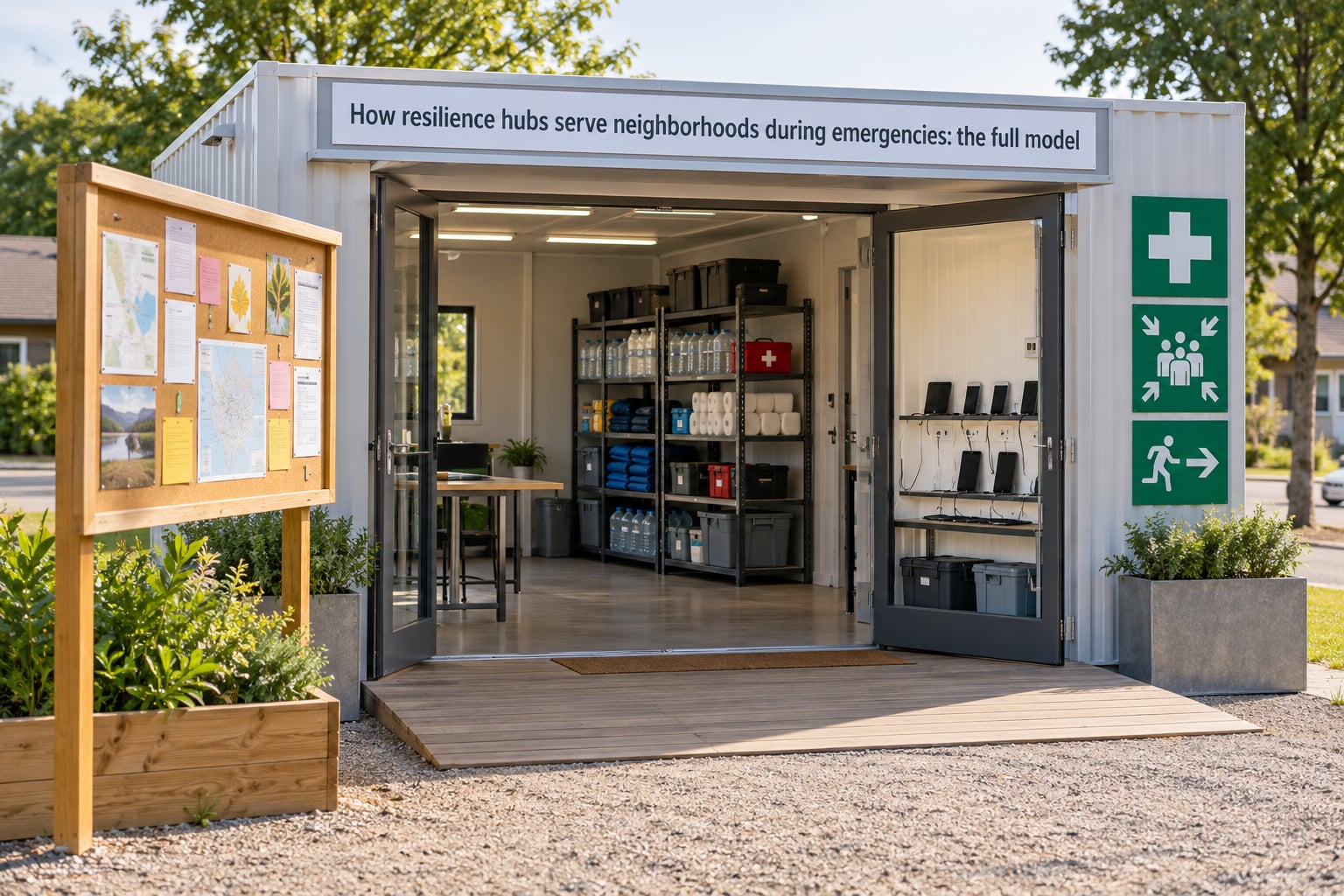
The model has three phases, and every good hub works on all three long before anyone needs it.
- Before: preparedness training, supply reserves, backup power, a mapped list of residents who need help, volunteer drills, and ordinary programming that keeps people connected.
- During: the hub opens as a powered, cooled, connected gathering place where residents charge devices, get information in their language, and coordinate help with each other.
- After: recovery support, referrals, replacement supplies, and an honest write-up of what failed so the next event is easier.
Who it serves matters as much as what it does. Rural and unincorporated communities with long repair times, aging residents, flood-prone and wildfire-prone blocks, low-income neighborhoods with older housing stock, coastal towns rebuilding after a hurricane, and anyone who depends on powered medical equipment all show up in the same queue.
A hub that only thinks about the emergency itself tends to be useless by the third event. The year-round version is the one that works, and that is the point most explanations of this model skip past.
What is a resilience hub?
A resilience hub is a trusted physical place, sometimes paired with a digital channel, that links residents, local organizations, public agencies and emergency information. It usually lives inside a building people already use: a library, a recreation center, a faith building, a nonprofit center, a tribal or rural-serving agency.
Advocacy and planning groups describe the same idea with four words, usually called the four R’s of resilience. Robustness means the building and its systems hold up under stress. Redundancy means there is a backup for the backup. Resourcefulness means people on the ground can improvise. Rapidity means help arrives before the second night, not the second week.
Two microgrid terms come up constantly. Solar-plus-storage is a rooftop or ground array paired with batteries, so the site can run on its own when the grid drops. Grid islanding is the switch that separates the site from the utility line and keeps it running locally. Many smaller hubs skip all that hardware and start with generators, phone chargers, a refrigerator and a folding table.
It helps to be clear about what a hub is not. A shelter exists to put people up for the night. A cooling center opens when the temperature crosses a threshold and offers air conditioning. A food bank distributes food on a fixed schedule. A hub overlaps with all three, but its defining feature is continuity: it runs when nothing is happening, so people know it exists and trust it before the crisis.
Ki Baja, an organizer with the Resilience Hub Collaborative, frames it bluntly: ninety-nine point nine percent of the time it is not a disaster the hub is responding to. That daily presence is what buys the response speed later.
How do resilience hubs work across the emergency timeline?
What happens before an emergency?
Prep work is the least photogenic part of the model and the part that decides everything. Before a storm, a hub maps which residents live alone, which need powered medical equipment, and which need transport, then keeps that list current and confidential.
Volunteers run through the same drill as first responders: who opens the building, where the keys live, who posts the notice, what gets said if official channels are down. Supplies get inventoried, batteries get tested, generators get fueled, and the communications plan gets rehearsed with the people who will actually use it.
Small hubs also learn their neighbors. Leo’s Community Development Center in Superior, Arizona keeps an always-open clothing rack and food stand, serves free community meals on Wednesdays, and runs monthly preparedness workshops. People show up long before they need anything, which is the whole strategy in one sentence.
| Hub component | What it delivers during an outage | Typical example |
|---|---|---|
| Backup power | Lights, refrigeration and outlets for essential medical equipment | Solar-plus-storage microgrid with a grid islanding switch, or a fueled generator for smaller sites |
| Climate-controlled space | Heat relief during extreme cold, cooling and filtered air during heat and wildfire smoke | An existing library or community room with a heat pump and air filtration |
| Communications and connectivity | Working phones, internet access, and a way to receive official guidance | Fiber service with a cellular or satellite failover, plus printed notices on a board outside |
| Water and food storage | Drinking water, well pumping, and cold storage for perishables | Tank storage, a generator-powered pump, and a shared refrigerator with a thermometer log |
| People | The actual service: coordination, translation, driving, and company | A named volunteer coordinator, a shift roster, and a mutual aid group on standby |
What happens when an emergency begins?
Hubs verify what is actually happening before they announce anything, then repeat official guidance in plain language and in the languages people in the block actually speak. Volunteers collect reports from the neighborhood: which streets are flooded, whose power is back, who needs a ride to dialysis.
Meanwhile the site does the ordinary things that become impossible elsewhere. Phones charge. Water gets pumped and stored. A refrigerator keeps food cold. Someone with a medical device gets a safe outlet. A whiteboard at the door lists who is driving where.
Mutual aid, the neighbor-to-neighbor help that runs alongside official response, is coordinated rather than improvised. That is a real difference. A hub with a volunteer coordinator moves a pallet of water; a group of good-intentioned strangers tends to duplicate each other three streets over.
After Hurricane Helene, grid electricity was down in Barnardsville, North Carolina, and fuel generators were of limited use because gas pumps were out and roads were impassable. The Footprint Project delivered a solar trailer the next day, and the operation became its largest North Carolina response to date, supporting more than seventy sites.
What happens during recovery?
The weeks after the event get less attention than the first night, and that is exactly when a hub earns its keep. Doors reopen for charging and cooling long after the sirens stop. Residents who lost documents get help finding the forms they need. People get referrals to health services, shelters, transport and rebuilding programs.
Hubs also document unmet needs. Which block never got a message. Which group of residents had no way to reach the hub. Which load kept failing. Those notes go into the next grant application and the next drill, which is how a hub improves instead of repeating itself.
And the social work continues. Disruption lands harder on people who already had less, so the recovery phase is when a hub decides whether it served the block or only the people who were already comfortable asking.
Which neighborhood needs can a resilience hub address?
Most hubs end up covering roughly a dozen things at once, and the specific list depends on what the neighborhood actually lacks.
- Power for essential medical equipment such as CPAP machines, oxygen concentrators and powered wheelchairs.
- Water — pumping, filtration and storage, since a dry well is a common first casualty.
- Heating and cooling in a safe, filtered space during extreme heat, wildfire smoke or cold.
- Charging and connectivity for phones, radios and laptops, with a satellite or cellular failover when the fiber line is down.
- Food and cold storage for both preservation and distribution, including community meals.
- Trusted information — official guidance relayed in plain language, plus rumor control.
- Translation and accessibility, including sign language, large print and audio formats.
- Transport coordination for residents with no vehicle or no way to reach services.
- Tool and equipment lending — chainsaws, pumps, wheelbarrows, extension cords.
- Referrals to health, housing and benefits services, including help completing applications.
A rural broadband gap can hollow out several of these. Power without connectivity still leaves a resident unable to file for aid, so a hub that wants to be useful during a long outage treats internet access as part of the service, not a bonus.
Who should operate and connect with a resilience hub?
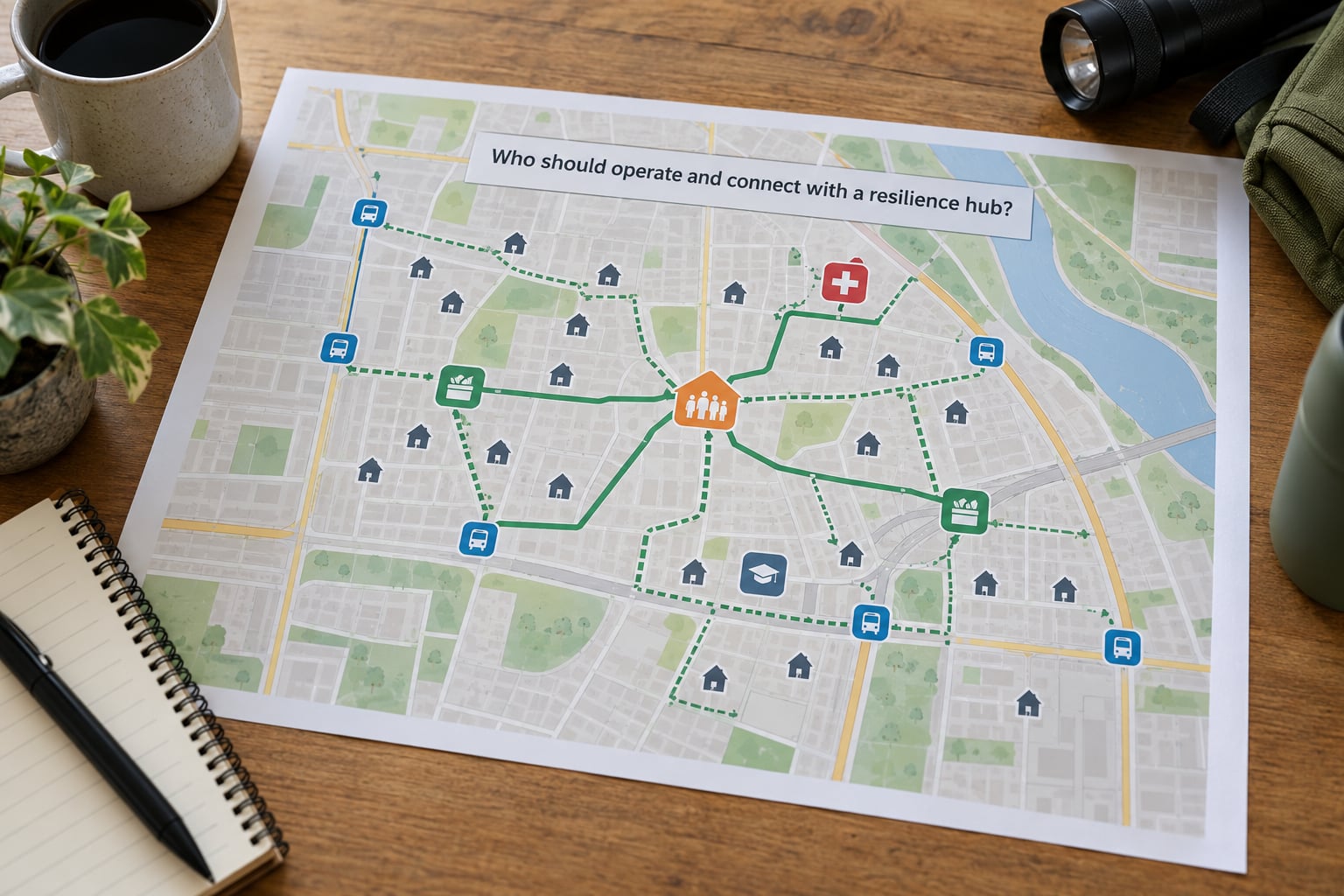
The operator is usually a nonprofit, a faith-based group, a library system, a tribal or rural-serving agency, or a small municipality, and the operating model varies more than people expect. Leo’s is run by a development center, Community Lighthouses in New Orleans works from churches, and SPACE in Pahoa, Hawaii grew out of a performing arts center that pivoted after volcanic vog damage and the pandemic into a school, fiber broadband and microfarming operation.
Around that operator sits a network: municipal departments, fire and EMS, public health, schools, food banks, mutual aid groups, clinics, small businesses that donate equipment, and resident leaders who hold the local knowledge no plan can write down.
Two structural choices matter. First, a written agreement that says who decides to open the hub, who owns the data, and who is accountable when something goes wrong. Second, resident control. Communities have been burned by decisions made elsewhere and then announced afterward, and they consistently ask to be consulted at the design stage rather than informed at the end.
In Dungannon, Virginia, Appalachian Voices hosted a series of community meetings before the group chose an old train depot as its home, rather than taking an assigned building and building goodwill afterward.
Two models dominate in practice, and they differ more in constraint than in mission.
| Urban library or civic-center hub | Rural or small-town microgrid hub | |
|---|---|---|
| Typical home | An existing public building already open to the public | A repurposed depot, annex, or community-owned building |
| Power approach | Utility-scale backup for communications and a handful of outlets | Solar-plus-storage sized to carry communications, refrigeration and water pumping |
| Main services | Charging, internet, cooling or heating, benefits help, tool lending | Power for medical equipment, water, cold storage, food distribution |
| Funding route | Municipal budget, public-private utility partnerships | State energy office microgrid grants, philanthropy, federal programs |
| Biggest constraint | Hours, staffing and keeping a shared building usable for its normal purpose | Distance from repair crews, long outages, and thin broadband |
How can residents find and use a local resilience hub?
Start with the obvious places: your library, your city or county office, your school district, your local nonprofit directory, and your utility’s outage page. Many hubs now list themselves on municipal emergency pages and in neighborhood messaging apps, so a search for your city name plus resilience hub usually gets you there.
Then find out the activation status, not just the address. A year-round building is not a 24-hour emergency service. Ask who holds the keys after hours, what the backup power covers, how long it runs, and whether there is a phone number that is answered by a person.
Know how to give and how to receive. Most hubs keep a list of residents who need help reaching a regular check-in, and most run short volunteer shifts that need far less commitment than people assume — a few hours, a specific task, a named backup plan.
And plan the fallback. If cell service is down, agree in advance with a neighbor on one phone tree, one group message and one physical meeting point. Hubs that drill this get through the first night far better than hubs that assume the alert system will work.
What makes a resilience hub effective and inclusive?
Trust is the first requirement, and it is built slowly. Baja points to connectivity and social cohesion as the strongest indicator of successful recovery, which is a plain way of saying that neighbors talk to each other before the emergency and keep talking during it.
After trust comes access. A hub on a single bus line, up a flight of stairs, or open only during business hours excludes a lot of people by accident. Accessible entry, nearby parking or a drop-off point, and hours that match shift workers all matter more than the size of the building.
Communication is where most hubs fail. Guidance in one language only, or posted only online, or read aloud without a printed copy for people who cannot see a screen, all leave someone out. Clear governance closes the loop: who decides, who holds the resident list, how long personal data is kept, and who to complain to.
What are the main limits and common mistakes?
Nobody publishes failure modes as readily as success stories, so it is worth reading the pattern.
- Duplicated effort. Two organizations start a hub in the same block with the same mission and half the volunteers. A partner map drawn before anyone buys anything prevents most of it.
- Unclear leadership. When the decision to open belongs to a committee that meets monthly, the building sits closed. One named person with one phone number solves it.
- Stale contact lists. The list of vulnerable residents is out of date by the second year unless someone is paid or formally responsible for updating it.
- Inaccessible communication. Online-only notices during an outage are a contradiction. Every channel needs a low-tech twin.
- Unchecked rumors. A hub that repeats an unverified claim loses credibility it may not get back. Say what is known, what is not, and when the next update is coming.
- Volunteer burnout. Year-round programming plus emergency duty burns out small teams. Shift limits, backup people and real handoffs are not optional.
- Funding cliffs. Hubs built on a one-time grant keep the equipment and lose the staffing. A recurring budget line, a utility partnership or a small annual fundraiser is what keeps a hub alive.
- Sitings and safety fights. Battery installations near homes raise real questions, and residents deserve site plans, safety documentation and a chance to ask them. Solar and diesel also spark genuine technical debate; a hub that shares its numbers gets further than one that argues from principle.
How can communities build a resilience hub from scratch?
The process is less mysterious than it sounds, and the order matters more than the budget.
- Run a needs assessment. A few listening sessions and a walk of the block. Ask what failed last time, who could not get help, and where people go already. Residents should be consulted before the design, not told after it.
- Map your partners and assets. Who has generators, refrigerated trucks, a kitchen, a building, a truck, translators, a nurse. Write it down and confirm it once a year.
- Choose a site people already use. Existing buildings avoid construction costs entirely and already have foot traffic, which is how year-round programming stays alive.
- Write an operating protocol. Who opens, who decides, who speaks for the hub, where information comes from, how supplies are distributed, and what happens when the site loses power itself.
- Build the technology plan. Decide what must stay running: communications first, then cold storage, then water, then medical-device outlets. Size solar and storage against that list rather than against a brochure, and test the failover connection.
- Recruit and drill. A named volunteer roster, a short training session, and one drill a year that includes handing out real supplies at real volume.
- Start the year-round programming. Workshops, meals, tool lending, repairs, benefits help. If the hub is only visible when something is burning, nobody will trust it when something is burning.
- Fund the recurring part. State energy office microgrid grants, utility partnerships, philanthropy and federal programs all appear in the mix; a hub that wants to exist in year five needs a repeating revenue source, not a single award.
Practical aids exist. Shareable published a step-by-step guide to turning a community space into a resilience hub, and regional networks such as the Pinal-Gila Resilience Hub Network in Arizona show the value of banding together — three small hubs working together attracted development grants that a single town of about three thousand residents could not pull on its own.
Frequently Asked Questions
Are resilience hubs the same as emergency operations centers?
No. An emergency operations center is a staffed municipal or county coordination facility for officials, agencies and large-scale response planning. A resilience hub is a neighborhood-scale facility that residents actually visit, usually in an existing library, faith building or nonprofit center, to charge devices, get information, cool down, and organize mutual aid. A hub supports the emergency operations center; it does not replace it.
When does a neighborhood resilience hub activate during an emergency?
Activation is a local decision, usually made by a named person or a small team on a written protocol rather than by committee. Many hubs open early and stay open, since a building that is already running is cheaper and calmer than one being opened at two in the morning. Ask your hub in advance who decides, what triggers opening, and how you will hear about it.
What services can residents get from a resilience hub?
Common services include charging and internet access, heating or cooling with clean air, water pumping and storage, food distribution and cold storage, power for essential medical equipment such as CPAP machines, tool and equipment lending, translation, transport coordination, and referrals to health, housing and benefits services. Which ones operate depends on the neighborhood, the equipment on site, and who volunteers.
How can someone volunteer at a local resilience hub?
Start by contacting the operating organization and asking for a specific, limited task rather than an open offer. Hubs usually need phone-tree callers, supply runners, translators, drivers, meal cooks, people who monitor a charging table, and people willing to do the boring work of updating the resident contact list. Ask about shift limits and backup coverage so the team does not burn out in the first event.
How do residents receive accurate information when normal communication systems fail?
Hubs relay official guidance in plain language and in the languages spoken in the block, and they say what is not yet known rather than guessing. When cell service fails, the fallback plan is agreed in advance: a phone tree, a group message, printed notices on a board outside, and a physical meeting point. A rumor-check role is assigned so unverified claims do not spread from the building.
Conclusion: Start with a Trusted Local Network
The whole model reduces to one habit: being useful before you are needed. A hub that maps trusted partners, lists the urgent needs of its block, agrees on accessible communication channels, and assigns clear responsibilities will do more on the third night than any amount of hardware bolted on afterward.
Start with a conversation. Bring the neighbors, the library, the clinic and the fire district into one room, and write down what your block cannot do alone.
Last reviewed for accuracy in 2026.