If you only get five minutes to pitch an app idea, you are not presenting a product, you are buying a conversation. The room decides in the first thirty seconds whether the rest is worth hearing, so every block of the pitch gets fixed seconds: about a minute on the problem, a minute on the solution, a minute on proof, a minute on why you can build it, and under a minute on the ask. Write it out, time it with a stopwatch, and cut whatever runs long.
I have watched a lot of founders fill those five minutes and still leave without a next step. It is rarely a bad idea underneath. It is a pitch that described the tech stack instead of the outcome, or spent four minutes on the market and thirty seconds on what they actually wanted.
Table of Contents
- What You Need
- How to Pitch an App Idea in Five Minutes: Step by Step
- How to pitch an app idea in five minutes: frame the problem
- Show the smallest useful solution
- Prove the idea is worth trying
- Explain why this app can work
- Make one clear ask
- A Five-Minute Civic App Pitch Example
- Common Mistakes
- Frequently Asked Questions
- How do I effectively pitch my app idea?
- How do I pitch an app idea if I have no prototype yet?
- What should I not tell investors in the first 60 seconds?
- How would you pitch an idea in less than two minutes?
- What are the tips for a strong pitch at a hackathon?
- Can ChatGPT create a pitch deck?
What You Need
Five ingredients. If any one is missing, the pitch collapses in the middle and you end up rambling to fill the gap.
1. One user problem, stated in a sentence a stranger can repeat back to you.
2. A focused solution, described by the outcome it produces rather than the technology behind it.
3. Evidence that the problem matters, even if it is 20 conversations and a spreadsheet of notes.
4. A credible advantage, the reason you are the one building this.
5. A specific next-step request, named out loud, with no vague trailing offer.
Before you speak, do five small things. Write the problem sentence and time it, it should land under fifteen seconds. Type the one number you most want them to remember and put it on a card. Cut your deck to six slides, because you will not get through more in five minutes anyway. Decide who is in the room, since an angel, a venture fund, a hackathon judge and a city buyer all weigh the same pitch differently. And send the deck as a plain file link, never behind a login, because on the day a portal login is one more thing to fail.
How to Pitch an App Idea in Five Minutes: Step by Step
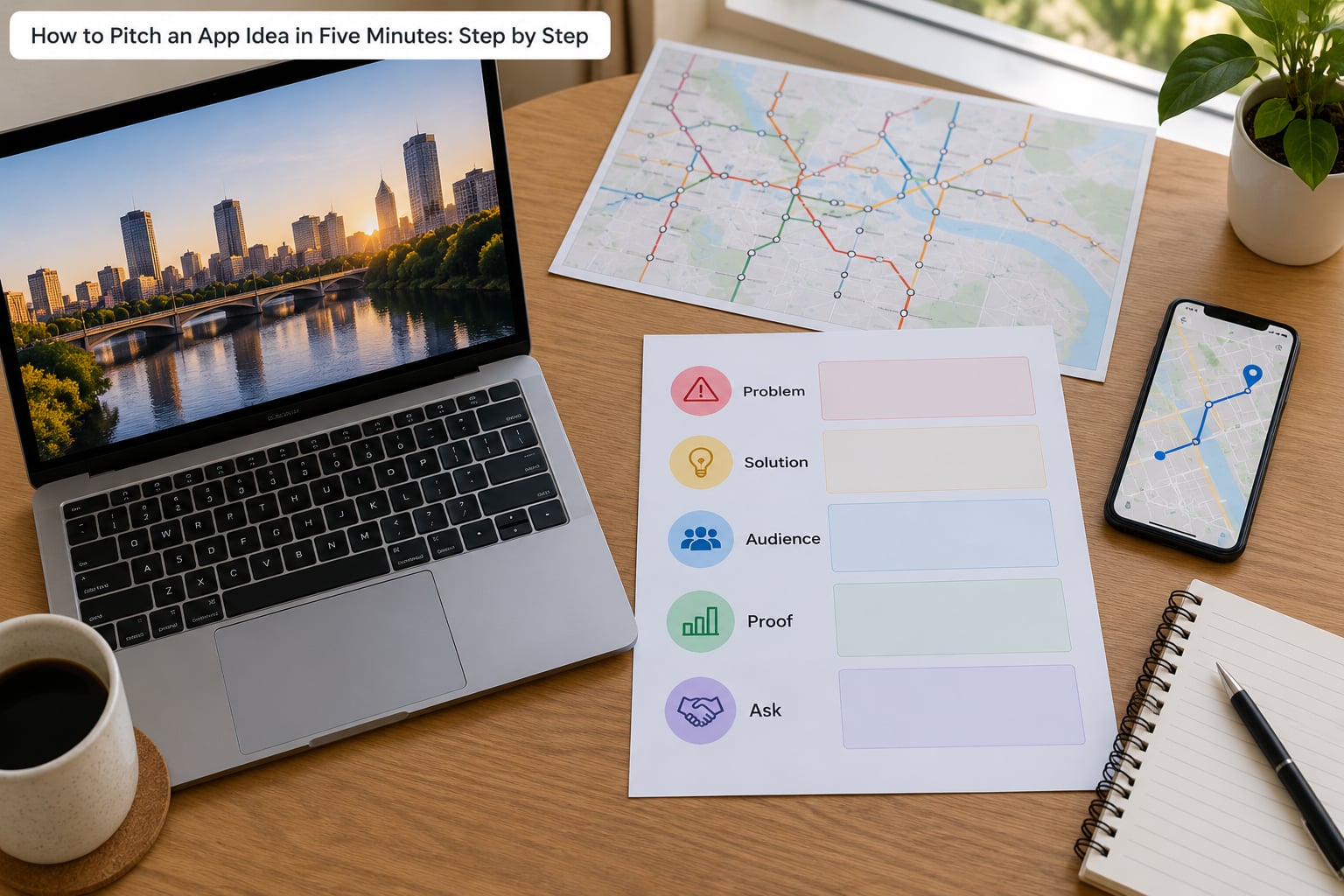
Here is the timing budget that makes the difference. No competitor-style list tells you when to say each thing, so here it is with the clock on every block.
| Clock | Block | Purpose | Number to say out loud |
|---|---|---|---|
| 0:00-1:00 | Problem and who has it | Earn attention, name the user | How many people hit it, and how often |
| 1:00-2:00 | The smallest useful solution | Show the outcome, not the feature list | The step it removes for the user |
| 2:00-3:00 | Proof it is worth trying | Prove demand exists | Users, pilots, waitlist or partner count |
| 3:00-4:15 | Why this can work | Market, model, your advantage | The size of the reachable slice |
| 4:15-4:45 | One clear ask | Ask for a specific thing | Amount, use of funds, next milestone |
| 4:45-5:00 | Buffer | Absorb nerves, questions, silence | Nothing |
How to pitch an app idea in five minutes: frame the problem
Open on one specific person having one bad day. Not “cities waste resources”, but “a rider with a broken leg waits eleven minutes at an elevator because the elevator outage alert never reached her phone.” Specificity is what makes a listener lean in, and vagueness is what makes them start checking email.
Then name who has this problem and how many of them exist. Quantify it, localize it, or both. A pitch for a smart city app sounds very different depending on whether you are talking about one transit authority’s elevator fleet or every accessible stop in a region, so pick one and stay there for the full minute.
Show the smallest useful solution
Describe the app in one sentence by connecting its main feature to that problem. If your app sends accessible transit outage alerts, the sentence is about the user getting a warning before they reach a platform, not about your notification pipeline or your API layer.
One outcome, not twelve. The format that holds up in short pitch exercises is “we help a specific user achieve a specific outcome by a specific mechanism”, and the rule is no jargon and no filler. The mechanism matters, but it goes last in the sentence.
Say why this beats the current workaround. Most people already handle the problem somehow: a group chat, a phone call to the transit desk, a screenshot of a status page. Your pitch has to acknowledge that workaround exists and explain what changes for the user after your app.
Prove the idea is worth trying
Proof does not have to be revenue. In rough order of credibility: a working demo, a signed pilot with a named organization, real usage from actual users, a waitlist with real names, letters of intent, then user interviews with a pattern in them. Skip straight to the demo if you have one, because nothing else substitutes for showing the thing.
Be honest about what you have not tested. Founders lose rooms by pretending a forecast is traction, and the honest version sounds stronger: we have run eleven interviews, six of them had the same workaround, and here is the screen we built in a weekend. Say what remains uncertain too. It reads as competence, not weakness.
Explain why this app can work
This is where the market, the model and your advantage go, in that order of importance, and you have about 75 seconds for all three. Keep the market numbers to one sentence and one figure, a reachable slice rather than a top-down total that nobody believes.
Tie the advantage back to the problem. Access to open data, a background running the same system, a community group that has been testing weekly, a partnership conversation already in progress, a technical capability the incumbent does not have. A claim only counts if it points at something real you can name.
If you are building for a city, a transit agency or a public health office, the buyer is different from a consumer app. The pitch to a municipal team centers on integration with their systems, procurement reality and what a pilot looks like, and grants can matter more than outside capital in the first year.
Make one clear ask
End with a sentence that names what you want: a 30-minute follow-up, an introduction to one person, a pilot with one neighborhood, or a specific amount and what it buys. “We would love to keep in touch” is not an ask, it is an exit.
Attach a milestone to the money. Funds to reach 200 pilot users in two neighborhoods, or six months of runway to ship the iOS app. Then close cleanly, something like “that is the whole idea, I would like to hear where you think it breaks.” It hands the room back to them and stops you rambling into the buffer.
A Five-Minute Civic App Pitch Example
Here is the same structure assembled for an accessible transit app, roughly 320 words spoken at a natural pace. The stage directions mark where each move happens.
[0:00-1:00] “Last month a rider in our pilot neighborhood missed a follow-up appointment because the elevator at her station was out for three hours and nobody told her. She found out from a stranger. There are 41 elevators in that station alone, and the transit authority’s outage notices go to a mailing list, not to phones. In our neighborhood, roughly 900 people use those stations daily, and about a fifth of them have told us they plan around a different route because they cannot rely on the information.”
[1:00-2:00] “The app is one screen. You pick the stations you use, and when an elevator goes down you get a push alert before you leave home, with the elevator number, which entrance it is at, and the nearest working one. People who cannot use stairs can also tap once to request a ride-hail pickup at the working entrance. That is the whole product. Today, if you want this, you follow the transit account on social media and read a thread that is sometimes forty minutes old.”
[2:00-3:00] “We have a working demo on both platforms, and we ran it for two weeks with 63 riders in that neighborhood. They opened the app an average of 4 times a week. Eleven of them changed a planned trip because of an alert, and nine told us they would not have known otherwise. We also have a written letter of intent from the neighborhood disability council, and the transit authority’s accessibility office has agreed to a data-sharing call next week.”
[3:00-4:15] “The advantage is that we have already mapped every elevator asset in three stations and built the alert logic around real outage data, and that mapping is a couple of weeks of work for anyone starting cold. The reachable slice is 41 elevators today, roughly 600 across the city, and about 180,000 riders a day pass through stations with lifts. We charge the transit authority an annual license per station; the rider side is free. The council has asked us to present at their public meeting in the spring.”
[4:15-4:45] “What I want is a pilot with one more station and a named contact in the authority’s accessibility office. If that goes well, the spring meeting pays for the build. I am asking for two named introductions, not money today.”
That script runs about five minutes and 20 seconds at a calm pace, so trim the market sentence if you speak quickly. Every claim in it is a number a listener could ask you to back up, which is exactly the point.
Common Mistakes
Starting with the technology. “We built it in Flutter with a serverless backend” means nothing to a city buyer or an angel. Lead with the person and the bad day, and let them ask about the stack.
Listing features instead of outcomes. Nine features in 60 seconds is a brochure, not a pitch. Cut to the one screen that changes the user’s day.
Hiding from the evidence because you fear the numbers. Say what you have and what you do not. A named pilot partner beats a projection chart every time.
Ignoring privacy and accessibility when the app touches real people. If you handle location or health-adjacent data, be ready to say what you store and for how long. If your users include people with disabilities, design and test for them, and say so, because in public-sector work it is often a requirement rather than a nice extra.
Ending without a request. The last fifteen seconds are the ones that produce a follow-up, and they get wasted more often than any other block.
For practice, record yourself three times. The first recording is almost always two or three times too long, and cutting it down is a mechanical job once you can hear where the filler sits. Mark the script with your clock times, run it standing up, and rehearse the ask out loud on its own until it is boring to you. If you are pitching over video, test screen share with the real file, keep the deck offline as a backup, and turn your camera on.
Frequently Asked Questions
How do I effectively pitch my app idea?
Lead with one specific user problem in about fifteen seconds, name who has it and how many, then spend a minute each on the smallest useful solution and the evidence that anyone wants it. Close with your advantage and one specific ask. Write every block with its own time limit, because an unpitched idea expands to fill whatever space you give it.
How do I pitch an app idea if I have no prototype yet?
Show the smallest thing you can actually make, and be honest that it is rough. A clickable prototype, a two-minute screen recording, or a wireframe on paper counts. Better, bring evidence you talked to users: how many interviews, what the shared pain was, whether anyone would pilot. A pattern in ten conversations persuades more than any mockup.
What should I not tell investors in the first 60 seconds?
Do not open with your tech stack, your funding history, or a long market story. Skip the introduction of your team, the origin of the idea, and any version of we think it might be disruptive. Also cut hedging words like maybe, kind of and potentially, which read as uncertainty. Start with a person and a specific problem instead.
How would you pitch an idea in less than two minutes?
Use the same five blocks at a quarter of the size: 20 seconds on the problem, 25 on the solution, 25 on proof, 20 on why you can build it, and 10 on the ask. Nothing gets removed except detail, and the order never changes. Practise it until the problem sentence comes out identical every time, because that sentence is what gets repeated in the room after you leave.
What are the tips for a strong pitch at a hackathon?
Judges score what they can see, so demo early and keep it under two minutes of a three-minute slot. Name the problem before anyone touches the app, explain the technology in one sentence, then show the working build. Slides should be minimal since the judges already read the project description. Say clearly who the target user is, and finish with the ask and your next step in the remaining seconds.
Can ChatGPT create a pitch deck?
It can give you a first draft of a structure, a rewrite of your problem sentence, and a list of questions to expect, which saves an hour of blank-page work. It cannot know your numbers, your user interviews or your market, and generic slides read as generic. Use it to prepare and to rehearse, then write the actual script and the numbers yourself in plain language.
Start with one job tonight: write the problem sentence, say it out loud, and time it. If it takes more than fifteen seconds or a stranger could not repeat it back, fix the sentence before you touch the deck, because everything else in a five minute app pitch hangs off that one line.