
Most hackathon projects never launch because the event rewards a working demo, not a usable product. Once the weekend ends, the borrowed time, borrowed tools and borrowed data disappear, and nobody has been given the job of continuing. A prototype proves a team can build something in 36 hours. A launch needs an owner, authorised data, a support plan and a route to real users, and a weekend supplies none of those.
Table of Contents
- Why Most Hackathon Projects Never Launch
- Why Most Hackathon Projects Never Launch: The Common Pattern
- What Happens After Demo Day?
- The post-event cliff
- Which Failure Patterns Stop Hackathon Projects?
- How Do You Know a Prototype Is Not Launch-Ready?
- What Does Launch-Ready Actually Mean?
- How Can Hackathon Teams Avoid a Dead Demo?
- Before the event
- During the event
- Immediately after
- What Should Happen in the First 90 Days After a Hackathon?
- Who Must Own the Project After the Event?
- Frequently Asked Questions
- Is a working hackathon prototype the same as a launchable app?
- What percentage of hackathon projects become real products?
- How can participants find funding after winning a hackathon?
- Can a civic app launch if city data is not yet available?
- How can hackathon organisers improve project completion rates?
- Conclusion: Start Planning the Launch Before the Hackathon
Why Most Hackathon Projects Never Launch

Attrition after a hackathon is the expected outcome, not an exception. The event compresses discovery, design, build, testing and deployment into a couple of days, then rewards a pitch instead of a shipped service. The gap between a winning demo and a live product is measured in months, not hours.
The table below maps the six failure patterns that do most of the damage to one diagnostic question each. Run it against your own project and the answers tell you whether you have a real launch or a weekend that ended.
| Failure pattern | Diagnostic question |
|---|---|
| No validated problem | Can you name five real users who have agreed to use this, and what they do today instead? |
| Demo appeal mistaken for value | Does the project still make sense with the slides, the stage and the confetti removed? |
| Adoption assumed, not planned | Through which specific channel will the first fifty real users hear about it? |
| Data or permissions unavailable | Do you have written access to the data, and does it carry personal information? |
| No operating owner or budget | Who signs off on hosting, support and fixes in month three, and what funds it? |
| Knowledge never transfers | Could a stranger read the repository and run this without asking the team? |
Why Most Hackathon Projects Never Launch: The Common Pattern
Look at the projects that stalled and the same five absences show up again: no validated problem, no accountable launch owner, no adoption route, no operating model, and no funded path past the event. The code is usually the part that went fine.
Forum threads on r/hackathon and Hacker News describe the same thing from the participant’s chair. The complaint is not that the build was hard, it is that the format only funds the parts that photograph well. Nobody gets judged on a support rota, an accessibility audit or a data retention policy, so nobody builds them.
What Happens After Demo Day?
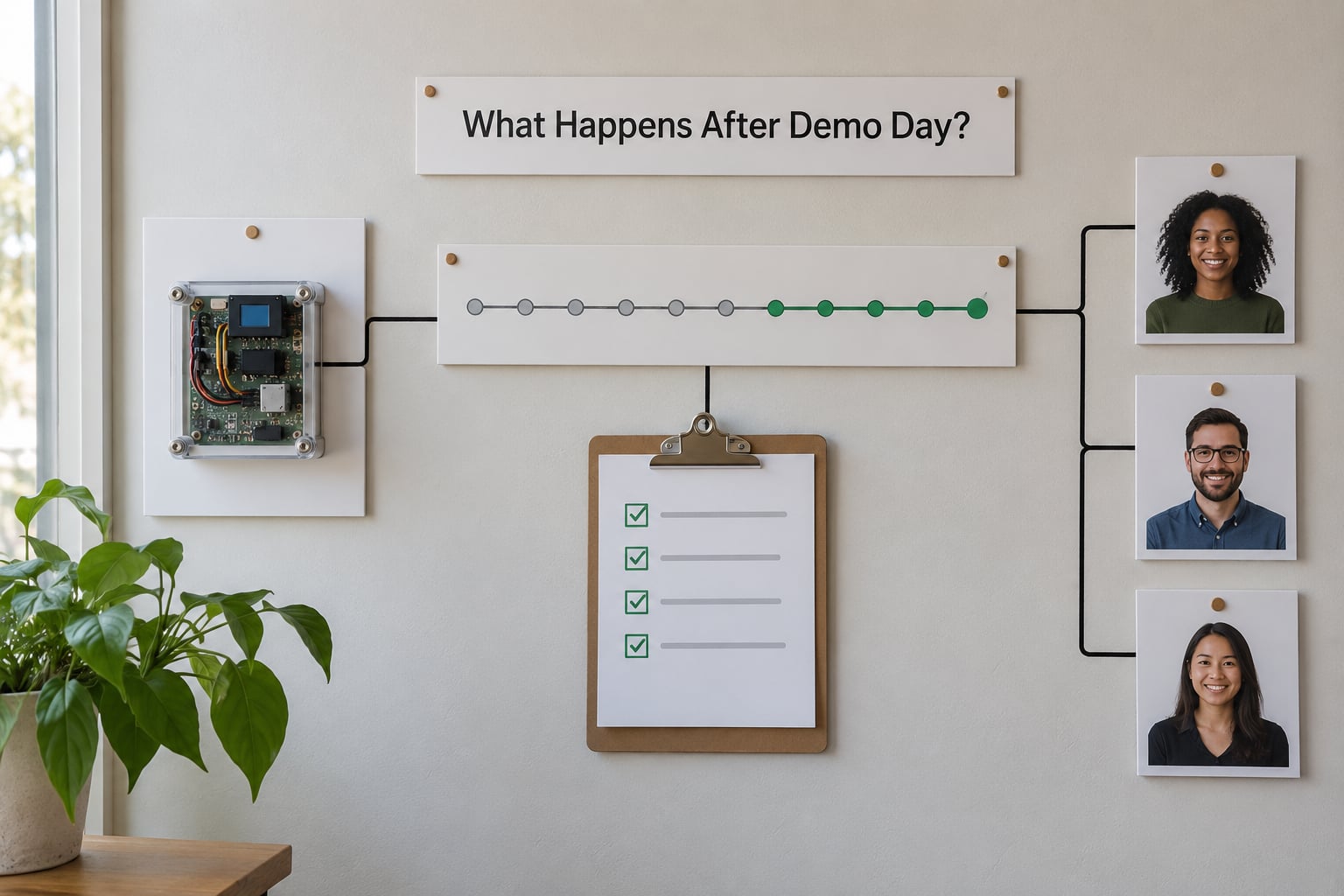
On Sunday afternoon the winning team hands over a repository, a slide deck and a promise. The judges go home. The sponsor team that could have adopted the project is already focused on its own roadmap, and by Tuesday the hackathon’s infrastructure, API keys and test accounts start expiring.
What the team loses first is not motivation, it is access. The demo ran on credentials that belong to the event. The data feed was a sandbox nobody promised to renew. The infrastructure was free tier with a 90-day trial, and 90 days is roughly one bug-fix cycle for a public-facing service.
Organisers usually make three decisions badly here. They award the prize and stop. They leave responsibility with the participants, who have jobs or exams. And they say nothing about the future, so the team hears silence as a verdict. Contributors in forum discussions notice this clearly, and it changes whether they come back to the next event.
The post-event cliff
The drop is not gradual. Most of the loss happens in a predictable sequence: the first three days after the event, when the adrenaline is gone and nobody has defined the next milestone; the first week, when the team discovers what breaks when nobody is awake to patch it; and the first month, when a single person with a job, coursework or a visa timeline quietly becomes unavailable and there is no second person who understands the code.
One community project exists purely because of this pattern. GitHub’s Finish-Up-A-Thon challenges people to revive abandoned hackathon repositories and finish them, which is a decent proxy for how widespread the abandonment is. If reviving other people’s projects is a popular side quest, few teams are reviving their own.
Which Failure Patterns Stop Hackathon Projects?
- The problem was never pinned down. A brief that is too broad leaves every team guessing, and a brief that changes mid-event invalidates hours of work. Participants repeatedly ask organisers for real-world, high-impact problem statements because generic to-do apps are not worth a weekend, let alone a year.
- Team composition was left to chance. Four developers and no designer, or a solo participant who registers and disappears, produces a functional interface nobody can use. Good teams pair a builder with someone who talked to a user that week.
- The judging rubric optimised for pitch. When the published criteria reward novelty and presentation, teams spend their final hours on slides. Nobody loses points for missing error handling, so nobody builds it.
- Demo delight was mistaken for user value. A thirty-second demo hides slow pages, empty states and the third case a real user hits. What works on stage has often only been tested with the happy path.
- Adoption was assumed rather than planned. Teams assume users will find the app after the applause stops. In practice, without a named channel such as a participating department, a newsletter, a community group or a procurement route, there is no way in.
- Data access and permissions were a surprise. Open data may exist in theory but not with the fields, the update frequency or the sharing terms the product needs. Civic projects stall hard here, because the data steward is rarely in the room.
- There was no owner, budget or mentor after Sunday. Shared responsibility across five stakeholders is not ownership. Someone has to answer for hosting costs, security patches and user support, and that job has to belong to a person with working hours.
- Knowledge stayed with the people who built it. Nobody outside the team can run the project. A repository with no setup notes, no environment documentation and a single maintainer is a project that ends with the maintainer’s next holiday.
- Sponsor tools burned build time. Long sponsor pitch sessions and unusable sandboxes take hours out of an already short window, which is a sponsor-side failure that teams pay for in features they never finish.
- AI-assisted building shifted the baseline. A participant on r/cscareerquestions described watching competitors finish a full-stack app on day one while they hand-built a proof of concept, concluding the contest had become a subscription comparison. When a working build is cheap, the demo stops being the differentiator, and whatever you learned about validating a problem is the only thing left that is hard to copy.
How Do You Know a Prototype Is Not Launch-Ready?
A prototype is launch-ready when a named party can put it in front of real users without improvising. Use this checklist to find out where yours stands. These are working thresholds for your own project, not industry statistics.
| Dimension | Prototype signal | Launch signal |
|---|---|---|
| Problem evidence | Judges found it interesting | Documented conversations with users who had the problem this month |
| Target users | Everyone | One named group, with how many of them and how you reach them |
| Data access | Sample CSV or public screenshot | Written access, agreed refresh, named steward |
| Production needs | No authentication, no persistence, no monitoring | Each of those either built or consciously deferred with a date |
| Accountable owner | Whoever built it | A named person or team in a role that exists next month |
| Funding | Prize money spent | A budget line covering at least the first year of hosting and support |
| Adoption channel | Hope | A specific channel with an owner and a date |
| Measurement | Positive demo feedback | Defined success measure and a baseline to compare against |
Scoring these honestly takes about twenty minutes and usually produces a shorter list than teams expect. That is useful. The four rows that fail most often are the owner, the funding, the adoption channel and the data steward, and none of them are solved by writing more code.
What Does Launch-Ready Actually Mean?
Launch-ready means the smallest real-world release that does one job properly, with six things true on the same day. The need is verified with people who have it, not inferred from a stage. One person is accountable for the service. The data is authorised and legally usable. Someone can support it without asking the builders. There is a known route to the first users. And there is a number that tells you whether it worked.
Notice that none of those six things is code. That is the uncomfortable part for anyone who spent the weekend shipping features. A civic app that helps residents book a recycling pickup is not harder to launch than one that tracks a fantasy bus route, but it needs a data steward, a privacy review and a service owner lined up before it can help anyone.
How Can Hackathon Teams Avoid a Dead Demo?
The fix is mostly done before anyone writes code. Teams that launch tend to have treated the hackathon as the start of a project rather than the end of one.
Before the event
- Talk to at least five people who have the problem. Record what they do now, not what they wish existed.
- Pick one user group. Not “everyone”, not “the community”.
- Confirm the data you need is accessible, and who administers it, before you design around it.
- Read the judging rubric and decide what it actually rewards.
During the event
- Assign roles with names on them, including a demo lead and a technical lead who is not the founder.
- Build one user path end to end rather than five paths halfway.
- Use real, authorised data if at all possible. Mock data hides every permission problem until launch.
- Write the setup instructions as you go, for a stranger.
Immediately after
- Name the launch owner before you leave the venue, in writing, and put it in the repository.
- Book the first follow-up meeting before the closing ceremony ends, with a date everyone can hold.
- Record a three-minute walkthrough with narration. Without it, nobody can pick the project up cold.
- Ask the organiser which specific team or department would use this, and request the introduction in writing.
One honest word to a sponsor beats a polished deck. Tell them what you built, what you did not build, and what you would do first with a week of engineering time. That conversation is where pilots start, and it never happens on stage.
What Should Happen in the First 90 Days After a Hackathon?
Here is the roadmap I would hand to a team on demo night. It is a structure, not a rulebook; adjust the dates to your service.
| Checkpoint | What should be true | If it is not |
|---|---|---|
| Day 3 | Owner named, next meeting dated, repository documented | Treat the project as closed and release it honestly |
| Week 1 | Five user conversations completed and written up | You have a demo, not a validated idea |
| Day 30 | Data access in writing, privacy and security questions answered | Escalate to the data steward before building anything on it |
| Day 60 | Scope cut to one job, hosting and support costed | Still adding features means you are not piloting |
| Day 90 | A pilot group using it, and a measurement against a baseline | Make an explicit decision to continue, pause or stop |
The day-90 decision matters most. Teams rarely stop on purpose; they drift. Writing the continue-or-stop criteria before the pilot starts is what stops a dead project from quietly consuming weekends for two years.
Who Must Own the Project After the Event?
Shared accountability without a single accountable owner is the most common organisational cause of abandonment. Every one of these roles matters, and exactly one person has to be answerable for the outcome.
- Municipal or organisational sponsor: puts the problem in front of teams, supplies realistic briefs, and decides whether a pilot is possible. Without them, you are guessing at demand.
- Product owner: decides what the service is for, cuts scope, and holds the roadmap. This is usually the person who carried the project through the event.
- Developer or technical lead: makes the build maintainable, writes the documentation, and handles the work nobody wants to do.
- Data steward: confirms what the data can legally and technically be used for, and at what refresh rate.
- Community organisation: brings the real users and keeps the service honest about whether it helps.
- Mentor: gives engineering or policy help on demand during the first three months, when the team is alone with the code.
- Funder: commits budget before the work starts, not after the applause.
For civic and open-data work, the difference from a startup is the route. There is usually no venture capital waiting for your parking app. The path runs through a department, a pilot agreement or a procurement process with its own calendar, which is slower and less glamorous but far more likely to still be running in a year. If nobody in the room knows which of those three applies to your idea, that is your first task.
Frequently Asked Questions
Is a working hackathon prototype the same as a launchable app?
No. A prototype shows that a team can build something that works in the moment. A launchable app also has an accountable owner, authorised data, authentication, monitoring, a support plan, a route to real users and a way to measure whether it helped. Those additions take weeks or months of work that a weekend format never budgets for, which is why most hackathon projects never launch.
What percentage of hackathon projects become real products?
No reliable public figure exists, because organisers rarely track which projects are still alive three months later. That absence is itself part of the problem. A better measure is to check each project yourself: is the repository updated, does a named owner exist, and is anyone using it. Those three checks tell you more than any completion statistic.
How can participants find funding after winning a hackathon?
Start with money that does not need a pitch: an internal innovation budget, a departmental pilot fund, a grant programme, or an incubator that takes a small equity position. Then use the hackathon network for introductions rather than money. Make the ask concrete, covering hosting and support for a year, because sponsor budgets are set around operational costs far more readily than around ideas.
Can a civic app launch if city data is not yet available?
Sometimes, and often you should launch smaller rather than wait. A prototype built on stale or sample data proves nothing about the real integration, so it can mislead you. Better options: pilot on a single neighbourhood, request a data use agreement with a named steward and a refresh schedule, or redesign the service around information the city already publishes regularly. Then measure whether it is worth the full integration.
How can hackathon organisers improve project completion rates?
Treat follow-through as part of the event rather than an afterthought. Publish the judging rubric, test challenge briefs with users first, host matchmaking so teams have designers and domain experts, and schedule 30, 60 and 90-day check-ins with a named owner attached to each project. Giving a budget line and a potential pilot before the closing ceremony improves survival more than a larger prize pool.
Conclusion: Start Planning the Launch Before the Hackathon
The answer to why most hackathon projects never launch is not bad code. It is that nobody was ever given the job, the money or the authority to continue, and the weekend rewarded the work that looks best on a projector. Fix it before the event by naming the user, the owner, the data steward and the pilot path while you still have the team’s attention.
Do one thing today: pick your project and answer the eight readiness questions from the diagnostic table. Whichever two come back weakest are your next fortnight of work, and the fix for both will be a conversation rather than a commit.