Selling software to a city government means working inside public procurement: register as a vendor, prove measurable value for a resident-facing service, clear security and accessibility review, then win a contract through a pilot, a competitive solicitation, a cooperative purchasing agreement, or a sole-source justification. It runs slower than enterprise sales and asks for far more evidence. Here is the order that works, step by step.
The biggest mistake I see is treating a city like one buyer with one budget. A city is a committee, a calendar, and a public record at the same time. Departments own the problem, procurement owns the paperwork, finance owns the money, and elected officials own the optics. Sales that respect all three move; sales that ignore any one of them stall for a year.
Table of Contents
- What You Need to Sell Software to City Governments
- Step-by-Step
- How to Sell Software to City Governments: Start With a Public-Sector Problem
- Map the Buying Committee and Decision Criteria
- Quantify Value in Public-Service Terms
- Build the Right Proof for a Government Buyer
- Design a Compliant Pilot and Procurement Path
- Set Pricing and Terms Cities Can Approve
- Run the Sales Process as a Collaborative Pilot
- Contract, Implement, and Earn the Expansion
- Common Mistakes
- Frequently Asked Questions
- How long does it take to sell software to a city government?
- Can a city buy government software for less than a formal bid threshold?
- Can a vendor use sole-source procurement to sell software to a city?
- What security documentation does a software company need to sell to cities?
- Does a startup need previous government experience to win a city contract?
- Conclusion
What You Need to Sell Software to City Governments
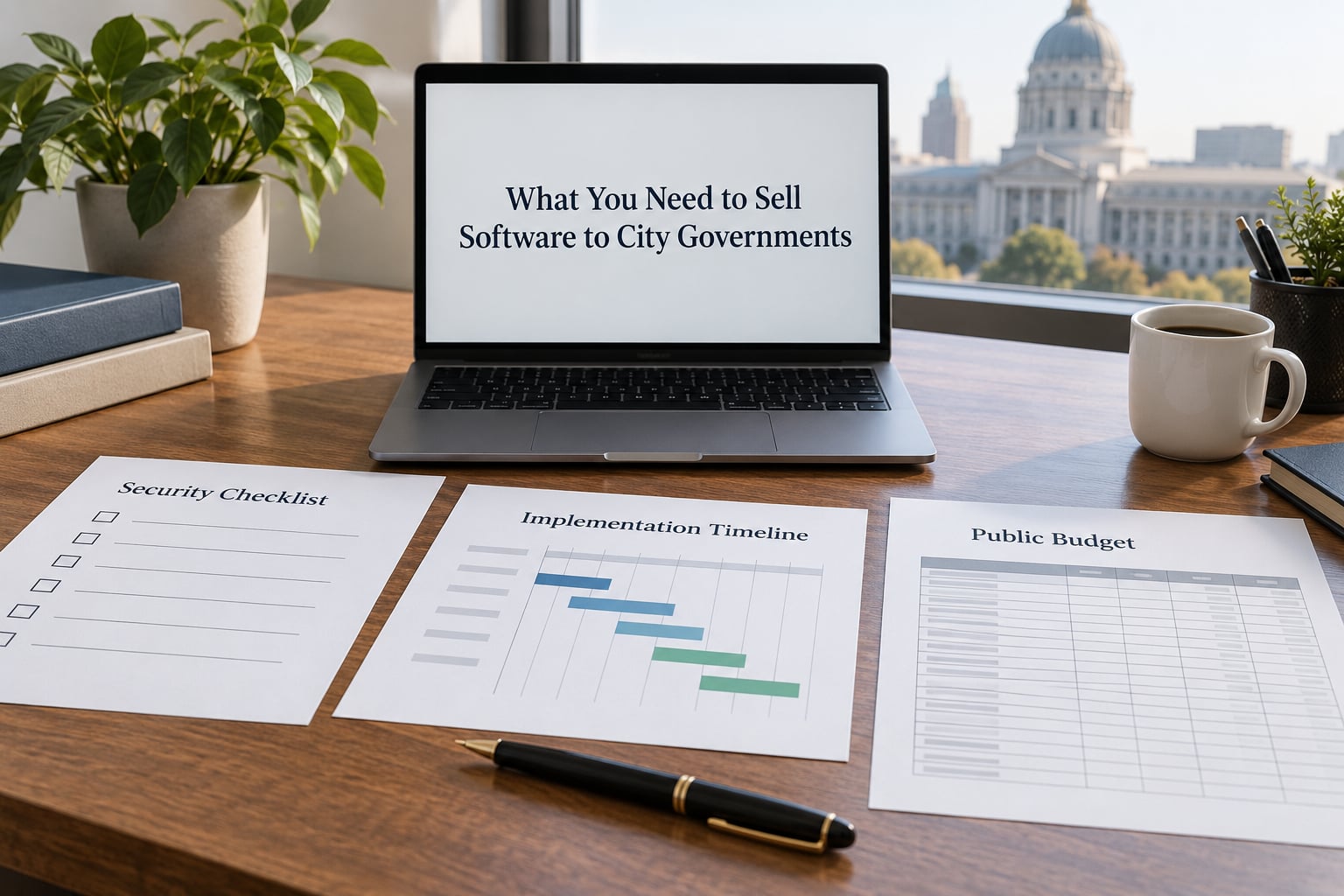
You need six things in place before a city can buy from you, and none of them are your product.
A narrowly defined municipal problem. Not “workflow efficiency” but “residents cannot see where their permit application stands without calling the planning department.” City staff read a general pitch and file it. A specific problem gets forwarded internally, and forwarding is what actually starts a deal.
Evidence you can produce on paper. A current SOC 2 Type II report, a written answer to the city’s security questionnaire, an accessibility conformance statement, architecture diagrams, and insurance certificates. Cities put these artifacts into a public evaluation file, so vague assurances are worth nothing.
Capacity to implement. Cities ask who does the data migration, who trains the staff, who answers at 7 a.m. on a Monday. A three-person team that cannot answer that will lose to a vendor that can, regardless of product quality.
A pricing model a finance office can approve. Recurring subscription separated from one-time implementation, with overages defined in writing and a term that fits a multi-year budget approval.
A working knowledge of procurement methods. You do not need to memorise statutes. You do need to know whether the city’s threshold for this purchase requires a formal bid, a three-quote purchase, or a sole-source memo.
A short readiness checklist keeps you honest: problem scoped to one department, compliance packet written, insurance active, vendor registration complete for at least a few target cities, one pilot reference or a documented substitute proof, and a named person on your side who owns each approval step.
Step-by-Step
Eight steps take you from research to a signed contract with a path to expansion. They overlap on purpose, because the operational sponsor, the procurement officer, the legal reviewer, and the elected official all move at different speeds. Expect to be in step 4 and step 6 at the same time for months.
How to Sell Software to City Governments: Start With a Public-Sector Problem
Lead with the broken service, not the feature list. A product demo answers “what does it do”; a city needs to hear “what stops working for residents today, and who absorbs that cost.”
Ask six questions before you show anything: How urgent is this right now, and what triggers the urgency? Which residents or staff are affected? What system handles it today? What political or policy constraints limit the solution? Whose budget pays for it? What does the city lose if nothing changes for another year?
Take a real example. A mid-size city asked vendors to speed up commercial permit status updates. The winning proposal did not lead with a dashboard; it led with the fact that staff were re-keying status changes from an old system, that the average applicant called twice to ask where their permit stood, and that the planning director had to explain the delay to the council every quarter. Those three facts set the baseline. Everything after them was a purchase decision.
Map the Buying Committee and Decision Criteria
Every city has more than one required signature, and most first-time sellers learn this late. Build a written map with one row per person: their role, their top priority, their likely objection, their authority to say yes or no, and the date you next follow up.
The operational sponsor runs the process and feels the pain daily. The department head carries political risk with the city manager. The procurement officer enforces the purchasing rules and can kill a deal over a missing certificate. The IT or security reviewer decides whether your architecture is permitted on the network. Legal reviews terms. Finance confirms the funding source. Elected officials rarely choose the vendor, but they can freeze a project that looks bad in a public meeting.
Document each row as you go. Two weeks later you will not remember who objected to a data residency clause, and the council agenda will not wait while you find out.
Quantify Value in Public-Service Terms
Translate features into outcomes a budget office recognises: staff hours released, service speed, compliance exposure removed, equity of access, resident satisfaction, risk avoided. Then show the arithmetic.
A simple value model has four parts: the baseline number, the target number, the unit of measure, and the source of the baseline data. Use the city’s own figures where you can, and label anything you estimated as an estimate.
Sample calculation for permit processing. Baseline: 180 applications a month, each needing about 25 minutes of staff follow-up and two resident callbacks on average. That is roughly 75 hours of staff time and 360 callbacks a month. If status visibility reduces callbacks to one per application and follow-up to 15 minutes, you free about 22 hours of staff time and remove 180 callbacks a month. Multiply by a loaded hourly rate from the city’s own budget, and you get a defensible number rather than a headline.
Build the Right Proof for a Government Buyer
Government buyers trust artifacts, not adjectives. The evidence package for a city should include pilot results with the measures agreed beforehand, case studies from comparable deployments, named references who will take a call, the SOC 2 report, the completed security questionnaire, a WCAG 2.1 AA or Section 508 conformance statement, architecture and data-flow diagrams, and an implementation timeline with named owners.
Keep unsupported claims out of the package entirely. “Reduces processing time” is weak. “Median turnaround moved from 14 business days to 6 across 180 applications during a 90-day pilot” survives a procurement review, a council meeting, and a public records request.
Design a Compliant Pilot and Procurement Path
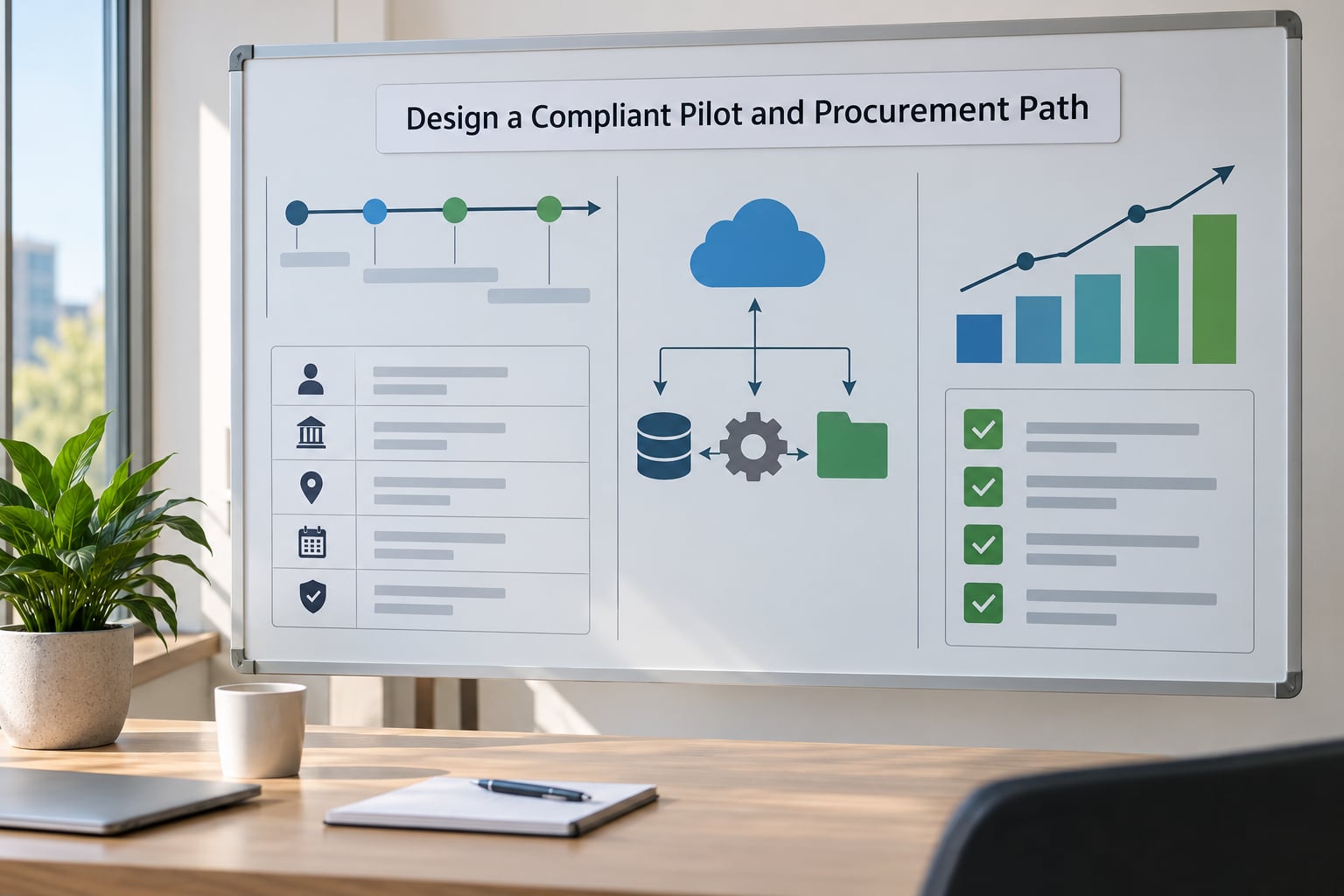
A pilot that is not written to convert is a free consulting engagement. Put the conversion terms in the pilot document itself, with a scope, success criteria, data handling rules, integration requirements, named city staff, a duration of roughly 90 days, and explicit exit criteria that trigger a purchase decision.
State which data may be used, whether real or synthetic, where it is stored, and who can see it. Cities often accept a pilot with synthetic data and a single sign-on integration, which removes most of the risk that would otherwise block the whole evaluation.
Know the procurement routes before you propose the pilot. A competitive bid or formal RFP runs open and scored against published criteria. A request for qualifications or information narrows the field. Cooperative purchasing agreements, run by bodies such as Sourcewell, NASPO, OMNIA, HGAC, or NCPA, let approved vendors sell to many cities without each city running its own solicitation. Sole-source purchases happen when the city argues only one supplier can meet the need, and that justification must be written and defensible. Small-purchase and micro-purchase rules allow purchases below a stated threshold with fewer formalities. Every one of these varies by jurisdiction and by city size, so confirm the current rule for the specific city rather than generalising from a blog, including this one.
Set Pricing and Terms Cities Can Approve
Split the numbers the way a finance office splits them: recurring subscription on one line, one-time implementation and data migration on another, support and managed services on a third, and integration work scoped separately if it is needed.
There is no universal city rate, and pretending otherwise gets you sent back. Offer a bounded pilot with a defined end date and a stated conversion path, name every overage condition in writing, and price multi-year terms so a department can show savings rather than a flat renewal.
Two practical details matter more than the headline number. City budgets are approved annually but committed over several years, so a three-year commitment can be approved once while your price stays flat. And contract terms should match how the city actually pays, which is often Net 30 or Net 45 with invoicing through a vendor portal.
Run the Sales Process as a Collaborative Pilot
Give the deal a cadence. A weekly thirty-minute working session with the sponsor, a monthly written status summary to the department head, and a scheduled security review with IT keep everyone aligned without anyone feeling chased.
Write a mutual action plan with dated items: security questionnaire returned, accessibility conformance letter delivered, reference call scheduled, proposal submitted, council committee date if required. Public agencies move on published deadlines and public agendas. Missing one is read as disorganisation, and it resets trust more than a late reply ever will.
Keep a single folder per city with every approval artifact, owner, and date. When an administration changes or a new procurement officer takes over, that folder is the difference between resuming in a week and restarting from zero.
Contract, Implement, and Earn the Expansion
Signature is the midpoint, not the finish. Plan implementation before the contract is signed so the first ninety days after go-live are scripted: data migration with city staff present, role-based permissions set per department, training sessions recorded and shared, and a named support contact published to the department.
Report outcomes on the schedule you agreed in the pilot. Six months in, the department head should have a one-page summary of the measures you committed to, and the council should never have to ask what happened next. That page becomes your reference, your case study, and your evidence for the next department.
Expansion then becomes a short conversation rather than a fresh sale. The same procurement work, done once, covers the next department in the city and the neighbouring city that asks for a reference. Ask for the reference only after the customer approves it in writing.
Common Mistakes
Treating the city as a single buyer is the first one. The fix is the stakeholder map, written before the second meeting and updated after every conversation.
Leading with technology instead of the broken service pushes the conversation to your strongest ground and the city’s weakest interest. Reframe each capability as a service outcome before you mention the interface.
Ignoring procurement rules until the award is a common and expensive error. Ask the procurement officer which route applies before you draft the pilot, not after.
Making savings claims you cannot defend is worse than making none. If the baseline is unverified, present a range and label the assumption. Public numbers get scrutinised in ways private ones never do.
Failing on security or accessibility blocks deals quietly, usually at the last review. Get the questionnaire and a conformance statement finished in advance, and treat a no on accessibility as a product problem rather than a paperwork problem.
Proposing an oversized pilot exhausts goodwill and staff capacity. Scope it to one workflow, one department, and about ninety days.
Hiding implementation costs surprises the finance office and pushes your price up later. Put migration, training, and support on their own lines in the first proposal.
Pursuing one contract and stopping treats government as a one-off revenue event. Practitioners report that city customers stay once the switching cost is high, which is exactly why the outcome report and the next-department conversation matter more than the signature.
Three habits pay off across every deal. Keep accurate records, because public agencies forget nothing. Use plain language, because your reader may be a council member, not an engineer. Assign an owner to every approval step, because a stalled step with no owner stalls forever.
Frequently Asked Questions
How long does it take to sell software to a city government?
Plan on six to twelve months for a first city deal, and longer if a formal RFP or a council committee sits on the critical path. A small-purchase route can be much faster, while a competitive solicitation with an evaluation committee often runs three to six months on its own. Forum sellers report deals that looked like ninety days stretching to a year and a half when an administration changed mid-process. Start your clock at first contact and track the fiscal year, not just your own pipeline.
Can a city buy government software for less than a formal bid threshold?
Often yes. Most cities set a small-purchase or micro-purchase threshold below which a department can buy directly, using a few quotes or a purchase order instead of a full solicitation. The threshold amount and the required procedure differ by city and change over time, so confirm the current local rule with the procurement officer before assuming a fast path exists.
Can a vendor use sole-source procurement to sell software to a city?
Only when the city documents why a competitive bid is not appropriate, which usually means a unique technical requirement, an urgent need, or proprietary compatibility with systems the city already owns. The justification is written, reviewed, and often open to challenge, so an unsupported sole-source request will fail. Ask the procurement officer how your situation would be justified before you build a plan around it.
What security documentation does a software company need to sell to cities?
Expect a SOC 2 Type II report or an equivalent independent assessment, a completed city security questionnaire, an architecture and data-flow diagram, a data retention and deletion policy, encryption and single sign-on details, and current insurance certificates. Accessibility documentation such as a WCAG 2.1 AA or Section 508 conformance statement is also requested often. Larger cities add penetration test results and background-check requirements for staff with system access.
Does a startup need previous government experience to win a city contract?
Not to get evaluated, and not always to win. Cities accept pilots and subcontract roles as ways to build past performance, and many will let you subcontract under a prime that already holds a city contract. Cooperate with an established local integrator, run one bounded pilot, and document results carefully. What kills deals is not inexperience but an inability to answer compliance or implementation questions on the record.
Conclusion
Pick one city and one specific public problem. Identify the buying group before you draft anything, calculate a baseline you can defend in writing, assemble the security and accessibility packet, and propose a bounded pilot with measures and a conversion path attached.
That sequence works because it matches how a city actually buys. Do the first two things this week and the rest becomes a calendar problem, which is far easier than a persuasion problem.