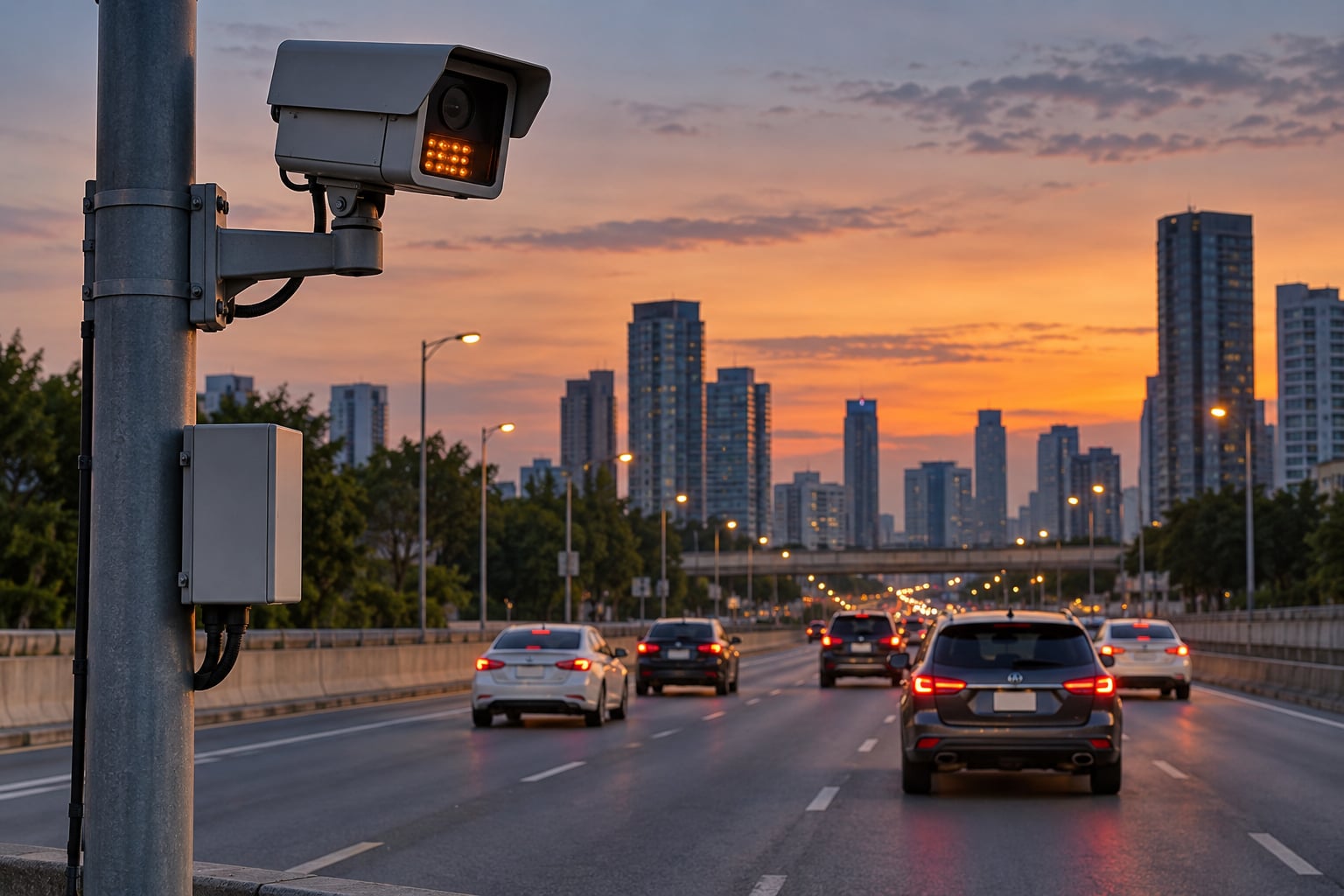
An automated license plate reader is a camera paired with optical character recognition software. It photographs each passing vehicle, converts the plate characters into text, and stores that text with the date, time and location so it can be checked against authorized databases in seconds. The read itself identifies a plate, not a person.
That last distinction is where most of the confusion lives. A read is a piece of text plus a timestamp and a spot on a map. Everything people argue about — retention, sharing between agencies, plate covers, whether a stop was justified — sits somewhere downstream of that read.
This guide walks the whole chain for developers, urban innovation teams and municipal staff: the optics, the recognition model, the database lookup, the alert, and the rules that decide how long the record survives and who can pull it.
Table of Contents
- How Automated License Plate Readers Work
- What Is an Automated License Plate Reader?
- How a Plate Becomes a Searchable Record
- What Technology Does the System Use?
- How automated license plate readers see in the dark
- How Accurate Are Automated License Plate Readers?
- What Happens After a Plate Match?
- Where Are License Plate Readers Used?
- What Privacy and Legal Issues Do They Raise?
- Data retention limits differ by state
- Who is allowed to search the data
- What Are the Limits and Common Failure Modes?
- Frequently Asked Questions
- Do automated license plate readers take a picture of the driver?
- Are automated license plate reader systems accurate?
- Can police search license plate data in real time?
- How long are automated license plate reader records kept?
- Can individuals access or challenge automated license plate records?
- Conclusion
How Automated License Plate Readers Work
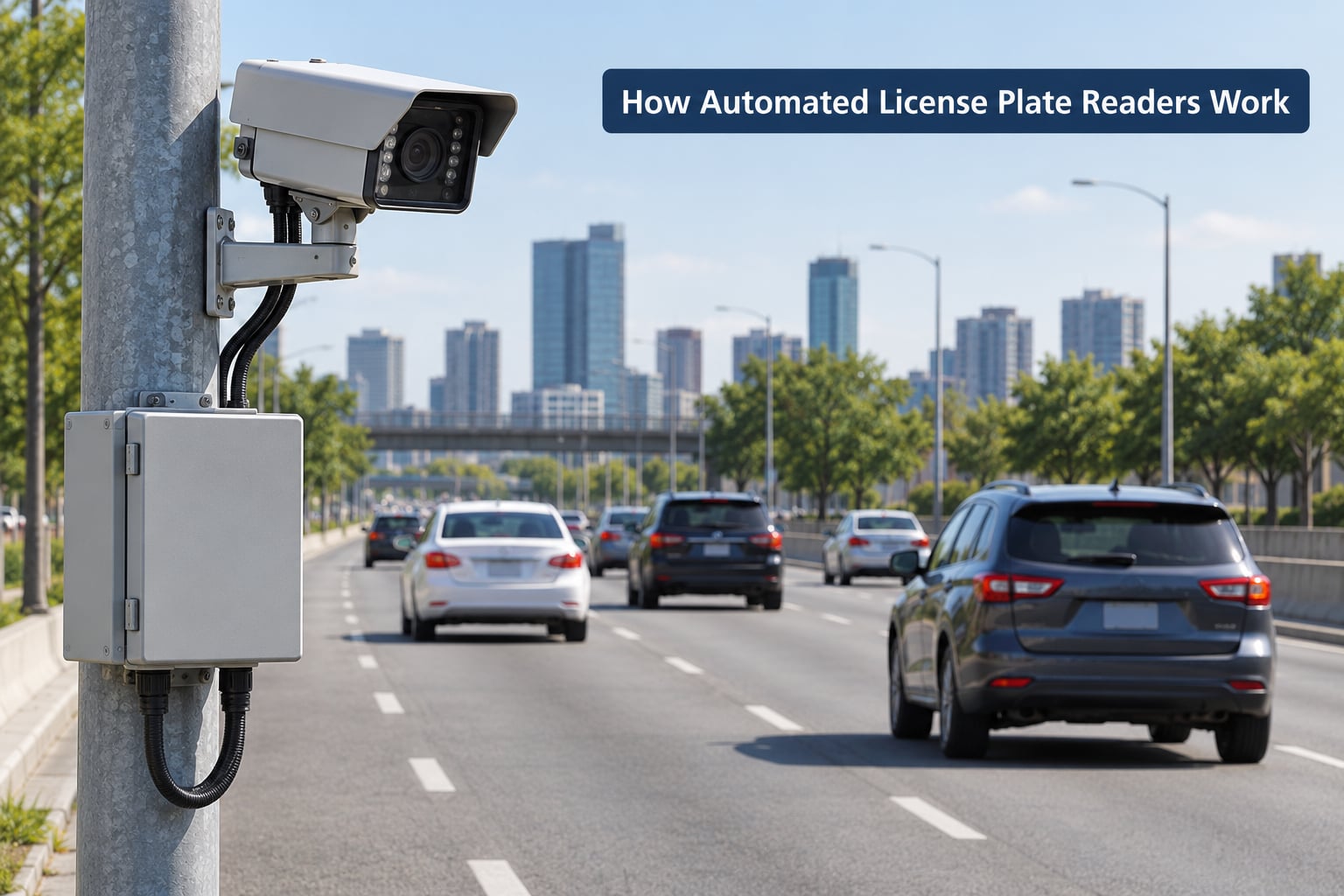
How automated license plate readers work is a five-stage chain: a camera fires on a trigger, several frames of the vehicle are captured, software finds and corrects the plate rectangle, an OCR model turns the characters into a text string with a confidence score, and that string is checked against a list of authorized records. A match sends a hit notification to an operator. A non-match is still stored, subject to the retention policy that applies.
Each stage can fail quietly. Glare can defeat localization, tilt can distort characters, a fast pass can blur the frame, and a confident-looking OCR result can still be wrong. The system reports what it read, not what was there.
What Is an Automated License Plate Reader?
An automated license plate reader, usually shortened to ALPR, is a camera system that photographs vehicles automatically and converts the plate into machine-readable text without a person looking at it. The US terms ALPR and LPR (license plate recognition) are used interchangeably. ANPR is the British and European equivalent term for the same basic idea.
A manual plate check is the useful contrast. An officer running a plate by hand types characters into a terminal and waits on a query, which takes minutes and depends on the officer noticing a suspicious vehicle. An ALPR does that comparison for every vehicle passing a given point, with no one watching.
The components are consistent across deployments:
- Camera — a high-resolution sensor mounted on a pole, structure or patrol vehicle, often paired with a second camera for the opposite lane direction.
- Illumination — visible light, near-infrared imaging, or a synchronized flash that briefly brightens reflective sheeting at the moment of capture.
- Capture software — motion or radar trigger logic, frame selection, and the decision about which frame to analyze.
- Recognition model — the localization and OCR pipeline, frequently a trained neural network rather than hand-written character rules.
- Data store — the indexed record of plate text, timestamp, camera location and any vehicle attributes.
- Reporting layer — the watchlist query, the hit alert to dispatch, and the officer-facing report view.
How a Plate Becomes a Searchable Record
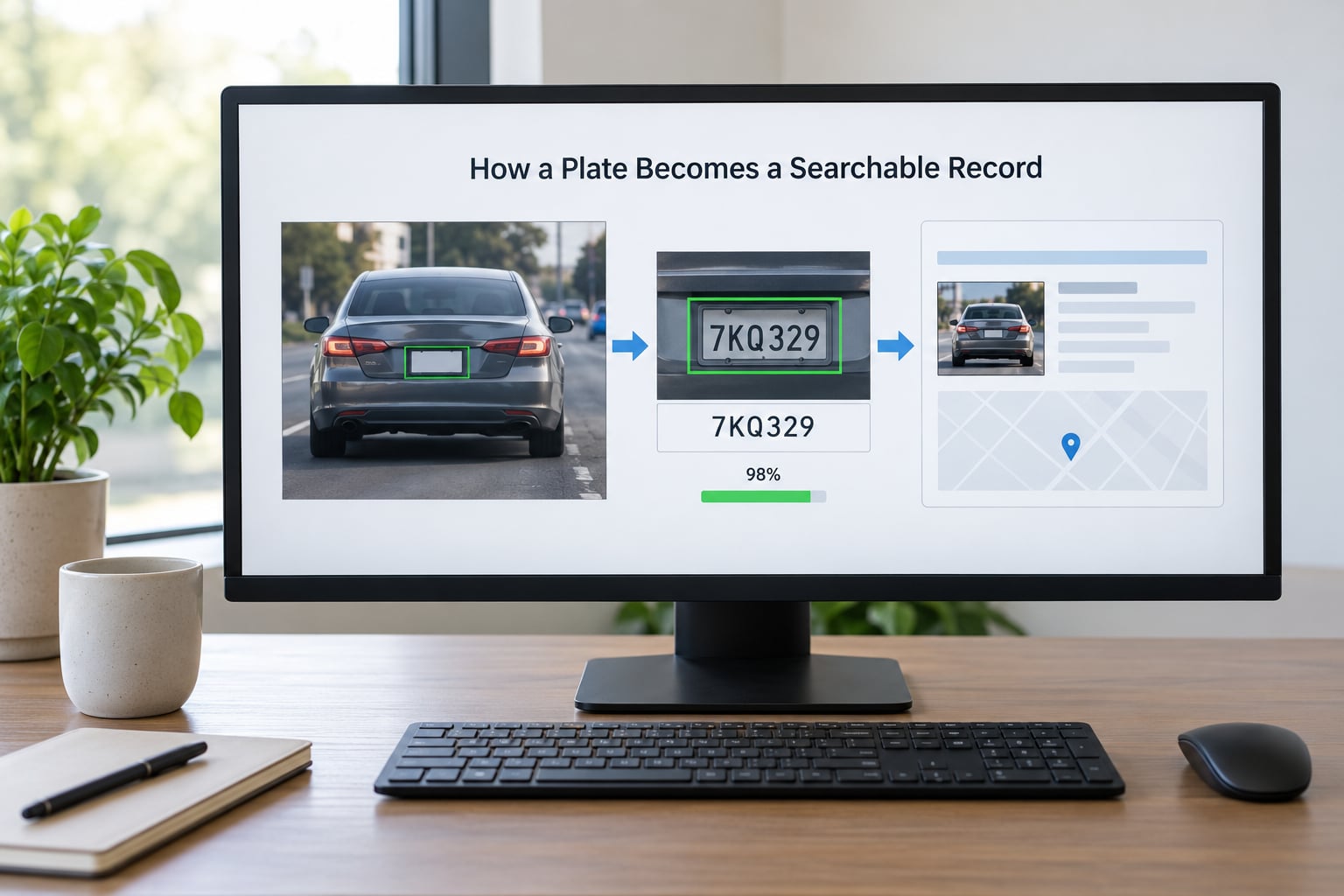
The pipeline runs the same way whether the camera is bolted to a mast arm or bolted to a cruiser bumper. Here is the order of operations.
- Trigger. A radar beam, loop sensor or plain motion trigger fires as the vehicle enters the detection zone. This is what sets the clock for the timestamp.
- Frame capture. The camera takes several rapid frames per vehicle rather than one, so a blurred exposure can be discarded in favour of a clean one.
- Plate localization. A detection model scans the frame for a rectangular, high-contrast object in the expected position. If it finds nothing, the pass is recorded as no-read.
- Preprocessing. The plate crop is deskewed and perspective-corrected, contrast and brightness are normalized, and glare from headlights or retroreflective sheeting is suppressed.
- Character segmentation and OCR. Individual character regions are separated and classified. The model returns a candidate string, often more than one candidate, each with a confidence score.
- Metadata assembly. The accepted string is bundled with the timestamp, the camera ID and its stored location, plus any vehicle attributes the deployment captures.
- Watchlist query. The string is compared against the records the deployment is authorized to check — stolen vehicle, wanted subject, Amber alert, or a local BOLO list.
- Alert or quiet storage. A match generates a hit notification. A non-match is written to the retention store and, in many configurations, immediately purged when the window expires.
Deduplication matters here. One pass over a camera can produce several candidate reads of the same vehicle, and a vehicle may pass several cameras in a corridor. Systems collapse these into a single event so that one drive is not counted as four sightings.
What Technology Does the System Use?
The hardware is a small camera and a computer, and most of the sophistication sits in the software between them. Deployments mix three capture approaches, and the mix matters more than the brand.
- Fixed pole and mast-arm cameras watch one point continuously, so they produce the highest volume and the most consistent geometry.
- Mobile patrol-car units roam, which spreads coverage but changes the camera-to-plate angle constantly.
- Flush-mount units bolt to a vehicle roof or grille with a much smaller housing, often paired with two cameras for front and rear plates.
Some deployments also run in test mode, capturing images to evaluate a location without querying any watchlist. Those reads carry none of the alert pipeline.
How automated license plate readers see in the dark
Visible-light cameras struggle after dusk, so night capture usually adds one of two things. Near-infrared imaging uses a dark filter over the sensor and an infrared illuminator that the human eye does not see, rendering the plate in a greyscale image where retroreflective sheeting stands out strongly. A synchronized flash fires a brief burst of visible light at the exact capture moment for the same reason. Both approaches exist to make the characters legible to the model, and both change the look of the resulting image compared with a daylight capture.
The recognition side has largely shifted to convolutional neural networks trained on large sets of labelled plate images from many states and countries, which is how a system handles the fact that there is no single plate design in North America. Time, camera ID and location come from the trigger and the camera’s own position record. Some systems additionally classify vehicle colour, make, model and body type, and some compute a vehicle signature — a rough outline — that helps separate two cars with similar plates.
How Accurate Are Automated License Plate Readers?
There is no universal accuracy percentage, and any vendor figure quoted without conditions should be treated carefully. The number moves with the frame itself. What follows is the honest way to think about it: accuracy is a property of a specific camera, at a specific spot, on a specific day.
| Factor | Effect on usable read rate |
|---|---|
| Camera angle and mounting height | Steep or offset angles distort characters and shrink apparent plate size |
| Speed of the vehicle | Faster passes produce more motion blur across multiple frames |
| Lighting and glare | Oncoming headlights and low sun angle are the most common causes of no-reads |
| Plate condition | Dirt, damage, missing characters and heavy bumper obstruction all reduce parse quality |
| State and country plate format | Unfamiliar designs, low-contrast characters and varied fonts are harder for the model |
| Plate covers or frames | Reduce or block reads entirely; the model will not recover characters that are not captured |
| Model confidence threshold | Lower thresholds yield more candidates and more false positives; higher thresholds drop usable reads |
| Rain, fog and lens condition | Degrade contrast for the whole scene, not just the plate |
The practical consequence is that a read rate measured at a well-lit intersection with a clean, front-facing mount says almost nothing about a side-mounted mobile unit on a dark road. Agencies that publish statistics usually report read rate, hit rate and confirmation rate separately, and a hit rate that looks impressive means little until you know how many of those hits were verified by an officer.
What Happens After a Plate Match?
A hit is a flag, not a conclusion. Four different things get conflated constantly, and keeping them separate is the whole point.
- A plate read is the OCR output alone. It is a guess about characters.
- A database hit is that string matching an entry in a list the system is authorized to search. The match may be against a stale record.
- A confirmed vehicle identity means someone verified the read against the physical plate, and sometimes verified the registered owner.
- Evidence of a particular event is the strongest of the four. It requires placing a confirmed vehicle at a confirmed place and time, and it usually requires someone to check that a vehicle was actually there.
Plates are shared, transferred and reissued. A rental fleet car, a reassembled car with a cloned plate, or a plate that was reissued after a title change can all produce a legitimate-looking hit that points at the wrong person. That is why a well-run program treats an alert as the start of a verification step rather than the end of one.
Worth saying plainly: the hardware cannot pull over a car, conduct a stop, or make an arrest. A human decides what happens next, and that decision is the part the technology has no opinion about.
Where Are License Plate Readers Used?
The original purpose is narrow. The observed use is wider, and the gap between them is where the policy debate lives.
Intended uses include stolen vehicle recovery, locating vehicles tied to Amber alerts or missing persons, hit-and-run investigations, searching historical reads after a case is opened, and parking or access enforcement at municipal facilities.
Secondary use is the practice of querying captured data for reasons not tied to the case that generated it, including bulk historical searches requested by agencies that did not install the cameras. Public discussion after incidents of out-of-area agencies querying another jurisdiction’s system has pushed this into the open in several cities, and in at least one case contributed to a city dropping its contract.
Non-police deployments run on toll roads, in parking garages and permit systems, at gated communities, and inside private fleet logistics. The same camera can serve all three roles, and a reader installed for parking enforcement can end up feeding a police watchlist. A reader installed by a homeowners association may sit on infrastructure a police department can later query.
That is the structural point about ALPR use: once the camera exists, the interesting question stops being what it is for and becomes what anyone with authorized access can ask it.
What Privacy and Legal Issues Do They Raise?
Every vehicle that passes is captured, including vehicles with no connection to any investigation. The policy questions are not about whether that is acceptable in principle — they are about limits. This is general information about how these systems are commonly governed, not legal advice; rules vary by state, city and contract, and you need local counsel for a specific situation.
Data retention limits differ by state
Retention is the single most common limit, and it is where the rules are most concrete. Many programs store non-hit data for a short fixed window and purge it automatically. Thirty days is a frequently cited figure in municipal policy documents, and some states cap retention for law enforcement ALPR data by statute or regulation. Specific windows differ widely — some are shorter, some run into months for hit data only, and hit records are often retained longer than routine reads. The only reliable number for a given system is the one in its own adopted policy or surveillance impact report.
Because a short retention window is the main safeguard, and because the window is a policy choice rather than a technical limit, it is worth checking the actual adopted policy for any system covering your routes.
Who is allowed to search the data
Access rules typically separate real-time watchlist alerts from historical queries. Alerts arrive automatically against a fixed list. Historical searches over stored reads are supposed to require a case number or supervisor authorization, and audit logs are meant to record who searched what and when. Whether that audit log is complete, and whether it is reviewed, is exactly the thing residents have asked to verify in council meetings.
The other lever is the public records route. Most agencies are subject to state public records law, which means a request for records showing reads of a specific plate or searches of a specific period is a legitimate request in many states. Responses vary widely in practice, and some departments publish aggregated audit reports rather than individual search logs.
Most of the privacy argument is really an argument about imagery rather than text. Plate text is a short, already-public identifier. A stored image of a vehicle, its occupants and its surroundings is a different kind of record, and deployments differ on whether they keep it at all.
What Are the Limits and Common Failure Modes?
Every deployment runs into the same handful of problems, and knowing them makes a report much easier to read.
- False reads. OCR confuses similar characters — 0 and O, 1 and I, 5 and S — and a low-contrast plate makes it worse. A confident OCR score does not mean the string is correct.
- Missed plates. Obstruction, extreme tilt, heavy rain and fast passes all produce no-reads that appear in reports as blanks rather than errors.
- Duplicate events. Poor deduplication inflates the apparent number of sightings of one vehicle.
- Similar formats. Many states use the same layout and colour scheme, so one learned plate design can be misread as another.
- Database errors. The record is wrong, the plate was reassigned, or the entry is outdated. The reader was correct and the conclusion is not.
- Tampering. Physical damage, lens obstruction, and camera theft are all real. Reports of cameras being removed, and of internal data and keys recovered, are why integrity review belongs in the same conversation as retention policy.
- Blind reliance. The most common failure is human: treating a match as proof rather than as a prompt to verify.
On plate covers and reflectors: they reduce or block reads, and no recognition model recovers characters the camera never captured. Legality is the catch. States vary widely, and some prohibit anything that obstructs the plate, while others permit covers with conditions on size, lettering and reflectivity. Covering a plate for ordinary driving can also be treated as an offence in its own right. Check your state statute before buying anything, and treat any product claim about being undetectable as a marketing statement rather than a technical fact.
Frequently Asked Questions
Do automated license plate readers take a picture of the driver?
Most systems photograph the whole vehicle as it passes, so the driver is technically in frame. Standard configurations analyze the plate region and many discard or crop imagery that is not needed for the read. Systems that keep stored images usually apply a separate retention rule to pictures than to plate text. Whether images are kept at all depends on the specific deployment and its adopted policy.
Are automated license plate reader systems accurate?
There is no single accuracy figure, because the read rate depends on the camera, the mount, the location, the weather and the vehicles passing through. A well-lit pole-mounted camera on a straight approach will substantially outperform a side-mounted mobile unit at night. Useful reporting separates read rate, hit rate and officer-confirmed rate, and the last of those is the one that matters for whether an alert led anywhere.
Can police search license plate data in real time?
Real-time watchlist alerts happen automatically: every read is compared against the lists the system is authorized to check, and a match is pushed to dispatch within seconds. Historical searches over stored reads are a different action. Those are supposed to require a case number, supervisor approval or a warrant depending on the jurisdiction, and they should appear in an audit log. Whether the log is complete and reviewed is a fair thing to ask about.
How long are automated license plate reader records kept?
Retention windows vary by state, city and contract, so there is no national default. A commonly cited figure is 30 days for non-hit data, and some states set statutory caps, while hit records are often retained much longer than routine reads. The authoritative number for any given system is the retention period in its adopted policy or surveillance impact report, which is normally a public document.
Can individuals access or challenge automated license plate records?
Usually, through public records law rather than directly from the system. A request asking whether a specific plate was captured or searched over a date range, or for audit logs covering a period, is a legitimate request in many states, though responses vary widely in practice. To challenge the accuracy of a read, you would need to compare it against your own records and raise it with the agency that made the stop.
Conclusion
An automated license plate reader turns a plate into text, attaches a time and a place, and offers that text to a list. Nothing further happens automatically. A hit is a prompt for a person, and everything legally and civically interesting — retention, sharing, stops, records requests — occurs in that gap between the read and the human decision.
If you are evaluating a system, start with four documents rather than a demo: the defined use case, the data-minimization and retention policy, an accuracy test at the actual locations with read and confirmation rates reported separately, and the oversight and audit plan. Ask to see the audit log before you sign. Any system that will not show you who searched what is asking you to take the oversight on faith, and that is the one part of this pipeline that has no substitute.