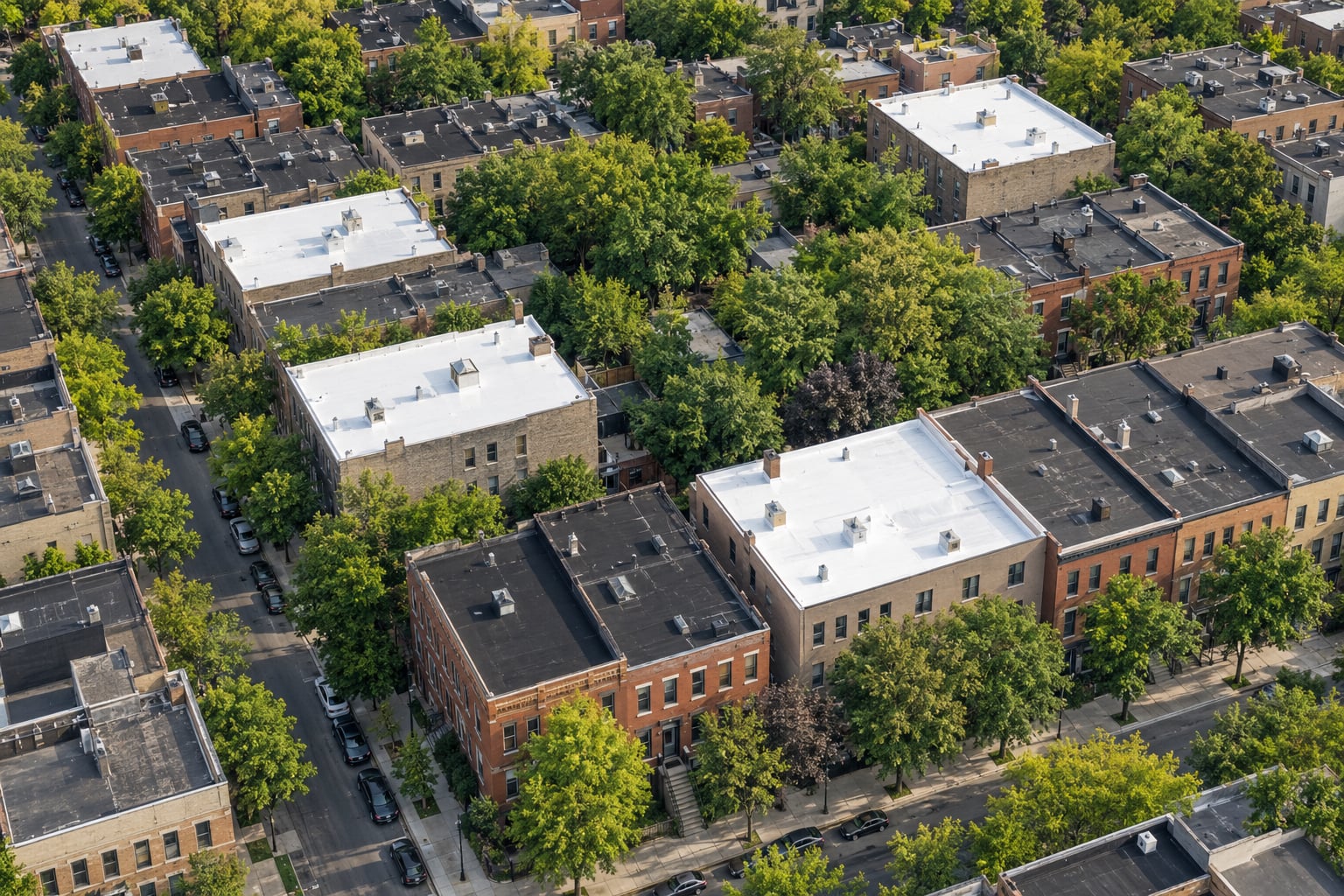
A cool roof lowers city temperatures by bouncing sunlight back to space instead of absorbing it as heat. A conventional dark roof takes in solar energy all day, heats up to extreme temperatures, and releases that heat into the surrounding air. Swap enough of those roofs for high-reflectance ones and the air itself cools down.
That’s the short version of how cool roofs lower city temperatures, and the details matter more than they sound, because “cooler roof” and “cooler city” are two very different numbers. Most of the confusion around this topic comes from mixing them up. A reflective roof surface can run 50°F below a conventional one. The air a few blocks away typically cools by a much smaller amount, usually 1 to 3°F.
This guide breaks down the physics, the measured results by city, the policy tools cities actually use, and the trade-offs nobody likes to talk about. It also explains how a city verifies that its ordinance worked, which is the part most coverage skips.
Table of Contents
- How Do Cool Roofs Reflect Sunlight?
- What Is the Science Behind Lower City Temperatures?
- Which Parts of a Building Benefit Most?
- How Much Can Cool Roofs Reduce Heat?
- How Do Cities Use Cool Roofs to Fight Urban Heat?
- What Are the Limitations and Trade-Offs?
- How Can a Project Decide Whether Cool Roofs Are Right?
- Frequently Asked Questions
- Which city has the worst urban heat island effect?
- What are the pros and cons of cool roofs?
- Do cool roofs last longer?
- What color roof reduces heat the most?
- How much do cool roofs cost, and are rebates available?
- How do cities actually measure whether cool roofs worked?
- Conclusion
How Do Cool Roofs Reflect Sunlight?
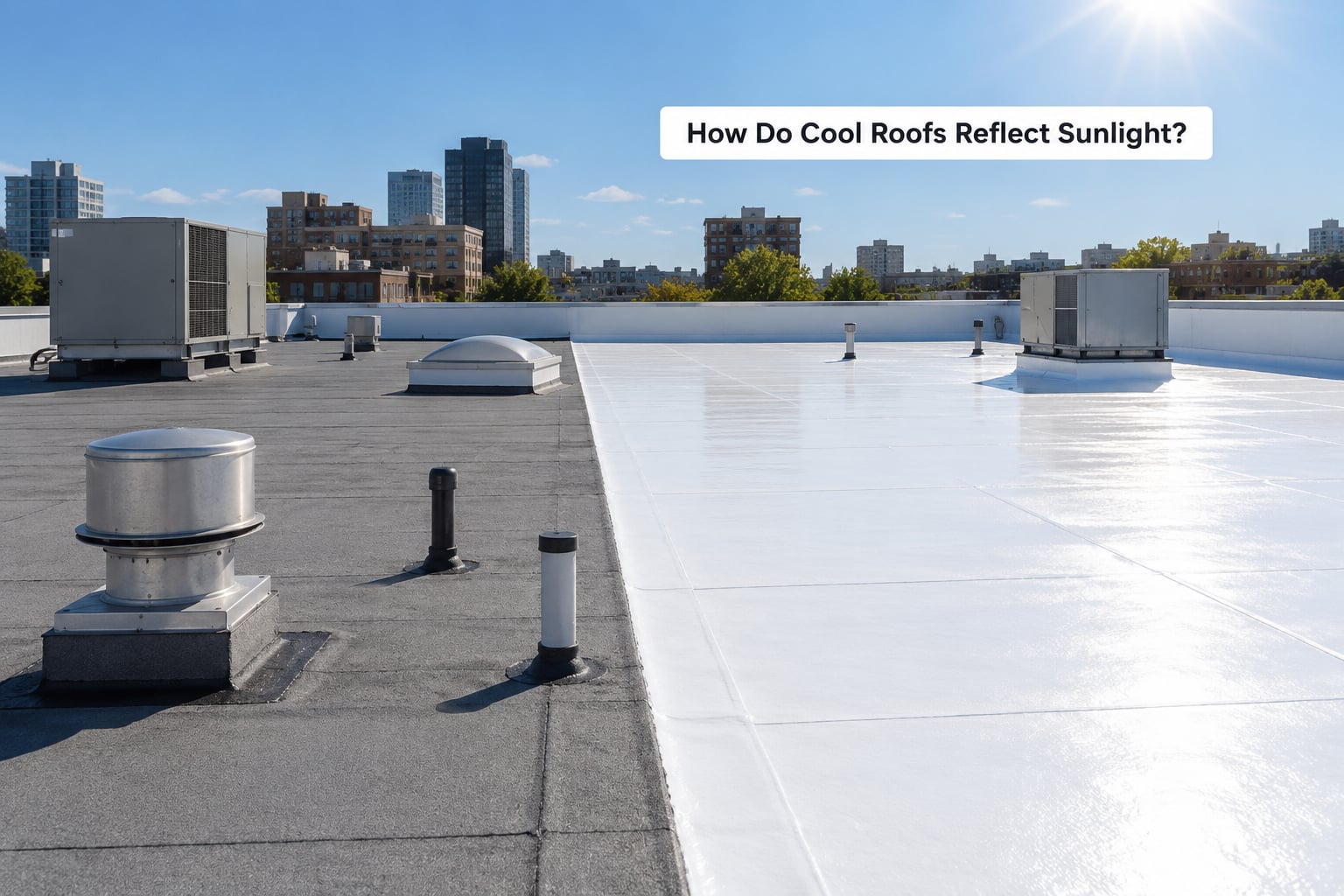
How cool roofs lower city temperatures starts with two physical properties. The first is solar reflectance, usually called albedo: the share of incoming sunlight a surface bounces back to the sky. The second is thermal emittance, also called emissivity: how well that surface radiates absorbed heat away as infrared instead of conducting it downward.
A dark asphalt roof reflects roughly 5 to 10 percent of sunlight and traps the rest as heat. A white membrane reflects upward of 80 percent. And here’s the detail that surprises people: the heat a dark roof does absorb isn’t only conducted into the building. Most of it is re-radiated as infrared and longwave energy into the air above the roof, which is exactly the heat that warms a city.
| Characteristic | Standard dark roof | Light-colored reflective roof | Certified cool roof |
|---|---|---|---|
| Solar reflectance | 5-10% | 40-70% | 80%+ initially, rated for aged performance |
| Thermal emittance | 0.85-0.95 | 0.85-0.95 | 0.85+ across the solar and infrared spectrum |
| Peak surface temperature | Can exceed 150°F on a hot day | 30-50°F lower | Up to about 50°F lower |
| Key metric | None | Visual brightness only | Solar Reflectance Index (SRI), typically 82 or above under code |
| Aging behavior | Darkens as coatings wear | Dirt and algae reduce reflectance | Rated on aged reflectance, not new reflectance |
One correction worth making early, since it comes up constantly online: a cool roof is not a green roof. “Cool roof” means a high-reflectance surface. A green roof means a layer of soil and vegetation. They solve overlapping problems in different ways, and only one of them is a painted or coated surface.
What Is the Science Behind Lower City Temperatures?
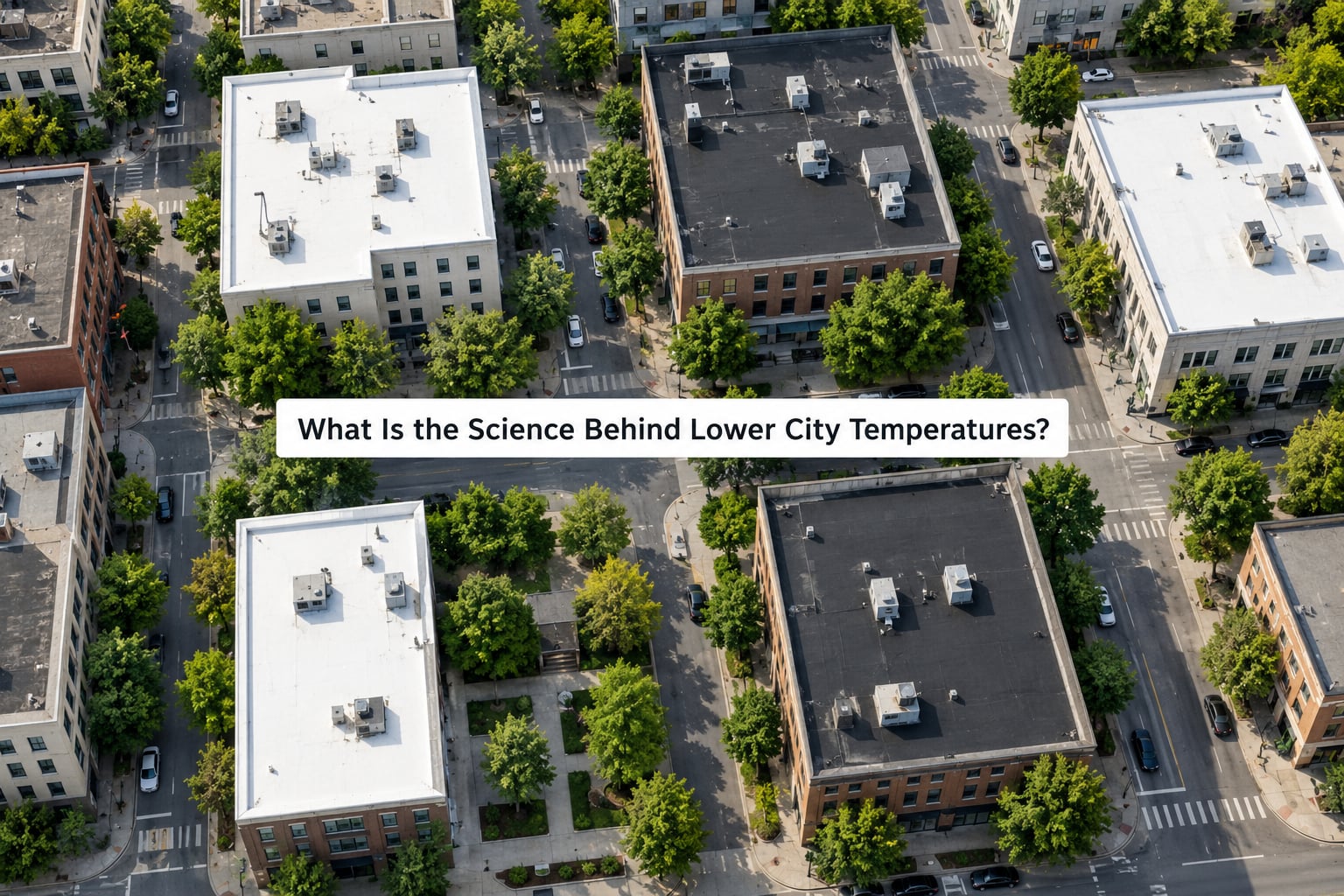
The urban heat island effect is the measurable gap between city and rural temperatures. Cities commonly run 1 to 4°F warmer on an annual average basis, and on clear, calm nights the gap between a dense downtown and the open countryside can reach 12°F or more. The heat comes from dark paving, dark roofs, few trees, and stored heat released slowly after sunset.
Roofs matter disproportionately because they are large, flat, horizontal, exposed to the full sky, and they absorb without any shading. In a typical low-density city, roofs cover roughly a quarter to a third of the ground area. That makes them the single largest surface a city can cool through building codes.
The chain from sunlight to cooler street-level air runs in six steps.
- Sunlight arrives. A summer afternoon delivers intense solar radiation onto every horizontal surface in the city.
- The surface absorbs or reflects. A dark roof absorbs most of it. A cool roof reflects 80 percent or more straight back to the sky.
- Surface temperature falls. With less energy going in, the roof surface stays dramatically cooler, so less heat conducts downward into the building.
- Less heat reaches the air. The heat a roof releases is mostly sensible heat into the air above it. Cooler surface means far less of it.
- Cooling load drops. With less heat arriving indoors, air conditioners run less, which cuts the electricity used and the waste heat pumped back outside.
- Ambient air temperature falls. Across thousands of roofs, reduced heat release lowers neighborhood-scale air temperature and slows the chemical reactions that form ground-level ozone.
That last step is the one people ask about most, and it’s also the one most prone to overstatement. Individual buildings feel the effect on their roof and top floor within hours. City air temperature changes require a substantial share of the roof area to change, and they show up as a modest citywide average improvement rather than a dramatic local change.
Which Parts of a Building Benefit Most?
The benefit concentrates wherever solar heat gain is largest and where occupants are least able to escape it. Top-floor units under a low-slope roof are the obvious case, because there is usually no other layer between the occupants and the roof surface.
Large-footprint buildings gain from sheer area. Warehouses, distribution centers, schools, hospitals, and big-box retail all have enormous uninterrupted roof planes and high daytime electricity demand from cooling. A school gym under a white membrane can run several degrees cooler than the same gym under a dark membrane, and that translates straight into lower cooling bills for the district.
Multifamily housing deserves particular attention. Low-rise apartments are dominated by roof area, and they hold large numbers of residents who often have no control over the cooling system, no ability to add insulation, and no budget for high energy bills. That combination makes cooling the roof a low-cost intervention for the people least able to absorb heat.
Four variables decide how much any single building gains: roof area relative to floor area, how well the roof is insulated, how much the roof is shaded by trees or taller adjacent structures, and how hard the cooling system already works. A heavily shaded roof in a humid coastal city may gain little. An unshaded warehouse in Phoenix may gain enormously.
It also helps to separate what a cool roof does from what it doesn’t. It reduces heat arriving from above. It does nothing about heat arriving through windows, walls, or an uninsulated attic floor, and it does not stop a building from releasing heat back into the street once the air conditioner runs.
How Much Can Cool Roofs Reduce Heat?
Two different numbers come out of the research, and conflating them is the most common error in coverage of this topic. Roof surface cooling is dramatic. City air cooling is real but modest.
| What is being measured | Typical reduction | What drives it |
|---|---|---|
| Roof surface temperature | Up to about 50°F (roughly 30°C) | Direct solar reflectance on an exposed surface |
| Indoor temperature, top floor | About 3-4°F in painted-roof field projects | Heat gain through the roof deck |
| Building cooling energy | Roughly 10-20% annual reduction in cooling use | Insulation level, cooling system, climate, occupancy |
| Citywide air temperature | Roughly 1-3°F typical; larger where coverage is high | Share of roofs converted, wind, humidity, background conditions |
| Peak electric demand | Noticeable reduction on the hottest afternoon | How synchronized building loads are |
City-level figures come from energy and climate modeling, and the ones most often cited come from the Smart Surfaces Coalition. Its modeling for Atlanta, which passed a reflective-roof requirement in June 2025, projected about 2.4°F of citywide peak cooling, roughly 6.3°F in the hottest neighborhoods, and $310 million in energy savings over 35 years. The neighborhood number is the important one, because the hottest areas are where the heat is most dangerous and where residents have the least tree canopy.
Separate modeling for Washington, D.C., put the citywide effect of widespread white roofs at about 1.8°C (3.2°F). Broader modeling of metropolitan-scale adoption has produced citywide air temperature reductions approaching 2°C in some scenarios. Those are projections, not measurements, and they depend on assumptions about adoption rates that are still being tested in practice.
The honest summary: a cool roof reliably makes its own surface much cooler, and it reliably cuts the cooling energy its building uses. City-scale cooling follows when enough roofs change at once, and it lands hardest where roofs were hottest to begin with.
How Do Cities Use Cool Roofs to Fight Urban Heat?
The main policy tool is the code requirement. Atlanta’s 2025 ordinance and Baltimore’s 2023 ordinance both push new and replacement roofs toward reflectance standards. Chicago, Los Angeles, and New York have moved in the same direction through their own building codes or purchasing standards.
At the state level, California’s Title 24 energy code sets reflectance thresholds for commercial roofs and has driven adoption across the industry through compliance deadlines. Alabama, Florida, Georgia, Hawaii, and Texas have comparable or related requirements.
Code requirements work slowly, which is fine, because roofs are replaced on a schedule anyway. Flat commercial roofs turn over roughly every 15 to 20 years, which works out to about 5 to 7 percent of the roof stock per year. A code adopted today has reached most of the city in about two decades without any dedicated retrofit program. Cities that want faster movement add rebate programs, direct-paint retrofits on public housing, and incentives aimed at low-income owners.
The measurement question is the interesting one, and it’s where smart city teams come in. To confirm that an ordinance actually cooled the city, a city needs street-level temperature sensors, a baseline period recorded before the requirement took effect, comparison areas that stayed conventional, and published data anyone can check.
That workflow matters because the skepticism is reasonable. Forum discussions on this topic frequently ask whether city-scale numbers of 1 to 6°F are real or just advocacy-group framing. The answer depends on having local measurements, not on trusting a press release. Cities with sensor networks and open data portals can settle the question for themselves; cities without them are relying on models.
Cool roofs also relieve peak demand on the electrical grid, which is not the same as reducing total energy use. Air conditioning is the single largest load on a summer afternoon, and lowering indoor temperature peaks reduces demand at the exact moment the grid is most strained and least able to supply it. That matters even more as heat waves push reliability margins thinner.
What Are the Limitations and Trade-Offs?
The winter heating penalty is real but small and easy to overstate. In a cold climate, a reflective roof sheds a little indoor heat in winter as well as summer. In practice the penalty is minor in most U.S. cities, and in hot climates a reflective roof reduces air conditioning bills enough to cover it several times over. The modeling literature generally finds the penalty acceptable, but it is a legitimate consideration in heating-dominated northern regions.
Glare is under-discussed. A highly reflective roof can send more light toward upper-floor windows across the street, into rooftop mechanical areas, or up at night where it brightens the sky. Mitigation is straightforward: specify moderate rather than maximum reflectance where adjacent buildings are close, and orient roof edges away from sensitive facades.
Coating performance degrades. Reflectance falls as coatings pick up dirt, algae, and biological growth. This is why codes specify aged reflectance and why the Cool Roof Rating Council publishes certified aged values. A roof that looks brand new but was never certified can lose a meaningful share of its reflectance within a few years.
Moisture behavior differs by color. Light roofs show staining and algae growth more readily, which matters for anyone who cares about curb appeal. White membranes also need correct drainage design, since standing water on a bright surface heats differently than on a dark one.
Installation quality decides whether the numbers actually materialize. Poor adhesion, ponding, incompatible primers, and skipping the substrate repairs underneath all erode performance. On commercial roofs, reflective coatings and membranes often extend roof life, since ultraviolet exposure is a main cause of degradation.
Embodied carbon deserves mention. Replacing a roof that still has service life to install a cool one throws away material. Coating an existing roof at its end of life is generally the lower-carbon path, which happens to align with the lower-cost path.
And cool roofs do not replace trees. A street tree cools through shade and evapotranspiration, addresses pedestrian-level heat directly, and delivers flood and air-quality benefits a roof cannot. The Smart Surfaces Coalition itself frames cool roofs as complementary. Trees take decades to grow, though, and a roof coating takes a day.
How Can a Project Decide Whether Cool Roofs Are Right?
Start with the roof, because everything else depends on it. If the roof is within a few years of end of life, specify the cool option on the replacement and the decision costs almost nothing extra. If the roof has a decade left, a retrofit coating may still pay off, and comparing the coating’s remaining performance against a replacement is the right calculation.
Then look at the building. High cooling load, large roof area, top-floor occupants, and a long list of heat-sensitive users all raise the value of cooling the roof. A low-rise distribution center in a hot climate is close to a guaranteed win. A shaded townhouse with good attic insulation is a marginal one.
Check the climate and the code next. Requirements such as an aged solar reflectance threshold or a minimum SRI value can settle the material choice for you. Codes commonly reference SRI of 82 or above for low-slope commercial roofs, and local rules may be stricter.
Look for local support. Utility rebates, municipal programs, and state requirements can change the economics entirely. There is no reason to fund a pilot program that already exists two miles away.
Finally, decide what you want to measure. If the goal is a cooler surface and lower bills, a thermometer on the roof and a utility meter tell you what you need. If the goal is neighborhood-scale cooling, you need sensors, a comparison area, and a published dataset, because one building’s savings says nothing about city air temperature.
Frequently Asked Questions
Which city has the worst urban heat island effect?
There is no single official ranking, but the largest measured urban heat island effects tend to appear in large, dense, hot cities with little tree canopy and extensive dark paving. Atlanta is often cited in cool roof modeling because of its documented 2.4°F citywide and 6.3°F neighborhood-level cooling potential. Philadelphia, Chicago, and Los Angeles show comparable patterns. The honest answer is that the worst-affected areas are usually specific low-income neighborhoods within a city rather than whole cities.
What are the pros and cons of cool roofs?
Pros: lower roof surface temperature, reduced cooling energy use, lower peak electric demand, longer roof life on commercial membranes, and neighborhood-scale cooling where adoption is widespread. Cons: a small winter heating penalty in cold climates, added glare onto nearby windows and rooftops, reflectance loss from dirt and algae, higher upfront material cost for some options, and embodied carbon from replacing a roof that still has service life.
Do cool roofs last longer?
Often, yes, but not because the coating is tougher. Most roofing materials degrade primarily from ultraviolet exposure, and a reflective surface absorbs less ultraviolet energy than a dark one. Studies on commercial single-ply membranes generally find cool roofs outlast their conventional counterparts on the same assembly. Field results vary with installation quality, drainage, and maintenance, so a properly specified system on a well-built deck beats a premium product on a neglected one.
What color roof reduces heat the most?
White or near-white, measured by solar reflectance, produces the biggest drop. White membranes commonly exceed 80 percent reflectance, while dark asphalt shingles sit near 5 to 10 percent. Color alone is misleading though: a dark brown shingle with infrared-reflective pigments can outperform a medium gray one that lacks them. Always check the aged solar reflectance value or SRI from a certified source such as the Cool Roof Rating Council rather than judging by appearance.
How much do cool roofs cost, and are rebates available?
For new roofs, a cool membrane or coating often costs a modest premium over a standard option, and many building codes already require one, so the real price difference is frequently near zero. Retrofit coatings on existing flat roofs cost more per square foot because of surface preparation, but they avoid tearing off a working roof. Check your utility rebate programs and municipal requirements first; in some cities the incentive covers most of the coating cost.
How do cities actually measure whether cool roofs worked?
Cities install street-level temperature sensors in treated and comparison neighborhoods, record a baseline before the rule takes effect, and track the difference through the hottest part of the summer. Publishing that sensor data as an open dataset lets researchers check the results independently. Modeling estimates such as Atlanta’s 2.4°F citywide projection remain predictions until a city has its own measurements, which is why sensor programs matter for verifying policy.
Conclusion
Cool roofs lower city temperatures because reflecting sunlight means less heat gets conducted into buildings and less heat gets released into the air above them. Across a whole city, that reduced heat release is what shows up as lower air temperature.
Start by assessing the roof itself: its age, its condition, its insulation, and how much of the building sits under it. Then check the local code and any rebate program before choosing a material. That order matters, because codes and incentives frequently settle the decision for you before you ever compare products.