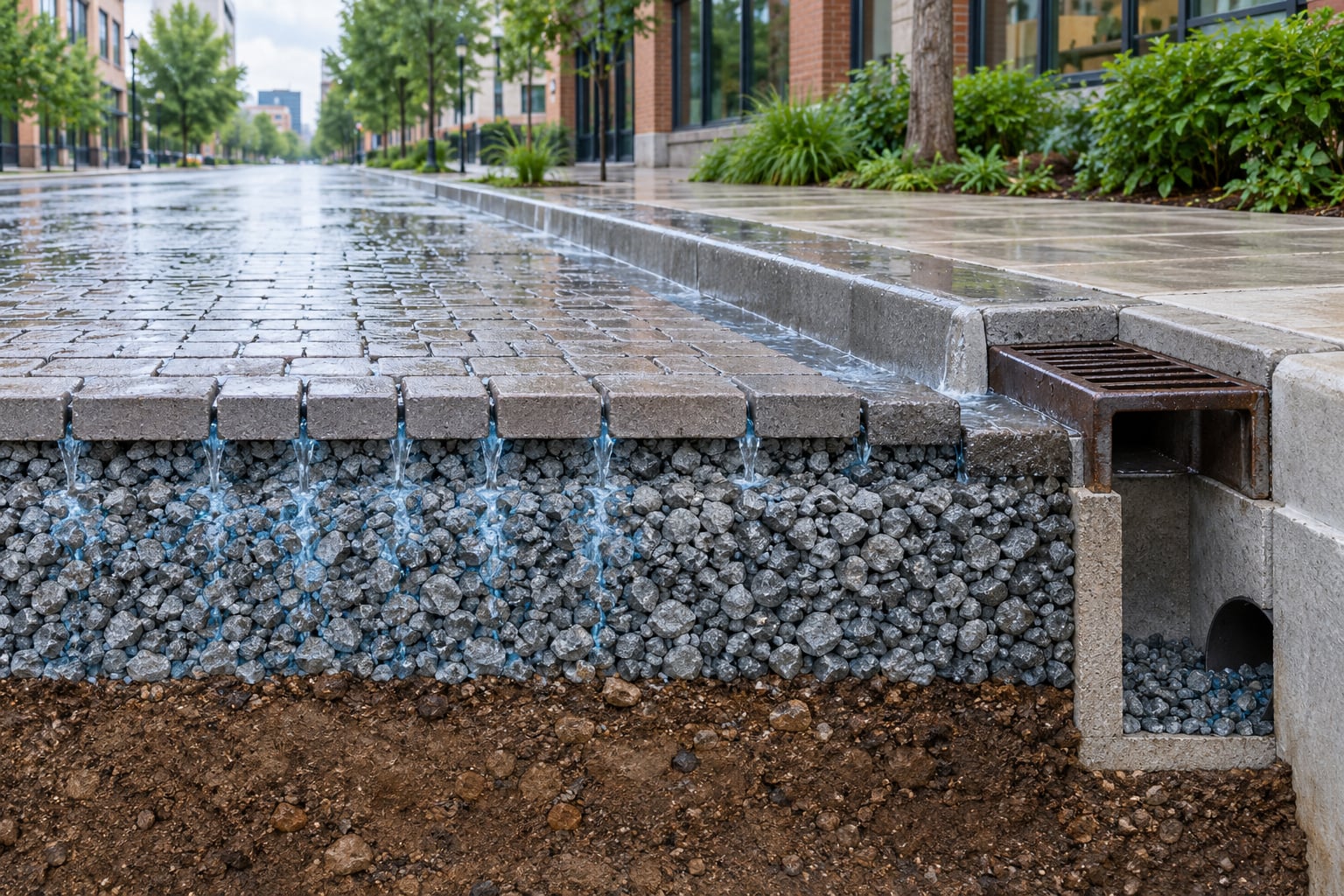
Permeable pavement works by letting rainwater pass through the paved surface and into an underground stone reservoir, where it is stored for a while and then soaks into the soil or drains away through a pipe. Instead of sheeting across a hard surface and heading straight for a storm drain, the water is slowed down and filtered on its way down. That is the whole mechanism, and everything else is detail.
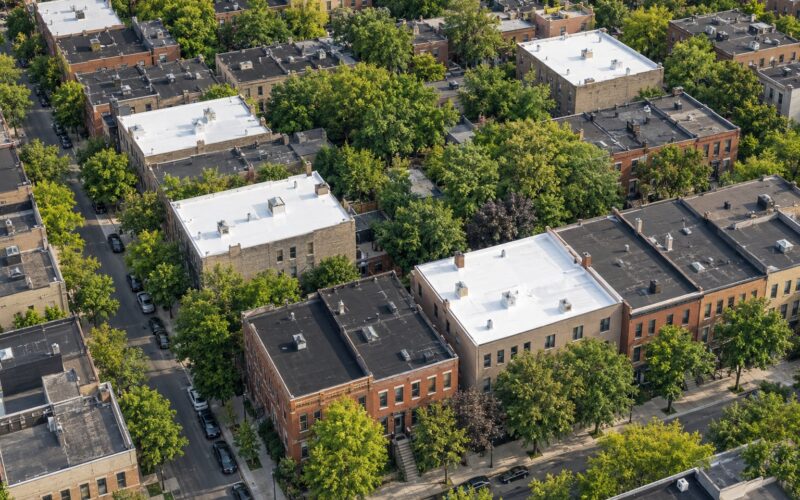
The reason cities care is arithmetic. Every square foot of asphalt or concrete sends nearly all the rain that lands on it into a pipe, fast enough to overwhelm older drainage networks during a single storm. Permeable pavement deliberately breaks that speed. A permeable sidewalk or parking lot behaves more like a shallow sponge, which is the idea behind Low Impact Development, or LID, a stormwater approach the EPA and FHWA both promote for retrofitting sites that cannot grow larger.
Table of Contents
- How Permeable Pavement Works
- What Is Permeable Pavement?
- What Are the Main Types of Permeable Pavement?
- What Happens When Rain Falls on Permeable Pavement?
- How Does the Underneath Structure Support the Surface?
- Why Is Permeable Pavement Used in Cities?
- What Are the Benefits and Limitations?
- How Is Permeable Pavement Installed?
- How Does Permeable Pavement Stay Working?
- What Affects How Well It Performs?
- How Is It Different from Conventional Pavement?
- Frequently Asked Questions
- What are the downsides of permeable paving?
- How long does permeable asphalt last?
- Is a permeable driveway cheaper than concrete?
- How expensive is permeable asphalt?
- How fast does permeable pavement drain?
- Do permeable pavers need a permit?
- Start With the Drainage Goal
How Permeable Pavement Works
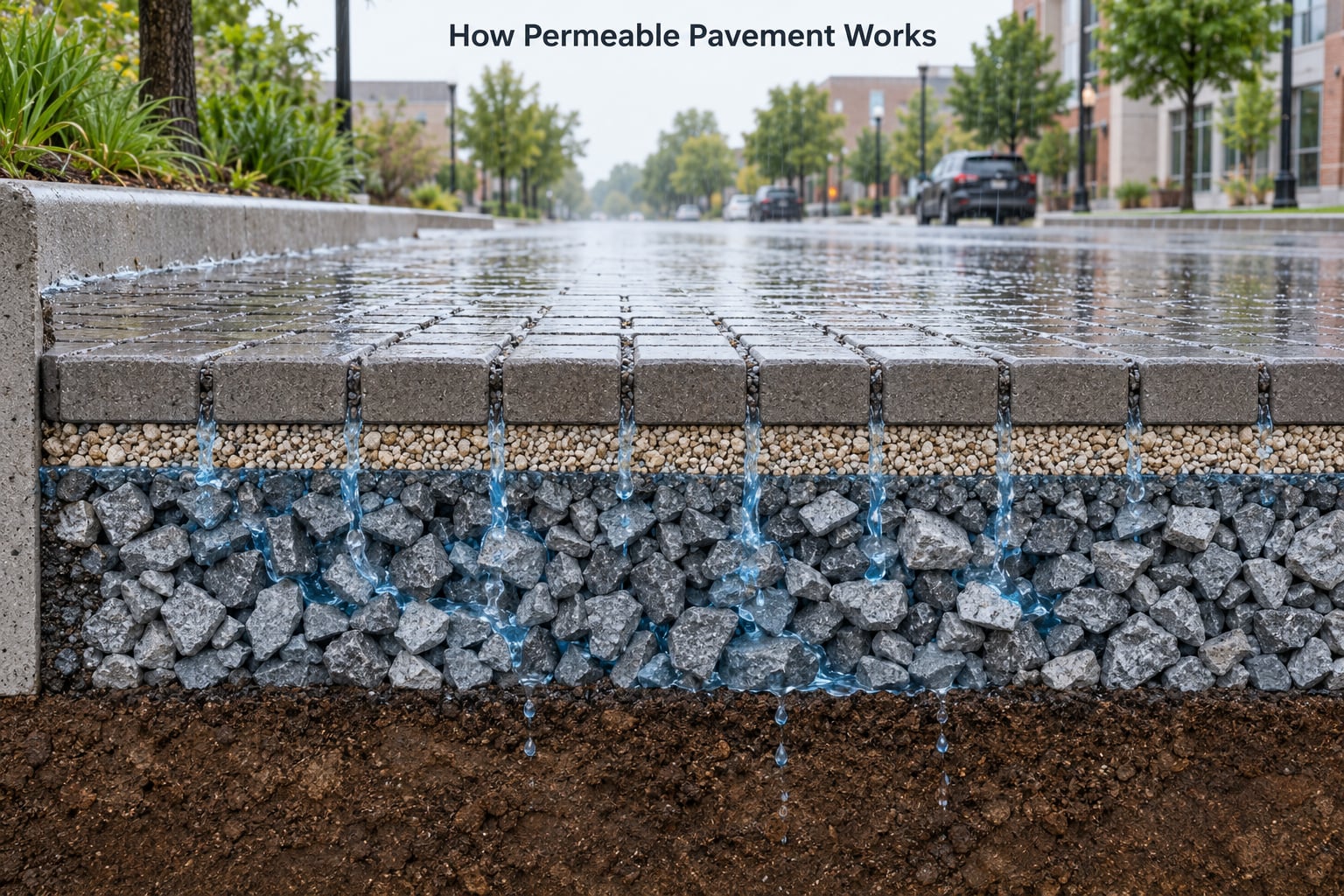
Water travels through openings in the surface into a bed of open-graded crushed stone below. That stone acts as a temporary reservoir, holding the water until it can infiltrate into the subgrade soil or leave through an underdrain. The surface itself is only the first stop, and the layer underneath is what actually does the storage work.
Understanding how permeable pavement works means looking at a stack of layers, each one doing a specific job. Get the stack wrong and the surface infiltrates fine on day one while the system backs up a year later.
What Is Permeable Pavement?
Permeable pavement is any paved surface built with connected voids so water can pass through it rather than across it. The EPA groups the common systems into three families: pervious concrete, porous asphalt, and permeable interlocking concrete pavers, often called PICP or simply permeable pavers.
Each family achieves that porosity a different way. Pervious concrete leaves the voids inside the mix by skipping the fine sand and part of the cement paste, so the pores run through the full thickness of the slab. Porous asphalt gets its voids from an open-graded aggregate that holds relatively little asphalt binder. Permeable pavers are solid concrete blocks set with wide, open joints filled with small stone, so the water moves through the gaps rather than through the blocks themselves.
That last point trips up a lot of people. With pavers, the concrete is not porous. The joints are the entire drainage path, which is why joint condition decides how well the surface performs.
What Are the Main Types of Permeable Pavement?
| System | How Water Passes Through | Typical Infiltration Rate | Best Suited To |
|---|---|---|---|
| Pervious concrete | Voids inside the concrete mix, continuous through the slab | Generally lower than pavers; slab prone to surface sealing | Low-traffic areas, sidewalks, light-duty streets |
| Porous asphalt | Voids inside an open-graded aggregate held by asphalt binder | Moderate, declines as binder coats the deeper pores | Parking lots, driveways, bike and walking paths |
| PICP | Wide open joints filled with washed stone | Highest of the three; measured rates up to 1,574 in/hr reported | Plazas, courtyards, low-speed streets, overflow lots |
| Resin-bound aggregate | Open aggregate locked in a resin layer, water passes between stones | Moderate; more common outside the US | Decorative paths, courtyards, lighter-duty areas |
| Open-grid pavers | Large voids formed by the shape of the block itself | High; vegetation can root in the openings | Emergency overflow parking, bioswale edges, verges |
Contractors tend to be more selective than specifications suggest. On forums, the pattern people report is consistent: permeable systems get used on sidewalks, parking lots, driveways and overflow areas, and left off heavy truck routes.
What Happens When Rain Falls on Permeable Pavement?
Follow a single raindrop from the gutter to the groundwater. Five steps cover the whole trip.
- The surface intercepts it. Water hits the pores in pervious concrete or porous asphalt, or the open joints between pavers. A slight slope toward a drainage inlet moves any water the surface cannot absorb.
- The bedding course carries it downward. A layer of washed open-graded aggregate, usually around 2 inches for pavers, sits under the surface and passes water into the base.
- The base and subbase store it. This is the stone reservoir: deep layers of open-graded crushed stone with roughly 30 to 40 percent void space. The water sits there, spread out across the area rather than concentrated.
- A filter layer keeps the stone clean. Geotextile fabric between the aggregate and the subgrade stops fine soil from migrating up and filling the voids, which would slowly kill the storage capacity.
- The water leaves the system. Most of it infiltrates into the subgrade soil and recharges groundwater. Where the soil drains poorly or the seasonal high water table sits too close to the surface, an underdrain pipe carries the water away to a storm system instead.
That final choice is the design decision that separates one permeable project from another.
How Does the Underneath Structure Support the Surface?
The pavement you stand on is the thinnest part of the system. Everything that makes permeable pavement work happens below it.
| Layer | What It Does |
|---|---|
| Surface layer | Handles traffic and resists wear while letting water in. Pervious concrete or porous asphalt at 4 to 8 inches; permeable pavers at 80 mm or 60 mm depending on load. |
| Bedding course | Open-graded aggregate that levels the surface and passes water down into the base. |
| Base and subbase reservoirs | Deep open-graded stone storing runoff like an underground cistern. Depth is sized so the reservoir drains within 24 to 72 hours. |
| Choker layer | A finer, tightly graded stone band that locks the surface layer in place and stops it from shifting into the base. |
| Geotextile filter fabric | Separates the stone from native soil so fines do not wash up and clog the voids. |
| Subgrade soil | The existing ground. Its infiltration rate decides whether full infiltration is possible at all. |
A common detail is the subgrade: designers often amend heavy clay with sand or gravel, or undercut and replace it, because clay simply will not accept water at the rate the surface delivers it.
Why Is Permeable Pavement Used in Cities?
Cities install it to slow water down and keep it out of the pipes. Texas A&M AgriLife and UF/IFAS have both documented measurable runoff volume reductions in the range of 73 to 85 percent for these systems, which is a large share of a typical rainfall event intercepted rather than discharged.
The rest of the case is water quality and load. Passing through a foot or more of open-graded stone filters the water, with PICP reported to remove roughly 67 to 81 percent of total suspended solids along with meaningful amounts of metals and nutrients. Peak flows arrive at the storm system spread out over hours instead of arriving in a spike, so pipes and culverts sized for the old flow rates cope better.
There are secondary effects cities notice. Groundwater recharge improves, surface water stays available for irrigation rather than going to a discharge point, and permeable surfaces stay cooler than dark asphalt during summer heat. Snowmelt and de-icing water infiltrate where it lands instead of refreezing on a street.
The smart city layer is newer. Sensor-instrumented test sections now feed infiltration and moisture readings into municipal drainage dashboards, which lets a public works department watch a system age instead of waiting for a pothole complaint.
What Are the Benefits and Limitations?
| Factor | Where It Favors Permeable | Where Conventional Wins |
|---|---|---|
| Runoff volume | Intercepts a large share of rainfall on site | Sends everything to the pipe |
| Infiltration | Varies widely; measured rates run from 5 to 1,574 in/hr across published projects | None; the surface sheds water |
| Maintenance | Needs sweeping and periodic joint top-ups | Shovel and patch only |
| Clogging | Joints and pores collect silt and organic debris over time | No pore structure to clog |
| Upfront cost | Higher, because of the stone reservoir and filter layers | Cheaper to build |
| Durability | Serviceable, but sensitive to load and to poor compaction | Proven under heavy traffic |
| Winter | Handles freeze-thaw well; needs conventional snow and de-icing practice | Standard practice |
| Groundwater | Fails on clay subgrade or a shallow seasonal high water table | Unaffected by soil conditions |
| Site fit | Parking lots, sidewalks, plazas, low-speed streets, overflow areas | Heavy truck routes, fueling and chemical storage areas |
Two hard limits show up repeatedly in practice. Clay-heavy subgrade can defeat the whole design, and upslope sediment sources will plug the surface faster than any maintenance schedule can keep up. For that reason, permeable surfaces are discouraged where runoff crosses a sediment-trapping slope on its way down, and around fueling or chemical storage where leaked fluid would reach the groundwater.
Anyone who promises a permeable surface eliminates runoff is overselling it. During a storm larger than the reservoir can hold, the system reaches capacity and behaves like a very good temporary drain, passing excess water through toward the outlet or overflow route.
How Is Permeable Pavement Installed?
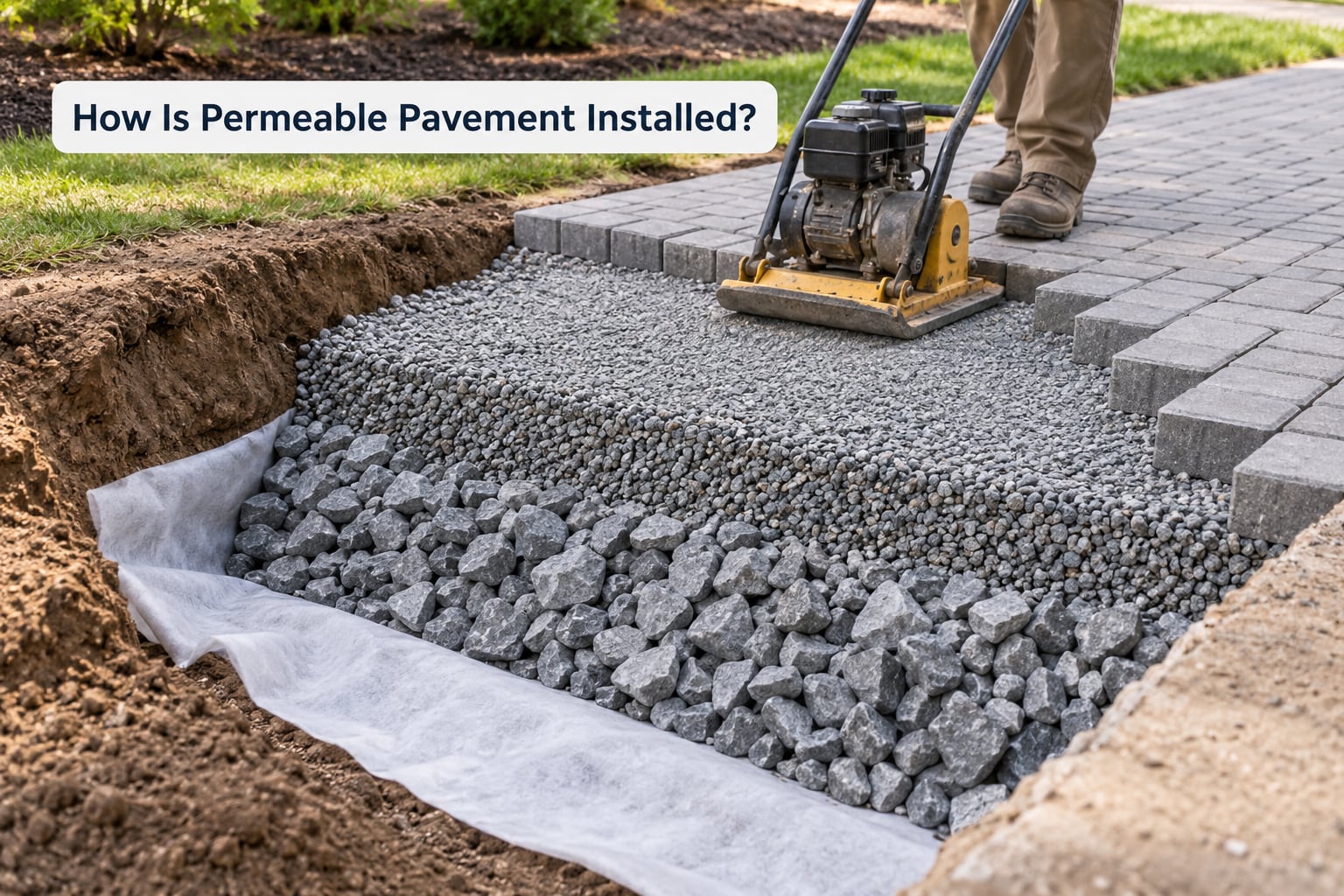
Installation runs bottom to top, and the order matters more than the finish work.
- Excavate to depth. Remove topsoil and cut the trench deeper than the base requires, including subgrade treatment.
- Prepare the subgrade. Confirm soil infiltration, and amend or replace clay. Compact and shape for drainage.
- Lay the filter fabric. Geotextile covers the prepared subgrade so stone and soil stay separated.
- Place and compact the base and subbase. Place open-graded stone in lifts, compacting each one, until the reservoir reaches design depth.
- Add bedding or choker course. A layer of smaller aggregate sets the surface and keeps it locked in place.
- Install the surface. Place porous asphalt or lay pavers; edge restraints hold the joints in line.
- Fill joints and inspect. Sweep stone into the joints, then test infiltration before the area is accepted.
Each project still needs site-specific engineering. Compaction of the reservoir is the step most often skipped and the one that most often explains a system that underperforms.
How Does Permeable Pavement Stay Working?
Performance decays gradually, and almost all of the loss is surface clogging. The cure is unglamorous: keep fines out of the joints and out of the pores.
- Vacuum or regenerative air sweeping. Twice a year is the usual recommendation, timed before and after the growing season so debris never has a chance to set.
- Joint top-up. Stone settles out of the joints in the first months after installation, and topping up around the 3 to 6 month mark is normal rather than a warranty problem.
- Infiltration testing. ASTM C1781 is the standard field test used to measure surface infiltration rate.
- Watch the trigger numbers. ICPI Tech Spec 23 calls for attention when measured infiltration falls below 20 in/hr, or below 40 in/hr on surfaces steeper than a 2 percent slope, and for corrective action when ponding exceeds 20 percent of the surface area or water stands for more than 15 minutes.
- Keep sediment sources away. Leaves, mulch and construction dust entering the surface do more damage than any amount of traffic.
- Repair settled areas early. A patch of settlement is far cheaper to fix before it becomes a ponding spot that collects dirt.
Owners with permeable paver driveways report a fairly settled routine: regular sweeping and occasional joint top-ups keep the water moving, and upkeep runs a little higher than with a solid driveway.
What Affects How Well It Performs?
Nine factors decide whether a permeable surface handles a storm or backs up.
- Rainfall intensity. A system sized for a design storm will overflow during a heavier one. Capacity is a volume, not a rate.
- Soil infiltration rate. This is the go or no-go number. Poorly draining subgrade rules out full-infiltration design.
- Groundwater level. A shallow seasonal high water table leaves nowhere for water to go.
- Reservoir depth. Too shallow and the storage runs out mid-storm; too deep and you have paid for aggregate that never gets used.
- Surface slope. A 1 to 2 percent fall moves excess water to a drainage inlet when the pores cannot keep up.
- Clogging. Silt, leaves and fines are the most common cause of declining rates.
- Construction quality. Segregated aggregate, under-compacted base layers and mixed-in fines all reduce the void space the design depends on.
- Traffic loading. Pervious concrete and porous asphalt lose strength faster under repeated heavy loads; pavers hold up better because each block carries its own load.
- Climate. Rainfall pattern, freeze-thaw cycles and drought all change how quickly the reservoir draws down.
Designers resolve the conflict between these factors with three approaches. Full-infiltration design sends all collected water into the soil and needs good subgrade. Partial-infiltration design treats some volume and underdrains the rest. A lined system stores and releases water through a pipe without relying on the soil at all, which is what most sites with clay or a high water table end up with.
How Is It Different from Conventional Pavement?
| Criterion | Permeable Pavement | Conventional Pavement |
|---|---|---|
| Water path | Through the surface into stone, then into soil or a pipe | Across the surface into gutters and pipes |
| Where water goes in a storm | Some infiltrates, some is stored, excess drains through an outlet | All of it runs off, fast |
| Surface appearance | Textured, aggregate visible, often lighter in color | Uniform, smooth, dark |
| Structural design | Thin surface over a deep granular base | Thicker base and subbase designed for loads |
| Maintenance | Regular sweeping, joint top-ups, infiltration testing | Resurfacing, patching, sealing |
| Stormwater rules | May qualify for a drainage credit or reduced impervious area | Counts as impervious surface |
| Typical uses | Parking lots, sidewalks, plazas, low-speed streets, driveways | Highways, heavy truck routes, loading areas |
Conventional pavement is cheaper to build and better suited to heavy loads. Permeable pavement is the option that fits where the drainage problem actually is, which is usually the same place the flooding happens.
Frequently Asked Questions
What are the downsides of permeable paving?
The real drawbacks are maintenance and site constraints. Surfaces clog with silt, leaves and jointing fines, so they need regular vacuum or regenerative air sweeping and periodic joint top-ups. Performance depends on soil that actually drains and a water table low enough to allow it. Heavy truck loading degrades pervious concrete and porous asphalt faster than conventional pavement, and the system cannot store more than its reservoir capacity in a large storm.
How long does permeable asphalt last?
Porous asphalt on a properly constructed stone base typically gives 15 to 20 years of service in parking and low-duty areas before resurfacing. Lifespan shortens with heavy traffic and with maintenance lapses, because clogged pores hold water in the binder and accelerate raveling. The underlying reservoir usually outlasts the surface, so a worn surface can often be renewed without rebuilding the base.
Is a permeable driveway cheaper than concrete?
No. A permeable paver or pervious concrete driveway generally costs more than a plain concrete slab, because you are also buying excavated depth, open-graded stone, geotextile and extra labor. Some municipalities credit drainage fees or offer stormwater utility credits for permeable work, which can offset the difference over time. For a private driveway, treat the higher upfront cost as a long-term trade rather than a bargain.
How expensive is permeable asphalt?
Cost per square foot depends on region, excavation depth, required reservoir thickness and how much of the existing surface can be reused. The stone reservoir is usually the largest line item, and sites with clay subgrade add amendment or undercut costs on top. Figures quoted by agencies such as FHWA and local public works departments are the most useful starting point, since material and labor vary widely by region.
How fast does permeable pavement drain?
The surface handles water far faster than the underlying reservoir can release it. Measured surface infiltration rates in published projects range from about 5 to 1,574 in/hr, but the system as a whole is limited by how quickly the subgrade accepts water. That is why design usually targets the reservoir drawing down fully within 24 to 72 hours, so it is ready before the next storm arrives.
Do permeable pavers need a permit?
It varies by jurisdiction. Because permeable surfaces reduce the amount of impervious area on a site, some planning departments treat them as stormwater best management practice and require a small design, soil test or drainage plan before approval. Others classify them purely as a paving material. Check with the local building or public works department early, since reworking an approved footprint to meet impervious area limits is expensive.
Start With the Drainage Goal
The mechanism is simple, but the right system depends on three things: where the water needs to go, what your soil will accept, and how deep your water table sits. Test the subgrade first, because a poor infiltration rate turns the choice into a partial-infiltration or lined design rather than a full one.
Then work with a civil or stormwater engineer to size the reservoir for the design storm, confirm the maintenance plan, and check whether your jurisdiction counts the surface as impervious. Most sites that fail do so for one reason: nobody checked the soil before the stone went in.