Reduce duplicate reports in a citizen reporting app by scoring every new submission against open records at ingestion time: location proximity first, then a time window, then category and description similarity. High-confidence matches merge into the existing record, uncertain ones go to a human queue, and nothing is deleted. Most teams get a meaningful cut in queue noise within a week of wiring up geospatial matching alone; text and image signals come after that.
The reason duplicates pile up is rarely one thing. It’s the same pothole submitted through the app, the web form, and the phone line, all landing as separate tickets because each channel writes to its own record. Residents with the same complaint can’t tell that anyone else already reported it, so the twentieth report on a storm drain arrives with the same energy as the first.
Getting this wrong is expensive in both directions. Over-aggressive matching buries a real complaint about a different problem. Under-aggressive matching leaves your public dashboard looking like a city in crisis when nothing has actually changed. The goal is a queue where each real-world issue appears once, with every resident who reported it still attached to the outcome.
Table of Contents
- What You Need
- A fixed category taxonomy
- Normalized locations
- Reliable timestamps
- Image and text payloads
- A usable access model for moderators
- A labeled test set
- Step-by-Step: Reduce Duplicate Reports Without Losing Valid Reports
- 1. Define what counts as a duplicate
- 2. Standardize the information submitted with each report
- 3. Add location and time-based matching
- 4. Use text, image, and metadata signals
- 5. Create a review workflow instead of silently deleting reports
- 6. Prevent duplicates at the point of submission
- 7. Test the rules with real examples and edge cases
- 8. Measure quality and tune the system
- How matching approaches compare
- Common Mistakes
- Treating proximity as proof
- Deleting instead of merging
- Penalizing repeat reporters
- Depending on exact wording
- Hiding existing reports from residents
- Automating without an audit trail
- Ignoring which neighborhoods get deduplicated
- Practical tips for a cleaner reporting queue
- Frequently Asked Questions
- How should a citizen reporting app identify duplicate reports?
- What is the best way to merge duplicate reports without losing comments?
- How close together should reports be before they are considered duplicates?
- Should duplicate reports be deleted automatically?
- How can an app reduce repeat submissions during an active incident?
- What metrics show whether duplicate detection is working?
What You Need
Before any matching runs, you need clean inputs. Without them, every threshold you set later will be arbitrary.
A fixed category taxonomy
Merge the labels your channels have accumulated into one controlled list. “Pothole,” “road damage,” and “street defect” should be one category, otherwise your matcher compares two records about different things and calls them unrelated.
Normalized locations
Every report needs a latitude and longitude, not just an address string. Addresses geocode to different points depending on the address database, and residents enter “Main St” without a house number often enough to matter. Store the point the resident actually tapped or the geocoded result, plus the raw address text for display.
Reliable timestamps
Keep both the time the resident submitted and the time the record was created in your system. Phone reports arrive days late, and channel-created timestamps are what a temporal window should run against.
Image and text payloads
Descriptions, photo attachments, and any structured fields such as hazard level or direction of travel. These become the secondary signals once location matching works.
A usable access model for moderators
Someone has to see uncertain matches. That means a queue, merge and dismiss actions, an audit trail, and roles that distinguish a moderator from an administrator. Teams running citizen reporting apps often build the matcher first and discover later that nobody is authorized to act on its output.
A labeled test set
Pull a few hundred historical records and have two staff members independently label them as duplicates, related, or distinct. This is the only honest way to know whether a threshold change helped. Without it, you are tuning on vibes.
Step-by-Step: Reduce Duplicate Reports Without Losing Valid Reports
1. Define what counts as a duplicate
A duplicate is two or more records describing the same physical issue at the same location that should be resolved by one work order. That’s the whole definition, and it’s narrower than most teams assume.
Related is not duplicate. Five residents reporting five different potholes on the same block of a street are five issues that belong in one neighborhood project but stay five records. Recurring is not duplicate either: a streetlight that fails again three weeks after a repair is a genuine new report, and merging it into the closed record destroys the repair history a public works team depends on.
Write your rule as a sentence and get a frontline dispatcher to agree with it. If two staff members would classify the same pair differently, the rule isn’t finished.
2. Standardize the information submitted with each report
Reliable matching needs comparable data, so normalize at intake: a controlled category, a single time format, and a point rather than a string. Auto-suggest the category as the resident types and confirm it before submission rather than trusting free text.
Add required fields that matter for matching later, like which side of the street or which direction of travel, only where the category genuinely requires them. Asking for everything on every report just produces skipped fields.
3. Add location and time-based matching
This is the highest-value step and the one most teams ship first. When a new report arrives, query open records in the same category within a radius, and within a time window, of the new point.
Common starting values are a buffer of roughly 50 to 100 meters and a window of 24 to 72 hours, but the right numbers depend on your category. A streetlight is a fixed object you can match within 15 meters. Illegal dumping needs a wider radius and a much longer window, since the same site gets dumped in repeatedly and each occurrence is real.
For the storage layer, a geospatial index such as PostGIS ST_DWithin, an H3 cell at an appropriate resolution, or a geohash prefix will do the candidate lookup in milliseconds at city-scale volumes. The candidate query should be cheap and broad; scoring happens after it returns a short list.
4. Use text, image, and metadata signals
Location alone will produce false positives in dense areas. Two adjacent front doors in a terrace are 8 meters apart, and a resident reporting a damaged step is not a duplicate of the neighbor reporting a broken gate.
Layer in a similarity score for the description text. Token overlap or edit distance handles “big hole in road” against “large pothole on carriageway” reasonably well. Sentence embeddings handle the harder cases, and for reports at municipal volume a hosted embedding endpoint is a realistic starting point rather than an exotic choice.
On images, perceptual hashing catches the same photo re-uploaded by a channel bot. It won’t catch a different photo of the same hole, which is fine, because the location signal already handles that case. Skip facial recognition and any identity-based signal entirely. Civic reporting apps attract reports about people, and inferring identity from a photo turns a duplicate checker into a surveillance tool.
5. Create a review workflow instead of silently deleting reports
Never drop a citizen’s report without a record that it was linked. The reviewer experience matters more than the matching algorithm here.
Split results into three confidence bands. High-confidence matches merge automatically and notify both residents. Medium-confidence matches sit in a queue showing the two records side by side with the matched signals highlighted, so a moderator can merge or dismiss in a few seconds. Low-confidence matches become new records untouched.
Give every action a reason code and an undo path. Merging should link the records, keep both authors, and consolidate comments and photos onto the parent — deleting instead leaves a resident wondering where their submission went. Moderators who can’t reverse a mistake will hesitate, and hesitant moderators let the backlog grow. Anyone can file an appeal when a merge is wrong, and those appeals are your best correction signal.
6. Prevent duplicates at the point of submission
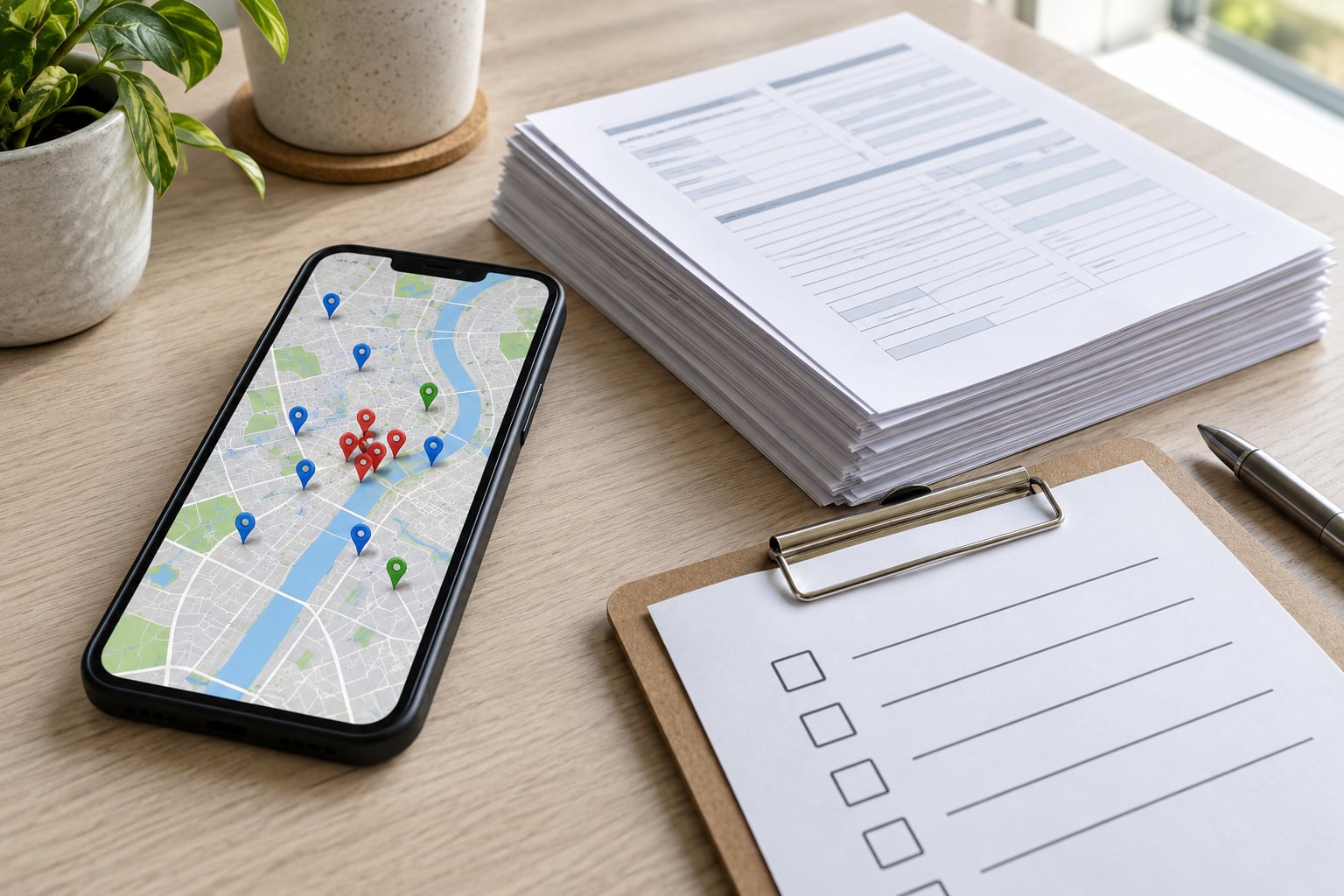
Detection is your safety net; prevention is cheaper. Before the resident submits, show nearby open reports on a small map with one line of context: “3 other people reported an issue here this week.” Offer to add them as a supporter of the existing report, which preserves their contribution without creating a new ticket.
The supporter model does more work than any matching tweak. It turns a duplicate into engagement data, and residents who get a status notification on the issue they joined stay involved. Some teams pair it with an explicit confirmation step: “Someone already reported this on Monday. Add your photo to that report, or submit a separate report if this is a different problem.” The escape hatch matters, because sometimes it really is a different problem.
7. Test the rules with real examples and edge cases
Run your labeled set before you go live, then hand-test the awkward cases. Recurring events such as a festival with the same noise complaints every year. Multiple locations in one report, such as every streetlight on a block. Different wording from different channels describing the same thing. Delayed phone reports arriving days after a storm. Anonymous submissions with no account history. Accessibility needs, since a flow that requires typing an address fails the residents most likely to be reporting from a sidewalk.
Start in shadow mode. The matcher runs on every submission and logs what it would have done, but nothing changes. A week of logs shows you the false-positive rate before a resident ever sees a wrong merge.
8. Measure quality and tune the system
Track a small set of numbers weekly. Duplicate rate tells you how much of the queue is repeats. False-merge rate, measured from moderator reversals and resident appeals, tells you what matching costs you in trust. Median review time tells you whether the queue is draining. Resolution time per unique issue tells you whether deduplication actually improved service, which is the metric that decides whether the program survives budget season.
Adjust one threshold at a time and keep the labeled set as your regression check. Loosen the radius when appeals spike; tighten the window when distinct issues get merged. Categories behave differently enough that a single global buffer rarely stays optimal for long.
How matching approaches compare
Each signal catches cases the others miss, which is why layered matching beats any single approach.
| Approach | Catches | Blind spot | Build effort |
|---|---|---|---|
| Geospatial buffer | Same spot reported through different channels | Adjacent but separate issues in dense housing | Low |
| Temporal window | Repeat submissions during an active incident | Delayed phone reports outside the window | Low |
| Text similarity | Same issue described differently | Very short descriptions, typos, non-English input | Medium |
| Image hashing | Re-uploaded or forwarded photos | New photos of the same problem | Medium |
| Hybrid scoring | Most real cases | Tuning cost, and it needs labeled data to tune | High |
Common Mistakes
Treating proximity as proof
Two records 10 meters apart are often two problems. Require category agreement and at least one corroborating signal before merging automatically.
Deleting instead of merging
Deletion removes the resident from the issue and hides the fact that anyone else cared. Link records, preserve both authors, consolidate comments.
Penalizing repeat reporters
A resident who reports the same problem twice is often the most engaged person on your platform. Rate limits and blocks hit the people with the worst connectivity or the most persistent problems. Moderators handling community apps already report the pain point of coordinated false reports from bot clusters; the answer is verification on the report, not punishment of the account.
Depending on exact wording
String equality catches almost nothing in practice, and it fails hardest on the residents whose first language isn’t the one your forms were written in.
Hiding existing reports from residents
If people can’t see the open report, they’ll file their own every time. Public status visibility is what makes deduplication feel fair rather than like silent rejection.
Automating without an audit trail
Any decision that removes a citizen’s report from view needs a timestamp, a rule version, and a human who can reverse it. Without that, a bad threshold quietly buries real complaints for weeks.
Ignoring which neighborhoods get deduplicated
Aggressive matching in neighborhoods with less trust in city systems looks like silencing. Audit merges by area, and watch whether suppressed reports concentrate in the communities already least served. Research on 311 data has documented how reporting patterns skew toward who feels safe filing, so dedup rules can compound an existing gap instead of just cleaning a queue.
Practical tips for a cleaner reporting queue
Label every merged pair with the signal that triggered it. When your false-positive rate climbs, that column tells you which rule to loosen in minutes instead of guessing.
Show moderators a confidence score and the matching evidence together. A number without context gets overridden by instinct; the side-by-side records get a fast, correct decision.
Train moderators on the edge cases from your own labeled set, not on a policy document. The pair of records that nearly convinced you to merge something you shouldn’t have is worth more as a training example than any rule in a wiki.
Keep the resident’s raw submission intact. Deduplication should reorganize your view of the work, not rewrite what someone told you happened.
Publish what happens to a merged report. A one-line status update sent to everyone attached to an issue does more for trust than any efficiency gain you report to the council.
Frequently Asked Questions
How should a citizen reporting app identify duplicate reports?
Score each new submission against open records using several signals in order: geospatial proximity first, then category agreement, then a time window, then description and image similarity. Combine them into one confidence score rather than trusting any single signal. High-confidence matches merge automatically, medium-confidence matches wait for a moderator, and everything else becomes a new record.
What is the best way to merge duplicate reports without losing comments?
Link the records instead of deleting either one. The merged record keeps every author’s name, all comments, and all photos, and each linked record stays viewable in history. Every merge records who performed it, why, and under which rule version, so it can be reversed. Residents attached to a merged issue should receive status updates on it.
How close together should reports be before they are considered duplicates?
It depends on the category. Fixed assets like streetlights work with a buffer of roughly 15 meters, while street surface defects often need 50 to 100 meters. Categories such as illegal dumping need a wider radius because sites repeat. Also require matching categories and a time window, usually 24 to 72 hours, before proximity alone can trigger a merge.
Should duplicate reports be deleted automatically?
No. Merging automatically is fine at high confidence when the action is fully logged and reversible, but deletion hides the fact that a resident raised the issue and can bury a legitimate second problem. Keep the original record, attach it to the parent issue, and make the merge reversible with a reason code so moderators and residents can see what happened.
How can an app reduce repeat submissions during an active incident?
Widen the time window while the incident is open, show nearby open reports on the map before submission, and offer to join the existing report as a supporter instead of creating a new one. Send supporters the same status updates. After the incident closes, return the window to normal so a genuinely recurring problem later is still captured as new.
What metrics show whether duplicate detection is working?
Watch duplicate rate, false-merge rate measured from moderator reversals and resident appeals, median time in the review queue, and resolution time per unique issue. Also track resident corrections, where someone reports that a merge was wrong. If appeals rise in a specific area, treat that as a signal to loosen thresholds there rather than as noise.
Start with the smallest useful version. Normalize your categories and locations, add a category-aware radius and time window at ingestion, run it in shadow mode for a week against a labeled sample, and merge only what clears a high bar. Once that works, layer in the supporter flow at submission time, which is where most of the remaining noise disappears. Revisit the thresholds monthly against your appeal rate rather than trusting the first configuration to hold as your volume grows through 2026.