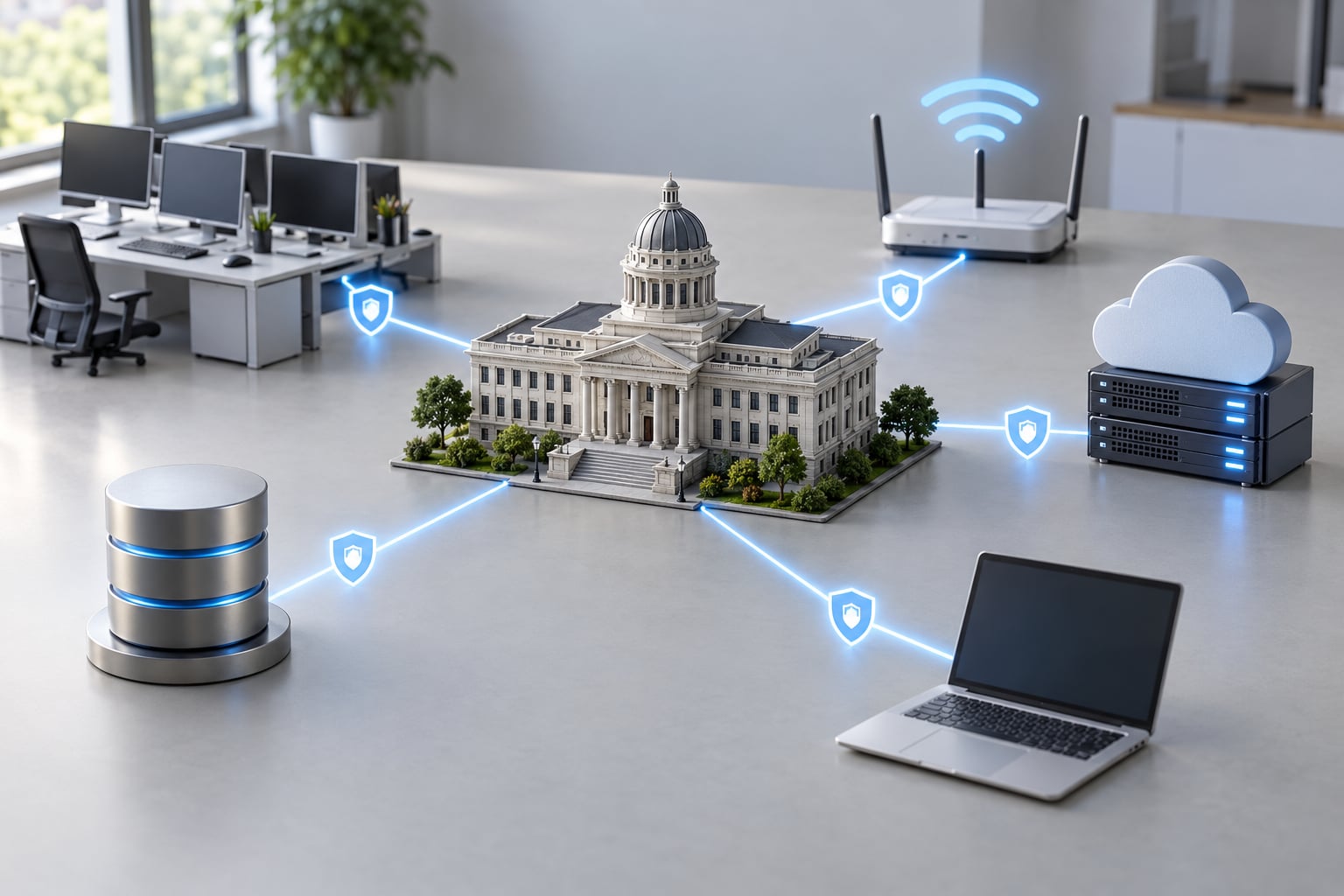
Municipal data breaches happen when someone with no business seeing city records gets into them, usually through a phished staff login, an internet-exposed remote access service, an unpatched vulnerability, or a vendor with weak controls. From there they copy, encrypt or sell the data, or use it to interrupt services residents depend on.
That short version is close to the truth, but it hides the part municipal leaders actually want: the pattern behind it. Almost no city breach is one dramatic masterstroke. It is a chain of ordinary weaknesses, each one survivable on its own, that line up.
Table of Contents
- How Municipal Data Breaches Happen
- What Data and Systems Are Usually at Risk?
- The Typical Municipal Data Breach Attack Path
- Why City Systems Are Vulnerable
- Common Causes of Municipal Data Breaches
- Compromised credentials: how municipal data breaches happen most often
- Ransomware with data theft
- Exposed remote access and unpatched software: how municipal data breaches happen quietly
- Misconfiguration and accidental exposure
- Denial of service attacks
- Insider mistakes and insider misuse
- Stolen and lost equipment
- Compromised vendor and update channels
- Availability plus extortion, combined
- How Vendors and Municipal Service Providers Increase the Risk
- How Cities Can Prevent and Reduce the Impact
- What Should a City Do After Suspecting a Breach?
- Frequently Asked Questions
- What is the most common cause of municipal data breaches?
- How can stolen city employee accounts lead to a data breach?
- Can ransomware affect municipal services as well as expose data?
- How should municipalities evaluate a vendor’s cybersecurity controls?
- Does encryption prevent a municipal data breach?
- How quickly must a city respond to a suspected data breach?
- Conclusion
How Municipal Data Breaches Happen
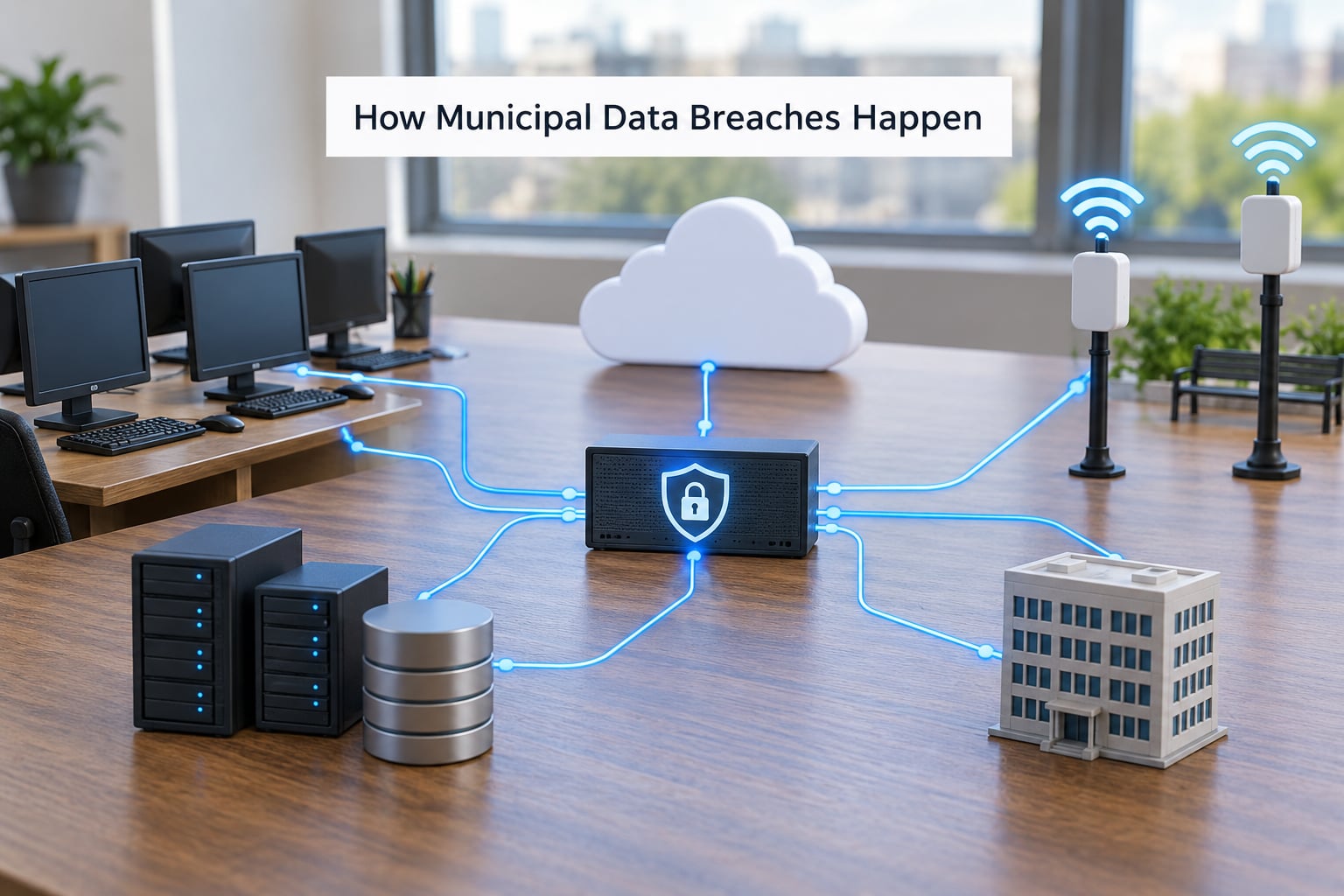
A municipal data breach is a confirmed event where an unauthorized party reaches data held by a city, county, town or other local government. Incidents are far more common than breaches: a blocked login or a quarantined email is an incident, while an intruder who actually reads or copies protected records is a breach.
Underneath the headlines, the mechanism repeats in the same five stages.
- Someone works out what is worth taking. Public data portals, permit and job sites, meeting minutes, vendor announcements and open records requests give attackers a map. A city’s own website often describes its systems more clearly than any security document would.
- They get a first foothold. A phished login, an exposed remote desktop service or an unpatched edge device is usually enough. It takes minutes, and it rarely needs a zero-day.
- They exploit the weak spot they found. Weak passwords, missing multi-factor authentication, over-permissioned accounts and unmaintained software do the rest of the entry work.
- They settle in and spread. Moving from one machine to the next across departmental servers is where a small intrusion becomes a city-wide one. The longer it stays quiet, the more systems it touches.
- They expose the data or use it as leverage. Copying records out before encrypting anything, then demanding payment to keep quiet, is the modern pattern. Pure service disruption is still used on its own.
What Data and Systems Are Usually at Risk?
Municipalities hold an unusually dense mix of personal and operational information, and much of it never leaves the building. Attackers weigh that against the fact that essential services stop working when systems do.
- Resident records. Utility billing, property tax and land transfer, permits, building inspections, vital records, court dockets, library cards, park and program registration.
- Payment details. Card numbers and bank account details attached to bill payments, and the recurring billing systems behind them.
- Employee and payroll data. Names, home addresses, salaries, tax details, benefits records, background checks and, in some cities, badge and access data.
- Utility and mobility systems. Water and wastewater billing, public transit and fare collection, parking systems, traffic signal control, and the billing portals behind them.
- Operational technology. Pumps, treatment sensors, air quality monitors, smart meters, cameras, and other Internet-connected devices that bridge into the physical world.
- Public communications. The city website, the content system behind it, the email domain used for official notices, and public Wi-Fi at libraries, airports and civic centres.
Resident data is the prize, but availability is the pressure point. Residents cannot pay a water bill, apply for a permit or call 311 through a broken portal, and councils notice that faster than they notice a spreadsheet leak.
The Typical Municipal Data Breach Attack Path
Traced end to end, the path is rarely clever. It is patient.
Atlanta shows how a technical shortcut becomes a city crisis. On March 22, 2018, an attacker exploited a JBoss deserialization flaw in the city’s network to gain a foothold. The attacker established persistence, deleted logs to slow discovery, then moved across the city’s systems and encrypted them, asking for roughly 51,000 US dollars in bitcoin. Atlanta refused to pay and rebuilt instead. Later assessments put the cost far above the demand, with the ICMA survey report citing about 17 million US dollars in response and recovery.
Baltimore shows the same outcome from two unrelated directions. In 2018, a firewall meant to protect city servers was accidentally disabled and a port stayed exposed for roughly 24 hours. Attackers used the opening, encrypted systems and demanded payment for about 76,000 US dollars in bitcoin. The city declined, and 911 dispatch, email and the parking system went down for weeks. In 2019, ransomware returned by a completely different route: a phishing email against an employee account, exploiting a weakness Microsoft had already patched two years earlier.
Dallas, in 2023, shows what decentralization does. In a Reddit r/sysadmin thread describing the aftermath, practitioners pointed to a county where each office ran its own systems with no shared security posture, and where visible security effort was hard to find. Separate networks mean separate weaknesses and no single view, so one department’s problems stay invisible to the others.
And St. Marys, Ontario, in 2019, showed the modern ending to this kind of path. The town of roughly 18,000 people was told to pay about 290,000 US dollars after its systems were encrypted and data taken. It stayed down for weeks. Small municipalities are targeted for the same reasons large ones are, with fewer people able to absorb it.
Why City Systems Are Vulnerable
The weaknesses are mostly structural rather than exotic.
- Legacy and end-of-life software. A 20-year-old system with no vendor support cannot be patched, so its known flaws stay open indefinitely.
- Distributed departments. Public works, the clerk, police and the library each run their own network, and nobody owns the connections between them.
- Thin security staffing. A handful of IT staff often support thousands of end users, and the security role is a second or third priority behind service desks.
- Excessive permissions. Accounts carry admin rights they never use, and access given for a project is never taken back.
- Public-facing services by design. Payment portals, permit lookups, open data downloads and email all have to sit on the internet.
- Rushed maintenance. Emergency patching windows compete with elections, budget season and other deadline-heavy periods.
- Slow disclosure. Residents in one Reddit r/roanoke thread learned about a local breach roughly three months after the fact, and were unclear what had been taken.
Common Causes of Municipal Data Breaches
Compromised credentials: how municipal data breaches happen most often
Stolen logins lead more municipal incidents than any technical flaw. A phishing message that looks like a benefits update or an emailed council agenda harvests a password, and that password often opens email, which opens a password reset flow for everything else.
Password reuse across personal and work accounts widens the door, and multi-factor authentication is still missing or only partly deployed on remote access. In a 2022 vendor survey of UK local authorities, one council reported 29 breaches in a single year.
Ransomware with data theft
Double extortion is now the default: encrypt systems to cause pain, and threaten to publish stolen records to cause reputational pain. Cities cannot absorb either one quietly, which is the point.
Some incidents are theft only, with nothing encrypted. Some are encryption only, from crews who no longer even steal data. Hackney Council’s attack has been associated with a reported cost around 10 million pounds, and Redcar and Cleveland reported that around 135,000 residents were locked out of online services.
Exposed remote access and unpatched software: how municipal data breaches happen quietly
Remote desktop and file transfer services reachable from the internet are scanned continuously, and a forgotten test server or an old VPN appliance is enough to walk in.
Baltimore’s 2019 ransomware arrived through an employee inbox against a vulnerability patched in 2017. A patch calendar that slips is as dangerous as one that does not exist.
Misconfiguration and accidental exposure
Disabled firewalls, permissive storage buckets, databases indexed by search engines, and internal documents pasted into public portals all end up in search results. Residents’ own records get exposed because they paid a water bill or applied for a permit.
Denial of service attacks
Flooding a city’s public portal or 311 phone line with traffic is cheap, needs no credentials, and is often used to distract staff while a real intrusion is underway.
Insider mistakes and insider misuse
Accidental oversharing, a misaddressed email or a lost laptop holding an unencrypted export causes real breaches. Deliberate misuse is rarer but shows up in cases involving bulk downloads before a resignation.
Stolen and lost equipment
Phones, laptops and field tablets travel to sites, meetings and homes. Without full-disk encryption and remote wipe, a lost device is a portable data breach.
Compromised vendor and update channels
Software update mechanisms and remote administration tools used by suppliers have both been used to reach customer networks. That path is covered next.
Availability plus extortion, combined
Attackers increasingly combine a disruptive outage with a data threat so the city faces two deadlines at once: restore service now, and decide about payment separately.
How Vendors and Municipal Service Providers Increase the Risk
A city can keep its own network tight and still be breached through someone it hired.
One case stands out for scale: a research team reported that more than 80 US municipalities had sensitive information exposed, all of them using the same web service provider aimed at municipalities. Nobody at those cities misconfigured anything. A single vendor’s storage settings did it for all of them at once.
The patterns repeat elsewhere. Contractors hold standing remote access that is never revoked when a project ends. Cloud providers handle resident records under shared responsibility that both sides read differently. Implementation partners leave test accounts and default credentials behind. Software suppliers update systems through the same channel attackers target.
This is also the hardest question after the fact, and residents ask it directly: whose fault was it? Practitioners in forum threads split on whether a shared platform failure belongs to the vendor or the city. The practical answer is that the notification obligation belongs to the city, whichever account was technically at fault.
How Cities Can Prevent and Reduce the Impact
Nothing on this list is exotic. Ordered by how often it stops an actual municipal incident:
- Identity first. Multi-factor authentication on remote access, email and privileged accounts, single sign-on to remove passwords from staff hands, and least privilege reviewed quarterly.
- Close remote access. Retire unused remote desktop and file transfer exposures, and require a managed device and a VPN for anything remaining.
- Patch on a schedule. Track internet-facing systems, apply critical updates on a fixed cadence, and plan for the systems that can never be patched.
- Secure email and identity verification. Sender filtering, SPF, DKIM and DMARC, plus out-of-band verification for any payment or credential change request.
- Segment the network. Separate departmental systems, billing networks, cameras and building controls from general office traffic.
- Collect less. Delete records on a schedule. Data that was never collected cannot be stolen, and residents notice less than you would expect.
- Encrypt what matters. Data in transit and at rest, plus full-disk encryption on anything portable.
- Test backups. Immutable backups stored offline, with restore tests on a schedule. Backups nobody has restored are a hope, not a control.
- Oversee vendors. Minimum security terms in every contract, access removed at project end, and evidence of controls rather than a promise in a sales deck.
- Log centrally and rehearse. Logs collected where one department’s IT team can actually see them, and an incident response plan tested through a tabletop exercise.
Mapping these against the NIST Cybersecurity Framework keeps the sequence honest, and the Canadian Centre for Cyber Security publishes baseline control lists small municipalities can adopt without writing a policy from scratch.
What Should a City Do After Suspecting a Breach?
The first hours decide how bad this gets. A calm sequence beats a heroic one.
- Contain. Isolate affected systems and accounts, revoke sessions and tokens, and block the observed activity. Do not wipe servers yet.
- Preserve evidence. Capture logs and images before they roll over. Without them, the entry point may never be identified.
- Assess. Determine what data was reached, what was actually copied, and which systems and services are affected.
- Escalate in the right order. The chief information officer or equivalent, then the city manager and elected leadership, then legal and communications, in parallel rather than in sequence.
- Notify. Contact the relevant regulators and law enforcement, and work out the disclosure clock that applies to the data involved. Investigation and notification deadlines are different, and that gap is why residents often hear nothing for three months.
- Support residents. Say what data was involved, what it means for the person affected, and what they should watch for.
- Find out why. Complete a root cause analysis while memory is fresh.
That last step is often the one dropped. A 2025 Auditor General report on a Manitoba municipality flagged exactly that failure: an incident was never investigated for root cause, so nobody learned how it happened or how to stop the next one.
Frequently Asked Questions
What is the most common cause of municipal data breaches?
Stolen or misused credentials, usually obtained through phishing, and often followed by ransomware deployment. Technical flaws such as unpatched vulnerabilities or exposed remote access services are the second most common entry point. Neither requires an unusual zero-day exploit, which is why basic identity controls stop more municipal incidents than any expensive security product.
How can stolen city employee accounts lead to a data breach?
A phished staff login opens email, and email is usually the master key: it carries password reset links for other systems, vendor invoices, payroll details and resident records. From there an attacker moves into department servers, escalates to an account with more rights, and copies data before anyone notices unusual login patterns.
Can ransomware affect municipal services as well as expose data?
Yes, and that is usually the point. Cities have reported 911 dispatch, 311 lines, email, parking and utility payment systems going down at the same time after an encryption event. Attackers combine the outage with a data theft threat, so the city faces service restoration and a payment decision at the same moment, with residents unable to pay bills or reach the city online.
How should municipalities evaluate a vendor’s cybersecurity controls?
Ask for evidence rather than assurances: independent audit results, breach notification terms with a short clock, encryption standards, access control and offboarding procedures, incident response history, and where data is stored. Contractually require removal of all access when a project ends. A vendor that cannot answer these questions plainly is telling you something useful.
Does encryption prevent a municipal data breach?
No. Encryption protects data once it is stolen, so it limits the damage of an exposed backup or a lost laptop, but it does nothing about a phished account that already holds valid keys or an intruder who is logged in legitimately. It also does not stop service disruption. Treat it as one layer behind identity controls, patching and backups, not as the answer on its own.
How quickly must a city respond to a suspected data breach?
Immediately, and containment comes before analysis. Revoke sessions, isolate affected systems and preserve logs within hours, because every hour determines how much data is reachable and how many notification deadlines are approaching. Regulators and affected residents generally expect to hear from the city early with an incomplete picture, not later with a complete one.
Conclusion
Most municipal data breaches come from connected, ordinary weaknesses: one reused password, one exposed service, one vendor with loose defaults. Each is fixable on its own, and that is the useful part of this picture.
Start with three things. Build an inventory of what sensitive data the city holds and who can reach it. Review privileged and dormant accounts, and take away access nobody needs. Then check whether the systems residents cannot live without, along with the vendors who touch them, could actually be restored this week. Those three answers will tell a city more about its exposure than any policy document.