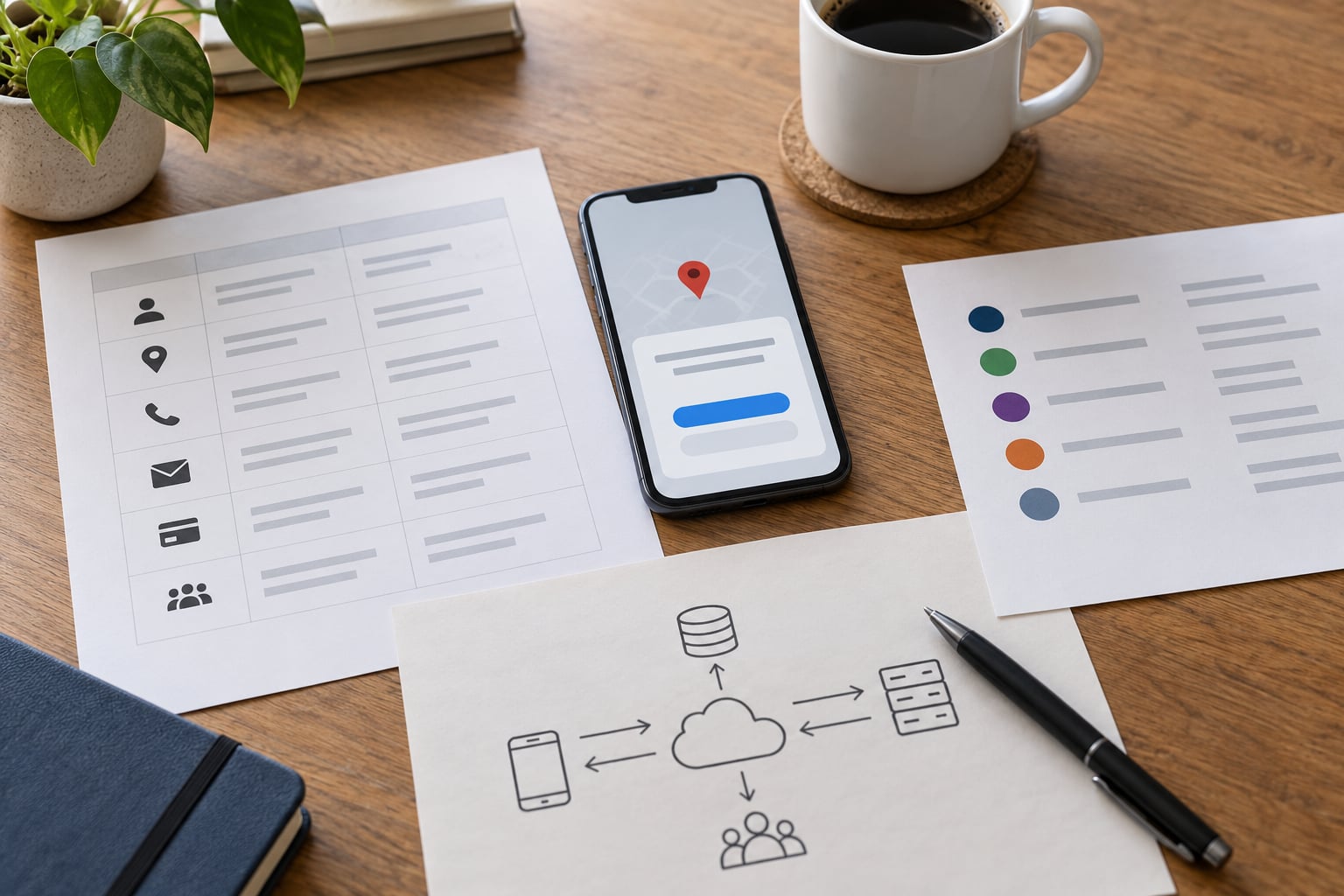
To write a privacy policy for a civic app, you start with a complete inventory of the data your app touches, connect each data type to a specific purpose and a lawful basis, then publish the result as a plain-language public web page linked from the app, the store listing and your onboarding flow. The hard part is not the writing. It is the mapping, and getting it right takes a few focused days rather than an afternoon.
Civic apps hold data that ordinary apps never see: precise geolocation tied to a household, utility and billing records, and the content of complaints that may name a neighbour. That changes the drafting brief in three ways. You must disclose disclosures to law enforcement and public records requesters. You have to explain where personal data ends and the anonymized open city data your agency publishes begins. And because the audience is the general public rather than a customer base that already chose to trust you, plain language and accessibility stop being nice touches and become part of the job.
The rest of this guide walks through the seven steps in the order they actually need to happen.
Table of Contents
- What You Need
- Step-by-Step
- How to write a privacy policy for a civic app: start with a data map
- Describe the app and define its scope
- Explain collection, use, and legal bases
- Cover permissions and user choices
- Disclose sharing, storage, and retention
- Explain security, rights, and contact routes
- Write, test, publish, and review the policy
- Common Mistakes
- Common Mistakes and Quick Fixes
- Frequently Asked Questions
- Do I need a privacy policy for my app?
- Can you provide an example of a privacy policy for an app?
- How do you write a simple privacy policy?
- How do you handle a public records request for data my app holds?
- Do government apps need consent banners like private apps?
- Is a free privacy policy template or generator good enough?
- Conclusion
What You Need
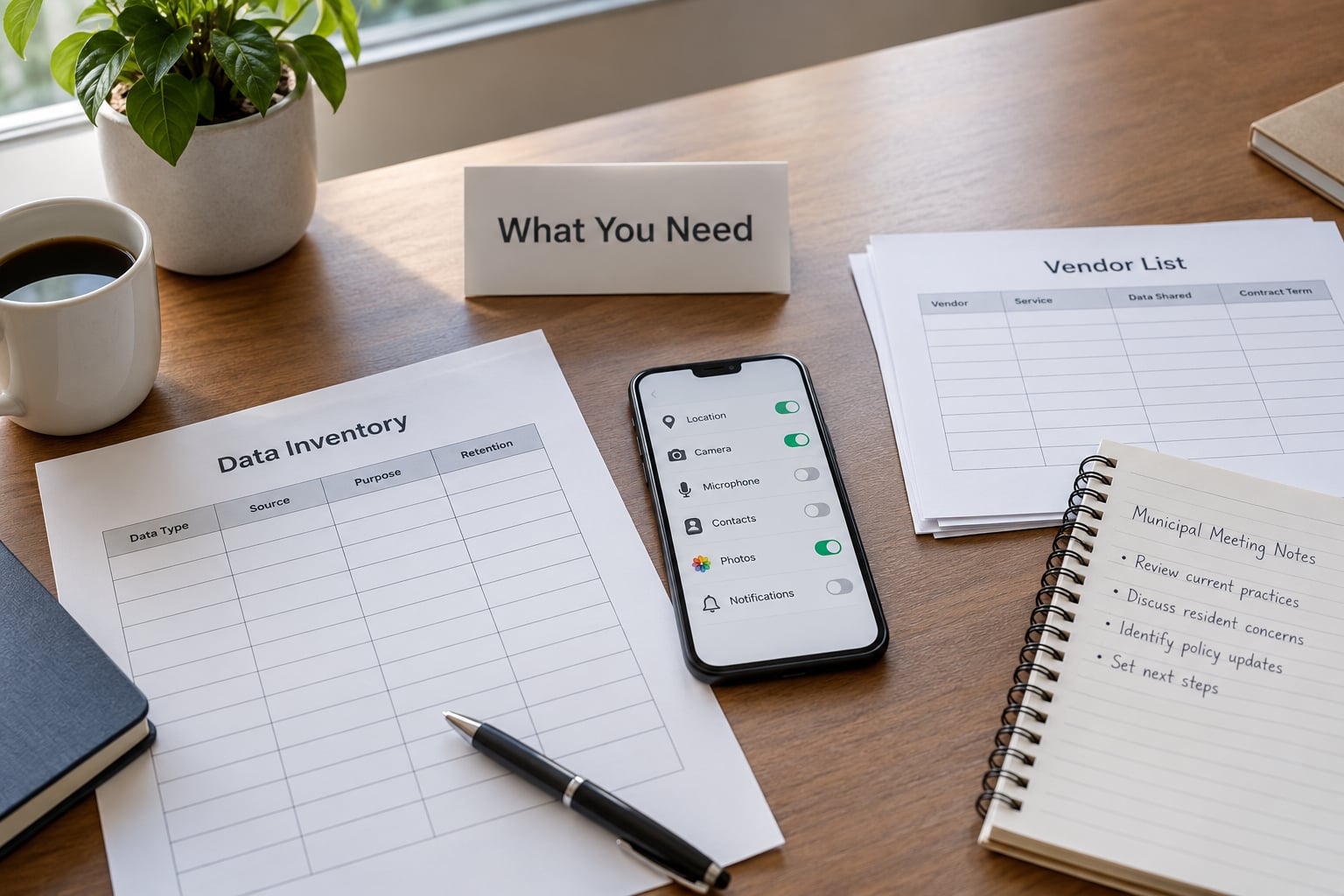
Drafting fails when it starts with a template. It works when it starts with six documents that already exist somewhere in your organisation, usually in different places.
A data inventory. Every field the app stores, not the ones you meant to store. Include backend tables, log files and analytics events, because the last two surprise people most often.
A permission list. Each device permission your app requests, and the one product feature each one supports. A permission nobody can justify is a permission you should delete from the build rather than justify in the policy.
A vendor map. Every third party that receives data: analytics, crash reporting, mapping, push notifications, payment, hosting. Note what each one sends and whether it acts as a processor on your instructions or as an independent controller.
A retention schedule. How long each category stays before deletion, and whether deletion is automated or a manual job. A schedule that does not exist yet is itself a finding.
A jurisdiction list. Where your users are and where your operator is registered. For a city app this often spans more territories than anyone expects, because residents travel and accounts follow them.
Legal references. The privacy statutes your jurisdiction applies, plus any ordinance specific to your agency. Requirements differ by country and change over time, so treat this as a starting point rather than an authority.
Two questions deserve an answer before you write a single paragraph: is there more than one party responsible for the data, and is any of it subject to public records law. Both answers change the structure of the document.
Step-by-Step
How to write a privacy policy for a civic app: start with a data map
Build the map as a table with one row per data category. Six columns is enough: what it is, why you need it, where it goes, who receives it, how long you keep it, and whether the user can decline it.
The categories that matter most in a civic context are precise geolocation, account and utility data, the content of service requests, demographics you ask for at signup, and ordinary device data. A complaint about a pothole with a photo attached is personal data even when the reporter never signs in, because the image and the coordinates identify a household.
Mark each row optional or required. If declining leaves the user with a workable version of the service, say so plainly and describe that version. If declining removes the service entirely, say that too, without apologising for it.
Now check the map against the app store declarations. The App Store privacy nutrition label and the Google Play Data Safety section are separate submissions that describe the same data. Developers routinely write an accurate policy and then contradict it in one of those forms, which is exactly the mismatch that draws store review attention.
Describe the app and define its scope
Open with a short scope paragraph. Name who runs the app, which city departments or partner organisations are involved, what the app does, and which platforms the policy covers.
If a contractor built or operates the app, name both parties and state their roles plainly. The city is usually the controller; the vendor is usually the processor acting on the city’s documented instructions. Where the vendor also runs its own analytics in its own name, it is a controller for that activity, and the policy should say so instead of hiding it in a list of subprocessors.
Add an effective date and a version number at the top. Residents who saved the old version need a way to find the new one.
Explain collection, use, and legal bases
Write one subsection per data category from your map, and inside each one state the purpose in plain words before naming the legal basis. Residents do not care that you rely on legitimate interests under Article 6(1)(f) of the GDPR; they care that you know where they live in order to send a crew to a streetlight outage.
Name both layers anyway. Cities usually rely on public task or statutory duty as the basis for core service processing, with consent for anything optional such as marketing emails or a non-essential analytics product. Requirements vary by jurisdiction, so say which regimes you are applying and why rather than implying one universal rule.
Keep every purpose tied to a feature that actually ships. A purpose statement with no matching feature is the fastest way to lose a resident’s trust, and it is easy to catch during review.
Cover permissions and user choices
Give each permission its own short block: what it enables, when the app asks, what happens if the resident declines, and where to change the setting later on both iOS and Android.
The declined case is the part templates omit. A transit app without location can still show schedules and let someone plan a route from a chosen origin. Say that. A utility app without precise location cannot find a meter, and pretending otherwise produces support tickets rather than trust.
Always offer an alternative route for reporting a problem. A web form, a phone number or an in-person counter lets someone who will not grant a permission still get the service, which is both good design and a defensible answer for a public body.
Disclose sharing, storage, and retention
List recipients by name where you can: the specific agency handling service requests, the transit operator supplying schedules, the contractor hosting the database. Named recipients age better than category labels.
Then write the two paragraphs that no generic template contains. The first covers public records: state that submitted reports and related records may be subject to your jurisdiction’s public access law, that some records are exempt from disclosure, and that redactions may be applied where an exemption applies. The second covers law enforcement: state that we respond to valid legal process, that we assess requests against the required legal standard, and that we notify the resident where the law allows.
Add the open data boundary. Published datasets should be aggregated or anonymized so that no individual can be identified, and it helps to name the threshold or method in general terms, for example that records below a minimum count are withheld.
Finish with retention stated as numbers rather than intentions. Closed service requests kept for three years, crash logs for ninety days, precise location for the duration of the request and no longer. Not as long as necessary.
Explain security, rights, and contact routes
Describe encryption in transit and at rest, role-based access, audit logging and staff training in a short paragraph. Do not promise absolute security. Say instead that no system is perfectly secure and describe the protections actually in place.
Then list the rights in the vocabulary of the regimes you named: access, correction, deletion, restriction, objection, portability where it applies, and an appeal or complaint route to an oversight body. For each one, give the channel, the expected response window and any identity verification needed to prevent someone else requesting another resident’s data.
End with a monitored email address and a postal address. A shared mailbox with a named backup owner is worth more than a privacy officer’s name that appears nowhere else.
The table below maps each section to what triggers it, so you can confirm nothing is missing before publication.
| Section | What it must contain | What triggers it | Civic-specific note |
|---|---|---|---|
| Scope and parties | Operator, partners, platforms, effective date | General transparency duty | Name the department and the contracted vendor separately |
| Data collected | Category, purpose, optional or required | GDPR transparency, CCPA/CPRA notice at collection | Treat precise location and complaint content as high risk |
| Legal basis | Basis per category, jurisdiction named | GDPR Art. 6, UK GDPR | Public task or statutory duty for core services |
| Permissions | What each enables, behaviour when declined | Platform review guidelines | Offer a non-permission route to the same service |
| Sharing and recipients | Named agencies, contractors, vendors | GDPR Art. 13, CCPA/CPRA disclosure | Public records and law enforcement clauses live here |
| Retention | Period or trigger per category | Storage limitation principle | Align with the agency’s records schedule |
| Security | Safeguards, breach notification process | General risk obligations | No absolute-security promises |
| Rights | How to exercise each, response window | GDPR Arts. 15-21, state privacy statutes | Include appeal to an oversight body |
| Children | Age threshold, parental consent where required | COPPA and equivalents | Relevant for school transit and youth programmes |
| Contact and complaints | Monitored channel, oversight route | Accountability requirement | Offer phone and in-person for accessibility |
Write, test, publish, and review the policy
Write for a resident with no legal training. Short sentences, defined terms, no defined terms where an everyday word will do. Read it aloud to someone outside the project, because they will stop you at the first sentence that only makes sense inside your organisation.
Then verify every claim against the product. Open each screen the policy mentions, check each retention number against the real job configuration, and confirm each named vendor appears in the current contract. Remove any sentence you cannot evidence.
Get the responsible privacy or records reviewer to sign off before publication, and expect them to focus on the public records and law enforcement paragraphs. Those are where municipal policies most often fall short.
Publish as a stable HTML page with a plain URL that will not be retired. Google Play specifically requires a public, non-editable, non-PDF link, and a file that anyone can download and edit does not satisfy it. Link the same URL from the store listing, the app’s settings screen and your onboarding flow, and keep one page rather than three slightly different versions.
Finally, set a review cadence and a trigger. Any new feature that collects a new category, any new vendor, or any change in retention means a policy update, an in-app change note and, where consent is the basis, a fresh consent prompt.
Common Mistakes
Common Mistakes and Quick Fixes
Vague purposes. We collect data to improve services says nothing and cannot be checked against product behaviour. Fix: one purpose sentence per category, written so a resident could tell whether a given feature justifies it.
Overbroad permissions. Requesting background location because the map is easier to build that way is the single most common finding in a civic app review. Fix: cut the permission, ship the narrower feature, then describe the narrower feature.
Unsupported public-interest claims. Citing public interest as justification for collecting more than the service needs is the claim residents push back on hardest. Fix: tie every category to a service or a statutory duty and drop the rest.
Hidden third-party sharing. Analytics and crash tools are listed only as service providers, hiding the fact that they receive identifiers and usage events. Fix: name each vendor, say what it sends, and state its role.
Policies that do not match the product. The written policy, the App Store privacy label and the Google Play Data Safety form drift apart after launch. Fix: compare all three before every release, not once at launch.
Missing the public records clause. Omitting it leaves the agency with a policy that does not describe a lawful and expected use of the data. Fix: one paragraph on access requests, exemptions and redaction, reviewed by someone who handles records requests.
Leaving the stale policy problem unsolved. Policies drift because no one owns them. Fix: name a responsible owner, set a recurring review, and treat a new data category as a launch blocker.
Frequently Asked Questions
Do I need a privacy policy for my app?
Almost always yes. If your app collects personal data, transparency rules such as the GDPR and CCPA/CPRA generally require a notice describing what you collect and why. Both Apple and Google require a privacy policy URL in the store listing, and Google Play demands a public, non-editable page that is not a PDF. An app that collects nothing still benefits from a short page saying so plainly.
Can you provide an example of a privacy policy for an app?
A typical data-collection clause reads: When you report a pothole, we collect the location of the report, the photo you attach and your contact details so a crew can find and fix it. We keep the record for three years and share it only with the public works department and its contracted repair contractor. A law enforcement clause states that we respond to valid legal process, assess each request against the required legal standard and notify you where the law permits.
How do you write a simple privacy policy?
Write from evidence rather than a template. List the data categories you actually store, pair each with one purpose, name every vendor that receives data, set a retention period per category, describe the security measures in place, list the rights residents have with a way to exercise them, and give a monitored contact address. Keep it to the length your app genuinely needs and link it from the app and the store listing.
How do you handle a public records request for data my app holds?
Say so in the policy rather than leaving it out. Submitted reports, photos and account records held by a public body are commonly subject to public access law. Explain that valid requests are reviewed, that exemptions apply where they apply, and that identifying information may be redacted before release. Run the wording past the person who actually processes records requests in your organisation, because they will be the one answering these.
Do government apps need consent banners like private apps?
Often not for core functions. Where processing is necessary to deliver a service the resident asked for, cities commonly rely on public task or statutory duty as the legal basis, so a consent banner on every screen is unnecessary noise. Consent is usually the right basis for anything optional, such as marketing emails or a non-essential analytics product. Requirements vary by jurisdiction, so confirm the basis with your privacy reviewer before shipping.
Is a free privacy policy template or generator good enough?
A template is a reasonable starting point for structure, and a short accurate policy you wrote yourself is usually safer than a long generic one. Neither substitutes for review by the person responsible for your records and privacy obligations. Generators also tend to assume a commercial context, which rarely fits a city or agency. Use them for scaffolding, then rewrite every clause against your real data map and vendor list.
Conclusion
Begin with a complete data map, because every clause in the policy traces back to a row in it. Drafting a privacy policy for a civic app means drafting around what the product actually does, not around what a generator produces, and keeping the paragraphs generic templates leave out: public records requests, law enforcement disclosures and the line between personal data and published open data.
Bring in whoever handles records requests and privacy for your organisation before you publish, not after a complaint. Then verify every sentence against the running app, publish one stable HTML page linked from all three places, and set a review cadence so the policy stays true as the app changes.