
A Code for America brigade is a local, volunteer-led group that meets on a regular schedule, finds a civic problem in its own city, and builds a digital tool to fix it with a government agency or nonprofit partner. That is the whole model in one line. The rest of this article unpacks who does what, how a project travels from idea to launch, and what changed after the brigade program itself ended in 2023.
Most people searching this phrase are trying to answer one of three things: what a brigade actually is, whether they could join one, or why the organization behind them is no longer running them. Let’s take those in order.
Table of Contents
- What Code for America Brigades Are
- Where brigades came from
- What a brigade is not
- How Code for America Brigades Work
- How Code for America Brigades Work With City Hall
- What happens in a typical brigade meeting
- Captain, co-captain, and the rest of the structure
- How a Brigade Project Moves from Idea to Launch
- 1. Need discovery
- 2. Project shaping
- 3. Triage and partner confirmation
- 4. Prototype
- 5. Testing with real users
- 6. Launch and handoff
- Who Participates in a Brigade?
- Roles that need no technical background
- How to find, join, or start a brigade
- What Makes the Brigade Model Different?
- What changed after the 2023 sunset
- What Happens After a Brigade Project Launches?
- What Are the Benefits and Limitations?
- Frequently Asked Questions
- How does Code for America work with government?
- What skills are needed to join a Code for America brigade?
- Do you have to be a developer to join a brigade?
- What happened to Code for America brigades after 2023?
- How long does a brigade project take?
- How do I find a Code for America brigade near me?
- What to Do First
What Code for America Brigades Are
A brigade is a place-based volunteer group in civic technology. Members meet in person or online, usually monthly, pick a problem that residents and city staff both find frustrating, and spend a few months building something small and specific to address it. That something is typically a web app, a data project, a public records tool, or a documented set of usability findings.
The label matters less than the structure. A brigade is a standing group with a schedule and a leader, not a one-time event. It recruits from the community it serves, and it keeps a partner organisation attached to the work so the output has somewhere to land.
Where brigades came from
Code for America started in 2009 as a nonprofit that placed individual developers inside city governments on year-long fellowships. The fellowship model worked, but it was expensive and hard to scale past a handful of cities. The Brigade program launched in 2012 as the answer: instead of sending a small number of people, organise many people locally and let each brigade run itself.
That model spread fast. By a 2019 Summit talk the organisation was citing roughly 76 brigades and about 25,000 volunteers. Treat those as historical markers rather than a live count. Brigade data has been maintained in a public GitHub repository since then, last updated in January 2025, which is a better signal that the network outlived its parent programme.
What a brigade is not
It is not the fellowship. Fellowships were individual, paid placements for a fixed term; brigades are ongoing volunteer groups. It is not a hackathon either, because a brigade commits to months of follow-through and maintenance, which is the part most events skip. And it is no longer a chapter of Code for America, a point we will come back to.
How Code for America Brigades Work
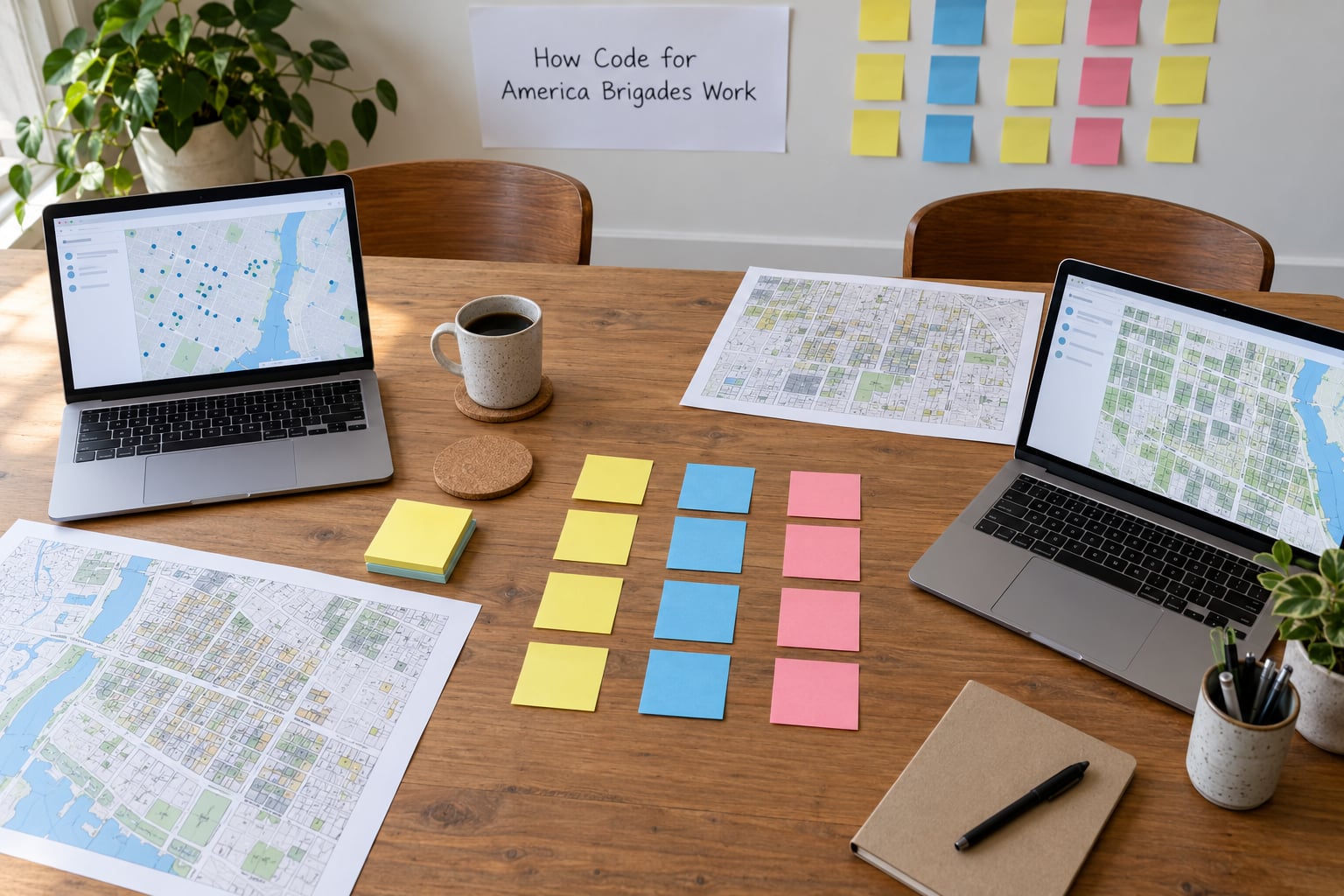
Four things happen repeatedly, and they are the same in almost every brigade. Somebody in the group talks to the people who own the problem, usually a city department or a community organisation. That partner describes the pain in plain terms, and the group writes it down.
The group then pulls whatever public data already exists, builds the smallest possible version of a fix, and puts it in front of real users. Feedback from those users drives the next round of changes. When it is good enough, the tool gets handed over with documentation.
Around that loop sit the administrative parts: a captain who keeps the group moving, a co-captain who covers when the captain cannot make it, regular meetups on a published calendar, and occasional hack nights where a bigger crowd shows up for one evening.
How Code for America Brigades Work With City Hall
The partnership is the fragile part, and this is where most explanations get vague. In practice a partner brings three things volunteers cannot get on their own: access to the underlying data or systems, a decision-maker who can authorise changes, and credibility that lets the tool reach residents who would not otherwise hear about it.
What the brigade brings is outside capacity and a fresh eye. City staff are rarely short on intent and often short on hours, and a volunteer team can absorb the work of, say, walking a benefits application with 30 residents and writing up where people get stuck. That kind of finding is often more useful to an agency than an app.
Code for Fresno is a good example of the relationship running the other direction. The brigade ran usability sessions on a state DMV website, where the deliverable was a report, not software, and the technical bar was close to zero.
What happens in a typical brigade meeting
Most meetings are two to three hours and split into a short check-in, working time on the current project, and a wrap-up. A brigade with a new member in the room usually adds an orientation first. Code for Boston runs a 30-minute orientation covering what Code for America is, what the local brigade does, what events exist, and how to join a project, because most newcomers arrive through a Meetup listing with no context at all. Code for Fort Collins solves the same problem with a monthly new member night plus a roughly 15-minute summary.
That variation is the honest answer to how brigades work: there is no central playbook, so each one develops its own habits. Code for Baltimore built mini hack challenges for first-timers who came specifically to learn to code.
Captain, co-captain, and the rest of the structure
A brigade captain handles the admin and the calendar, keeps the partner relationship warm, and makes sure someone is actually driving the project. The co-captain is the backup and the second pair of eyes. On larger brigades the captains hand off day-to-day build work to two other structures: working groups, which are standing specialisations such as Code for SF’s data science group, and brigade action teams, which are small temporary groups assembled around one project from idea to launch.
How a Brigade Project Moves from Idea to Launch
The lifecycle below is the part almost nobody publishes in writing. It usually lives in training video chapters, which is exactly why a text version is useful.
1. Need discovery
A partner describes a problem in their own words. Open Oakland’s record clearance work started when a librarian, not a city agency, reached out about residents struggling with forms. Unusual origins are normal.
2. Project shaping
The group writes down the problem, the users, and what a good outcome looks like. Projects that come in with a fixed solution attached tend to stall, because the problem usually turns out to be a process problem.
3. Triage and partner confirmation
Someone confirms the partner will actually host the thing. Code for America’s own project search workshop taught volunteers to submit an issue describing the problem, so the work could be matched to a brigade rather than duplicated.
4. Prototype
Something rough goes live in a weekend. CourtBot, the court-transparency project, worked because it could start as a scraper and a readable page rather than a system integration.
5. Testing with real users
Five to ten residents go through the tool while someone watches. This is where most of the real requirements surface, and it is the step volunteer engineers consistently say they learn the most from.
6. Launch and handoff
The project moves to the partner with a written record of what it does, what it does not do, and what breaks if nobody maintains it.
| Project | Brigade and city | What it did | Non-technical contribution |
|---|---|---|---|
| Clear My Record | Open Oakland, Oakland | Helps residents understand and clear old criminal records | Library table hours helping residents complete forms |
| Food4Thought | Code for Tulsa, Tulsa | Mobile-friendly meal locator built with a nonprofit partner | Data collection and cleanup from mostly spreadsheet sources |
| DMV usability sessions | Code for Fresno, Fresno | Documented where residents fail on a state website | Running moderated sessions and writing the report |
| CourtBot | Multiple brigades | Made local court data readable and searchable | Research, outreach, translation |
Who Participates in a Brigade?
Developers are the minority in most brigades, and that is not a fluke. Roughly a third of brigade members have been described as non-technical. The rest fill roles that decide whether a project survives contact with a real city department.
| Role | What they actually do | Skills needed | Typical commitment |
|---|---|---|---|
| Brigade captain | Runs the calendar, holds the partner relationship, keeps the group alive | Organisation, communication | Year-round, a few hours a month |
| Software engineer | Builds and maintains the tool, reviews pull requests | Web development, APIs, data access | A few hours a week during a project |
| Designer or service designer | Research, flows, interface, accessibility | User research, human-centred design | Project-based |
| Community organizer | Connects the group to residents and to the partner | Listening, facilitation | Ongoing |
| Government liaison | Explains the agency’s constraints and gets decisions made | Institutional knowledge | A few hours a month |
| Data collector | Gathers and cleans the input a project needs | Spreadsheets, research | Short, defined tasks |
Roles that need no technical background
If you can talk to a person for twenty minutes and write down what they said, you can be useful to a brigade today. Design, research, translation, facilitation, meeting notes, and data cleanup are all bottleneck work in a volunteer project. Code for Tulsa’s Food4Thought is the clearest proof: it was mostly spreadsheets, which means mostly people who know how to read a spreadsheet.
How to find, join, or start a brigade
Search for a “Code for” group in your city, then check whether it still meets. A surprising number of brigade sites have gone stale, so confirm through a current Meetup listing or a live event calendar before assuming a group is active.
If nothing turns up, the bar to starting is lower than most people expect. Recruit five to ten people who show up reliably. Identify a partner with a real operational problem. Pick one project small enough to finish in a season. Register the group as its own nonprofit or find a fiscal sponsor. Publish a calendar. That is genuinely the process; there was never a template to follow.
What Makes the Brigade Model Different?
Three comparisons do most of the work. Compared with a civic tech consultancy, a brigade is not selling hours, is not accountable to a contract, and hands the tool over rather than maintaining it for a fee. Compared with a hackathon, a brigade has continuity, a partner relationship, and a maintenance phase most events skip entirely. Compared with an in-house city digital team, a brigade adds outside perspective and can move faster, but it has no authority to change policy or compel a department to adopt anything.
| Aspect | Under the Code for America brigade programme | Today, as independent brigades |
|---|---|---|
| Financial handling | Managed by Code for America as fiscal sponsor | Each brigade handles its own money or uses a new sponsor |
| Brand relationship | Formal “Code for” organisational relationship | Name and brand use became a brigade-by-brigade question |
| Structure | Shared programme expectations and training | Fully autonomous, no central playbook |
| Joining | Findable through the network | Find the local group directly, or start one |
What changed after the 2023 sunset
Two things happened in 2023, and both are documented. Code for America announced in February that it would stop managing finances for local brigades, a change trade press covered at the time. In March the organisation published reflections on the brigade network’s next chapter, describing an end to fiscal sponsorship and a transition period of about ten months.
The stated reasoning was volunteer engagement falling after the pandemic and years of difficulty finding funding, not a dispute with the brigades themselves. As of 2026, the practical picture is that brigades that survived are independent organisations with their own leadership, their own money, and the same volunteer method they always used. The parent programme’s end changed the plumbing, not the process.
What Happens After a Brigade Project Launches?
This is where outcomes diverge most, and the difference comes down almost entirely to whether the partner wanted the thing. If a department committed to owning it, the project gets repository access, documentation, and sometimes budget for a part-time maintainer. If nobody owns it, the repository sits on a volunteer laptop until it breaks.
Healthy brigades treat handoff as a deliverable rather than an ending. They open-source the code, write a plain-language record of decisions, list known bugs, and name the person or agency responsible for each. Some projects fold into a city website; others become a tool the partner keeps running under its own name; some quietly stop, which is normal and not a failure.
Open Oakland’s record clearance work illustrates the version that sticks. Volunteers contributed a few hours a month at a public library, a low-cost commitment the host could sustain indefinitely, so the project never depended on a single volunteer burning out.
What Are the Benefits and Limitations?
The benefit is capacity and learning on both sides. Residents get services they can actually use, city staff get evidence they could not have gathered themselves, and volunteers get the kind of stakeholder practice that most technical work never teaches. Open Oakland logged 50-plus volunteer hours on one project, which is a fair measure of what a small group can move.
The limitations are real. Each brigade runs itself, so a newcomer in a weak brigade gets a worse experience than a newcomer in a strong one. Volunteer engagement has fallen since the pandemic, and captains report feeling that locally rather than as a strategy question. Funding for maintenance is the most common failure mode, followed closely by a founding captain burning out.
None of this makes brigade output a substitute for professional public-sector procurement or staff. A brigade can surface a problem, prototype a fix, and hand over evidence. It cannot procure, staff, or guarantee that a department will change a policy. Code for Fresno’s DMV work succeeded precisely because it was scoped as research with a report at the end, not as software the state had to adopt.
Frequently Asked Questions
How does Code for America work with government?
A brigade partners with a city agency, department, or nonprofit that owns the problem being solved. The partner supplies data access, a decision-maker who can authorise changes, and a route to reach residents. The brigade supplies outside capacity: user research, a prototype, and written findings. Most projects end in a handoff with documentation rather than software the city must adopt.
What skills are needed to join a Code for America brigade?
You need almost none to start. Engineers, designers, and data people are useful, but community organizers, librarians, government staff, researchers, and translators often fill the bottlenecks. Roughly a third of brigade members have been non-technical. What matters more than skill is showing up regularly and being willing to sit through user interviews, which is where the real requirements surface.
Do you have to be a developer to join a brigade?
No. Code for Fresno ran DMV website usability sessions that needed almost no technical experience. Open Oakland volunteers helped residents complete record clearance forms at a library. Code for Tulsa built a meal locator from mostly spreadsheet data. Showing up consistently and talking to real users is the part that actually decides whether a project works.
What happened to Code for America brigades after 2023?
In February 2023 Code for America announced it would stop managing finances for local brigades, and a March 2023 post described ending fiscal sponsorship with a transition period of roughly ten months. Surviving brigades continued as independent nonprofit organisations with their own leadership and funding. The stated reasons were falling volunteer engagement after the pandemic and difficulty securing multi-year funding.
How long does a brigade project take?
Most run a single season, roughly three to six months, from needs discovery through launch and handoff. Committees sometimes work a smaller experiment, and longer-running tools like CourtBot have been picked up repeatedly as new brigades revisit them. Ask any brigade what its current cycle is, because each one sets its own pace.
How do I find a Code for America brigade near me?
Search for a Code for group in your city and check whether it still meets. A fair number of brigade websites went stale after the 2023 change, so confirm through a current Meetup listing or event calendar rather than a landing page. If nothing is active locally, starting one takes a core group, a partner with a real problem, one small project, and a decision about legal structure.
What to Do First
Find out whether your city still has an active group, because that answer changes everything else. If one is meeting, show up to an open meetup with no project knowledge and ask for the 15-minute orientation. If nothing is running, the fastest useful step is a single conversation with a city department about a problem they already complain about.