
The short answer to how to prioritize features with limited budget: write down the cap in cash and person-months, score every candidate on value and cost, sort by score, and fund features in order until the running total hits the number. Everything past that line gets deferred with a written reason, or cut.
That last part is where most guides stop too early. Under a fixed budget, prioritization stops being an optimization exercise and turns into rationing. Every feature you accept quietly displaces another one, so the real work is drawing an evidence-backed line and living with what falls below it.
The process below runs in two working sessions and produces a spreadsheet anyone can audit. It works for a startup MVP, a small delivery team, and a city department working to a fixed grant envelope, because all three have the same problem: more good ideas than money to build them.
Table of Contents
- What You Need
- Step-by-Step: How to Prioritize Features with Limited Budget
- 1. Clarify the user problem and product goal
- 2. Separate must-haves from nice-to-haves
- 3. Estimate effort, cost, and uncertainty
- 4. Score impact against feasibility
- 5. Look for dependencies and quick wins
- 6. Build a now-next-later roadmap
- 7. Validate the order with stakeholders and users
- Common Mistakes
- Frequently Asked Questions
- What is budget prioritization?
- What is the RICE framework?
- What are the 5 levels of priority?
- What are some effective prioritization techniques?
- How do you prioritize features when everything is high priority?
- How do you cut features to fit a fixed budget?
- Start With the Highest-Value Problem
What You Need
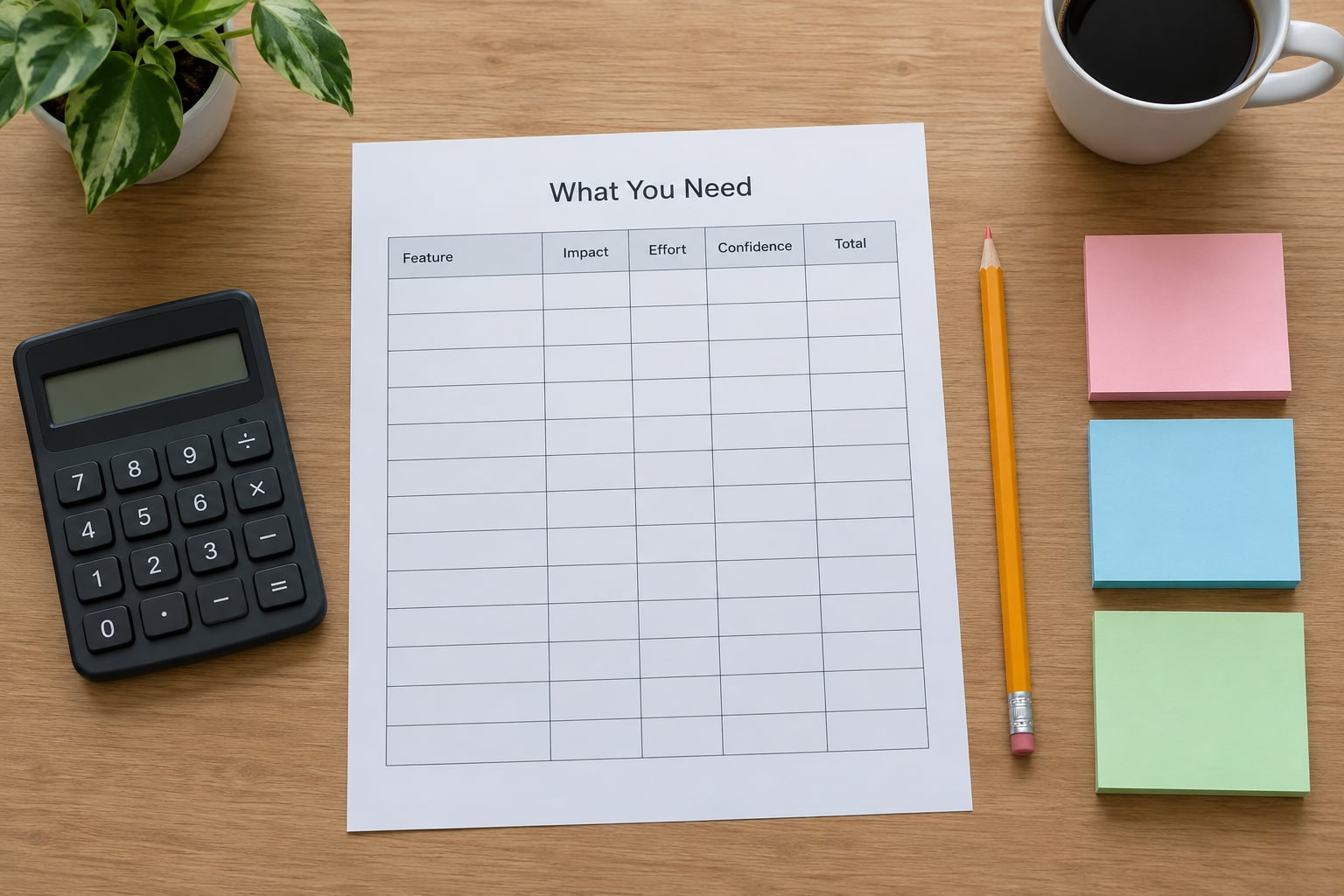
You need seven inputs before you rank anything. Teams that skip this step end up scoring features against a goal nobody agreed on, which is how a spreadsheet full of sensible numbers produces a roadmap nobody defends.
| Input | Where it comes from | What a weak version looks like |
|---|---|---|
| Target users | Interviews, front-desk logs, ticket history, sign-up data | Everyone who uses the portal |
| Core problem | One sentence naming who, what they do today, what changes | A list of feature ideas |
| Budget | Finance figures or the funding agreement, split one-off from recurring | Whatever we can raise |
| Capacity | Real engineering availability for this cycle, including support load | Nominal headcount |
| Technical constraints | Existing stack, integrations, data quality, security reviews | Noted quietly, discovered at build time |
| Success metric | One number per funded feature, with a baseline | Better engagement |
| Stakeholder requirements | A named list of who can require work, and on what grounds | Anyone in the meeting |
You also need one worksheet and no new tooling. A spreadsheet with these columns handles a 30-item backlog: feature, problem addressed, users affected, value score, one-off cost, annual recurring cost, confidence, dependencies, cumulative cost, decision.
If your team has fewer than five candidate features and two weeks of runway, a shared document beats a framework. Budget-conscious teams are right to be suspicious of advice that assumes paid research tools; the scoring pass costs a couple of hours and nothing else.
Step-by-Step: How to Prioritize Features with Limited Budget
Seven steps, roughly two sessions. The order matters more than the tooling, because each step produces the input the next one needs.
1. Clarify the user problem and product goal
Turn the broad idea into one measurable outcome. For a permit and services app, that might be cutting the share of applications that get returned for missing documents from 34 percent to under 15 percent within a year.
Ask the team three questions in writing: who has this problem, what do they do about it right now, and what has to be true for us to have helped. If the answers name a feature rather than a situation, push back and rewrite. Features are candidates; problems are the thing you are buying against.
You know this worked when two people who disagreed politically still describe the goal the same way. Everything downstream inherits that clarity.
2. Separate must-haves from nice-to-haves
Sort candidates into three buckets. The first is essential to the minimum viable product: without it, the product fails at the single goal you just defined. The second is valuable enhancement that improves the goal but does not determine it. The third is an experiment or a later-cycle idea.
The test for bucket one is simple: if you shipped everything else and left this out, would the outcome fail or become actively harder? A sign-in flow, a way to see the status of a request, and a record people can trust are typical essentials. Offline mode and a redesigned colour palette usually are not.
A stakeholder request is evidence, not classification. The person closest to the goal gets a vote on whether their request is essential; seniority gets a vote on whether the goal itself still matters.
3. Estimate effort, cost, and uncertainty
Give each feature two cost numbers instead of one. The first covers design, build, testing, data or API work, security review and launch. The second covers what it costs to keep alive each year: hosting, third-party calls, messaging, licences, and the support time it creates.
Estimate uncertainty explicitly, because unknown integrations are the usual reason a cheap-looking feature eats a budget. Any item involving an API nobody has used, a data set that has never been cleaned, or a statutory approval multiply the one-off estimate by roughly one and a half, and get a confidence mark of low.
Estimates will disagree between engineering, product and support, and that disagreement is normal rather than a sign anyone is being careless. The rule that settles it: take the largest credible estimate on record, then re-estimate together with whoever disagreed, and keep both numbers in the sheet. If it stays contested, plan with the higher one and treat the difference as a risk to retire during the build.
For civic work, add two line items competitors rarely mention: the data steward hours needed to keep an open dataset current, and the accessibility review every public-facing screen has to pass.
4. Score impact against feasibility
Score each feature, then sort. Two models cover most situations. RICE scoring is the first: Reach times Impact times Confidence, divided by Effort. Reach is the number of affected users in this cycle, Impact is 3 for massive, 2 for high and 1 for low, Confidence is 80 percent when you have evidence and 50 percent when you do not, and Effort is person-months.
Weighted scoring is the second. Give each criterion a weight that reflects your situation, rate every feature 1 to 5, and multiply. Weighted scoring costs the same afternoon as RICE and handles awkward cases better, such as a compliance item that is low impact for users but mandatory for the organisation.
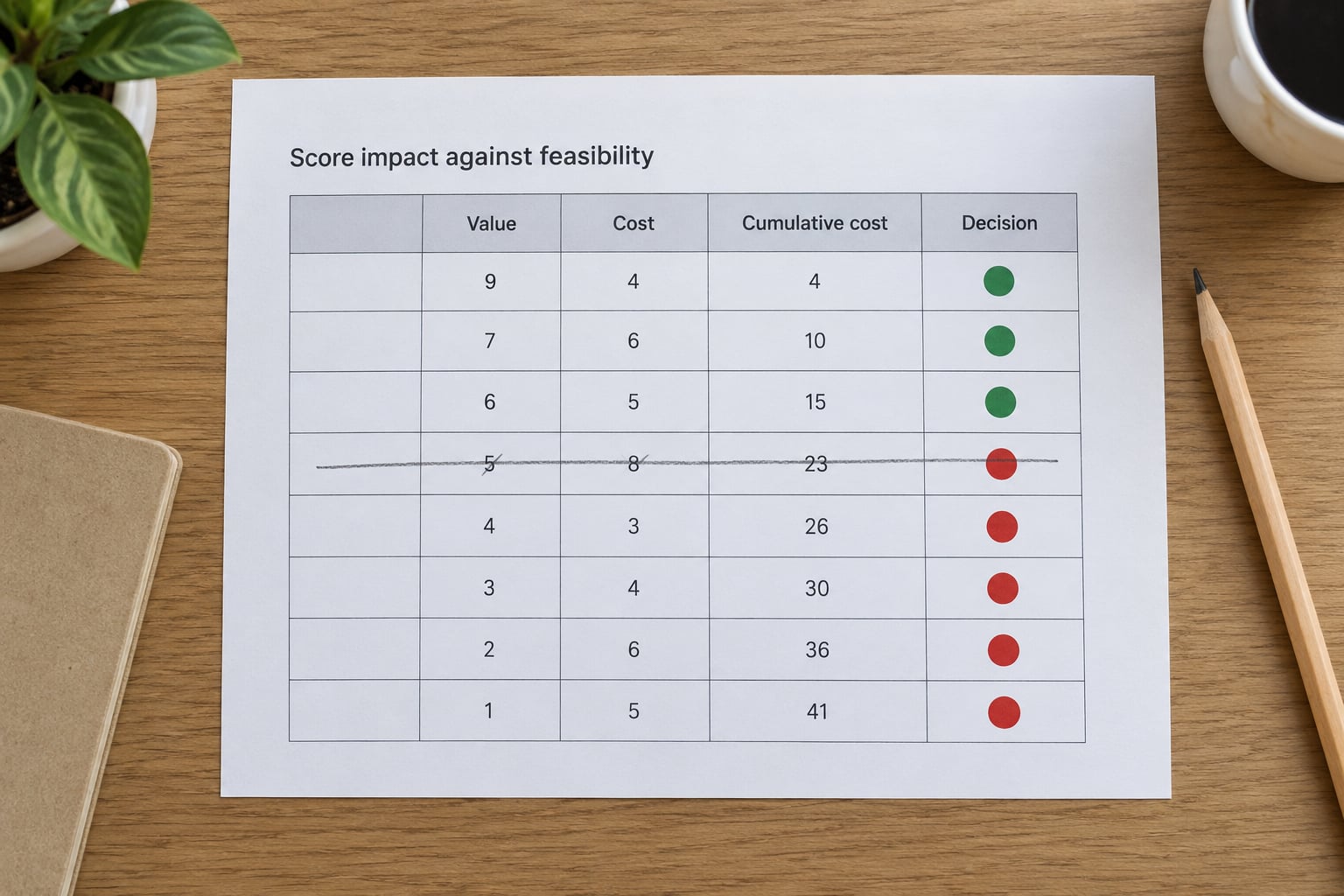
Whatever model you use, then reconcile the sorted list against the cap. Here is an illustrative cycle with 40,000 USD available, 4,000 held back for support and contingency, and 36,000 usable for build.
| Feature | Value score | Cost (USD) | Cumulative cost | Decision |
|---|---|---|---|---|
| Application status tracker for residents | 21 | 9,000 | 9,000 | Fund |
| SMS renewal reminders | 18 | 5,500 | 14,500 | Fund |
| Bulk submission for repeat document types | 15 | 12,000 | 26,500 | Fund |
| Partner API over the open dataset | 12 | 11,000 | 37,500 | Fund, last item |
| Staff dashboard redesign | 7 | 14,000 | 51,500 | Defer to next cycle |
| Theme and display options | 3 | 3,000 | 54,500 | Reject |
The cut line sits after the fourth row. Two decisions follow from it. The dashboard redesign is deferred rather than killed because it becomes more valuable once the status tracker generates real usage data. The theme options are rejected outright, because a small cost does not rescue a feature that moves no metric.
When a feature misses the line by a small margin, try slicing it rather than dropping it. Bulk submission could ship for the two document types that cause most returns, costing roughly a third of the full version, and the remaining types could go into a later release against the same goal. Slicing works when the thin version still moves the metric on its own.
5. Look for dependencies and quick wins
Some items have to come first because other work sits on top of them. Authentication, location permissions, a stable data schema, analytics and API credentials are typical. Fund those out of order, and say plainly in the roadmap that they are foundations rather than user-visible wins.
For everything else, plot value against effort and read the four quadrants. Quick wins are high value and low effort, and they buy goodwill for the harder work. Big bets are high value and high effort, and under a tight budget you can usually fund exactly one of them. Fill-ins are cheap but low value, which makes them good candidates for later-cycle padding rather than cycle one. Money pits are high effort and low value, and they are the first thing to cut when money disappears mid-project.
The Kano model explains why delight features go first. A basic or performance feature leaves someone neutral, a threshold feature satisfies without impressing, and a delighter produces genuine surprise. When the envelope shrinks, delighters fall out first, which surprises the people who asked for them most recently.
6. Build a now-next-later roadmap
Move funded items into a current release group, push the next two items into a following release, and keep everything else visible in a later backlog. Set the cutoff in person-months rather than in wishes: if you have 9 engineer-months and you have reserved a fifth for testing, security review, support and requirements nobody has thought of yet, the current release can hold about 7 engineer-months of committed work.
Public-sector and grant-funded projects add one extra split. Agreements usually name committed deliverables, and those are not really candidates for scoring, since the funding depends on them. Score only the discretionary pool that sits outside the agreement, and treat the named deliverables as a fixed cost that eats into the same envelope. Grant money that goes unspent at the end of a period is often simply lost, which makes sequencing more urgent than elegance.
Write the funded items with their metric and a review date. A roadmap with metrics attached can be re-scored in six weeks; a list of features can only be re-argued.
7. Validate the order with stakeholders and users
Take the proposed order to four groups: a handful of real users, the frontline staff who handle the volume, partner organisations that depend on the data, and the people who hold the budget. Ask what the order predicts will happen, not whether they like it. Agreement on the diagnosis is what you are after.
Scores collide often, so agree the tie-breakers in advance and write them down. When two features are level: fund the one that other work depends on; failing that, the cheaper one, since it frees budget for a third item; failing that, the one whose decision is reversible, because a small reversible bet can be corrected cheaply while a large permanent one cannot. If the tie is between a feature that adds income and one that cuts cost, pick the one that produces cash inside the budget cycle when cash is the binding constraint.
Publish the deferred list too, each item with its reason and the condition that would change the answer. That single habit does more for trust than any scoring model, because it turns a cut from a personal rejection into a documented position that anyone can audit later.
If the result contradicts something already announced, take the numbers to the room rather than defending the ranking. Offer the smaller slice or the later date as a concrete alternative, and make the trade-off visible: this item costs roughly the same as the two items it would displace.
Common Mistakes
Most bad prioritization under budget comes from one of six habits. Each has a cheap fix.
- Funding the loudest request. HiPPO, highest paid person’s opinion, wins because no agreed criterion was applied. Fix: every funded item needs a named metric and a source for its value score, and the loudest request enters the list like everyone else’s.
- Trying to satisfy every stakeholder. A committee request is not a commitment, so the work never actually leaves the list. Fix: record required items separately with the name of the person who can require them, then rank only the discretionary pool.
- Confusing low effort with high value. Cheap items win the argument and the budget stops moving the metric that matters. Fix: sort by value score first, and treat effort as a divider rather than as the ranking key.
- Underestimating the running cost. The build fits and the second year does not. Fix: price recurring cost per feature and fund it explicitly as a line, not as an afterthought.
- Skipping user evidence because there is no research budget. Scores come entirely from opinion. Fix: three or four short conversations with recent users, plus a look at what people already do in the product, will move confidence marks more than any workshop.
- Treating the roadmap as permanent. Funding shifts mid-cycle and the old list keeps governing new work. Fix: re-score on a fixed date, keep deferred items with their trigger conditions, and drop anything nobody can still justify.
Technical debt belongs in the same conversation as a funded line rather than an afterthought. Migrating a service, retiring a script or fixing an authentication flow will not win a vote against a visible feature, so budget it as a percentage, commonly a tenth of the cycle, and defend it with the hours the current workaround costs.
There are moments when a framework is the wrong tool. With four candidate features, one deadline and a team that agrees on the goal, a one-hour judgement call recorded in a short note is enough. The point is not the format. The point is that someone wrote down what they decided and why, so the next person can check the reasoning instead of guessing at it.
Frequently Asked Questions
What is budget prioritization?
Budget prioritization is the practice of ranking and sequencing features so that only the highest-value items fit inside a fixed budget. You decide explicitly what is funded now, what is deferred, and what is cut entirely, and you record the reason for each decision so it can be defended later and revisited when conditions change.
What is the RICE framework?
RICE is a scoring model for ranking features using four inputs: Reach, Impact, Confidence and Effort. Multiply reach by impact and confidence, then divide by effort in person-months. The result gives a rough value-per-unit-of-cost ranking. RICE works best when reach and confidence come from real data rather than optimism.
What are the 5 levels of priority?
Most teams use four buckets: must have, should have, could have and will not have this cycle. The fifth level is the explicit reject list, which keeps permanently declined ideas from returning every planning round. Bucketing forces a decision on each item, so nothing survives a quarter without someone owning it.
What are some effective prioritization techniques?
The techniques that hold up under a budget constraint are weighted scoring, an impact against effort matrix, RICE with a confidence penalty, cost of delay, opportunity scoring for existing products, and prioritising by constraints when one resource is the binding limit. Pick one, run it fully, and score every item the same way.
How do you prioritize features when everything is high priority?
Fix the goal first, then apply tie-breakers you agreed in advance. When two items score level, prefer the one other work depends on, then the cheaper one, then the more reversible decision. Features that no metric can be attached to are not high priority, they are unmeasured, and they should lose ties until someone defines the measure.
How do you cut features to fit a fixed budget?
Sort features by score, add costs until you reach the cap, and treat the last funded item as the cut line. Everything below it is either deferred with a written trigger for reconsideration, sliced into a thinner version that still moves the metric, or rejected. Publish that list so deferred items carry a reason instead of quietly returning.
Start With the Highest-Value Problem
Do this first, tomorrow, in one sitting: pick one measurable outcome, score only the features tied to it, and add costs until you reach your real cap. Whatever sits below the cut line is deferred with a reason, or rejected, and you write the list down.
The first funded item should be the smallest one that produces genuine evidence about the goal. A narrow slice that moves the metric teaches you more than a wide feature that ships late.
Then set a date, six to eight weeks out, to re-run the same scoring pass with the same columns. Budgets move, stakeholders change their minds, and the first version of this plan will be wrong in ways no spreadsheet can show you in advance. The scoring process is worth more than the score.