
To apply for a small business grant, you confirm your eligibility, find a program that fits, assemble your business documents, read the funding notice closely, write a clear proposal with a line-item budget, and submit before the deadline. Most applications take 10 to 30 hours of your time.
Here is the part most applicants get wrong: grant money is non-repayable, but it is never free of conditions. It comes with a specific purpose attached, it competes against every other applicant, and it usually has to be justified line by line.
The federal government does not fund businesses just to start. There is no general grant for opening a shop or launching a service. Money is awarded for a defined project, and the funder’s goals decide who wins. If your business does not fit one of those purposes, a forgivable loan or a small business loan is a faster path.
Below is the process I would follow, in the order that saves the most wasted effort.
Table of Contents
- What You Need Before You Start
- Business identity documents
- Financial records
- Your operating story
- Step-by-Step: How to Apply for a Small Business Grant
- 1. Confirm That Your Business Is Eligible
- 2. Find Grants That Match Your Business
- 3. Read the Instructions Before You Start
- 4. Prepare a Complete Business Profile
- 5. Gather Financial and Supporting Documents
- 6. Write a Specific Project or Business Plan
- 7. Review the Application for Scoring
- 8. Submit Before the Deadline and Keep Proof
- 9. Follow Up and Track the Decision
- Common Mistakes That Get Applications Rejected
- Frequently Asked Questions
- What documents do I need to apply for a small business grant?
- How long does it take to get a small business grant?
- What is usually the biggest reason a grant application is rejected?
- Do I need a formal business plan to apply for a grant?
- Are small business grants taxable?
- What should I do after I submit a grant application?
- Conclusion
What You Need Before You Start
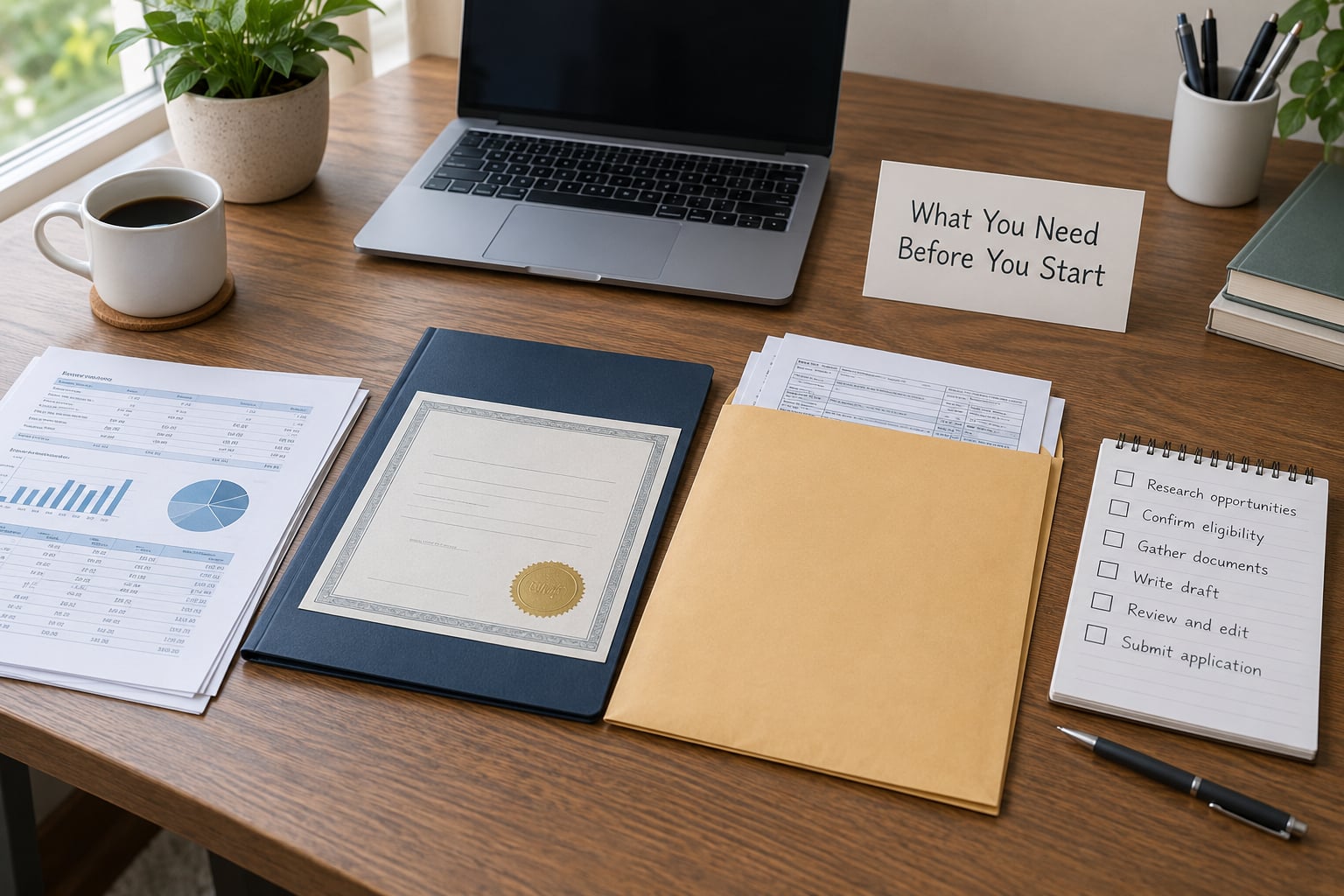
Grant reviewers score you against a checklist, so the work is really about assembling proof. Gather these items before you look at a single application form.
Business identity documents
- Employer Identification Number (EIN) from the IRS
- Articles of organization, or the equivalent formation document for your entity type
- Business license and any state or local registrations
- Employer identification number for your state if you have payroll
- Unique Entity Identifier (UEI) and active SAM.gov registration, required for federal applications
Financial records
- Business and personal tax returns for the last two or three years
- Profit and loss statement and balance sheet, current
- Bank statements covering the last 12 months
- Payroll records and payroll tax filings if you have employees
- Debt schedule listing outstanding equipment loans and credit lines
Your operating story
- A business plan, even a short one, with market and competition detail
- Use-of-funds statement: what you want, how much, and what each dollar buys
- Three-year financial projections with the assumptions written down
- Resumes or role descriptions for the people who will do the work
- Letters of support from customers, partners, or a local agency
- Any permits, leases, or site control documents the project needs
Entity type matters less than most applicants assume. A sole proprietorship, an LLC, an S-corp, and a C-corp can all receive funding. What actually gates eligibility is whether you are for-profit or a nonprofit, whether you meet the funder’s size standard, and whether you match any ownership or location rules. Answering the “can an LLC get grant funding” question early saves weeks of wasted drafting.
Step-by-Step: How to Apply for a Small Business Grant
1. Confirm That Your Business Is Eligible
Read the eligibility section before the narrative section. Program pages list ownership requirements, revenue caps, minimum years in business, geography restrictions, industry exclusions, and match requirements. If you fail any single line, the application is usually screened out before a human reads it.
Watch the match rule closely. A program that offers one dollar for every dollar you contribute is not a giveaway, and small businesses lose applications by not realizing that until after they’re selected.
2. Find Grants That Match Your Business
Grants.gov is the federal clearinghouse. State portals and economic development offices cover state and local money, and many city and county programs fund neighborhood-scale projects. For energy, rural, or export work, check the agencies that run those portfolios directly.
Build a tracking sheet with columns for the funder, funding purpose, award range, deadline, match requirement, and required attachments. Ten tracked opportunities beat fifty half-remembered ones, because you can only chase what you are tracking.
Apply for the program where you are a strong fit, not the one with the biggest number. Narrow eligibility usually means fewer applicants, and owners on grant forums consistently say niche and industry-specific programs are more winnable than broad ones.
3. Read the Instructions Before You Start
Open the full funding notice, often called a Notice of Funding Opportunity, and read it before writing anything. Find the scoring criteria, word limits, page limits, required formats, and required attachments.
Also check whether the funder wants a project plan, a full business plan, or only a use-of-funds statement. Reviewers score against published criteria, and missing one is a deduction you cannot argue back.
4. Prepare a Complete Business Profile
Write one master profile covering your legal name, entity type, ownership, location, NAICS code, industry, mission, products or services, employee count, annual revenue, and years in operation. Every application field should draw from that single document.
Consistency gets noticed. If one application says you have four employees and another says six, a reviewer may question every other number in the file.
5. Gather Financial and Supporting Documents
Assemble the documents listed earlier into one folder, named by funding opportunity. Name files the way the instructions ask, because “Scan0023.pdf” is the kind of detail that quietly costs points.
Check expiration dates. Business licenses and insurance certificates often need to be current within the last 12 months, and an expired certificate is one of the most common automatic disqualifications.
6. Write a Specific Project or Business Plan
Lead with the need, not with your history. Name the problem, show who has it, and say why your business is positioned to solve it. Then state plainly what the money buys and what changes if you get it.
Set measurable outcomes: units produced, jobs created, customers served, energy reduction, revenue generated. Reviewers need to be able to tell whether you hit the mark later, and vague goals make that impossible.
Explain the budget in the same language as the request. If you are asking for a specific amount for equipment and training, say that in one sentence near the top. Burying the ask is the most common writing mistake in these files.
Skip inflated projections and unfalsifiable claims. A three-year revenue forecast that assumes every lead converts tells a reviewer you have not stress-tested your plan.
7. Review the Application for Scoring
Run a self-review before submitting. Is every scoring criterion addressed somewhere you can point to? Do the numbers in the narrative match the budget? Are all attachments included and named correctly?
Then have someone outside the business read it. A fresh reader finds unsupported claims faster than you will, and it is the cheapest quality control available.
8. Submit Before the Deadline and Keep Proof
Submit at least 48 hours early. Portals time out, file uploads fail, and a deadline that means midnight local time usually means midnight server time somewhere else.
Save the confirmation page or email, record the submission date, and keep a copy of everything you sent. When you follow up later, that record is what lets you prove you met the deadline.
9. Follow Up and Track the Decision
Confirm receipt with the program contact listed in the notice. Then track decision windows, funding amounts, and any debrief opportunity in your sheet so the next application benefits from what you learn.
Decisions commonly take weeks to months, and federal competitive selections can run longer. If you are rejected, ask whether a debrief is available and whether resubmission is allowed next cycle. There is rarely feedback otherwise, which is why owners treat a first application as a rehearsal rather than a make-or-break shot.
Common Mistakes That Get Applications Rejected
- Applying to the wrong program. Fix: check eligibility line by line before writing a word.
- Unsupported claims. Fix: attach a document to every number you cite.
- Reusing a generic business plan. Fix: mirror the funder’s language and priorities, because reviewers score against them.
- Missing attachments. Fix: use the required-attachments list as a final packing checklist.
- Miscalculated budget. Fix: total the line items in a spreadsheet and confirm the narrative total matches.
- Vague narrative. Fix: state the need, the activities, the outcomes, and the total request in four short paragraphs.
- Missing the deadline. Fix: submit 48 hours early and save proof of submission.
- Paying for a guaranteed award. Fix: no legitimate program charges an application fee or promises approval.
One more worth naming: waiting on a fee-based service that claims to have non-public grant databases. Every federal opportunity is public, and guaranteed-award pitches cost applicants thousands of dollars.
After an award, watch your restrictions. Spend only on approved categories, keep receipts, meet any match commitment, and file required progress reports on time. Funds misspent or unreported can be recovered, with penalties.
Frequently Asked Questions
What documents do I need to apply for a small business grant?
Most funders ask for the same core set: an EIN, formation documents, a business license, business and personal tax returns, a profit and loss statement, balance sheet, and recent bank statements. Federal programs also require an active SAM.gov registration with a Unique Entity Identifier. Add a business plan, a use-of-funds statement, financial projections, and letters of support to cover the narrative side. Check the required attachments list for the specific program, since each funder sets its own rules.
How long does it take to get a small business grant?
Budget 10 to 30 hours to prepare a typical application, then expect weeks to months for a decision. Federal competitive selections can stretch longer because of review panels and award negotiations. Preparation time drops significantly once you have a master business profile, current financials, and a reusable document folder in place. Owners who apply repeatedly report that the second and third applications take far less time than the first.
What is usually the biggest reason a grant application is rejected?
Most rejections trace back to eligibility or incomplete documentation rather than a weak story. Applications fail automated screening when they miss an ownership, revenue, size, or location rule, or when a required attachment is missing, expired, or misnamed. Another common cause is a narrative that does not address the published scoring criteria. Reviewers score against the funder’s own list, so anything you do not address cannot earn points.
Do I need a formal business plan to apply for a grant?
It depends on the program. Larger federal and foundation programs usually want a business or project plan with market detail, financials, and an organizational structure. Smaller local and corporate programs often accept only a use-of-funds statement and a short narrative. Either way, a one-page plan covering your market, financials, and funding purpose is worth preparing, because you can expand it to fit stricter requirements.
Are small business grants taxable?
Generally yes. The IRS treats most grants as taxable income in the year you receive them, whether or not the grant is restricted to a specific purpose. Some programs issue tax-exempt awards or structure funds as contracts or cost-share reimbursements, which are treated differently. Keep records of what you received and what you spent, then ask a CPA or tax preparer how your specific award should be handled.
What should I do after I submit a grant application?
Save your confirmation page or submission email, then note the date in your tracking sheet. Contact the program contact listed in the notice to confirm receipt if that is customary for that funder. Track the decision window and funding amount so you know when to check back. If you are declined, ask whether a debrief is available and whether the program accepts resubmissions next cycle.
Conclusion
Start today with one program you plausibly qualify for. Read its eligibility section, build the document checklist from section two of this guide, and only then draft the narrative.
Grant programs open and close frequently, and many listings you find in search results are already closed. Confirm current status on the awarding agency’s own page before you invest hours, and consider a free SCORE or Small Business Development Center advisor as a second pair of eyes.