
If you are working out how to split equity in an early startup, there is no universal formula. Most founding teams land between 50/50 and 70/30, adjusted for time commitment, cash contributed, existing intellectual property, and who is taking the biggest career risk. Decide early, vest everything, and write it down.
That is the short answer. The longer version is that equity is the only piece of the puzzle most founders argue about twice, so the process matters as much as the percentage. Founders on r/startups and r/ycombinator describe the split conversation as the fastest way to learn whether a co-founder is a partner or a passenger.
Get it done in the first month, while the company is cheap to restructure. A few thousand dollars of legal time now beats a bitter dispute after a seed round, when changing the cap table means renegotiating with investors, employees, and a lawyer all at once.
Table of Contents
- What You Need Before You Talk About Percentages
- Step-by-Step: How to Split Equity in an Early Startup
- Step 1: Define the Ownership You Are Creating
- Step 2: Agree on Founder Contributions and Roles
- Step 3: Set a Simple Initial Split
- Step 4: Create an Employee Equity Pool
- Step 5: Add Vesting and Good Leaver Provisions
- Step 6: Document the Split and Plan for Dilution
- Common Mistakes That Cost Founders the Most
- Splitting 50/50 out of habit
- Mixing percentages with share counts
- Skipping vesting on founder shares
- Allocating the entire company to founders
- Making verbal promises
- Ignoring the founder who dies or is disabled
- Frequently Asked Questions
- How should two founders split equity in an early startup?
- Should startup founders use equal equity splits?
- How much equity should founders leave for employees?
- Should founder shares be subject to vesting?
- How does investor funding affect founder ownership percentages?
- Do founders need a written equity agreement?
- Conclusion
What You Need Before You Talk About Percentages
Walk into the conversation with documents and decisions settled, not with a guess about what is fair. Here is the short list.
- A current share count — how many shares are authorized and issued today.
- A role description for each founder — full-time or part-time, and what each person actually owns.
- The hiring plan for the next 12 months — how many people, and how much you expect to pay them.
- Your cash and IP position — what each founder has put in beyond their time.
- Standard vesting terms — four years with a one-year cliff is the market default.
- A written founders’ agreement — the document that turns a conversation into a legal obligation.
The share count matters more than founders expect. A 60/40 split means something different on 10,000 shares than on 10 million, and the option pool has to come out of somebody’s slice. Decide the pool before you assign percentages, not after.
Step-by-Step: How to Split Equity in an Early Startup
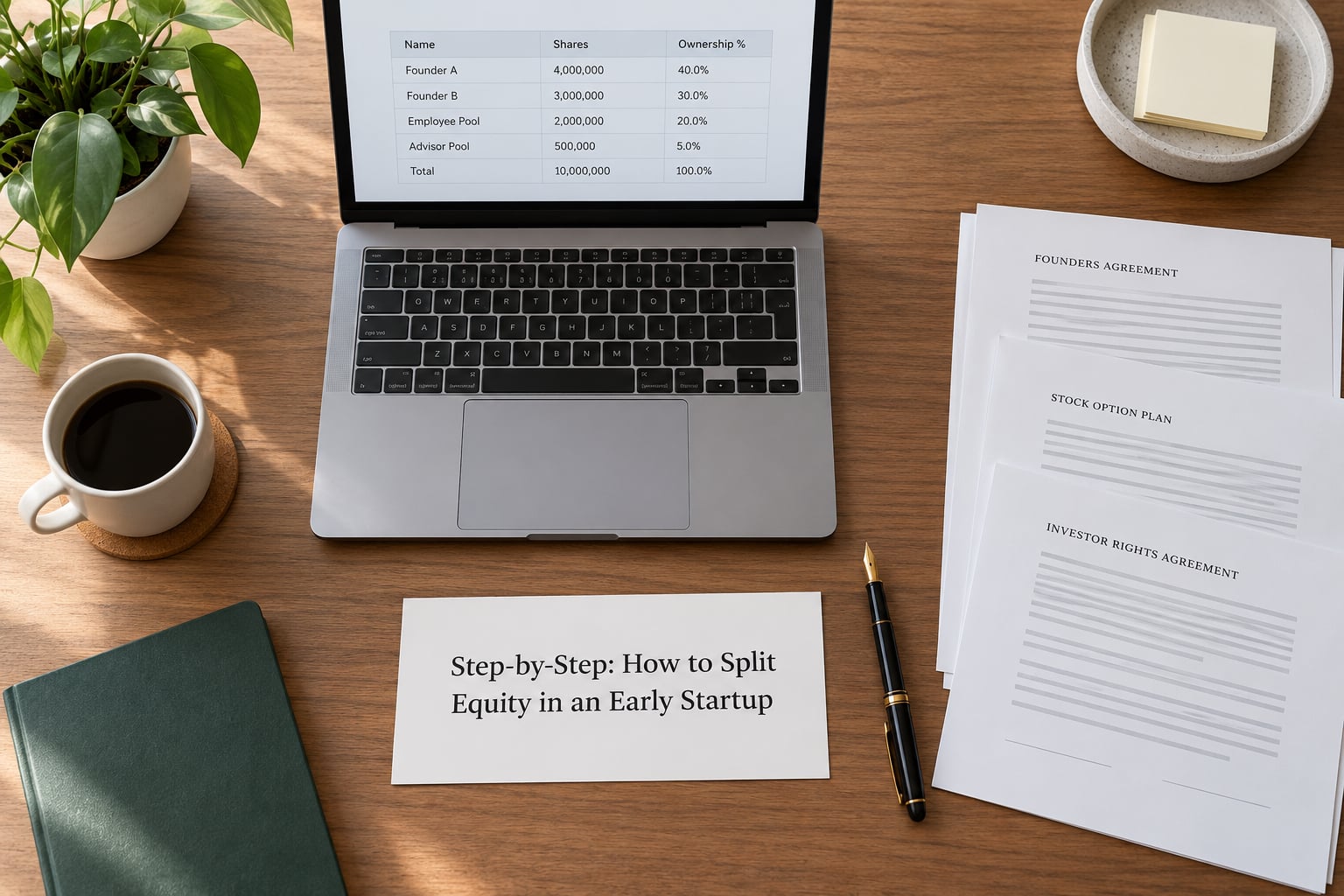
Step 1: Define the Ownership You Are Creating
Separate founder equity, employee equity, and investor equity before you assign any number. They are different conversations with different time horizons, and mixing them is how founders accidentally hand out 20% of the company in a hallway.
Founder equity pays out over years and usually carries a vesting schedule. Employee equity usually comes from an option pool, vests over four years, and has an exercise price. Investor equity arrives later at a negotiated price. Keep them apart on the cap table from day one.
Step 2: Agree on Founder Contributions and Roles
Score each founder on the factors you actually value. The table below is the format most teams land on after a few rounds of arguing.
| Factor | Weight | Alex (scores 1-5) | Jordan (scores 1-5) |
|---|---|---|---|
| Full-time commitment | 40% | 5 | 5 |
| Cash contributed | 20% | 2 | 4 |
| Existing IP or code | 20% | 5 | 1 |
| Scarce skills | 10% | 3 | 5 |
| Personal risk taken | 10% | 3 | 5 |
Alex scores 3.7 weighted points and Jordan 4.1, which lands near a 47/53 split. Neither founder loves it, both can see the math. That visibility is the whole point — a score both people signed off on is much easier to defend three years later than a number one person announced.
Two rules keep this honest. Weight your most important factor at 40% or higher so a single dimension cannot quietly dominate, and score before you discuss percentages, not after. Otherwise you are just splitting the difference with extra steps.
Step 3: Set a Simple Initial Split
Convert percentages into share counts on the fully diluted basis, then park the pool before you finalize anyone’s number.
| Situation | Typical founder split | Notes |
|---|---|---|
| Two co-founders, equal commitment | 50/50 | Works, but expect deadlocks. Consider 49/51. |
| Two co-founders, one part-time | 70/30 to 80/20 | Weight by risk, not hours logged. |
| Three co-founders | 40/35/25 | Give the smallest stake real substance or nobody owns it. |
| Technical plus business co-founder | 50/50 | Job title means nothing; shipped work does. |
| Late-joining co-founder | 5-15% | Vesting plus a longer cliff, always. |
| Advisor | 0.25-2% | From the option pool, not founder shares. |
One more thing founders argue about: whether the person who had the original idea deserves a premium. Community consensus is usually a 5-10% bump for whoever conceived the thing before anyone else was in the room. Fair enough, as long as it is written into the agreement rather than remembered out loud.
Step 4: Create an Employee Equity Pool
Set aside 10-20% of the fully diluted company for employees and advisers before your first full-time hire. Ten percent is tight; twenty is comfortable for a team that will grow fast.
Here is the arithmetic. If you issue 8,000,000 shares and reserve 1,600,000 for the pool, that pool is 20% of fully diluted ownership. When you grant 200,000 options to an engineer, it is 2.5% fully diluted — but it is 2.78% of what the founders held after the pool was carved out. Founders routinely underestimate this because they divide by issued shares only.
Approve the pool before hiring starts. Retro-fitting a pool means either diluting founders without consent or telling your first hire their grant is worth less than it was on Tuesday.
Step 5: Add Vesting and Good Leaver Provisions
Vest founder shares over four years with a one-year cliff, and make sure both founders understand what the cliff means. Until month twelve, nothing is vested if someone leaves. At month twelve, a quarter vests at once, then monthly for the remaining three years. That single provision prevents the messiest scenario in the entire article — one founder leaves in month five with half the company.
Define what happens on departure in plain terms. Good leaver covers quitting, firing for cause being handled fairly, death, and disability. Bad leaver covers fraud, theft, and wilful breach. In both cases the company usually repurchases the unvested shares at the original issue price, and good leaver terms are more generous than most founders expect to need until they do.
Acceleration matters too. Single-trigger acceleration pays out on a change of control. Double-trigger requires both a change of control and the holder being let go, which is the version investors tend to like better because it keeps the team motivated through an acquisition.
Step 6: Document the Split and Plan for Dilution
Get these into one signed founders’ agreement: the share counts and percentages, the vesting schedule, the IP assignment, decision-making and voting, deadlock resolution, and the repurchase terms. Separately, each founder needs to file an 83(b) election within 30 days of receiving restricted stock — miss that window and the tax bill on paper gains can be brutal.
Then model dilution before it happens. Here is the shape of it, assuming 8,000,000 shares issued and a 1,600,000 share pool:
- Founders hold 100% of fully diluted ownership at formation.
- A seed round issuing 2,000,000 shares takes founders to roughly 80%.
- A Series A issuing 5,000,000 more takes founders to about 53%.
- A pool refresh before Series A pushes founders under 50%.
Run that projection before you promise your team that everyone will still own a third of the company at Series B. Nobody does, and finding that out during a fundraise is a bad afternoon.
Common Mistakes That Cost Founders the Most
Splitting 50/50 out of habit
Fifty-fifty feels fair and is a governance disaster. Two equal owners cannot break a tie, and the deadlock resolution clause you write now will be the most expensive paragraph in the agreement later. Founders on r/SaaS threads almost universally recommend 49/51 for that reason. Equal is defensible only if you accept a third party as tie-breaker.
Mixing percentages with share counts
Saying “you get 40%” while the cap table says something different is how companies end up with two founders who each believe they own more of the company than exists. Assign shares, then read percentages back from the cap table. Always fully diluted.
Skipping vesting on founder shares
Owning unvested shares you cannot lose is not a benefit. If a co-founder leaves in month three, you either keep them at the table or you end up in a buyout negotiation with no leverage. Vesting protects both founders equally.
Allocating the entire company to founders
If the cap table shows founders at 100% with no pool, you have no way to hire anyone without renegotiating with both founders. Reserve the pool first. Every hire after that is a grant, not a crisis.
Making verbal promises
“We’ll sort out the details later” is not an agreement, and it is unenforceable in most places. Forum threads on r/startup are full of founders who thought a handshake was enough and learned otherwise when the company got busy.
Ignoring the founder who dies or is disabled
Almost nobody plans for it. A buyback provision triggered by death or disability, and a clear statement of who may purchase the shares, costs nothing to include and answers a question that is miserable to resolve later.
Frequently Asked Questions
How should two founders split equity in an early startup?
Start with a weighted factor score covering full-time commitment, cash contributed, existing intellectual property, scarce skills, and personal risk. Most two-founder teams that score honestly land between 50/50 and 70/30. Assign the result as share counts on a fully diluted basis, carve out the employee option pool first, and vest both founders over four years with a one-year cliff.
Should startup founders use equal equity splits?
A 50/50 split works when contributions really are equal, but it creates permanent governance friction because two equal owners cannot break a tie. Many founders choose 49/51 instead so one person has the deciding vote on board matters. If you go 50/50, name the deadlock resolution process and the tie-breaker in the founders agreement before you need it.
How much equity should founders leave for employees?
Most teams reserve 10 to 20 percent of the fully diluted company for employees and advisers before hiring. Ten percent covers a small team, while twenty gives you room for a growth year without asking founders to approve new grants. Reserve the pool at formation so existing founders absorb the dilution instead of the first hire.
Should founder shares be subject to vesting?
Yes, and it is the market standard. Founder shares typically vest over four years with a one-year cliff, meaning nothing vests until month twelve and a quarter vests at that point. Vesting protects the company when a co-founder leaves early, and it protects the founder who stays from having to buy out a departing partner.
How does investor funding affect founder ownership percentages?
Every new share issued dilutes everyone who holds shares today unless they participate in the round. A seed round can cut founder ownership from 100 percent to roughly 80 percent, and a Series A often takes them below 55 percent before any pool refresh. Founders usually sell part of their stake rather than all of it, so their relative proportions often stay the same even as the total falls.
Do founders need a written equity agreement?
Yes. A written founders agreement should cover share counts and percentages, vesting, the intellectual property assignment, voting and deadlock resolution, and repurchase terms. Verbal arrangements are hard to enforce and near impossible to sort out later. Each founder should also file an 83(b) election within 30 days of receiving restricted stock to limit the tax treatment of future gains.
Conclusion
Write down what each founder is contributing: hours, cash, intellectual property, skills, and the risk they are taking with their career. Score those factors together and let the percentage fall out of the math rather than out of a guess made in the first five minutes.
Reserve the option pool before you finalize anyone’s share count, vest every founder over four years with a one-year cliff, and have a qualified attorney turn the whole thing into a signed founders agreement. That is the whole job — four decisions, one document, done in the first month.