
Volunteer tech groups — civic tech brigades, nonprofit digital service squads, hackathon teams, open-source maintainer groups — organize projects by running one repeated cycle: intake a partner’s problem, score and scope it, name an owner for every deliverable, track the work on a board tied to the code repository, meet on a fixed cadence with written async updates in between, demo publicly, and close with a retro and a handoff. There is no manager, no performance review and no employment continuity behind that cycle, so the structure has to be written down instead of assumed.
The pattern is well worn. Code for America brigades run a four-document lifecycle covering selection, initiation, development and closeout, built on the idea of build with, not for. Groups that adopt the hard, meaningful partner problem instead of the easy demo tend to hold people’s attention, because the work actually matters to somebody.
How volunteer tech groups organize projects is a cycle you can write down and repeat, not a mystery: what you need before you start, seven stages that take a project from a hallway conversation to a finished handoff, and the four mistakes that kill volunteer projects faster than anything else.
Table of Contents
- What You Need Before You Start a Volunteer Project
- How Volunteer Tech Groups Organize Projects Step by Step
- 1. Define the Community Need and Project Scope
- 2. Form a Small Team With Clear Ownership
- 3. Choose a Lightweight Governance Model
- 4. Break Work Into Phases, Tasks, and Milestones
- 5. Establish Communication and Decision Records
- 6. Test With Real Users and Manage Risk
- 7. Hand Off, Measure, and Close the Project
- Common Mistakes and How to Fix Them
- Starting With Technology Before a Clear Need
- Giving Everyone Too Many Responsibilities
- Relying on Informal Communication
- Volunteering Without Limits or Support
- Frequently Asked Questions
- What roles does a volunteer tech team need?
- How often should a volunteer tech group meet?
- How do volunteer tech groups choose which projects to build?
- How do you keep volunteer developers engaged between projects?
- What should a volunteer tech project budget and timeline look like?
- Conclusion
What You Need Before You Start a Volunteer Project
Nine things. If you cannot name one person who is responsible for each of them, the project will stall inside a month. Most groups have a list somewhere — the question is whether anyone reads it.
- A defined community problem. One sentence naming who has the problem and what it costs them. “Small nonprofits lose donation revenue on broken web forms” works. “We need a better website” does not.
- An initial project sponsor. One person from the partner organization who can answer questions within a couple of days and who can actually make decisions. Partner responsiveness, not volunteer availability, is the usual bottleneck.
- A core team of three to six people who have committed to the full span of the project, not just the kickoff.
- A small working group that does the week-to-week work — typically one developer, one designer, and one rotating contributor.
- Written decision-making authority. Who can approve a scope change, who can approve a release, and what does not need approval at all.
- One communication channel and one project-management tool. Two tools, not twelve. See step 5.
- A shared source of truth — usually a repository wiki or a single document — that a volunteer who joined last week can read without asking anyone.
- A budget and resource policy. Even for a zero-dollar project, write down who pays for hosting and domains, what happens when a paid tier runs out, and whether donated money is acceptable at all.
- Basic risk and accessibility notes. What personal or sensitive data would this project touch, and who can be blocked from a screen by a form nobody tested.
Record these in a one-page project charter. A charter with nine short fields takes twenty minutes to write and prevents most of the arguments that would otherwise happen in month three.
How Volunteer Tech Groups Organize Projects Step by Step
Seven stages, and each one has an output you can point at. If a stage produces no artifact, it did not happen.
1. Define the Community Need and Project Scope
Turn a broad idea into a problem statement. Name the affected residents or partner staff, the outcome you want, the constraints you cannot cross, and — critically — what the project will not attempt.
That last part does more work than the rest. A volunteer team with an unbounded brief will spend its first six months debating scope. A team told “we are not rebuilding the CRM, and we are not doing email integration this round” can finish something small and useful.
Output: a one-paragraph scope statement.
Sign it worked: you can write a test for completion that a stranger would agree with. “Residents can submit a repair request and track its status without phoning the office” passes. “The site is better” does not.
2. Form a Small Team With Clear Ownership
Recruit a mix rather than a pile of developers. Useful combinations are builders (developers, data people), domain advisers (someone who actually knows how the partner’s work happens), a project coordinator, and a community representative who can speak for the people the project serves.
Every deliverable gets one accountable owner and one backup. Not a committee. The recurring failure in volunteer projects is not unwillingness — it is that six people each assume someone else filed the accessibility label, so nobody does.
State the time expectation out loud. Most published cadence guidance for volunteer groups points at the same window each week, often a late-afternoon slot that overlaps partner staff hours, because volunteers who work in the same three-to-five p.m. window as the people they are building for are dramatically easier to schedule.
Output: a roles table with owner, backup and expected hours.
Sign it worked: every name in the table has agreed to it out loud, and no one holds more than two active tasks.
3. Choose a Lightweight Governance Model
Three options cover almost every volunteer tech group.
Leader-led. One organizer decides, and everyone else advises. Fastest, and it breaks the day the leader gets a new job or moves cities — which happens constantly in volunteer groups.
Coordinator-led. A project coordinator owns process and deadlines while technical decisions stay with the tech lead. This is the most common working model and the one that survives a handover best.
Consensus or council. Decisions by agreement or vote. Appropriate when a project touches policy, budgets or public data, and expensive otherwise: the discussion time starts eating delivery time within two meetings.
Whatever you pick, write down three things: how decisions get documented, how disagreements get resolved (a deadline, an escalation path, or a named tiebreaker), and who can access sensitive data. Governance that takes more time than shipping is a tax on volunteers, and they will vote with their feet.
Output: a one-paragraph decision rule, written in the repo.
Sign it worked: a new volunteer can find the last three decisions and understand them without asking anyone.
4. Break Work Into Phases, Tasks, and Milestones
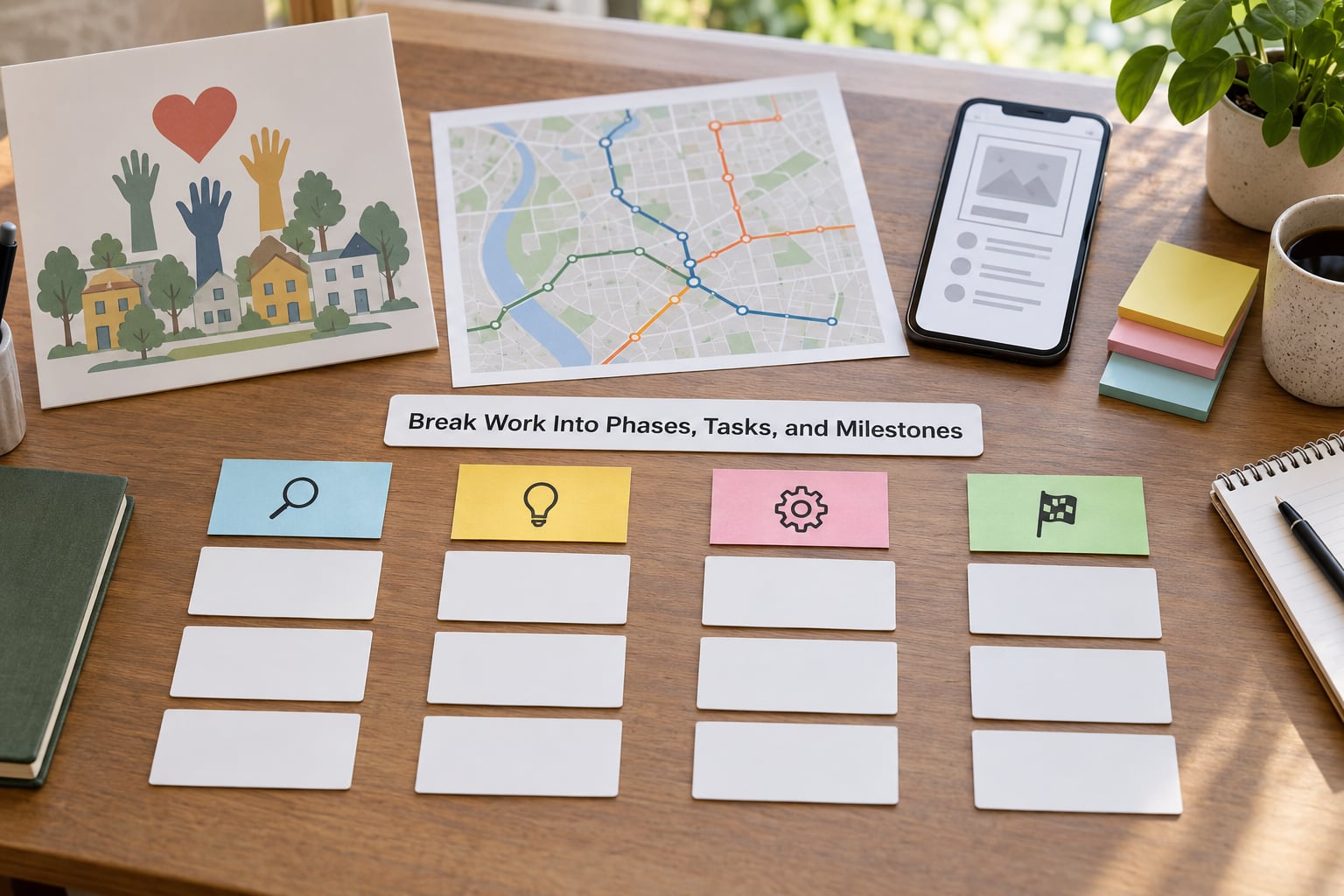
Split the project into phases with real stop points: discovery, prototype, pilot, feedback, and handoff or maintenance. Each task carries an owner, a dependency list, a date and an acceptance criterion — the sentence someone else could use to check whether the work is finished.
Use the issue tracker as the board rather than a parallel tool. Issues get labels for skill needed, priority and phase, so picking up work is self-serve. A separate spreadsheet board that nobody updates is worse than no board.
Take a mid-size example. A volunteer group building a repair-request tracker for a housing nonprofit splits it like this: discovery — interview six staff members and pull the current form fields. Prototype — a clickable mock of the submission and status flow. Pilot — live submissions for one building for two weeks. Feedback — themed findings from roughly twenty requests. Handoff — training session, credentials transfer, and a written decision on who maintains it after the volunteers leave.
Every one of those phases ends in something a person can look at. That is the test for whether a phase is real.
Output: a board with dated milestones and acceptance criteria.
Sign it worked: you can point to a milestone you are willing to call finished, and two people agree.
5. Establish Communication and Decision Records
One primary coordination channel, a fixed recurring check-in, and written updates between. Long gaps between meetings are what kill volunteer projects — progress made in week two is usually gone by week nine because nobody remembered the decision behind it.
Keep async updates to five lines: what I finished, what I am doing next, what is blocked, what decision I need, and whether the scope changed. That format alone prevents most of the “I thought you were handling that” moments.
Keep a searchable decision log — a short file listing the date, the decision, the reasoning and who was in the room. Forum advice on running these groups is consistent on this point: choices made in a chat thread disappear, and chat scrolls.
Output: a channel, a calendar, an update template and a decision log.
Sign it worked: a volunteer who was absent for six weeks catches up in under fifteen minutes.
6. Test With Real Users and Manage Risk

Recruit representative users before you build, not after. For a civic project that usually means partner staff and the residents who will actually use the thing, recruited through the partner rather than through your own channels.
Plan a small pilot with a consent-based feedback form, write down what you found, and prioritise revisions by how many people hit the problem rather than by who argued hardest in the meeting.
Six risk categories come up repeatedly, and each has a cheap prevention:
- Privacy and security. Keep real personal data out of development environments. Use fake records for testing.
- Accessibility. Test forms and flows with a keyboard only and a screen reader before launch, not after a complaint.
- Unsafe deployment. Never let a volunteer push straight to production. Staging plus a checklist plus one person who holds deploy rights.
- Partner confusion. Send two people to partner meetings and have both write up the same notes. A single no-show should not derail anything.
- Volunteer burnout. Bound the commitment, rotate the on-call burden, and watch the calendar, not just the repository.
- Beginner blockage. A steep stack is a retention problem. New contributors need a first issue that builds in their first evening.
Output: pilot findings, a prioritised revision list and a written risk register.
Sign it worked: at least one change you made came directly from something a real user told you.
7. Hand Off, Measure, and Close the Project
Closeout is the stage most groups skip, and it is the one that determines whether volunteers come back. Document the final deliverable, the work that remains, the credentials and who holds them, what data was collected and what happens to it, and the named support contact at the partner.
Measure two things honestly. Usefulness — were the intended users better off, in a way the partner can confirm? Participation — did volunteers stay, join mid-project, or leave? Both are worth knowing, and the second one is the leading indicator for the next project.
Then decide, and say it out loud: is the project complete, does it need another iteration, or is the partner adopting it? A published principle worth borrowing is that deploying to production is not the same as being done. Somebody still has to answer questions in six months, and write down who.
Archive what is reusable, thank the volunteers specifically, and post the demo publicly. Demo days are cheap and they are the best recruiting tool a volunteer group has.
Output: a handoff document, a short retro, and a closing demo.
Sign it worked: the partner can run the thing without asking you a question.
Common Mistakes and How to Fix Them
Four failures account for most stalled volunteer projects. Each has a boring, proven fix.
Starting With Technology Before a Clear Need
Picking the stack, the platform or the feature before validating the problem is the most expensive mistake available, because you build confidently toward the wrong target. Easy demo projects also tend to get abandoned, precisely because they were never important to the partner.
Fix: write the one-paragraph need statement first, name the intended users, define one measurable outcome, and only then look at tools.
Giving Everyone Too Many Responsibilities
Equal participation sounds fair and produces blurred ownership. Six people each holding a third of four deliverables means every deliverable has six partial owners and nobody accountable.
Fix: one accountable owner per deliverable, a named backup for every key person, a hard cap of two active tasks per volunteer, and every decision recorded in a shared location so it stops living in one person’s memory.
Relying on Informal Communication
Important choices made in a chat thread or shouted across a meetup vanish, and two volunteers end up building incompatible versions of the same feature.
Fix: one stable source of truth, five-line written updates, notes from every meeting with owners named, and a decision log people can search. Consistency beats volume here — plan weekly or monthly, and never cancel a session just because only two people said yes.
Volunteering Without Limits or Support
Urgent requests, unclear availability and unlimited responsibility produce the quiet disappearance that volunteer-run projects report most often, and usually the disappearance looks like a personal failing when it is a design failure.
Fix: publish a time boundary per role, rotate any on-call duty, cap how many projects a volunteer is actively on, keep the recurring slot at sustainable hours, and plan a clean handoff rather than an indefinite handover of a live system.
Frequently Asked Questions
What roles does a volunteer tech team need?
Most volunteer tech teams need five roles: a project coordinator who owns process and deadlines, a tech lead who owns technical decisions, a design lead who owns usability and accessibility, a domain adviser who knows how the partner’s work actually happens, and an onboarding buddy who gets new volunteers productive. Small groups merge these roles, but keep one accountable owner and one backup for each deliverable rather than spreading it evenly.
How often should a volunteer tech group meet?
Weekly works best for an active build team, and monthly is fine for a group that mostly runs meetups and workshops. Pick one recurring slot and keep it, because long gaps between sessions are what destroy volunteer project momentum. Add written async updates between meetings so nobody depends on showing up to learn a decision. Do not cancel a session just because only a couple of people RSVP’d.
How do volunteer tech groups choose which projects to build?
They score proposals against a short written criteria list: is the community problem clear and specific, does the partner commit a named decision-maker, is the scope finite and reachable by volunteers in three to twelve months, and can the result be handed over cleanly? Groups that pick hard, meaningful partner problems hold volunteers better than easy demo projects, which tend to get abandoned because they were never important to the partner.
How do you keep volunteer developers engaged between projects?
Give people something small to finish, not an open backlog. Maintain a labelled first-issue list a beginner can finish in an evening, pair new volunteers with an onboarding buddy, run a public demo day at the end of each cycle, and thank people by name for specific work. Keep the between-project load light and predictable, because the most common reason volunteers disappear is not that they lost interest but that they were asked for more than they offered.
What should a volunteer tech project budget and timeline look like?
Most civic tech volunteer projects run zero-dollar to a few hundred dollars a year, spent on hosting, domains and event costs, so write the resource policy before spending anything and decide who pays when a paid tier expires. Plan for three to twelve months from first meeting to handoff, and record the date ranges at kickoff. A project with no written timeline tends to drift until a volunteer gets a job and the work stops.
Conclusion
How volunteer tech groups organize projects comes down to four things that survive contact with reality: a scope statement somebody can test, one accountable owner per deliverable with a named backup, work tracked on a board tied to the repository, and a fixed cadence with written decisions. Everything else — the tools, the events, the branding — sits on top of that and moves when the bottom moves.
So start small. Write the need statement this week, name your first three to six people, and put a sixty-minute scope-and-ownership meeting on the calendar. If the group can walk out of that hour with a written scope and a names-on-a-list roles table, the rest of the process is follow-through.