
A grant budget gets approved when every line item is necessary, affordable, allowable and traceable to a specific activity in your narrative. To write one, work from the project work plan outward: list each activity, attach a cost to it, calculate fringe and indirect costs from the resulting base, then write a justification that a reviewer can check line by line. Budgeting a typical civic tech grant takes most teams two to three working days once the source documents are in hand.
Reviewers treat the budget as a scoring document, not an appendix. They scan the categories, check that the arithmetic holds, verify each cost is reasonable, and then cross-check the budget against the work plan. An application with a slightly less polished narrative and a clean, consistent budget usually outscores the reverse.
One rule runs through everything below: every activity in the narrative has a matching line item in the budget, and every line item is explained in the narrative. Drift between the two is the most common reason a strong program gets downgraded.
Table of Contents
- What You Need
- Step-by-Step: How to Write a Grant Budget That Gets Approved
- 1. Define the grant’s scope and budget period
- 2. Build a complete project cost list
- 3. Separate project costs from future operations
- 4. Calculate personnel and fringe costs accurately
- 5. Add equipment, software, travel and other direct costs
- 6. Calculate indirect costs and match requirements correctly
- 7. Justify every line item with a clear budget narrative
- 8. Check the budget against the application requirements
- After approval: what the budget becomes
- Common Mistakes
- Frequently Asked Questions
- How do I format a budget for a grant?
- What are indirect costs in a grant budget?
- How do I write a budget justification for a grant?
- Can you give me an example of a budget narrative for a grant application?
- What are the most common budget mistakes in grant applications?
- Can I use ChatGPT or other AI tools to build my grant budget?
- Conclusion
What You Need
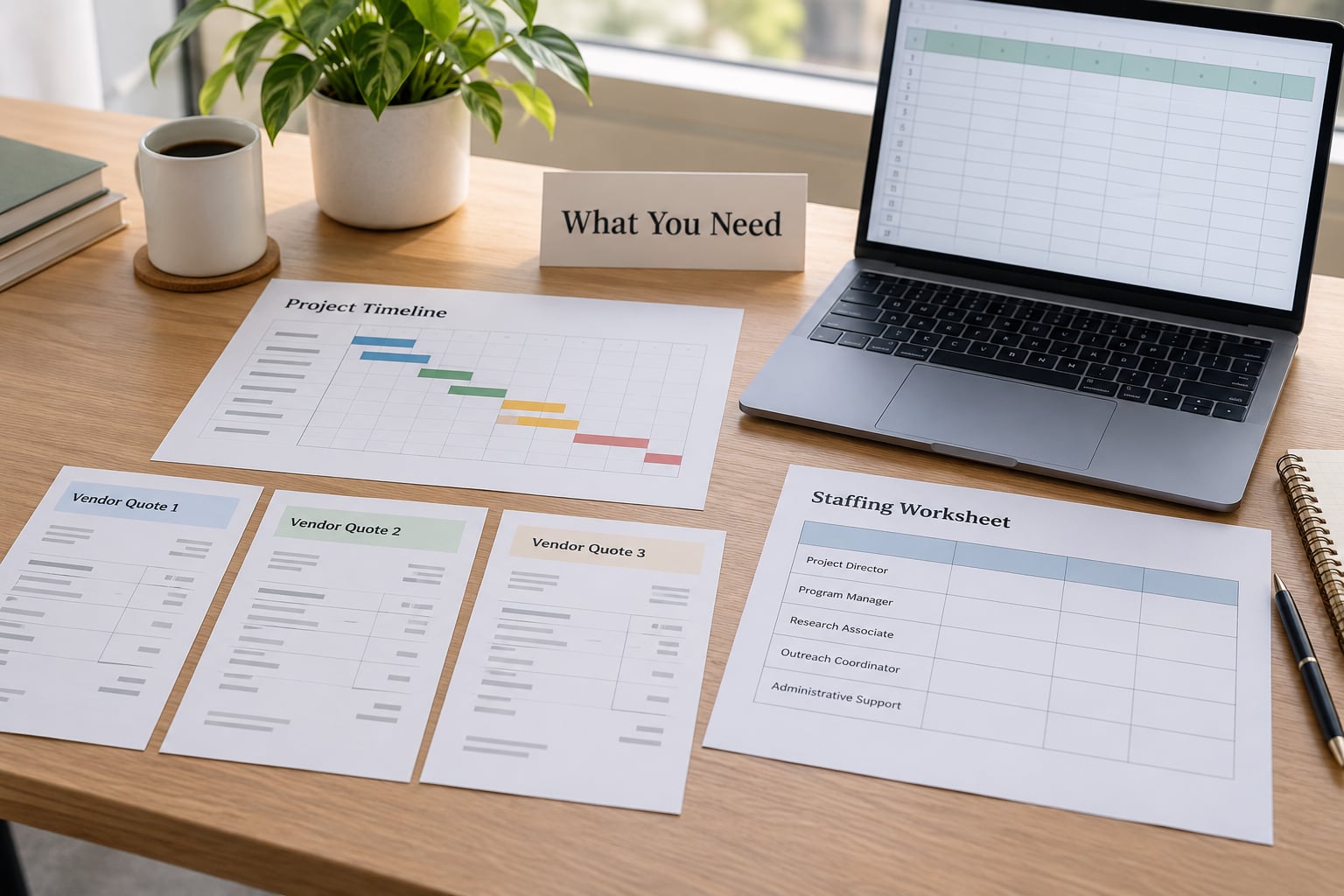
Do not open the budget form yet. Gather the source material first, because a budget built without documentation turns into estimates that reviewers discount or reject.
The funder’s rules. Download the instructions and the budget forms themselves, not just the summary page. You need the award ceiling, the minimum and maximum request, the required cost categories, the indirect-cost cap, the match requirement, the required forms, and the page limits on the justification narrative.
Your project scope. The work plan, start and end dates, activity list, milestones, deliverable schedule and the number of people or sites the project touches. Without dates you cannot assign staff effort, and without an activity list you cannot justify a single line.
Staffing assumptions. Every role, current salary, the share of time committed, and the fringe rate you actually pay. Pull salaries from payroll, not from memory, and check regional comparables or Bureau of Labor Statistics data when you are filling a role that does not exist yet.
Vendor quotes. Written quotes for anything over your organization’s small-purchase threshold, plus dated screenshots of published pricing for software, hosting and services. A quote you can attach converts an argument about price into a fact.
The financial context. Most funders want your indirect rate agreement if you have one, your most recent audited financials or Form 990, and a note on committed future funding. If you have lost a major grant, say so here rather than letting the reviewer discover the gap in your reserve ratio.
A reviewer. Someone who did not write the narrative. You will need them later for the cross-check, and it is far cheaper to find them now than three days before the deadline.
Step-by-Step: How to Write a Grant Budget That Gets Approved
1. Define the grant’s scope and budget period
Start by fixing the dates. Every cost in a grant budget must be claimed inside the budget period, so a laptop bought in the final month of year one cannot be charged to a two-year award unless the funder allows advance purchase.
Write the period at the top of your worksheet, then list the three or four major deliverables beneath it. Each one becomes a budget block. When the reviewer later asks whether a cost is necessary, the answer is the deliverable it supports.
Write down the assumptions in plain sentences while they are fresh: headcount, hours per week, number of sites, number of workshops, duration of the data contract. Assumptions written this way become the text you reuse in the justification, so nobody has to reconstruct your reasoning later.
2. Build a complete project cost list
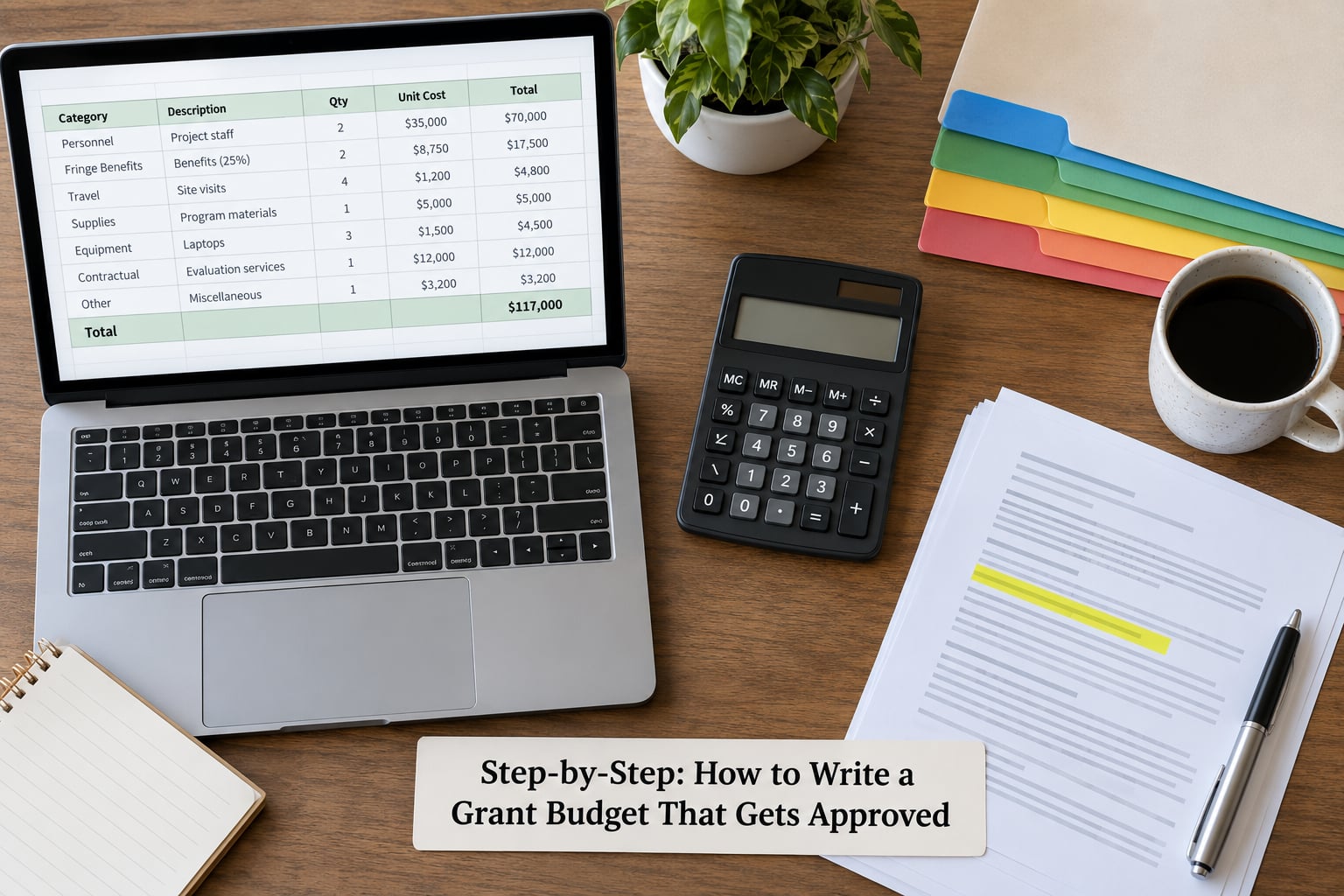
Enter costs in the categories the funder asks for, not in categories that suit you. The standard set is personnel, fringe benefits, travel, equipment, supplies, contractual, construction, other direct costs, and indirect costs. Grouping things differently rarely survives review.
Use this reference when you sort your list:
Personnel includes salaries, wages, hourly labor and student stipends tied to named work. Fringe benefits cover payroll taxes, health insurance, retirement contributions and paid leave. Travel covers transport, lodging, mileage and per diem. Equipment means items at or above your funder’s capitalization threshold, which is commonly 5,000 under 2 CFR 200 Uniform Guidance. Supplies covers consumables and items below that threshold. Contractual covers vendors, consultants, subcontractors and data licenses. Other direct costs catches anything project-specific such as participant stipends, accessibility services or cloud fees. Indirect costs are shared expenses that cannot be assigned to one project, often called F&A or overhead.
Do not enter a lump sum called “project expenses”. That single line is where many otherwise careful applications lose credibility.
3. Separate project costs from future operations
Decide early which costs belong in the grant and which belong to you, your partners or a post-award operating plan. A pilot is grant-funded; running that pilot forever at full scale usually is not, and a reviewer who suspects you have funded a recurring expense with one-time money will reduce the whole budget.
Ask of each line: does this expense exist only because this project exists? If the answer is no, it belongs elsewhere or it needs a clear sustainability note.
Where operations genuinely continue, say so directly. Something like “hosting costs are covered for the 12-month pilot period; ongoing hosting is covered by the partner’s existing infrastructure contract” tells a reviewer you have thought about sustainability. Silence is what raises doubts.
4. Calculate personnel and fringe costs accurately
Personnel is usually the largest line and the one reviewers check most carefully, because the math is easy to verify. Define FTE and level of effort inline: FTE is full-time equivalent, and level of effort is the share of one person’s workload committed to the project.
Multiply annual salary by FTE to get the project-year salary. Here is a worked example for a 12-month smart-city curb and transit sensor pilot:
Project director at 95,000 a year, committed at 0.4 FTE, gives 38,000. Data engineer at 110,000 committed at 0.5 FTE gives 55,000. Community engagement coordinator at 62,000 committed at 0.25 FTE gives 15,500. The salary total is 108,500.
Now the fringe benefits rate. Calculate it as total annual benefit costs divided by total annual salary costs. If your organization pays roughly 30,380 in benefits against 108,500 in salary, your rate is about 28 percent. Apply that rate to project salaries: 108,500 times 0.28 gives 30,380.
Two things trip applicants here. First, never use a round rate without saying where it came from; “28 percent fringe, based on the organization’s actual benefit costs from the most recent fiscal year” is defensible and a bare “28 percent” is not. Second, if a staff member is split across several grants, name the allocation method, such as a documented timesheet or a straight percentage of salary, and state that it is applied consistently.
If you share one person across grants, reviewers worry about double-dipping, and they will ask. A one-line note that effort is tracked monthly against a timesheet removes the concern entirely.
5. Add equipment, software, travel and other direct costs
Price each item from a quote or a dated published price, and show the unit and quantity in the worksheet so the arithmetic is visible. “12 curb sensors at 780 each” survives review; “sensor deployment” does not.
Do not skip the awkward line items. Accessibility services, workshop facilitation, participant stipends, translation, data cleaning and open-data publishing all have real costs, and a civic tech application that funds software but forgets to pay the people running community workshops reads as naive.
Use a contingency line only where uncertainty is genuine, typically on capital or hardware-heavy budgets, and keep it to 5 to 10 percent of direct costs. Label it explicitly as contingency, explain what it covers, and make sure the funder allows it. Unexplained contingency looks like padding, and funders often strip it out.
For multi-year awards, build a step-down budget: more staff effort in year one for setup and design, tapering in later years as the work moves to maintenance and evaluation.
6. Calculate indirect costs and match requirements correctly
Indirect costs, also called F&A costs or overhead, are shared expenses that cannot be assigned to one project: rent, utilities, accounting, human resources, insurance and general administration. A direct cost would exist only because your project exists; an indirect cost would exist regardless.
The rate is applied to a base, and you must name the base. Modified total direct costs, abbreviated MTDC, excludes certain items from the base, including equipment above the capitalization threshold and the sub-award portion of a contract. Many smaller organizations that have never negotiated a rate may elect the de minimis rate, which is 10 percent of MTDC, with no formal agreement required.
Continue the worked example. Salary of 108,500 plus fringe of 30,380 plus other direct costs of 55,986 gives total direct costs of 194,866. Equipment above the capitalization threshold is excluded from MTDC, so the modified base is 164,466. At a de minimis rate of 10 percent, the indirect request is 16,447. The grant request is 211,313.
Now match and cost share. Cost share is money or in-kind value you contribute alongside the grant, and in-kind value includes donated space, staff time or equipment. Count each source once, describe the basis for valuing it, and confirm the funder’s definition. Some funders exclude in-kind from the match calculation; others require a specific ratio such as one to one. Several private foundations cap indirect costs at 10 to 15 percent, which is well below a real rate, and the honest move is to show your full calculation, request what the cap allows, and note that your organization absorbs the difference rather than quietly deleting a cost line.
7. Justify every line item with a clear budget narrative
The justification tells reviewers why each cost is necessary and reasonable. Write it line by line, following the order of the budget form so reviewers can read it against the numbers without hunting.
Four sentences per line item is plenty: what it is, why the project needs it, how you priced it, and how it connects to a deliverable or funder priority. Then state your assumptions once, at the top, so you are not repeating them twenty times.
Compare two treatments of the same line. Weak: “Software and hosting costs for the data platform.” Strong: “Cloud hosting and managed database support for the open-data pipeline, covering 12 months of continuous ingest from 40 curb sensors and six transit stops. Priced from the provider’s published annual plan of 12,400 plus 1,800 in additional storage and alerting, which supports the milestone of a public dashboard in month 7 and monthly published data quality reports thereafter.”
The second version names the quantity, the price source, the period and the deliverable. That is the whole difference.
End the narrative with the cost-effectiveness line reviewers reward: total request divided by participants, sites or residents served. At 211,313 for a pilot touching 1,200 residents, that works out to about 176 per resident, which makes the scale legible to someone who does not read budgets all day.
8. Check the budget against the application requirements
Run a compliance pass before you write the cover letter, because changes are cheaper now. Confirm the totals add up and that each category figure matches its line items. Check that every cost falls inside the budget period, that no unallowable cost slipped in, and that personnel totals match the staffing plan in the narrative.
Verify that the request sits within the funder’s ceiling and minimum, that the indirect rate matches your agreement or your de minimis election, that match is documented and meets the required ratio, and that every required form and attachment is present. Check that your justification stays inside the page limit while still covering every line.
Finally, run the cross-check with a fresh reader. Give them the narrative and the budget side by side and ask them to point to any activity without a line item and any line item without a narrative mention. Every answer should come back clean.
After approval: what the budget becomes
An approved budget is a contract, and knowing the variance rules protects the award. Most funders allow movement between categories without asking, within an overall budget change of around 10 percent. Moving more than that, or shifting money between budget years or into a new category, usually requires written prior approval. Check your specific agreement and note the threshold in your files now.
Track actual spending against the approved lines monthly rather than waiting for the quarterly report. Catching a 20 percent overrun in equipment in month three is a conversation. Catching it at year end is a repayment conversation.
Common Mistakes
These are the errors that most often downgrade an otherwise strong application, with the correction for each.
1. Narrative and budget drift. Your work plan promises community workshops, field testing and a public dashboard, but none of them appears as a cost line. Reviewers read this as a plan the applicant has not costed. Fix it by walking the activity list and confirming each item has a cost attached, in either direction.
2. Rounded numbers with no source. A budget padded with round figures reads as an estimate rather than a plan. Fix it by working to the specific number and attaching the quote, the published price or the payroll record behind it.
3. Requesting overhead above the cap. Some applicants submit their full negotiated rate to a funder that caps indirects at 12 percent. Fix it by requesting the capped amount, stating your real rate and where it comes from, and noting that your organization covers the difference.
4. Budgeting operations with project money. Requesting ongoing hosting, permanent staffing or year-two maintenance as project costs. Fix it by separating pilot costs from post-pilot operating costs and explaining who covers them after the award.
5. Ignoring unallowable costs. Entertainment, fundraising costs, general donations and most lobbying are commonly unallowable under federal rules, and many private funders have their own exclusions. Fix it by checking the allowability list before the arithmetic, not after.
6. Inconsistent staff effort. The narrative says a coordinator is quarter-time while the budget charges half-time. Fix it by reconciling every FTE figure against the staffing section of the work plan, value by value.
7. Hiding administrative costs. Applicants drop legitimate shared costs because of the overhead myth, then cannot explain how the project will actually be administered. Fix it by requesting indirect costs at the allowed rate and describing them in plain language as the core mission support that keeps the project running.
Four habits raise reviewer confidence above the budget itself. Show your work, since a visible calculation is easier to trust than a clean total. Name your assumptions once and reuse them. Attach sources. And be honest about uncertainty, because a candid note about a funding gap reads far better than false precision a reviewer can see through.
On whether you can use AI tools like ChatGPT for grant writing: they are reasonable for outlining your categories, checking arithmetic and drafting a template you then correct with real figures. They are not a substitute for your rates, quotes, agreement terms or judgement about what belongs in the request. Many funders now ask applicants to disclose AI assistance, so check the instructions before you submit, and never paste confidential financials or partner agreements into a public tool.
Frequently Asked Questions
How do I format a budget for a grant?
Use the category structure the funder’s own forms require: personnel, fringe benefits, travel, equipment, supplies, contractual, other direct costs, and indirect costs. Show quantity and unit price per line, group nothing into a lump sum, total each category and the whole request, and attach a narrative justification that follows the same order as the form.
What are indirect costs in a grant budget?
Indirect costs, also called F and A costs or overhead, are shared expenses that cannot be assigned to one project, such as rent, utilities, accounting and insurance. They are calculated as a percentage of a base, usually modified total direct costs, or MTDC. Organizations without a negotiated rate agreement may usually elect the de minimis rate of 10 percent of MTDC, while many private foundations cap the request at 10 to 15 percent.
How do I write a budget justification for a grant?
Follow the order of the budget form and write one short block per line item: what it is, why the project needs it, how you priced it, and which deliverable or funder priority it supports. State your shared assumptions once at the top so you do not repeat them, and end with a cost-per-participant figure that makes the scale easy to understand.
Can you give me an example of a budget narrative for a grant application?
Weak: software and hosting for the data platform. Strong: cloud hosting and managed database support for the open-data pipeline, covering 12 months of ingest from 40 curb sensors and six transit stops, priced from the provider’s published annual plan of 12,400 plus 1,800 in storage and alerting, supporting a public dashboard in month 7. The strong version names quantity, price source, period and deliverable.
What are the most common budget mistakes in grant applications?
The most common are narrative and budget drift, rounded numbers with no price source, requesting overhead above the funder’s cap, charging ongoing operating costs to project money, including unallowable costs, staff effort that contradicts the work plan, and dropping administrative costs to avoid the overhead myth. Each is corrected by reconciling the budget against the narrative line by line before submission.
Can I use ChatGPT or other AI tools to build my grant budget?
AI tools are useful for outlining categories, checking arithmetic and drafting a template you then correct with real figures from payroll, quotes and your agreement. They cannot supply your fringe rate, indirect rate or vendor pricing. Check the funder’s instructions, since many now ask applicants to disclose AI assistance, and never upload confidential financials or partner agreements to a public tool.
Conclusion
Open with your funder’s instructions and budget form, then gather the work plan, payroll figures and vendor quotes before you calculate anything. Build one line item per activity, apply fringe to project salaries, apply your indirect rate to the correct base, and write the justification in the same order as the form. Finally, hand the narrative and the budget to someone who has not seen the project and ask them to find any line without an activity or any activity without a line. Getting there is how to write a grant budget that gets approved: traceable costs, visible math, and a reviewer who never has to guess.