Building a government sales pipeline comes down to four things: knowing which agencies to target, qualifying each opportunity before you spend proposal dollars, mapping the buying group inside the agency, and recording every next action in your CRM. Most teams stumble on the second one, because a public-sector opportunity looks different from a commercial deal the moment you find it. The buyer is a program office, the money sits in a fiscal-year budget line, and a contracting officer, not a VP of procurement, decides who gets the work.
Budget a long runway. Complex federal pursuits typically run nine to eighteen months from first contact to award, and municipal work can move faster while still being formal. This guide covers what you need before you start, the four-step process that turns a list of leads into a forecastable funnel, and the mistakes that quietly flatten most government pipelines. If you sell civic tech, smart city, energy, mobility or open data, the same mechanics apply with different sourcing tools.
Table of Contents
- What You Need
- Step-by-Step
- How to Build a Sales Pipeline for Government Customers by Defining the Right Opportunities
- How to Build a Sales Pipeline for Government Customers by Mapping the Buying Process
- How to Build a Sales Pipeline for Government Customers by Qualifying Demand
- How to Build a Sales Pipeline for Government Customers by Creating a Repeatable Follow-Up System
- Common Mistakes
- Frequently Asked Questions
- How long does a government sales cycle usually take?
- What is the best way to find government procurement opportunities?
- Should small businesses use the same government sales pipeline?
- How do you qualify a government customer before investing time in a proposal?
- What CRM stages work best for public-sector sales?
- How can a vendor build relationships without prior government experience?
- Conclusion: Start With One Government Account
What You Need
Six things need to exist before you touch a single opportunity. Skipping any one of them is how pipelines turn into a cluttered contact list.
- A named target agency list. Five to fifteen agencies or departments you actually want, with the office level where your solution fits. National agencies are not one buyer; a county health department and a state transportation bureau buy nothing alike.
- A written ideal customer profile. The problem you solve, who feels that problem daily, what a good program looks like today, and the contract types you can realistically win. Civic tech vendors usually have a sharper profile than “any municipality.”
- Sourcing tools you will actually check. SAM.gov for federal solicitations and forecasts, state and local procurement portals for public bids, and a paid aggregator if you want incumbent and award history instead of just open listings.
- A buying-group map template. One row per stakeholder: role, name, what they control, what they are worried about, and the next step with them. Blank and ready before the first meeting.
- A CRM with government-specific fields. Solicitation number, NAICS code, set-aside eligibility, procurement method, contracting officer, incumbent, contract vehicle, and your probability of win. A generic five-stage pipeline cannot carry this.
- Security and compliance facts in writing. Your registration status, entity registration number, small-business size standard and set-aside eligibility, past performance references, and any framework or certification you hold.
- A bid/no-bid scorecard. Weighted criteria decided in advance, including a total contract value floor and ceiling, prime-only status, incumbent presence, and set-aside eligibility. The scorecard is what stops pursuit decisions from being made on gut feeling, which is where most public-sector pipelines quietly leak proposal hours.
Step-by-Step
The process below is the one that survives contact with reality. Run it in order, and each stage hands the next one something solid to work with.
How to Build a Sales Pipeline for Government Customers by Defining the Right Opportunities
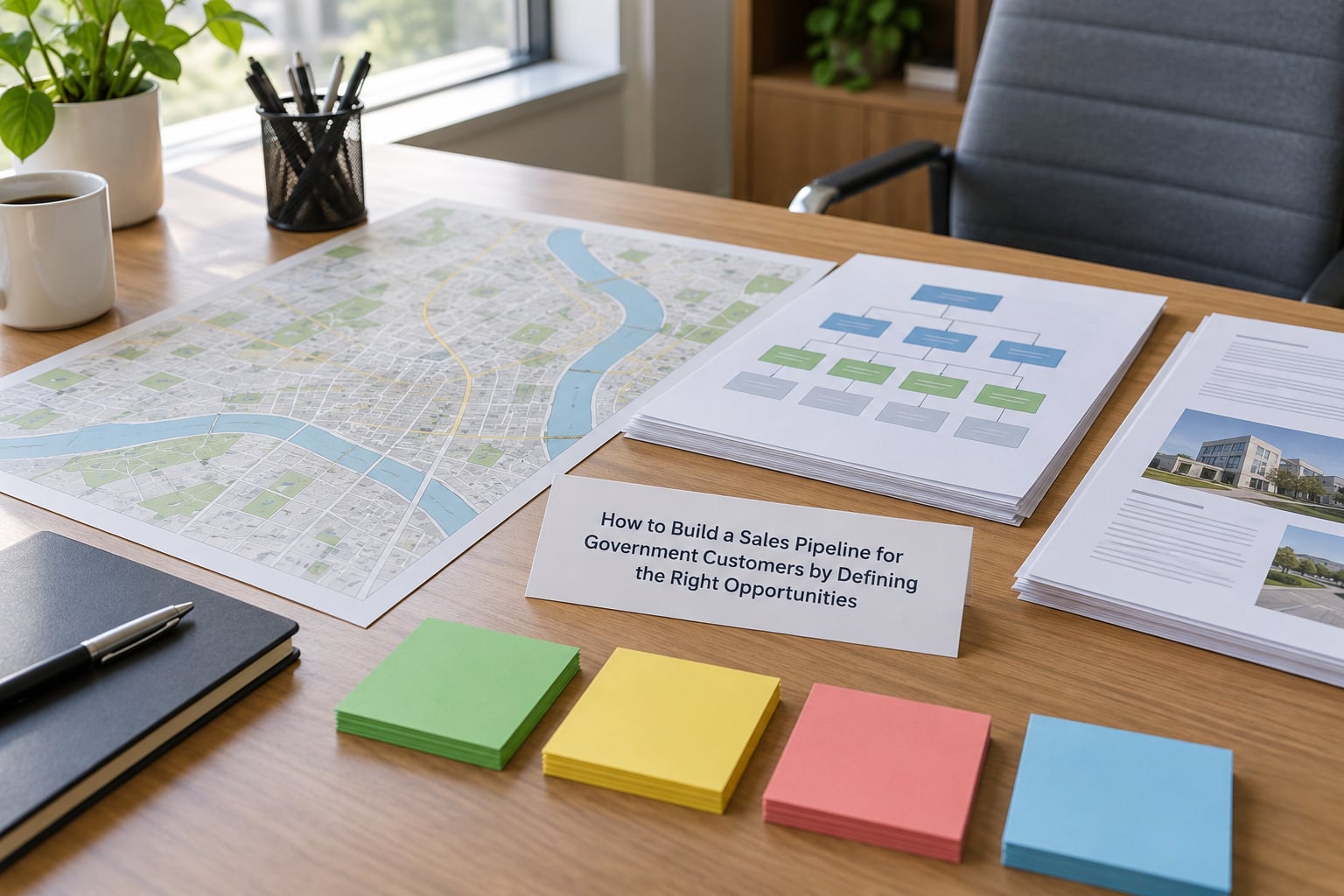
Start narrow. Pick a problem you already understand, then find the agencies where that problem is a funded priority rather than an aspiration. Agency budget justification documents and published strategic plans are the fastest way to see which programs have money attached to them this fiscal year.
Score every candidate opportunity on four dimensions before it enters your pipeline: fit with your ideal customer profile, contract value against your floor and ceiling, whether you can prime or only subcontract, and how strong the incumbent is. Anything that fails the fit test gets archived, not nurtured. That single filter removes more wasted proposal hours than anything else in this process.
How do you know it worked? After a month of sourcing, roughly a third of what you find should pass the scorecard, and every surviving item should have a named office, a plausible funding source, and a solicitation or forecast date attached to it.
How to Build a Sales Pipeline for Government Customers by Mapping the Buying Process
A government purchase has more hands in it than a commercial one, and each hand can stop you. Build the map before you pitch anything.
- Program sponsor or budget owner — wants the problem solved, owns the outcome, rarely writes the contract.
- Contracting officer or procurement office — runs the solicitation, controls the schedule, and is the only person who can answer questions about the process.
- End users — the staff who will live with your solution daily. They can kill a deal quietly if you ignore them.
- IT, security and legal reviewers — they check your security posture, data handling terms and contract language, and they do it on a fixed schedule.
- Elected officials or department leadership — at state and local level they set direction and often have to appear publicly behind the decision.
- Evaluation committee — scores the proposals against published criteria, so every claim you make should map to a line item in the solicitation.
For each person, record what they control, what would make them say no, and what happens next. That last column is what turns a warm conversation into pipeline.
How to Build a Sales Pipeline for Government Customers by Qualifying Demand
Qualification separates a real opportunity from a polite conversation. In government, the useful signals are unusually concrete, and they are worth asking for directly.
Ask what problem prompted the initiative, what happens if nothing changes this fiscal year, which budget line funds it, when the money was set aside, what procurement method they expect, whether they have an incumbent, who else is evaluating, and what result they would report to leadership if this works. Add one more: what happens to the timeline if your security review takes three weeks.
Score each answer rather than writing prose. A simple five-point scale across urgency, authority, budget, timeline and competitive alternatives gives you a number you can put in the CRM, and a number is what you can filter on later. Ten opportunities scoring above your threshold are a real pipeline. Ten opportunities with enthusiastic emails are not.
Verifying details with the contracting officer or the agency’s procurement office is the fastest way to a straight answer, and it is a standard step rather than an optional one. Do it before you commit proposal staff to a pursuit.
How to Build a Sales Pipeline for Government Customers by Creating a Repeatable Follow-Up System
Government sales reward patience and punish vagueness. Every opportunity in your CRM needs a next action with a date and an owner, a list of stakeholders you have actually spoken to, the objections raised so far, and the outcome you expect from the next conversation.
Run a 30-minute pipeline review once a week with the people who can act on it. Work through every open opportunity, and ask three questions: what moved, what is blocked, and what is the next action. Deals that have not moved in thirty days either get a specific next step or they leave the pipeline. That is the discipline teams call a gate review, and it is what turns a messy opportunity list into something you can forecast.
Forecast on exit criteria, not optimism. A prospect should only count as committed when a solicitation exists, a decision maker has confirmed the timeline, and you know the method. Everything before that is a number you will revise.
Common Mistakes
Ignoring procurement rules. Teams write a persuasive proposal for something they were never eligible for. Fix: confirm registration, size standard, set-aside eligibility and NAICS alignment before you write a word.
Talking to one person. A friendly program manager who cannot approve anything. Fix: aim for four to six contacts per opportunity, including the procurement office and an evaluator or end user.
Selling before you understand the public problem. Agencies are accountable to residents, not to a revenue target. Fix: ask what they are measured on, then lead with that outcome.
Treating interest as intent. A returned call and a polite email are not a forecast. Fix: require a dated next step and a named stakeholder before an opportunity advances a stage.
Letting the CRM go stale. A pipeline nobody updates is a list of names. Fix: no next action and no date means the record is dead, regardless of how warm it felt.
Pursuing everything equally. Ten pursuits, no wins, exhausted proposal staff. Fix: use the scorecard ruthlessly, including your total contract value ceiling.
Treating federal, state and local as one market. Portals, thresholds, public bid requirements, council approvals and procurement staff differ by jurisdiction. Fix: pick one level of government for your first ninety days and learn it deeply.
Assuming registration creates demand. A SAM.gov registration on its own produces nothing. Fix: pair every registration with a sourcing routine and a named set of agencies.
Two habits do more than any tactic here. Prospecting for thirty focused minutes most days beats one heroic weekly afternoon, and relationships beat cold outreach almost every time. Referrals and warm introductions consistently outrank cold calls.
Frequently Asked Questions
How long does a government sales cycle usually take?
Complex federal pursuits commonly run nine to eighteen months from first contact to award, driven by security review, evaluation committee scheduling, and fiscal-year budget timing. State and local procurements are often shorter, sometimes three to six months, but council or board approval can add months at the end. Plan your pipeline on the long end of the range, since losing a single month inside a proposal schedule is easy and hard to recover.
What is the best way to find government procurement opportunities?
For federal work, search saved filters on SAM.gov by NAICS code, set-aside type, place of performance, and agency. State and local buyers post on their own procurement portals and often publish bid calendars or upcoming project lists. Paid aggregators add value by showing award and incumbent history that public search does not. Whatever the source, check details with the contracting officer before you commit pursuit resources.
Should small businesses use the same government sales pipeline?
Use the same stage structure, but weight your sourcing toward set-asides you are eligible for, since competition is thinner there. Track your size standard and registration status as required fields so nobody on the team proposes on something the company cannot win. Small firms also need tighter total contract value ceilings, because proposal labor is often the same two people no matter how large the opportunity is.
How do you qualify a government customer before investing time in a proposal?
Score the opportunity on urgency, budget authority, funding timing, procurement method, competitive alternatives, and measurable outcome, using criteria set before the opportunity reaches your desk. Then verify the details directly with the contracting officer or procurement office. If the agency cannot name a funding source, a decision timeline, and the person who recommends the award, it is not ready for proposal work yet.
What CRM stages work best for public-sector sales?
Seven stages usually work best: identified, qualified, capture planning, pursuit approved, proposal submitted, negotiation, and award. Each stage needs written exit criteria so no opportunity advances on enthusiasm alone. Add government fields to every record, including solicitation number, NAICS code, set-aside, contracting officer, incumbent, contract vehicle, and probability of win, then review the whole pipeline weekly.
How can a vendor build relationships without prior government experience?
Lead with the public problem and a specific outcome rather than your product history. Offer something useful before you sell: a short briefing on a program you have studied, an introduction to a relevant association or council meeting, or a small piece of analysis on the agency’s own published data. Reference relationships and partner with a prime contractor who already holds contract vehicles and past performance you can cite.
Conclusion: Start With One Government Account
A government sales pipeline is built, not collected. Define who you are targeting, qualify hard against criteria you set before the opportunity arrives, map every hand that touches the decision, and hold a weekly review where any deal without a dated next action leaves the funnel. None of that is glamorous, and it is the entire job.
Do one thing this week: pick a single agency, find one live initiative inside it, map the buying group from program sponsor to contracting officer, and schedule a discovery conversation about the public problem and the procurement path. That one account, mapped properly, will teach you more than a month of browsing portals.