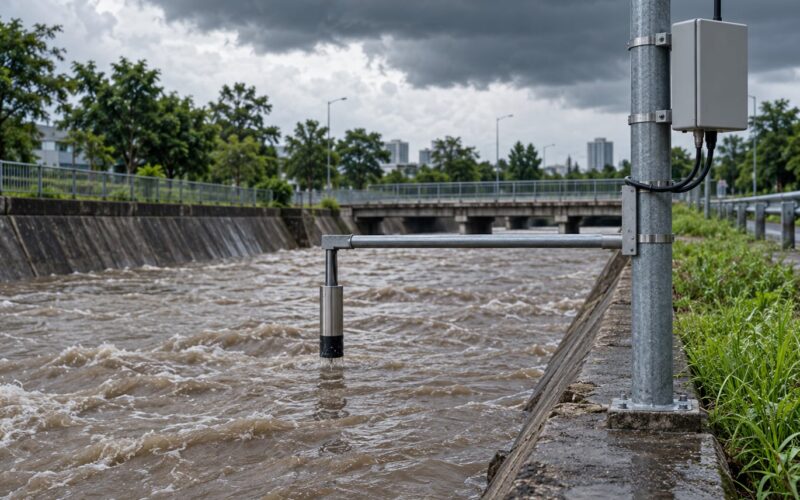
Data anonymization protects residents by removing or obscuring the identifiers that tie a record to a person, while keeping the aggregate patterns a city needs to run transit, power, water and emergency services. How data anonymization protects residents in practice is simple to state: a traffic sensor, a smart meter or a card tap still tells a planner how many people crossed a corridor at 8am, but nobody can work out which resident it was.
Get it wrong and the dataset becomes a map of one person’s day. Get it right and a city gets planning-grade numbers with the identity risk taken out. The difference between those two outcomes is mostly a handful of technical decisions, made before the data ever leaves the building.
Table of Contents
- What Is Data Anonymization in a Smart City?
- How Data Anonymization Protects Residents in Smart Cities
- How Data Anonymization Protects Residents from Re-Identification
- Which Smart City Data Needs the Strongest Protection?
- Which Data Anonymization Methods Should Cities Use?
- How Can Cities Use Data Without Losing Its Public Value?
- Does Anonymized Data Still Carry Privacy Risks?
- What Safeguards Should a Responsible Anonymization Program Include?
- Frequently Asked Questions
- Is anonymized data always completely anonymous?
- What is the difference between anonymization and pseudonymization?
- Can anonymized mobility data still identify a resident?
- Which anonymization method is best for smart city data?
- Do residents need to consent to every anonymized dataset?
- How can cities tell whether anonymization works?
- Conclusion
What Is Data Anonymization in a Smart City?
Data anonymization is the process of removing or transforming personal identifiers in a dataset so that no individual can reasonably be identified from it, while keeping the statistical patterns inside it usable for planning and analysis. In a smart city, that usually means stripping names, addresses, licence plates and device IDs, coarsening overly precise values, and grouping records until individuals disappear into the group.
Anonymization is not the same as deleting names, and it is not the same as pseudonymization. Stripping the name column off a transit tap file and publishing the rest is barely a protection: a row that still holds an exact timestamp, a route number and a card ID can be re-linked to a person using other records. That is de-identification in name only.
The four techniques below are the ones that get confused most often. Only the first one takes data out of the personal-data category under privacy law.
| Technique | What it does | Reversible? | Legal status of the result |
|---|---|---|---|
| Anonymization | Rewrites or aggregates records so no individual can reasonably be identified | No | Generally falls outside personal-data rules such as GDPR |
| Pseudonymization | Replaces identifiers with a code, keeping the link to a person in a separate key | Yes, by whoever holds the key | Still personal data; GDPR Article 4(1) applies in full |
| Data masking | Hides values in place, such as showing a partial account or account number | Only partly | Usually still personal data |
| Encryption | Scrambles data at rest and in transit so only key holders can read it | Yes, with the key | Still personal data; a security control, not an anonymization method |
Identity data is especially dangerous in a city because no single system knows much, but the systems know about each other. A transit tap says where you went. The smart meter says when you were home. The parking record says how long you stayed. The building permit file says who lives at that address. Any one of those is thin; stitched together with civic registries and commercial data, they describe a person precisely.
How Data Anonymization Protects Residents in Smart Cities
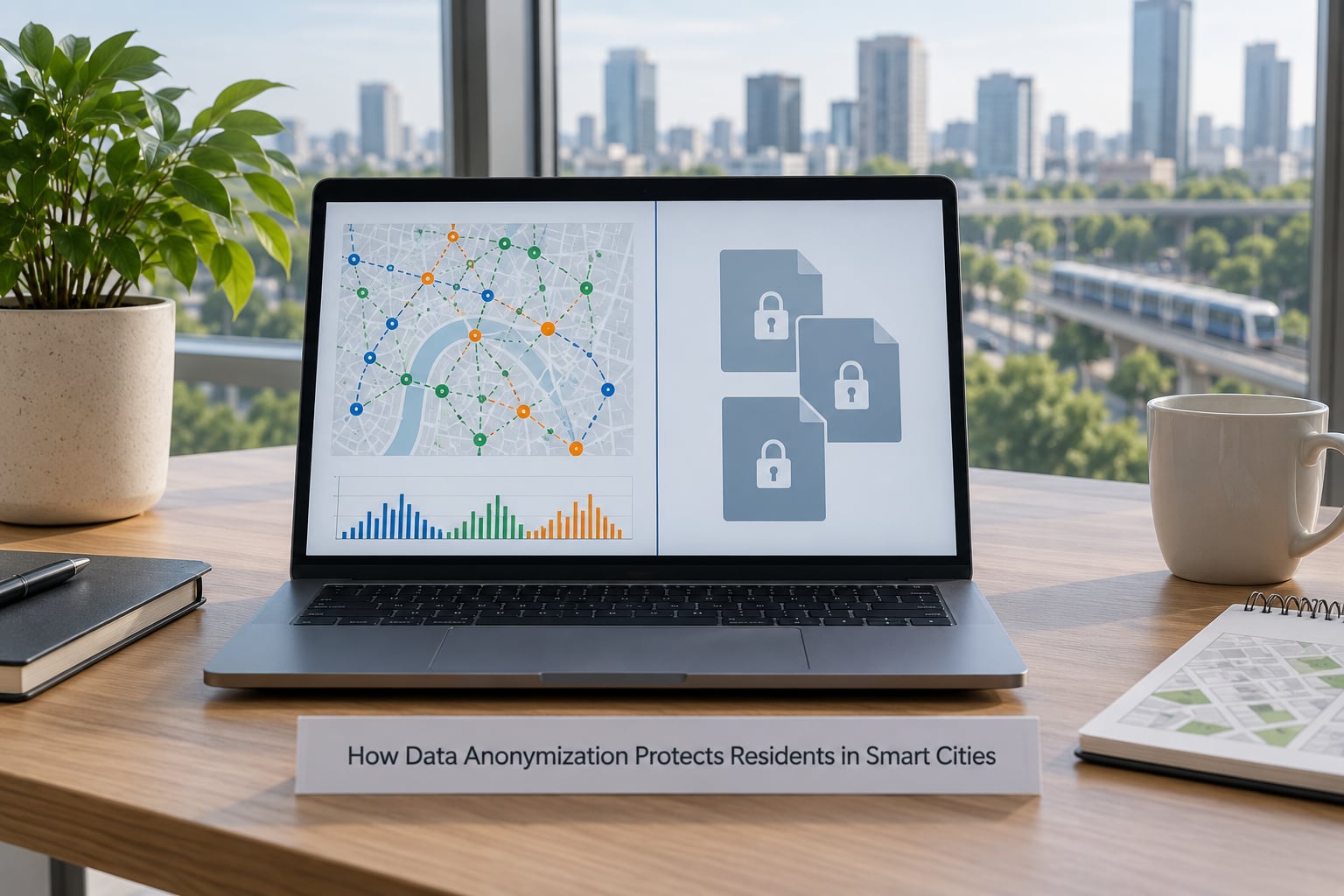
Anonymization works as a chain with four links, and a chain is only as good as its weakest one. Cities that treat it as a single step at publication time usually end up with weak protection. Cities that build it into collection get much further.
- Reduce what is collected at all. Data minimization means a sensor records an occupancy count instead of a stream of individual detections. Nothing collected cannot be leaked, matched or re-identified, which makes it the strongest form of protection available.
- Break the link between records. Generalization widens values until they stop pointing at one person: a birth year becomes an age band, a street address becomes a district, a minute becomes an hour window. Aggregation groups records until each row represents several people.
- Control who can see the raw material. Role-based access, encryption at rest and in transit, and strict retention limits matter most for the pre-anonymized source files, which remain the real prize for anyone after a breach.
- Publish and analyze the safe version. Open data portals, transit dashboards and planning models run on the aggregated copy, so the public value survives while the identity risk does not.
For the resident, this shows up as a short list of concrete protections. Anonymization limits identity theft, because a leaked parking dataset no longer names the residents whose plates it logged. It limits surveillance, because a week of movement traces cannot be reassembled into a daily schedule for one person. It limits discriminatory profiling, because a scoring model built on aggregated counts cannot single out an individual for worse treatment. It limits stalking and doxxing, because location history is the raw material of both. And it keeps residents outside the blast radius of a breach, since an attacker who steals an anonymized file has to steal it twice to get anything useful.
How Data Anonymization Protects Residents from Re-Identification
Re-identification usually succeeds through combination rather than brute force. A row that looks anonymous on its own can be resolved by joining it to another table. The attackers’ toolkit is unglamorous: a specific timestamp, a device fingerprint that survives in a cookie or a MAC address, a household of one, an unusual route, a rare medical appointment at a facility with a handful of users.
Four techniques push back against this. Generalization widens precision, so an exact time becomes a window and an exact place becomes a zone. Aggregation merges rows, so the unit of analysis is a group rather than a person. Thresholding, usually called small-cell suppression, withholds any group too small to hide safely, because a cell with one record is a person with a label on it. Data minimization removes fields the analysis never needed, which denies the attacker the join key.
None of this makes re-identification impossible. It makes it expensive, unreliable and obvious to auditors. That distinction matters more than any of the individual methods, because a protection that is cheap to break is not a protection at all.
Which Smart City Data Needs the Strongest Protection?
Sensitivity depends less on the sensor type than on what the record reveals when joined to something else. Public transport tap data is thin on its own and rich once it touches a fare account. Smart meter readings are similar. Camera and traffic-plate captures are rich from the first frame.
| Data type | What it can reveal | Sensitivity | What anonymization it needs |
|---|---|---|---|
| Mobility and transit taps | Home, workplace, daily rhythm, health appointments | High | Aggregation by time band and zone, suppression of rare routes |
| Smart meter and water usage | Occupancy patterns, appliances, low income or holiday absence signals | High | Coarsening readings, household-level grouping, noise on published series |
| Traffic and public-space sensors | Plate numbers, faces, vehicle tracks, presence at a location | Very high | Detection avoidance or immediate on-device deletion of identifiers |
| Air and environmental sensors | Usually a location reading with no person attached | Low to medium | Aggregation to district level, minimal identifiers |
| Service delivery and benefits records | Directly links a named person to a need, payment or vulnerability | Very high | Usually none for publication; statistics only |
| Citizen feedback and surveys | Opinions linked to a person or a small group, sometimes on sensitive topics | Medium to high | Minimum group size, free-text review, removal of location fields |
The pattern is worth noticing: the data that needs the strongest protection is usually the data a city has least reason to publish in raw form. Environmental readings and aggregate parking occupancy are rarely a privacy problem. Benefits files and camera captures almost never belong in an open portal at all.
Which Data Anonymization Methods Should Cities Use?
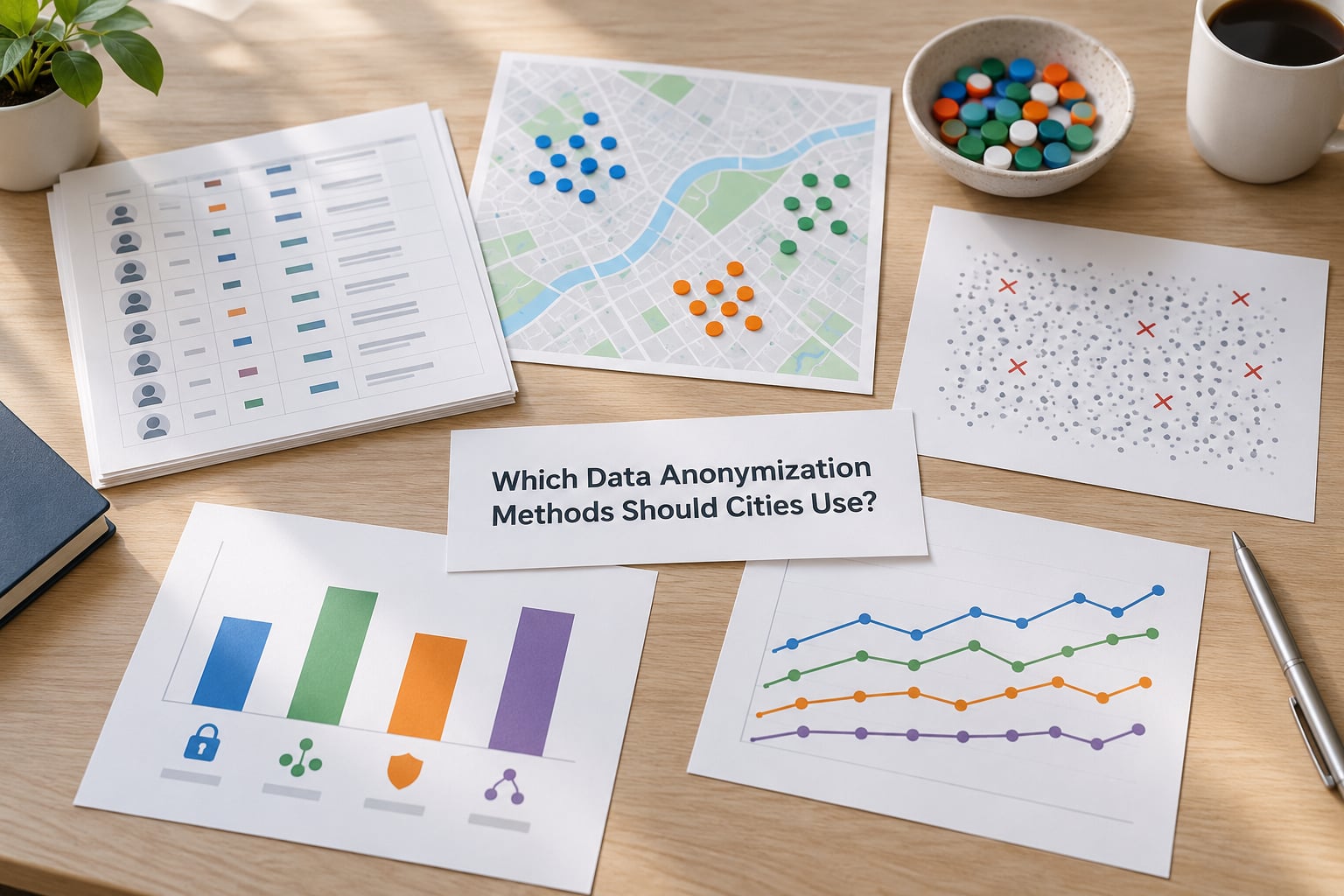
No single method covers smart city work. The honest answer is that the strongest programs stack two or three, matching the method to the question being asked of the data.
| Method | How it protects residents | What it preserves | Operational limit | Best fit |
|---|---|---|---|---|
| Removal | Deletes identifiers outright | Everything else in the row | Breaks if the remaining columns are themselves identifying | Low-risk datasets with no person attached |
| Generalization | Widens values into bands and zones | Structure and rough magnitude | Fine detail is lost; bands must not become unique | Age, location and time fields |
| Aggregation | Merges records into groups | Totals, distributions, trends | Group-level only; rare events stand out | Transit, parking, waste, energy planning |
| Suppression and thresholds | Withholds groups below a minimum size | Everything above the threshold | Creates holes in sparse data and can signal its own existence | Small-area counts, service-delivery statistics |
| Perturbation and noise | Adds random error to values | Statistical averages and long-run trends | Small samples become noisy; needs a documented noise budget | Published counts, energy and water series |
| k-anonymity | Guarantees each record shares its attributes with at least k others | Group equivalence classes | Shifts attacks to homogeneity, so l-diversity is often added | Formal guarantees in structured registers |
| Differential privacy | Bounds how much one person’s presence changes a result | Aggregated queries with a measurable privacy cost | Requires a privacy budget and careful tuning; hard to explain publicly | Dashboards and repeated public queries |
| Synthetic data | Generates stand-in records with the same structure | Shape of the data for modelling and demos | Models inherit the bias of the source and must not be mistaken for real people | Hackathons, testing, vendor demos |
These methods are not equally friendly to the public. Aggregation and suppression are easy to describe on a data portal, and residents tend to accept them. Differential privacy produces stronger guarantees but costs accuracy and needs a plain-language explanation, which most cities have not written yet. Synthetic data is very useful for developers and dangerous if anyone downstream mistakes generated trips for real ones.
How Can Cities Use Data Without Losing Its Public Value?
Worked example: a transit authority wants to add a bus lane on a corridor that suffers chronic delays. Raw tap data can answer the question and expose residents at the same time, because a single card’s taps reveal where someone lives and where they work. So the analysis never touches the row-level file.
- Tap records are converted to zone-to-zone movements and grouped into hourly totals, so no line describes one passenger.
- Trips made by fewer than a set number of people in a zone pair are withheld, which removes the rare origins that are really just one household.
- Only the corridor-level flows are loaded into the planning model, so the model sees demand, not people.
- The same aggregated series feeds the public dashboard, so residents can see how the change affected their corridor without any of them being visible in it.
The planning benefit survives intact. Delay patterns, peak demand, transfer pressure and the effect of the new lane are all still measurable, because they were never properties of an individual. Bilbao’s local council aggregates data for exactly this reason, per the OECD’s review of smart city data governance, and the city’s approach is a common reference point precisely because it kept the useful layer and dropped the identifying one.
The same balance shows up in parking occupancy, where counts of free bays are published while plate records are deleted at the kerb, and in waste collection, where route efficiency is planned from fill-level sensors with no household attached. What cities give up is the ability to trace a pattern back to one person, which in practice is the ability they almost never need.
Equity is the part that gets skipped. When a system is designed around identifiable data, the people with the least protection are usually the ones who get profiled most. Aggregating before you analyze keeps small populations, including undocumented residents and people in supported housing, from standing out in the record.
Does Anonymized Data Still Carry Privacy Risks?
Yes. Anonymized data is a much safer artifact, not a harmless one, and the honest version of this argument matters more to residents than a reassuring one.
- Re-identification by linkage. The standard case. Anonymized transit flows are joined against another dataset and individual journeys reappear. This is the reason a documented method, not the word anonymized on a portal page, is what you actually need to see.
- Singling out. A group of one is a person. Sparse rural data, a rare medical procedure or a distinctive work pattern can isolate a single individual even inside an aggregated dataset.
- Inference. Aggregated counts can reveal things about a person without naming them. A neighbourhood with a high share of a given reading may tell a landlord something about the people living there.
- Small-group leakage. Suppressing the smallest cells helps, but repeated queries against a public dashboard can rebuild what was withheld. Query budgets exist for this reason.
- Insider misuse. The un-anonymized source files remain inside the authority, and a contractor with legitimate access is a real threat vector.
- Nominal versus statistical protection. Removing names is nominal. A guarantee about how much an attacker can learn, such as a k-anonymity floor or a differential privacy budget, is statistical. Only the second survives contact with a determined attempt.
Developers on forums like r/technology and r/homelab keep circling the same objection: stripping geolocation while keeping timestamps and device IDs is a small concession dressed up as a policy. The criticism is fair. It is also why the technique has to be published alongside the data.
What Safeguards Should a Responsible Anonymization Program Include?
Ten items cover most of what a mature program does. If a city cannot show you seven of them, the open data portal is doing more work than the privacy office.
- Collect less from the start. Decide at design time what the sensor does not need to record.
- Fix the purpose in writing. Purpose limitation means a parking dataset cannot quietly become an enforcement tool.
- Run a data protection impact assessment for any new sensor or dataset, with the result published in summary form.
- Publish the method. Technique, thresholds, k value and noise budget, written so a resident can read it.
- Test before release. Attempt re-identification against the candidate dataset and record what failed.
- Keep source files under access control with role-based permissions, encryption at rest and in transit, and named data stewards.
- Set retention limits and delete on schedule rather than keeping everything indefinitely.
- Log who used which dataset and for what, and keep the record of processing activities current.
- Audit on a schedule, including after any breach, and fix what the audit finds.
- Have an incident response plan that assumes an anonymized file may turn out not to be.
Residents have rights that outlive anonymization, and they apply even when a dataset is published: access to what a city holds about them, rectification of errors, objection to certain uses, and portability. Data subject rights are the backstop when anonymization falls short.
Frequently Asked Questions
Is anonymized data always completely anonymous?
No. Anonymized data is safer, not risk-free. Some datasets fall out of personal-data rules once no reasonable means remain to identify a person. Others look anonymous but can be re-linked to individuals using auxiliary data such as public registries, census files or commercial records. Ask what method was used and at what threshold, not whether the portal calls it anonymized.
What is the difference between anonymization and pseudonymization?
Pseudonymization replaces identifiers with a code, so the records remain linkable to a person through a key someone else holds. Anonymization aims to make that link practically unresolvable. Under GDPR, pseudonymized data is still personal data and the law applies in full. Data that is genuinely and irreversibly anonymized generally falls outside the rules entirely.
Can anonymized mobility data still identify a resident?
Yes, in specific and well-documented ways. A person who takes the same unusual route at the same unusual time, lives alone, and has very few comparable neighbours can stand out even in aggregated data. Attackers combine mobility records with public information and other datasets to resolve individuals. Grouping, thresholding and adding noise all raise the cost of that attempt.
Which anonymization method is best for smart city data?
It depends on the question and the risk. Aggregation and suppression suit counts such as transit flows, parking occupancy and energy demand. Generalization suits age, location and time fields. Differential privacy suits dashboards that accept repeated public queries. Data minimization beats all of them when the sensor never had to record the identifying detail in the first place.
Do residents need to consent to every anonymized dataset?
Usually not, because genuinely anonymized data is treated differently from personal data in most privacy regimes. That is exactly why the anonymization has to be real rather than cosmetic, and why cities publish their method and thresholds. Consent still matters for the underlying collection, for pseudonymized data, and where local law is stricter than the baseline.
How can cities tell whether anonymization works?
By testing it rather than asserting it. A release process should include documented threshold values, group size minimums, small-cell suppression rules, a stated noise budget, and an independent re-identification attempt against the candidate dataset. If the city cannot publish those details, or repeats an audit only after an incident, the protection is a promise rather than a control.
Conclusion
The first step is unglamorous and decides most of the outcome: inventory what the city holds about residents, then find where one record can be joined to another. Pick the privacy goal for each dataset, choose the technique that matches it, and test the result before anything is published or analyzed.
Done well, this is what lets a city publish transit flows, occupancy counts and energy patterns without turning residents into the dataset. The technique, the thresholds and the audit trail matter more than the word anonymized on a web page, and residents can judge which one they were given.