
Developers actually use API documentation when it gets them from zero to a first successful call in under ten minutes, and tells them exactly what to do when that call fails. Everything else is a nicety. If you want to know how to document an API so developers actually use it, the work is not in writing longer reference pages; it is in auditing what a new developer has to accomplish, building one tested happy path, and then keeping every example honest against the running service.
The failure mode is well worn. In forum threads from r/webdev, r/programming and the Let’s Encrypt community forum, developers describe docs that look correct, pass review, and still lose the integrator, because the walkthrough assumes knowledge the reader does not have. A r/Backend thread titled API documentation drift captures the other half of the problem: the spec, the docs site and production quietly diverge until somebody’s integration fails at 2am.
Outdated documentation is worse than missing documentation, and that single opinion shows up repeatedly. The fix is not more words. It is a workflow with owners, tests, and a definition of done.
Table of Contents
- What You Need
- Step-by-Step: How to Document an API So Developers Actually Use It
- 1. Identify What Developers Need to Succeed
- 2. Build a Quickstart Developers Can Finish
- 3. Write an Endpoint Reference Developers Can Scan
- 4. Show Real Requests and Errors So Developers Actually Use Your API
- 5. Add Schemas, Validation Rules, and Authentication Guidance
- 6. Design Navigation Around Common Tasks
- 7. Test, Publish, and Maintain the Documentation
- Common Documentation Mistakes and How to Fix Them
- Frequently Asked Questions
- How much API documentation do I need before launch?
- Should I use OpenAPI 3.1, Markdown, or both for API documentation?
- How do I test API examples so they do not become outdated?
- How should I document API versions and breaking changes?
- How can I tell whether developers are actually using my API documentation?
- Conclusion
What You Need
Before you write a single page, gather the raw material. Most teams already have it scattered across tickets, chat and a half-finished OpenAPI file.
- A stable or versioned API. Document the version developers will be pointed at, and freeze it for the duration of the guide. If there is no versioning yet, document one version and say so plainly.
- An endpoint inventory. Every path and method, grouped by resource, with a one-line purpose. This becomes the table of contents of your reference.
- Authentication details. How a key is issued, what scopes exist, how it is rotated, and what a revoked key looks like from the client’s side.
- Representative requests and responses. Captured from a real call, not typed from memory, including a genuine error body.
- Error definitions. Status code, machine-readable code, human message, and the action the developer should take next.
- A named owner. One person or team accountable for the docs, with a slot in the release checklist rather than a best intention.
For tooling, the common stack is an OpenAPI 3.1 editor, a docs-as-code setup in Markdown or MDX, and a hosted documentation site that renders the spec. Redoc and Swagger UI render an OpenAPI file directly and are the fastest route to a usable reference. Docusaurus gives you versioning, search and MDX guides. ReadMe and Archbee layer a UI, an editor and analytics on top of the spec, which suits teams without a docs specialist. Postman supplies a runnable collection and environments; HTTPie is friendlier than curl for reading a response while you are still learning the shape of it.
Pick one and write the prose around it. Chasing tool choice is a way of avoiding the harder question, which is what a developer is supposed to accomplish in the first ten minutes.
Step-by-Step: How to Document an API So Developers Actually Use It
The workflow runs in seven steps, and the success test is simple: hand the docs to a developer who did not build the service, ask them to get a key and make one real call, and time how long they take without asking anyone a question.
1. Identify What Developers Need to Succeed
Start with the audience, not the endpoints. A municipal open-data platform serves a hobbyist building a weekend map and an enterprise integrator writing a nightly ETL job, and they need different first pages. Name the jobs to be done, the supported use cases you are actually prepared to support, and the version, base URL, media types, rate limits and credential type for each.
Then separate required information from implementation detail. A developer cannot call anything without the base URL, the credential and the request shape. Everything else is optional reading, and mixing the two is what makes a reference exhausting to scan.
Turn the endpoint inventory into a prioritised documentation plan. The twenty percent of endpoints that carry most traffic get full examples today; the long tail gets accurate summaries now and detailed pages when someone asks.
2. Build a Quickstart Developers Can Finish

One tested happy path, start to finish: get credentials, set an environment variable, send one request, read the response, and do one more useful thing with it. That last part matters. A quickstart that stops at a successful call teaches the reader nothing about the shape of the data, so follow it with a second call that filters or paginates.
Give copy-ready commands in curl and in at least one language you actually support, and explain what each line does. Unlabelled code samples are the single most common complaint in developer forums: the request works, the reader has no idea which part was the auth, which part was the filter, and which part can be changed.
State the platform and versions you tested on. If your example depends on a particular Node or Python release, name it, because the version in the reader’s head is almost certainly not the one you have.
Then run the quickstart yourself, from a clean machine, with a key you created thirty seconds earlier. Anything you had to guess at is a gap in the page.
3. Write an Endpoint Reference Developers Can Scan
Each operation needs the same nine elements, in the same order, every time: purpose in one sentence, method and path, authentication requirement, required headers, path and query parameters with types and defaults, request body schema, response schema, example request and response, and the errors this endpoint can return.
Group endpoints by resource rather than by team or by database table. A developer looking for bike-share station availability is thinking in resources, not in your service boundaries.
Consistency does more work than cleverness here. Same parameter names across endpoints, same casing, same field ordering in example payloads, same wording for optional. Twitch developer forum threads asking for a concise version of API documentation are really asking for predictability: what the method is, what goes in the headers, what goes in the body, what comes back.
Explain unfamiliar concepts in context. If pagination uses a cursor, say so next to the parameter and show it in the example, not in a separate glossary page.
4. Show Real Requests and Errors So Developers Actually Use Your API
Accurate examples are the documentation. A response full of foo, bar and id: 123 teaches the reader that your payloads are clean, which is the exact opposite of what production looks like.
Use realistic values: identifiers that look like identifiers, ISO 8601 timestamps with a timezone, units in the field name or the description, nullable fields that are actually null in your sample, and enough nested structure to show how objects relate. Include the boring cases too, because developers hit them on their first call: an empty result set, a validation failure with a field path, a missing scope, a rate limit response with its retry hint, and a 500 with a request ID they can quote to support.
Put a copy button on every sample. Developers convert from reference reader to integrator the moment code leaves their clipboard and runs in their own terminal.
5. Add Schemas, Validation Rules, and Authentication Guidance
Schemas should state what the server enforces: which fields are required, formats, minimum and maximum values, defaults applied when a field is omitted, allowed enum values, units, nullability, and how child objects relate to parents. These are the details that generated clients and hand-written validators get wrong, and where a r/programming thread about OpenAPI compliance proxies made its point: a constraint written in the spec but never enforced produces a client that passes validation and fails at runtime.
Provide a complete OpenAPI 3.1 document. A spec is not a substitute for prose; developers in the Let’s Encrypt forum thread asked for a guided narrative alongside the spec, not instead of it, which matches what people consistently ask for in r/webdev.
Document authentication as a lifecycle, not a header. How to request a key or token, which OAuth 2.0 scopes map to which endpoints, how to refresh an expiring token, how to rotate a key without downtime, where a key is allowed to be stored, and what the client sees when a credential is revoked. An OAuth 2.0 walkthrough with a token refresh example is worth more than a paragraph describing it.
6. Design Navigation Around Common Tasks
Structure the site the way developers search, not the way your org chart is drawn. The usual spine is quickstart, authentication, core concepts, operations grouped by resource, guides, errors, webhooks, SDKs, changelog.
Cross-link from every concept page to the endpoints that use it and back again, keep anchors stable so external links do not rot, ship search that handles a mistyped path fragment, and flag clearly where behaviour differs by platform, region or plan.
7. Test, Publish, and Maintain the Documentation
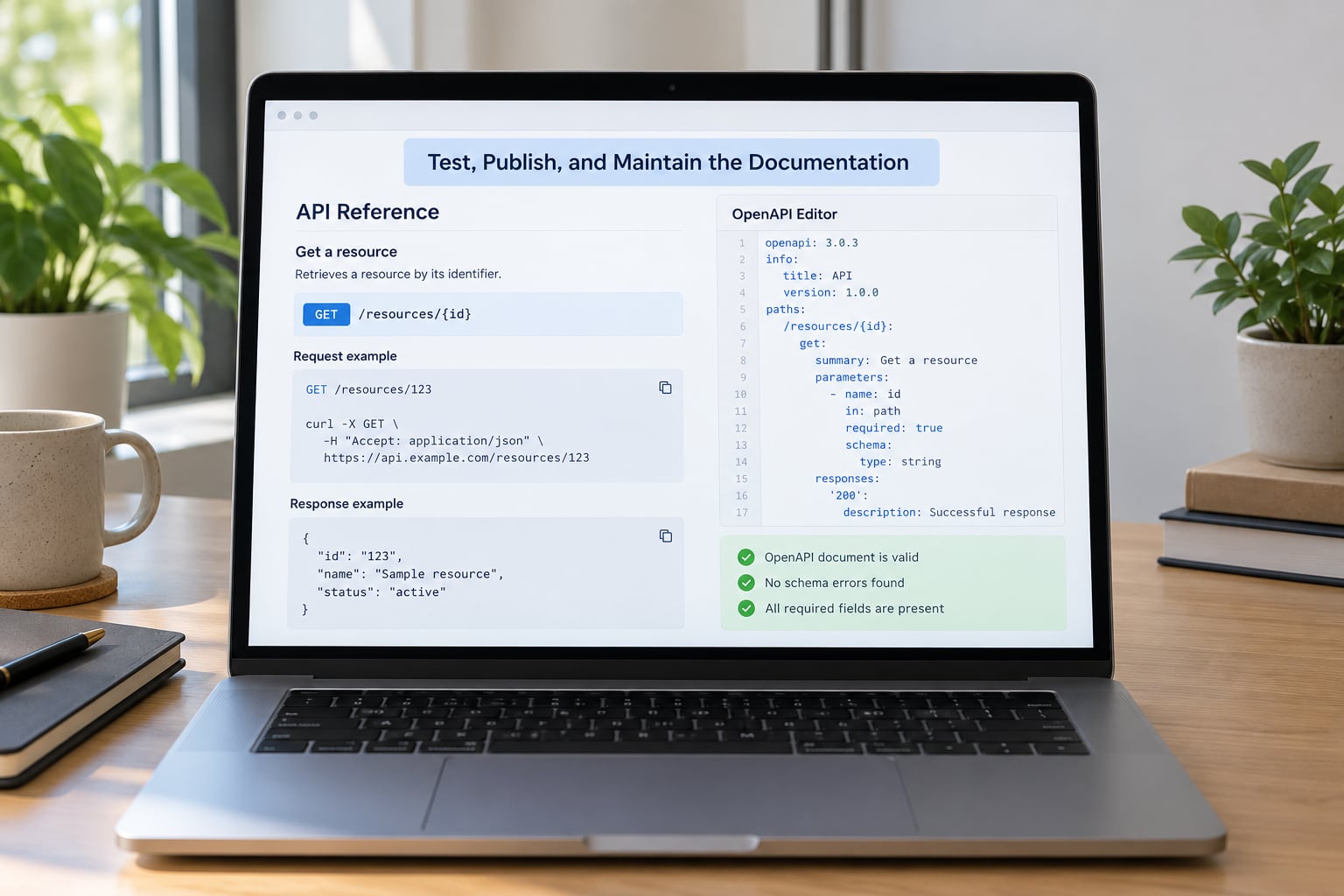
Documentation earns trust by being verifiably current. Validate the OpenAPI document in CI, execute every documented example against a test environment on a schedule, and fail the build when one breaks. A sample that returns a 404 in CI is worth more than a reviewer reading it carefully once.
Review with a developer who did not write the docs and is not on your team. Ask them to narrate as they go; the places they pause are the places the page is written for your architecture rather than for the reader.
Then assign ownership and wire it into the release process. When a schema or endpoint changes, a documentation check runs. Breaking changes are announced with a dated changelog entry, a migration note, and a deprecation window with a specific end date. Re-test the examples every release, not once at launch.
Common Documentation Mistakes and How to Fix Them
These are the failures that show up again and again, each with the fix that closes it.
- Describing features instead of tasks. Fix: rewrite the landing page around what the reader is trying to do, not around your product’s capability list.
- An incomplete quickstart. A sample with a placeholder the developer must fill is worse than no sample. Fix: publish commands that run as-is, with values already filled.
- Multiple competing getting-started guides. Readers stall over which one is canonical. Fix: one quickstart, everything else linked from it or moved into guides.
- Undocumented errors. A bare
400 Bad Requestis a dead end. Fix: an error catalog with a code, a cause and a fix, cross-linked from every endpoint that can return it. - Missing units and constraints. Is
durationseconds or milliseconds? Fix: put units in the field name or description and give the accepted range. - Reference-only documentation. A schema dump explains nothing. Fix: pair every reference resource with a short task guide that uses it.
- Documentation drift. Fix: treat the spec as a tested artifact, lint it, diff it against production, and run examples in CI.
- Publishing once. Docs are a product with a release cycle, not a deliverable. Fix: a named owner, a checklist item per release, and a dated changelog.
Frequently Asked Questions
How much API documentation do I need before launch?
Enough for a new developer to get a key, make one successful call, and handle a failure. That means a quickstart, an authentication page, a reference covering your most-used endpoints with real request and response examples, and an error catalog. Everything else can follow. Teams that write the full surface before launch usually ship nothing; teams that ship the first successful call and iterate reach more developers in the same quarter.
Should I use OpenAPI 3.1, Markdown, or both for API documentation?
Both, with clear roles. Use OpenAPI 3.1 as the source of truth for the contract so it can be linted, diffed and tested in CI, and render it into the reference pages. Use Markdown or MDX for the guides, concepts and walkthroughs that a schema cannot express. The spec keeps the reference honest; the prose keeps the reader oriented.
How do I test API examples so they do not become outdated?
Run them. Keep every documented example in a file or collection, execute it against a test environment on a schedule, and fail the build or the job when a call stops returning the documented status and shape. Add linting and validation for the OpenAPI document in the same pipeline. Documentation drift is usually a silent divergence, and an executable example is the cheapest detector you can add.
How should I document API versions and breaking changes?
Version in the URL path, keep at least the current and previous version live, and never edit a published version’s meaning. Announce breaking changes in a dated changelog with a migration note, and give a specific deprecation end date with a recommended replacement endpoint. Tell developers in advance through the channels they already read, and let old versions serve read-only traffic until the end date rather than switching them off abruptly.
How can I tell whether developers are actually using my API documentation?
Measure time to first successful call for a sample of new accounts, the share of activated keys that completed setup through the docs rather than support, how often example snippets get copied or run, and the volume of tickets per integration that trace back to a missing explanation. Watch search terms in your docs site for questions the pages do not answer. Falling time-to-first-call with flat ticket volume is the signal that the docs are working.
Conclusion
Start by auditing your API and your audience, then hand the quickstart to a developer who has never seen the service and watch where they hesitate. Fix every step that is broken, vague or dependent on knowledge you did not write down. After that, treat the docs as a tested product with a named owner: examples run in CI, the spec is linted, breaking changes carry a dated migration note, and you track time to first successful call so you know whether any of it worked.
This workflow was last reviewed in 2026, and the examples are re-run on every release rather than written once and forgotten.