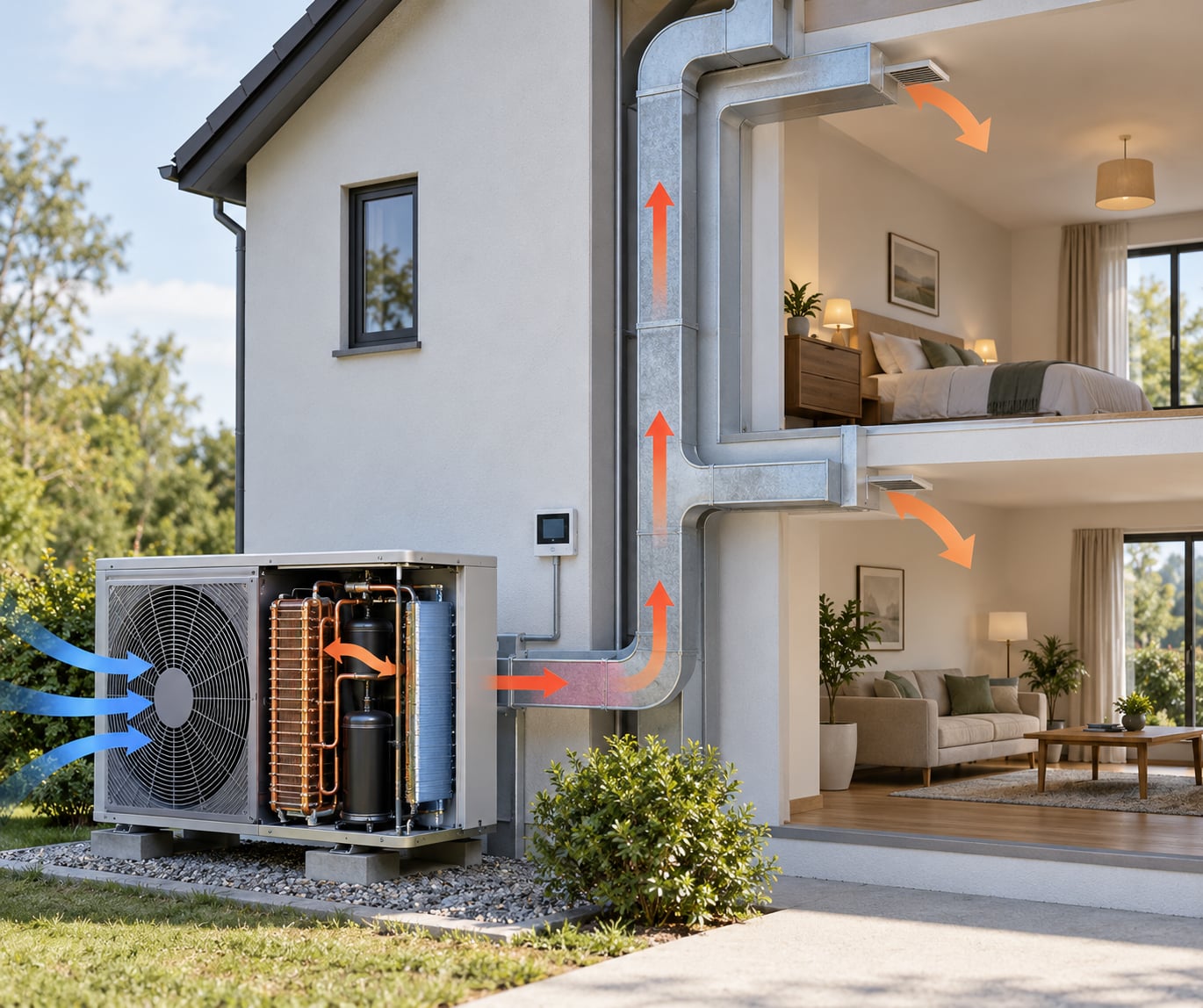
Heat pumps reduce building emissions by moving heat that already exists outdoors into the building rather than burning fuel to make it. One unit of electricity drives three to six units of delivered heat, so a home that swaps a gas boiler for a heat pump cuts fuel combustion immediately and cuts carbon harder as the electricity supply cleans up.
That last part matters more than most write-ups admit. On a coal-heavy grid a heat pump still beats a boiler, but the margin is narrower, and the same appliance on a cleaner grid does much better five years later. This guide covers the mechanism, the arithmetic, and the building decisions that decide whether a specific project lands at the good end or the disappointing end of that range.
Buildings still account for roughly two-fifths of energy consumption in the European Union and over a third of global greenhouse gas emissions, with heating the largest single source inside them. Electrification only pays off if the equipment is specified properly, which is where most of the interesting detail sits.
Table of Contents
- How Heat Pumps Reduce Building Emissions
- What Is a Heat Pump and How Does It Work?
- Why Moving Heat Uses Less Energy Than Making It
- How Building Type and Location Affect the Emissions Savings
- How Much Can a Heat Pump Reduce a Building’s Carbon Footprint?
- How to calculate how heat pumps reduce building emissions for one building
- What Makes a Heat Pump More Efficient in Practice?
- Do Refrigerants and Manufacturing Emissions Matter?
- When Are the Emissions Reductions Smallest?
- What counts as good enough insulation for a heat pump
- How to Choose a Low-Emission Heating Strategy for a Building
- Frequently Asked Questions
- Do heat pumps always reduce building emissions?
- How much carbon does a heat pump save compared with a gas boiler?
- Do heat pumps use more electricity than gas heating?
- Can heat pumps reduce emissions in cold climates?
- Are heat pumps suitable for existing buildings?
- Conclusion
How Heat Pumps Reduce Building Emissions
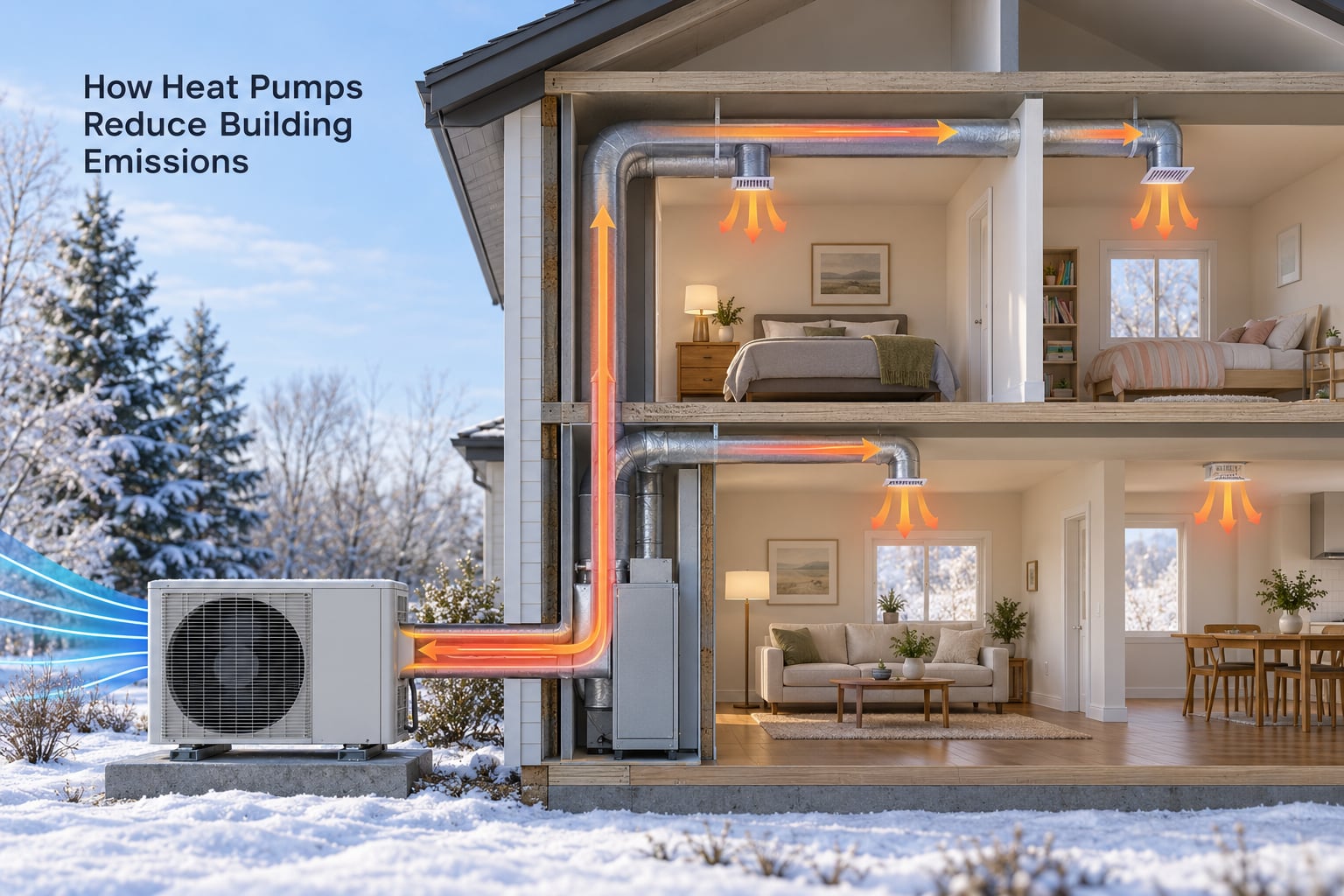
Two separate emission numbers matter here, and mixing them causes most of the confusion. Operational emissions come from fuel burned during operation: gas, oil, coal, and grid electricity. Embodied emissions come from manufacturing, shipping, installation, and eventually disposal.
A heat pump attacks the first number directly. Instead of purchasing heat at roughly the price of a combustion appliance, the building buys electricity and a machine that multiplies it. The second number is real but modest next to a fifteen-year supply of avoided fuel combustion, which is why a properly run heat pump normally pays back its manufacturing footprint early in its service life.
The mechanism breaks into five steps, and each one is worth understanding because each is also a place performance gets lost.
- Absorb. A fan draws outdoor air, ground-loop water, or lake water across a coil. Heat already present in that source transfers into a refrigerant, which boils at a low temperature.
- Raise. A compressor squeezes the refrigerant vapour, which raises its temperature well above the outdoor reading. This step is the only place electricity is actually spent.
- Deliver. The hot refrigerant passes through an indoor coil and releases its heat into the supply air or water running through the building. The refrigerant cools, condenses, and returns to the outdoor coil.
- Multiply. The delivered heat equals the electricity consumed plus the heat picked up outdoors. That ratio is the coefficient of performance, usually 3 to 6 for a modern air-source unit running in normal conditions.
- Decarbonise over time. The appliance emits whatever the grid emits at the moment it runs. As generation changes, the emissions of a fixed heating installation keep falling without any work on the building.
That fifth step is the reason a heat pump installed today outperforms the same model installed a decade ago, and it is the strongest argument for switching earlier rather than later even on a carbon-heavy grid.
What Is a Heat Pump and How Does It Work?
A heat pump is a refrigerator running in reverse, with the evaporator and condenser swapped. Four parts do nearly all the work: the refrigerant circuit carrying the fluid, the compressor that raises its pressure and temperature, the two heat exchangers that absorb and release heat, and the fans or pumps that move air and water through them.
Take a primary school that replaces two old gas boilers with a rooftop air-source unit serving eight classroom wings. A cold morning starts the cycle: outdoor air at 4 degrees crosses the outdoor coil, and refrigerant inside boils at a temperature below that reading.
The compressor lifts the refrigerant vapour to roughly 55 to 70 degrees, and a reversing valve directs it to the indoor coil rather than the outdoor one. Warm supply air at 35 degrees enters the ductwork, giving each classroom about 20 degrees of delivered air. Because the air is only slightly warmer than the rooms return, the system can run at low fan speeds for long stretches, which is exactly the operating window where efficiency is highest.
Air-source, ground-source, and water-source units run the same loop; they differ only in where the outdoor heat comes from. Ground and water sources stay at more stable temperatures, so they hold a higher coefficient of performance in winter, but drilling loops or running intake and discharge piping costs more and needs a site that supports it.
Why Moving Heat Uses Less Energy Than Making It
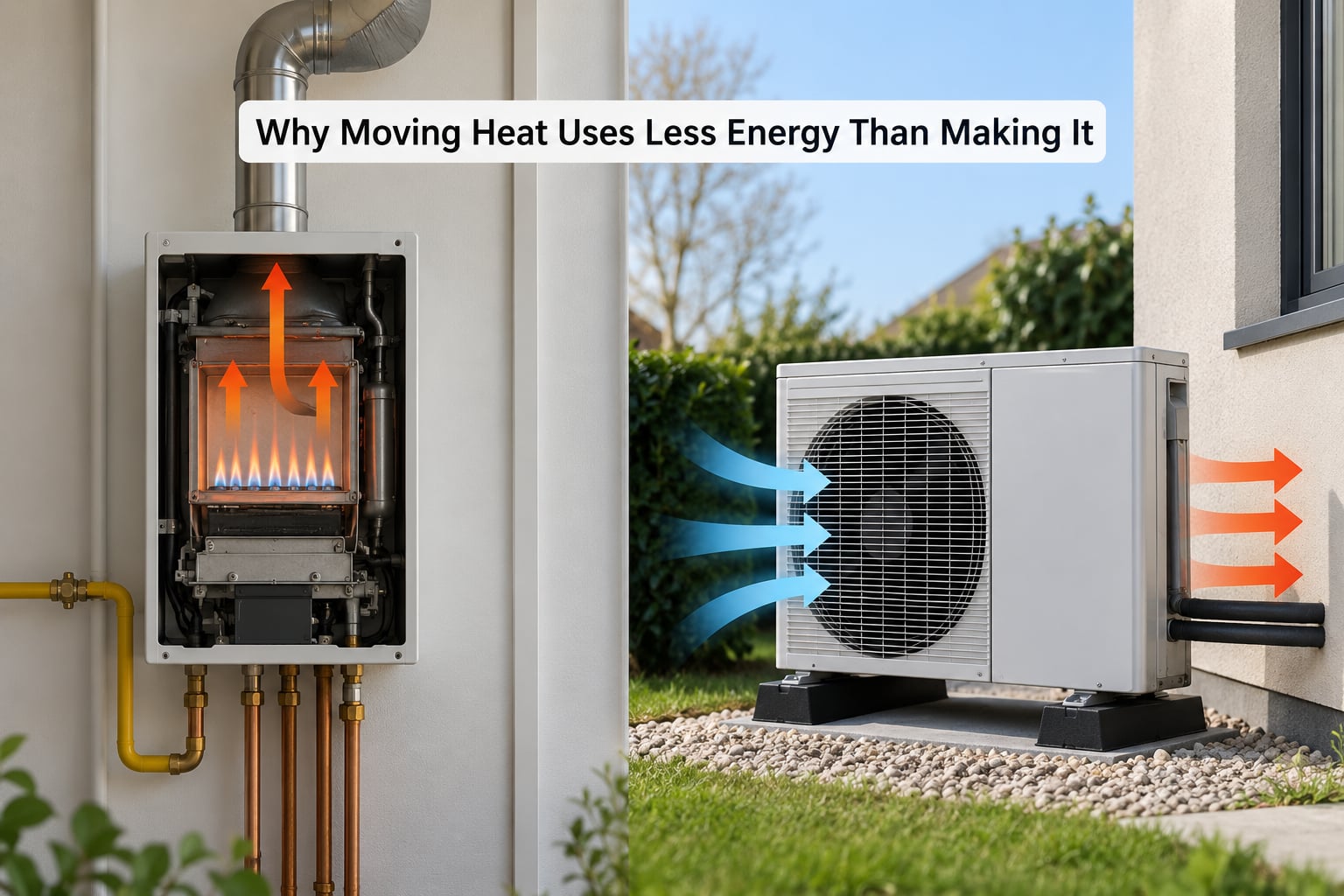
A modern condensing gas boiler converts roughly 90 to 95 percent of its fuel energy into heat. That sounds excellent until you notice what it means: to deliver 10 units of heat it burns about 10.5 units of gas, and every one of those units carries carbon straight out of the flue.
A heat pump with a seasonal coefficient of performance of 3 delivers the same 10 units of heat for roughly 3.3 units of electricity, none of which is burned inside the building. Nothing is created from scratch, so the losses are far smaller.
| Heating system | Seasonal efficiency | Energy input per 10 units of delivered heat | Where the emissions go |
|---|---|---|---|
| Condensing gas boiler | 90-95 percent | About 10.5 units of gas | Mostly out of the flue |
| Oil furnace | 80-90 percent | About 11 to 12.5 units of oil | Mostly out of the flue |
| Electric resistance heater | Close to 100 percent | 10 units of electricity | Mostly up the generation stack |
| Air-source heat pump | Seasonal factor 3 to 4.5 | About 2.2 to 3.3 units of electricity | Shared with whatever generates the grid |
| Ground or water-source heat pump | Seasonal factor 4 to 5 | About 2 to 2.5 units of electricity | Shared with whatever generates the grid |
Seasonal performance is not the same number as laboratory efficiency. A unit rated at a coefficient of performance of 4.5 at 7 degrees delivers far less at minus 10 degrees, once defrost cycles start removing heat from the outdoor coil. The seasonal factor, measured across a whole heating season, is the figure to design against.
Grid intensity then decides how much that efficiency is worth in carbon terms. A three-times performance heat pump uses a third of the electricity of resistance heating, so it cuts emissions by roughly two-thirds on any grid. Against a gas boiler, the saving depends on how the boiler fuel and the grid compare, and the comparison changes as the grid changes.
How Building Type and Location Affect the Emissions Savings
Detached homes usually show the largest percentage saving, because they are the most likely to be running oil, propane, or a very old gas system, and because a single owner controls the whole retrofit. Adding two ducted units to a 1970s ranch in a heating-dominated town can displace oil that has a higher carbon intensity per unit of heat than the local grid has per unit of electricity.
Apartment blocks vary more than people expect. A 1960s concrete tower with a central oil plant has one plant to replace and a single decision to make, which makes it the easiest case, while a 1990s complex with individual gas risers is closer to a collection of small houses with shared corridors and metering on top.
Offices and schools have long occupancy hours and central plant, which makes them the strongest candidates for a heat pump that also covers cooling. Offices also carry the highest risk of poor outcomes, because they were designed for long hours of high ventilation, and a system picked for peak winter load will run at part load most of the year.
Mixed-use blocks are interesting for a different reason: they can share one heat source between a residential tower, retail units, and a car park or data room with year-round demand, which lifts the overall utilisation of the plant.
Location matters through three variables. The first is grid carbon intensity, which sets the ceiling on the benefit. The second is heating demand, since a building with a small load has less to save and a harder time running equipment efficiently. The third is the quality of the available heat source, since stable ground or water temperatures beat freezing air in deep winter.
Hot climates reverse the question rather than removing it. In cooling-dominated buildings the heat pump already replaces an air conditioner, and the emissions comparison then runs against the electricity a compressor-based cooler would have used anyway, against diesel generation in regions where the grid is weak, and against the fossil fuel burned to make the power.
How Much Can a Heat Pump Reduce a Building’s Carbon Footprint?
How to calculate how heat pumps reduce building emissions for one building
The arithmetic is straightforward once you have four inputs, and most utilities publish the last one free. Keep the units straight and the whole calculation takes about ten minutes.
- Baseline fuel. Take the annual heating energy the building uses today, in kilowatt-hours of gas, oil, or electricity. Utility statements and metering give you this.
- Boiler emissions factor. Multiply by the factor for that fuel, typically around 0.18 to 0.20 kg CO2e per kWh for natural gas and roughly 0.27 kg for heating oil in the UK and comparable European figures.
- Heat pump electricity. Divide the baseline heat demand by the seasonal performance factor you expect, not the rating. A factor of 3 means one third of the boiler fuel quantity in electricity.
- Grid factor. Multiply the result by your supplier’s carbon intensity, often published as grams of CO2e per kWh or kilograms per MWh.
For a 10000 kWh annual gas bill on a grid at 0.207 kg CO2e per kWh, the boiler side works out at roughly 2020 kg CO2e a year. The same heat through a heat pump at a seasonal factor of 3 takes about 3333 kWh of electricity, which comes to roughly 690 kg. That is a reduction of about 66 percent, or roughly 1330 kg of CO2e avoided every year.
| Grid carbon intensity | Boiler emissions | Heat pump at factor 3 | Reduction |
|---|---|---|---|
| 0.45 kg CO2e per kWh, coal-heavy | About 2020 kg | About 1500 kg | About 26 percent |
| 0.30 kg CO2e per kWh, mixed fossil | About 2020 kg | About 1000 kg | About 50 percent |
| 0.21 kg CO2e per kWh, current average | About 2020 kg | About 700 kg | About 65 percent |
| 0.05 kg CO2e per kWh, renewable-heavy | About 2020 kg | About 167 kg | About 92 percent |
Notice the direction of travel. The saving is smaller on a dirty grid but still clearly positive, and it grows every time generation decarbonises without anyone touching the building. Switching from oil changes the baseline too, and because heating oil carries more carbon per unit of heat than gas does, the reduction from an oil-heated home is usually the largest of all.
Two cautions on the numbers. Emissions and running cost are separate questions, and a heat pump can deliver a large carbon cut while the household bill rises if electricity is priced several times higher than gas. The reverse is also possible. And the table above describes seasonal averages; a building that leans on resistance backup heat during cold snaps sits closer to the resistance-heating row, not the heat pump row.
What Makes a Heat Pump More Efficient in Practice?
Nominal seasonal factors come from controlled testing. Real buildings deliver a range, and the difference is usually design and commissioning rather than equipment quality.
The envelope comes first. Insulation, glazing, and airtightness determine how many hours a year the system runs and at what supply temperature. Poor fabric conditions force higher water temperatures, which lowers the coefficient of performance and can make the upgrade hard to justify. A study cited in building decarb guidance found that minimum-efficiency heat pumps raised heating costs in 39 percent of homes, dropping to 19 percent where the building was insulated and to 5 percent with high-efficiency equipment on a good envelope.
Sizing to the load matters. An oversized unit cycles on and off, wastes capacity, and struggles to hold temperature on the mildest days. Undersized units run long and hard, leaning on backup heat when they should not.
Deliver heat at low temperature. Large floor loops and cast-iron radiators sized for a 70-degree boiler are a poor match for a heat pump that wants 35 degrees. Replacing them with emitters designed for low-temperature water, or adding low-temperature fan coils, is often the single highest-return change in a retrofit.
Controls and commissioning. Weather compensation that matches water temperature to outdoor conditions, and airflow balanced and verified, keep the system inside its efficient range. A building energy management system with temperature, flow, and power sensors can shift heating away from peak grid hours, which lowers both cost and the marginal emissions associated with that period.
Maintenance. A clean coil and an unclogged filter are not housekeeping details; fouling on the outdoor coil and filters raise the temperature difference the system must work against.
Do Refrigerants and Manufacturing Emissions Matter?
Yes, and they are the fairest objection to the whole argument. A refrigerant leak puts a gas with a high global warming potential straight into the atmosphere, which is worse per kilogram than the carbon dioxide a boiler emits.
Three things govern how big that number gets. The refrigerant itself matters: older hydrofluorocarbon blends have global warming potentials in the thousands, while the low-global-warming-potential alternatives used in newer equipment sit far lower. Leakage rates matter, and scheduled service with leak detection keeps them small. Service life matters too, because a machine running fifteen years spreads its manufacturing footprint over far more useful heat than one replaced after eight.
The practical conclusion is not that efficiency and refrigerant should be traded against each other, but that they belong in the same assessment. Low-emission refrigerants, verified charge, commissioning that confirms the system holds its charge, and a maintenance contract all belong in the specification. Most jurisdictions now also regulate recovery of refrigerant at end of life, which is part of why proper decommissioning matters.
When Are the Emissions Reductions Smallest?
What counts as good enough insulation for a heat pump
Failures cluster in predictable places, and most of them are visible before anyone switches the system on.
- High or rising supply temperatures. Existing radiators and a boiler-designed loop push the refrigerant to work harder, and performance drops as water temperature climbs.
- Oversized equipment. Short cycling wastes part of every cycle and leaves the building relying on backup heat.
- Poor airflow or unbalanced ductwork. Undersized ducts, blocked filters, and registers that never close are common in retrofits.
- Frequent backup heat use. If the resistance backup carries a meaningful share of hours, the emissions look more like electric resistance heating.
- Weak insulation. A leaky building needs more heat at a higher temperature, exactly the conditions where heat pumps perform worst.
- Defrost losses in cold weather. Real but bounded, and better handled by low-temperature supply, good coil design, and defrost control.
- A carbon-intensive grid. The saving narrows but stays positive, as the scenario table shows.
There is also a timing point. A replacement done a year before the existing system fails has to be justified as a standalone purchase. A replacement made when the furnace or boiler reaches end of life can be assessed against the cost of a like-for-like fossil replacement, which is the comparison most households actually face.
How to Choose a Low-Emission Heating Strategy for a Building
For developers, facility managers, and city energy planners, the sequence below tends to produce decisions that hold up under scrutiny.
- Characterise the load and the site. Get real heating and cooling demand, ideally from metering rather than estimates, plus the available heat source: ambient air, ground loops, or a water body.
- Compare fuel-switching scenarios, not just appliances. Model the existing fossil system, the heat pump, and any sensible envelope improvement side by side over the same 15 to 20 year horizon.
- Model whole-life carbon. Include operational emissions at today’s grid intensity, an assumed decarbonisation path for future electricity, refrigerant leakage and recovery, and the embodied carbon of manufacture and installation.
- Specify for low-temperature delivery. Choose emitters, loop temperatures, and airflow that let the system run in its efficient band, and set the backup heat to the lowest capacity that keeps the building safe.
- Verify after commissioning. Log seasonal performance against design assumptions, fit sensors and controls that watch drift over time, and treat the first full heating season as part of the project rather than the end of it.
For a city or municipal portfolio, steps three and four scale up: heat pump load is flexible enough to be aggregated into demand response or virtual power plant programmes, and buildings with good metering and a building energy management system can be recruited in weeks rather than years.
Frequently Asked Questions
Do heat pumps always reduce building emissions?
Almost always, and the exception is narrow. A heat pump beats a fossil boiler unless the electricity is so carbon-heavy that the fuel saved no longer offsets the grid emissions, which in practice means older coal generation rather than modern gas. It can lose to electric resistance heating only if it is oversized, cycling badly, or the backup coil carries most of the load. Against well-insulated buildings with correct sizing, emissions fall further as the grid decarbonises.
How much carbon does a heat pump save compared with a gas boiler?
For a building needing 10000 kWh of heat a year, a gas boiler at 0.202 kg CO2e per kWh emits roughly 2020 kg. The same heat through a heat pump at a seasonal factor of 3 uses about 3333 kWh of electricity, which on a 0.21 kg grid is about 700 kg. That is roughly 65 percent less. On a coal-heavy grid the reduction falls toward 25 percent; on renewable-heavy generation it exceeds 90 percent.
Do heat pumps use more electricity than gas heating?
The electricity bill usually rises, and the fuel bill disappears. A gas boiler burning 10000 kWh of gas is replaced by roughly 3300 kWh of electricity at a seasonal factor of 3. Whether that costs more depends entirely on the electricity-to-gas price ratio in your region, not on the equipment. Households in the same city can see opposite outcomes. Emissions and cost are separate questions, and it is entirely possible to cut carbon while spending more.
Can heat pumps reduce emissions in cold climates?
Yes, with correct sizing and low-temperature distribution. Cold air reduces the coefficient of performance and triggers defrost cycles that remove heat from the outdoor coil, so a winter seasonal factor of 2 to 3 is realistic in a harsh climate rather than the 4 to 5 seen in milder conditions. On a clean grid that still beats gas, and cold-climate buildings heated by oil or coal usually see the largest reductions of any building type.
Are heat pumps suitable for existing buildings?
Most of them, yes, though the fabric dictates the outcome. Older homes with radiators sized for 70-degree water usually need new low-temperature emitters, and heavily insulated buildings are far easier to convert. Ductless indoor units can serve individual rooms in a retrofit without touching ductwork at all, then be replaced by a whole-system design later. Survey the envelope and the existing heat distribution before choosing equipment.
Conclusion
Heat pumps reduce building emissions because they replace combustion with a transfer process: electricity drives a refrigerant cycle that collects heat already present in the environment and delivers three to six times as much inside. Where the building burned gas or oil, the fuel disappears from the stack, and the remaining emissions sit with the electricity supplier, falling as the grid cleans up.
Start by putting a number on the current system. Pull the last full year of fuel use, apply the emissions factor, and compare it with the same heat delivered at a realistic seasonal performance factor and your supplier’s published grid carbon intensity. That single exercise shows the range a project could land in, and it makes the design choices about sizing, supply temperature, and envelope far easier to argue for.