
Table of Contents
- What Is Differential Privacy?
- What differential privacy adds that removing names does not
- How Differential Privacy Works in Plain English
- What Does the Privacy Budget Mean?
- What Happens to the Data?
- How Is Random Noise Added?
- What Is a Differential Privacy Mechanism?
- Differential Privacy for City Data: Practical Examples
- Transit and mobility data
- Energy and utility meter data
- Library and civic service visits
- Traffic and footfall counts
- 311 and other service demand
- What Are the Limitations and Trade-offs?
- How Can You Tell If a Privacy Claim Is Credible?
- How Does Differential Privacy Differ from Other Privacy Tools?
- A Plain-English Glossary
- Frequently Asked Questions
- Does differential privacy make data anonymous?
- What is a good epsilon value for differential privacy?
- Can differential privacy stop all re-identification attacks?
- Does differential privacy make the underlying database safe?
- Why does adding noise reduce accuracy?
- Can cities use differential privacy for real-time dashboards?
- What to Do First
What Is Differential Privacy?
Differential privacy is a mathematical standard, not a product. You do not buy it and you do not switch it on. You design the way results are produced so that a formal guarantee holds: for any individual, the probability of getting back any particular output changes by at most a set amount when that person is added to or removed from the data. That set amount is epsilon.
The word “differential” refers to this difference in probabilities, not to a difference between people. The guarantee is about how little the output can be affected by one record, and it holds whatever the attacker already knows. Someone with your postcode, your employer, your car registration and your library borrowing habits still cannot beat it, because the guarantee was never built on the assumption that an attacker lacks information.
What differential privacy adds that removing names does not
Removing names is a data-hygiene habit. Differential privacy is a guarantee that survives contact with an adversary. The history of why that difference matters is not hypothetical.
- In 1998, Massachusetts governor William Weld released individual health records for state employees. Within days, a researcher identified several staff members using outside information about their circumstances, and the state withdrew the data.
- In 2006, AOL released what it called anonymised search logs. Individual accounts were tied to real people through their search topics, a technique now called linkage attack. AOL settled with users over the exposure.
- Netflix Prize ratings data was described as anonymous. A researcher showed that a movie rating sheet could be matched against public reviews to identify specific subscribers.
- Researchers reconstructed a large share of the 2010 US Census from published aggregate tables and then re-identified tens of millions of records, showing that aggregates are not automatically safe.
None of those failures were caused by careless people taking shortcuts. They were caused by data that was released with no measurable protection and no way for the public to check the promise.
Differential privacy answers three objections at once. It holds against attacks nobody has thought of yet. It degrades gracefully as an attacker learns more. And it is checkable: the epsilon value and the code that produced the noise are published, so anyone can verify the claim.
How Differential Privacy Works in Plain English
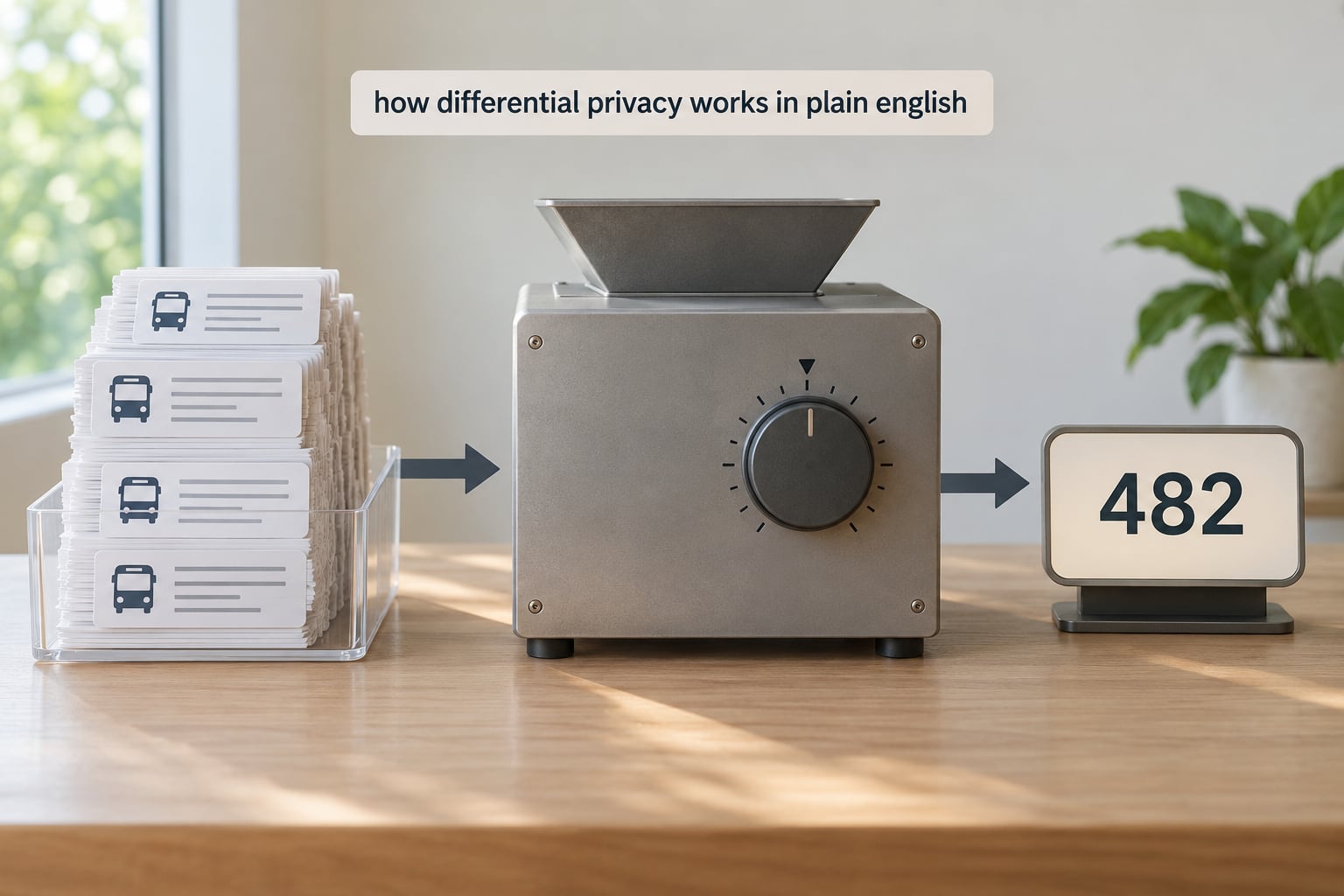
How differential privacy works comes down to five decisions. Most of the difficulty for a first-time reader is not the noise, it is agreeing in advance on what is being protected and how much distortion is acceptable.
- Define the protected unit. Decide what one unit of privacy is. A person, a household, a device, a vehicle. A person who shares a household address can have their privacy protected twice, while the neighbour in the same building gets none. Getting this wrong is the most common way a well-intentioned release still leaks.
- Set the budget. Agree on an epsilon for the analysis, and treat it as a spend, not a setting. Every query, table and chart draws down from the same account.
- Size the noise. Work out how much one person’s record could change the answer, called the sensitivity, and calibrate the randomness to that and to epsilon. Small changes in the data get small noise, large changes get large noise.
- Publish only the protected output. The raw records stay inside the controlled environment. What goes out is the noisy aggregate, plus the epsilon that produced it.
- Track cumulative spend. Add up what each release cost. Ten tables at the same epsilon cost considerably more than one table, and the total is what an attacker is really working against.
A worked example makes the shape concrete. Suppose a transit agency wants to publish average morning delay for its busiest routes. The honest figure comes from thousands of individual boarding records. Straightaway you can see two different questions hiding inside one request: what is the delay overall, and how many late services happened on route 14 last Tuesday.
The overall average is safe to publish once noise is added, because a single rider barely shifts it. The second question is not. A count for one route on one day might be a single number, and a single number can identify a person. Differential privacy does not make that count safe; it makes the question unsupportable at that granularity, so the agency either suppresses the query or serves it only inside a trusted research environment. The numbers in this section are illustrative rather than measured figures.
What Does the Privacy Budget Mean?
Epsilon is the dial that controls how much distortion the output can tolerate in exchange for protection. A smaller epsilon means stronger protection and more noise. A larger epsilon means a cleaner answer and weaker protection. There is no threshold where privacy switches on, which is why the number alone tells you very little.
| Epsilon setting | What it buys you | What it costs you | Reasonable for |
|---|---|---|---|
| Very small, roughly 0.1 or less | An individual’s presence is close to undetectable | Visible rounding; small or sparse datasets become hard to interpret | High-risk releases such as detailed health or location data |
| Small, roughly 1 | Strong practical protection with usable numbers | Small counts may need to be rounded or withheld | City statistics on housing, mobility or service demand |
| Large, 10 or more | Very close to the exact answer | Protection is weak; a determined analyst may undo the noise | Internal analysis or low-sensitivity operational data |
Two properties make epsilon more than a formality. First, composition: release two things at epsilon and you have spent roughly twice the budget, so the number that matters is the total, across every table, dashboard refresh and partner release over the life of the dataset.
Second, post-processing invariance. Once a noisy result has been published, anyone can analyse it freely without spending more budget, because the guarantee already covers everything you might do to it. Useful analysis of a protected output costs nothing extra.
Practitioners are candid that this leaves open questions. Forum discussion on Stack Exchange and Hacker News keeps circling the same problem: nobody has an agreed answer for what a safe total budget looks like, and the people who defined the standard are themselves still arguing about how large an epsilon is too large. Treat any single number you are shown as one team’s judgment, not a fact of nature.
What Happens to the Data?
Individual records are collected, held and analysed in a controlled environment. Queries run against that environment. What crosses the boundary is a statistic with noise in it, not a smaller table of people.
That distinction matters because it tells you where the risk sits. Differential privacy protects the release. It does not turn the operational database into a harmless thing, and it does not help if someone with legitimate access walks out with a backup. It also does not protect the fact that a person exists in the database at all, when that fact is already public or obvious from the context.
Ask what a protected output lets you conclude, and nothing more. A noisy mean from 40,000 riders describes the system. It says nothing reliable about any one of them, and that is the point of the arrangement.
How Is Random Noise Added?
The noise is not arbitrary. It comes from a specific distribution, scaled by the sensitivity of the query and set by epsilon, and different questions get different mechanisms.
- Rounding and suppression. Counts below a threshold are published as zero or bucketed. Simple, easy to explain, and it protects only when the threshold is chosen well.
- Randomized response. The person answers the sensitive question with a coin flip that decides whether the true or a decoy answer is reported, calibrated so that the population proportion can still be estimated. The individual is genuinely uncertain whether their answer was the real one, which is the source of the protection.
- The Laplace mechanism. Adds noise from a smooth curve to numeric answers such as sums and averages. The amount added is proportional to sensitivity and inversely proportional to epsilon, which is why halving epsilon doubles the noise.
- The Gaussian mechanism. Adds bell-curve noise instead. It suits statistics with complex structure and scales to large numbers of queries, which is what makes it the usual choice for trained machine-learning models.
Adding noise “just enough to be safe” fails for two reasons worth knowing. An attacker who queries a count twice, once including a person and once excluding them, subtracts the two answers and cancels the noise entirely. And an adversary with outside information knows which result is which, so weak noise makes some outputs identifiable. The formal proof is what tells you the noise is enough against any such strategy, including strategies that have not been invented yet.
What Is a Differential Privacy Mechanism?
A mechanism is simply the rule that turns data into a protected output, along with the proof that it satisfies the guarantee. Choosing one is mostly a question of what you are computing.
- Counts. How many people used a service. The most common release in a city context, and the easiest to break if the count is small.
- Averages and sums. Delay, usage, spend. Noise scales with how much one person could move the total, so totals from small populations need more noise.
- Histograms. The distribution of trip lengths or arrival times across fixed bins. The building block for most mobility dashboards.
- Trained models. DP-SGD clips each person’s gradient during training and adds noise to the update, so the model itself becomes the protected output. This is how a model can be released for public use at all.
| Approach | Where noise is added | Trust model | Accuracy cost |
|---|---|---|---|
| Central | At the organisation, before release | The holder of the raw data is trusted | Lower; you control how noise is distributed |
| Local | On the device, before data is collected | The collector is not fully trusted | Higher; more noise needed for the same guarantee |
| Distributed | Between separate holders who never pool raw data | No single holder sees everything | Costly and complex to set up |
Most published civic statistics are central, because a city agency is the trusted party and wants useful numbers. Local approaches fit situations where the collector cannot be trusted, such as a fleet of sensor devices contributing to a citywide count.
Differential Privacy for City Data: Practical Examples
Transit and mobility data
What is published: average delay by route and hour, or a noised origin-destination flow matrix at district level. What an attacker could infer: a rare route or a late-night stop with a handful of riders can point at individuals, especially combined with a public timetable or a lost phone. How the trade-off changes the result: counts on thin routes get rounded or withheld, so the agency may publish reliable figures for busy corridors and only a band for the rest.
Energy and utility meter data
What is published: hourly consumption totals for a block or a building, rather than per household. What an attacker could infer: a distinctive consumption pattern can fingerprint a household, and pairing it with occupancy data from another source identifies the home. How the trade-off changes the result: publishing at a finer geographic grain means more noise, so the block-level view stays clean while individual feeders need a coarser release.
Library and civic service visits
What is published: counts of visits by branch and age band. What an attacker could infer: someone who uses a specific branch’s archive service, or a specialist clinic’s waiting list in small numbers. How the trade-off changes the result: small categories are collapsed, and a request that would isolate a handful of individuals is refused rather than noised.
Traffic and footfall counts
What is published: hourly vehicle counts at a junction, or pedestrian flow along a corridor. What an attacker could infer: sensor data tied to a specific vehicle or a predictable single shift can be followed. How the trade-off changes the result: the useful signal here is the aggregate flow, which noise barely touches, so real-time dashboards can operate at low epsilon without becoming useless.
311 and other service demand
What is published: category counts by ward, and what share of requests were resolved in a target time. What an attacker could infer: a spike in a specific request type in a small ward can reveal something about a household, a clinic or a single business. How the trade-off changes the result: high-volume categories work with modest noise, while rare complaint types in small wards need a minimum-count rule, which means some questions simply cannot be answered from the public release.
The pattern is consistent. Where thousands of records sit behind a figure, noise is a rounding error and the analysis stays useful. Where a handful of records sit behind it, the honest answer is that the question should not be answered at all.
What Are the Limitations and Trade-offs?
Differential privacy is a real guarantee with real costs. Being clear about them is what separates it from a marketing claim.
- Accuracy drops, and small datasets suffer most. The noise needed to protect a small population is large relative to the numbers being described. On a thin dataset, a 5% distortion can swing an average enough to reverse a conclusion.
- Exact answers are off the table. If your use case needs a precise figure, differential privacy is the wrong tool and a secure research environment is the better one.
- Outliers get buried. A single household with unusual consumption, or a person generating hundreds of 311 calls, produces a result that reads as ordinary. Practitioners on forums point out that this makes genuine outlier analysis hard.
- It does not prevent misuse. Noisy data can still be collected without consent, used for purposes people dislike, or published by an organisation with a bad record. The mechanism guarantees something about output, not about behaviour.
- The critique worth taking seriously: in a long Hacker News thread on the topic, practitioners argued that differential privacy is sometimes used as plausible deniability, a way to legitimise collecting data that should never be collected in the first place. That is a governance failure the mathematics cannot touch.
- Combining releases still needs care. Composition accounting bounds the risk, but publishing many overlapping statistics and then comparing them by hand can still reveal more than the arithmetic suggests.
Differential privacy is one layer in a stack that also includes consent, data use agreements, access controls and secure environments. Teams that treat it as the whole answer end up with a strong guarantee about a number produced in a badly governed process.
How Can You Tell If a Privacy Claim Is Credible?
You do not need to read the proof to check the work. Ask these six questions when a vendor, agency or partner presents a protected dataset.
- What is the privacy unit? Person, household, device or record. If it is a record, several people may share one record and the protection does not reach them.
- Which datasets are covered? A guarantee that applies to one table and not the joined version is close to worthless.
- What is the total budget, and how was it allocated? A single epsilon quoted for a year of releases is not the same as one epsilon per table.
- How are repeated queries controlled? If anyone can ask unlimited questions, the budget claim is either wrong or unenforced.
- Can the code and the epsilon be published? A claim that cannot be checked is an assertion.
- Who tested it, and when? Independent verification with a written methodology beats a marketing page. Ask for the accuracy loss they measured, not just the privacy figure.
Red flags: no epsilon published, “anonymised” used where no guarantee exists, a claim of privacy plus exact numbers, or a set of small subgroup tables that add up to a person. Any one of those is worth a pause.
How Does Differential Privacy Differ from Other Privacy Tools?
Differential privacy is usually the wrong question on its own. The useful question is what each tool does, and which gaps it leaves for the others to fill.
| Tool | What it protects | Guarantee type | Main weakness |
|---|---|---|---|
| Differential privacy | Statistical outputs released to anyone | Formal, measurable, survives auxiliary information | Accuracy loss, especially on small counts |
| De-identification | Direct identifiers in a record | Judgement call, no measurable promise | Re-identification from other datasets |
| k-anonymity | Identity of individuals in released rows | Every group of k shares attributes | Ignores attribute and background knowledge; fails on homogeneous groups |
| Encryption | Data in transit and at rest | Strong, well understood, cryptographic | Does nothing once the holder decrypts |
| Access controls | Data against insiders and outsiders | Operational, revocable, auditable | Breaches, insider misuse, over-broad permissions |
| Data enclave or secure environment | Results extracted from a controlled space | Procedural, plus rules on what may leave | Slow, expensive, hard to scale for public release |
| Consent and contracts | Use of data for a stated purpose | Legal and organisational | Unenforceable once data is shared onward |
De-identification removes a label. Differential privacy removes the ability to isolate a person from a result. Encryption protects data while it is sealed. Access controls protect it from people who should not see it. An enclave keeps the raw data in one room and controls every exit. Used together they cover far more than any of them alone.
A Plain-English Glossary
| Term | Meaning in one line |
|---|---|
| Epsilon | The dial setting that fixes the privacy-to-accuracy trade-off |
| Sensitivity | How much the answer would change if one person were added or removed |
| Mechanism | The rule that adds noise and produces the protected output |
| Randomized response | A coin-flip protocol that protects the answer to a sensitive question |
| Laplace mechanism | Curve-shaped noise added to numeric answers |
| Gaussian mechanism | Bell-curve noise, used for many queries and for model training |
| Privacy loss budget | The finite total allowance spent across every release |
| Composition | The rule that adds up privacy loss across repeated releases |
| Post-processing | Analysing a protected output costs no extra budget |
| Local vs central | Noise added on the device, or at the organisation before release |
| DP-SGD | Training a model so the model, not the records, is the protected output |
Frequently Asked Questions
Does differential privacy make data anonymous?
No. Anonymous means nobody can be identified, which is a claim you can only check by trying. Differential privacy is a measurable guarantee about how much one person can affect a published result, with a stated epsilon. It also admits the output is approximate. Some teams describe DP-protected data as anonymised, but the honest description is protected and deliberately imprecise.
What is a good epsilon value for differential privacy?
There is no agreed safe number, and any vendor who gives you one as a fact is overselling. Values around 1 offer strong practical protection with numbers most analysts can use; values near 0.1 suit genuinely sensitive releases but distort small samples badly. Values above 10 are close to unprotected. The right choice depends on what the data describes and what a leak would cost, so treat epsilon as a documented judgment rather than a spec.
Can differential privacy stop all re-identification attacks?
It stops re-identification of individuals from the published output, which is a stronger and more checkable promise than any other common approach. It does not stop someone misusing the data, and it does not hide the existence of a person already obvious from context. If a whole group shares an unusual pattern, the guarantee about each individual still holds even when the group is easy to characterise.
Does differential privacy make the underlying database safe?
Not on its own. The guarantee covers outputs, not storage. Your operational database still needs encryption, access controls, logging and a defensible retention policy. The usual pattern is a controlled environment that holds the raw records, a protected analysis layer that runs the queries, and a publishing step that releases only noisy results with their epsilon attached.
Why does adding noise reduce accuracy?
Because the noise is the protection. If an answer were exact, someone querying with and without a given person could compare the two results and isolate that person’s contribution. Calibrating noise to epsilon is what makes that comparison uninformative. The cost falls hardest on small counts, where the noise is large relative to the number being described, and it barely touches large aggregates such as a district-level average.
Can cities use differential privacy for real-time dashboards?
Yes, for dashboards built on aggregate flows. Hourly traffic counts and transit volumes involve many records, so the noise is a small rounding effect and live updates stay readable. Dashboards that expose a single vehicle, a small branch or a rare complaint category are a different story and usually need a minimum-count rule or a coarser grouping. Decide the grain first, then pick the epsilon to match it.
What to Do First
Pick one dataset you publish and write down what a single person’s presence would change about it. That figure, the sensitivity, tells you everything about whether a sensible epsilon is affordable there.
If the answer comes back large, the release is too fine-grained and the honest fix is a coarser release rather than a bigger epsilon. Everything else in how differential privacy works in plain english follows from that one calculation.