
Keeping volunteers engaged on long projects means protecting three things volunteers quietly lose after the first month: clarity about what comes next, proof their work mattered, and a reason to show up. The fix is a system, not a pep talk: small visible milestones, a communication rhythm that keeps running when you are busy, and recognition that names the specific thing a person did.
The drop-off is steep and it is early. Most groups I have worked with lose somewhere between a quarter and a third of their volunteers inside the first couple of months, and on a six-month build that compounds fast. The people who leave are rarely the weakest ones. They are usually the ones whose work disappeared into a shared backlog with no name on it.
The rest of this guide is the sequence I would follow as a coordinator: what to set up before anyone starts, four repeatable steps that carry a project from kickoff to month six, and the mistakes that stall momentum halfway through. The setup takes an afternoon, and the whole approach can be running inside a month.
Table of Contents
- What You Need to Keep Volunteers Engaged on Long Projects
- Step-by-Step: How to Keep Volunteers Engaged on Long Projects
- How to Keep Volunteers Engaged on Long Projects: Set the Direction
- How to Keep Volunteers Engaged on Long Projects: Create Early Wins
- How to Keep Volunteers Engaged on Long Projects: Build a Rhythm That Survives Silence
- How to Keep Volunteers Engaged on Long Projects: Recognize Contributions and Reinvigorate Tired Roles
- Common Mistakes That Stall Long Volunteer Projects
- Frequently Asked Questions
- What are some ways to keep volunteers engaged?
- How do you keep volunteers motivated when the project is long?
- How do you prevent volunteer burnout?
- What do you do when a volunteer drops out mid-project?
- How do you measure volunteer engagement on a long project?
- Conclusion
What You Need to Keep Volunteers Engaged on Long Projects
Before you write a single message to a volunteer, put six things in place. Most teams have one or two of them, which is why their long projects run on goodwill until the goodwill runs out.
- A written project brief. One page covering the problem, the outcome, what is explicitly out of scope, and the finish line. A shared document beats a verbal briefing every time, because new volunteers arrive weekly on a long project.
- Named ownership. Every task needs a person attached to it, never a team name. A task with three names has no owner; a task with one name has a volunteer who feels responsible.
- A realistic timeline with visible markers. Not just a start and end date, but the five or six moments along the way where something demonstrable exists. Those markers are what you report against later.
- One communication channel that already works. Pick the tool your most reliable volunteer already opens. Adding a second platform usually splits the group rather than reaching it.
- Recognition you can do on a Tuesday. A thank-you note, a mention in the weekly update, a demo slot, a reference letter. Decide in advance which ones you can sustain, because expensive recognition that happens once is worth less than a small one that happens monthly.
- A way to capture feedback and attendance. Even a shared spreadsheet. Volunteer engagement cannot be managed if you do not know who turned up, who went quiet, or who said they felt unused.
If you cannot get all six, get the first three. Role clarity and visible milestones carry more of the load than any appreciation gesture, and that surprises most first-time coordinators.
Step-by-Step: How to Keep Volunteers Engaged on Long Projects
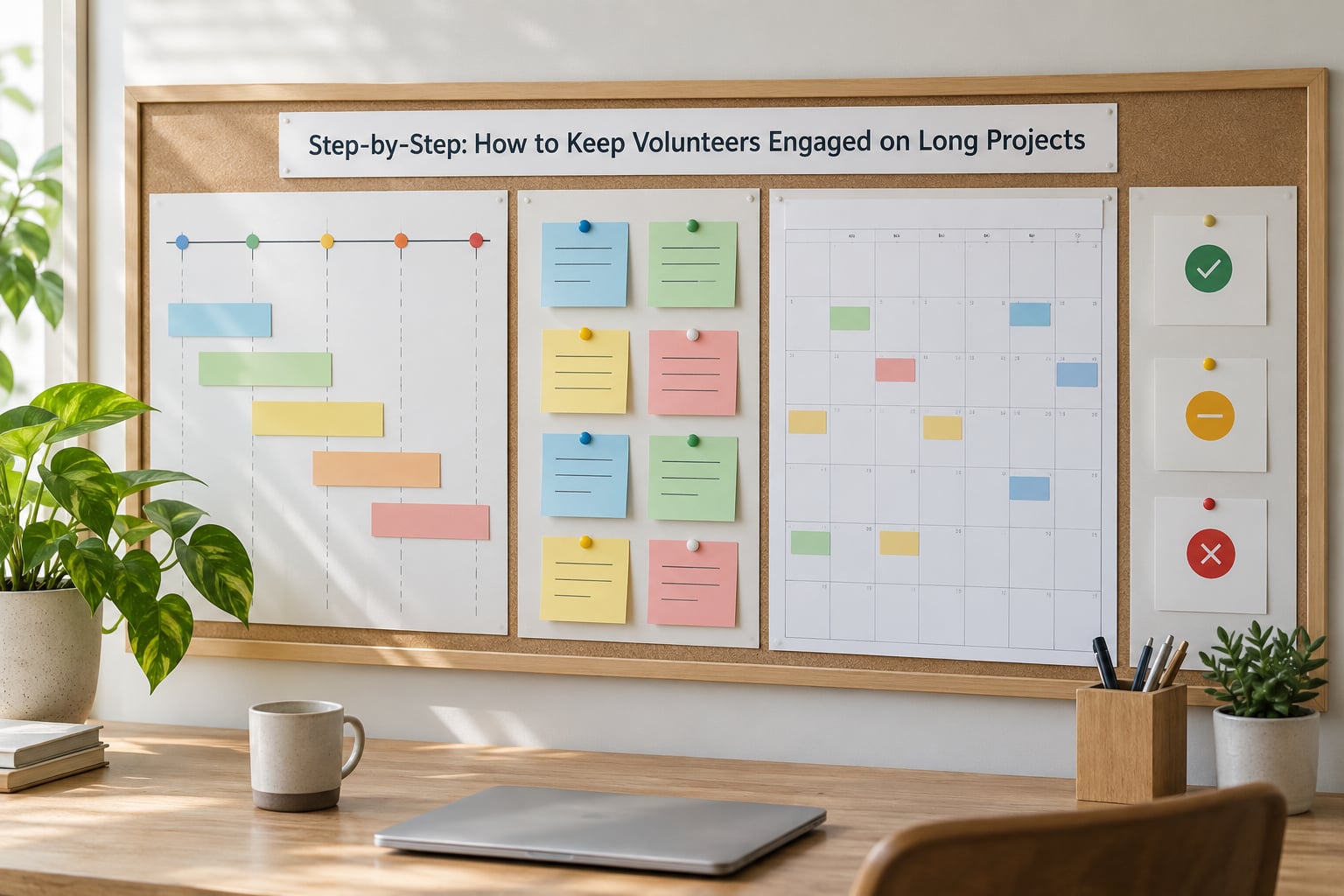
How to Keep Volunteers Engaged on Long Projects: Set the Direction
Long projects do not lose people because the work is hard. They lose people because the work stopped being legible somewhere around week three, when the founding group is busy and the newest person cannot tell what a finished piece actually looks like.
Turn your broad mission into a charter that fits on one page and answers four questions. What is the outcome, stated as something that will exist at the end? What is each role responsible for, in plain language? What is out of scope, listed explicitly? And what is the first visible milestone, with a date?
That last question does most of the work. A volunteer who joins for a specific, reachable first milestone sticks around to see the second one, and then the third. The same volunteer handed a vague six-month assignment usually disappears by week five.
Give every role a one-pager: the purpose, the expected time commitment per month, the first three tasks, the named contact, and what good work looks like on this project. Two hundred words is plenty. Post it where people can find it and repeat it in the welcome message, because most people read the welcome message once and never again.
You will know this step worked when a volunteer who has been around two weeks can describe the project’s goal and their own part in it without hedging. If they cannot, your brief is not doing its job.
How to Keep Volunteers Engaged on Long Projects: Create Early Wins
The first month decides the retention curve. Volunteers who ship something small in their first few weeks are far more likely to still be there in month four, because they have evidence about what this place is like rather than a guess.
Break the opening phase into tasks that can be finished in days, not weeks. A first contribution should be visible to someone other than the person who made it. A schema that gets accepted, a dataset that gets cleaned, a page that gets published, a demo that gets shown to the group. Small and witnessed beats large and invisible.
Then connect the work outward. When each early task lands, say in the group channel what it unblocked and who did it. People who never see the connection between their task and the project stop seeing a connection at all, and that quiet loss is hard to reverse later.
Watch for the skills mismatch problem while you are still small. A volunteer doing grunt work they signed up to escape will leave, and usually without saying why. If someone with a design background is copying rows into a spreadsheet, you have not run out of designers; you have run out of design tasks, and that is a planning failure rather than a motivation failure.
How to Keep Volunteers Engaged on Long Projects: Build a Rhythm That Survives Silence
Cadence is what keeps volunteers engaged on long projects when the coordinator has a bad week. Pick a rhythm you can sustain when nothing is happening, because a rhythm that only appears during good news teaches people to expect silence.
Four touchpoints cover almost every project:
- A short weekly update, same day each week, three lines: what landed, what is next, what is blocked. Same day matters more than long. An update that arrives on Wednesday one week and Thursday the next reads as improvisation.
- A working session or open call, twice a month, with an agenda posted in advance and a recording or notes posted after. A call nobody can prepare for is a tax on the most engaged people in the group.
- A decision point every four to six weeks, where volunteers see what was chosen and why. Decisions made without them breed the quiet resentment that shows up as passive disengagement later.
- An asynchronous pulse check, a three-question form at the halfway mark and near the end: still interested, capacity right now, anything blocking you. It takes most people under two minutes and gives you early warning that no meeting would have produced.
Run the same rhythms for remote and international volunteers, where the relationship problem is structural. There is no hallway, no lunch, no accidental overhearing of a decision. If your updates only happen live, distributed volunteers are effectively looking at a group that holds meetings without them. Record sessions, post written decisions, and keep a single shared thread where context lives, so nobody has to ask three people to find out what was decided.
Coordinators running multi-country online projects tend to describe the same failure in different words: without a regular cadence, the people who joined first drift and the ones who joined later never meet them. The fix is unglamorous. Publish the schedule, name one person as the contact, and respond within a stated window, even when the response is “I am checking on that.”
How to Keep Volunteers Engaged on Long Projects: Recognize Contributions and Reinvigorate Tired Roles
Generic praise reads as filler. “Thanks everyone for your hard work” tells a volunteer they were interchangeable, which is exactly the opposite of what you want. Specific recognition tells them you know what they did.
Build recognition around one story, one number, and one thank-you, and send it within a few days of the moment. Name a specific task, the result it produced, and the person it affected. In coordinator meetings, the difference lands immediately: specific notes get forwarded by recipients, generic ones do not.
Recognition also works in front of peers. Announcing participation in the group, tagging people in a post-project summary, and giving demo slots at a show-and-tell all reinforce that contribution was seen. In practice a tagged announcement gets far more engagement than the same message sent untagged, and the effect grows when the post names the work rather than the attendance.
The second half of this step is reinvigoration, and it is the one most teams skip. Somewhere in month three, tasks start to feel repetitive and the challenge that got someone involved is gone. The fix is to rotate scope, not to increase volume. Move a strong contributor onto a harder problem, pair a steady volunteer with a new one as a buddy, or hand over a piece of work that has grown past its original owner.
Protect the energy budget while you do it. A volunteer who says they have four hours a month means four hours, and a coordinator who treats that as a negotiation is how the most reliable people quietly burn out. Skills-based volunteers in particular will leave overused roles faster than underused ones, and one of them leaving takes three other people’s work with them.
Common Mistakes That Stall Long Volunteer Projects
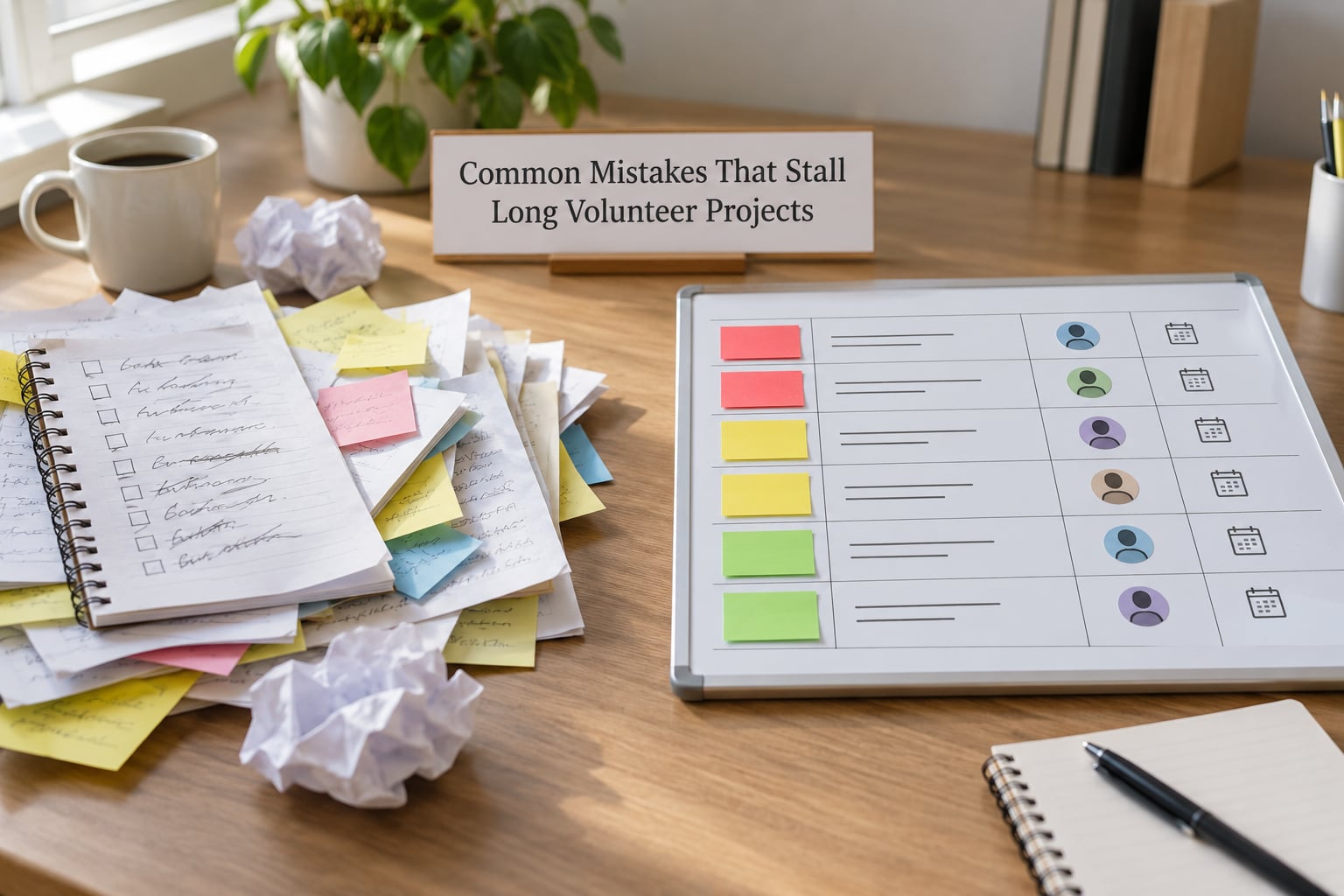
Here are the failures I see repeatedly on projects that run past two months, each with the correction that tends to work fastest.
- Vague ownership. Tasks assigned to “the data team” get done by nobody. Correct it by putting one name on every task, and by asking people to raise their hand for work rather than allocating it silently.
- Invisible progress. Volunteers cannot tell whether the project moved this month. Publish a one-screen status: done, in progress, next, blocked.
- Unequal workloads. Two or three dependable people absorb everything until they burn out and take the knowledge with them. Keep a bench of two backups for any critical role, even if one is inactive.
- Late feedback. Reviews that arrive a month later teach volunteers their work is not being read. Set a review turnaround, and keep it even when the answer is “not yet, here’s why.”
- Endless meetings with no decisions. If a meeting ends without a recorded decision, an owner, and a date, cancel the next one. People read that as being managed rather than supported.
- Guilt-based retention. Saying you will be disappointed if someone leaves ranks as pressure, and the people who were going to stay are the ones who stay resentfully. Exit without guilt and invite them back; that conversation works far better than the silent treatment.
- Chronic urgency. Every week framed as a crisis teaches people that the real project is a fire drill. Keep roughly a fifth of planned work unscheduled so normal weeks feel normal.
- Silent scope changes. Redirecting someone’s work without telling them is the single most common reason capable volunteers disappear without explanation. Tell people when their task, deadline, or role changes, even when the change is small.
There is one more worth naming: over-reliance on the coordinator. When the person holding volunteer relationships leaves or changes roles, the group usually dissolves with them, and the volunteers never hear why. Write down the rituals, the channel, and the schedule so the structure survives a staff change.
None of these fix themselves. Pick two, run them for 30 days, and only then add a third. Programs that attempt all eight at once tend to manage none of them well by month two.
Frequently Asked Questions
What are some ways to keep volunteers engaged?
The reliable methods on long projects are: give each person a small, clear role with a named owner; break work into visible milestones they can see completed; keep a predictable communication rhythm that runs even in quiet weeks; share short updates that connect a volunteer’s task to a real outcome; recognize specific work by name and by number; and give people growth, not just more hours. Ask about capacity honestly instead of assuming it.
How do you keep volunteers motivated when the project is long?
Front-load proof instead of pushing motivation. Give every volunteer a first win inside their first few weeks, then connect it publicly to the larger goal. After that, rely on structure rather than appeals: published milestones, a fixed update day, and a decision point every four to six weeks where people see what was chosen and why. Energy dips around the fourth to eighth week for most projects, and that dip is a predictable point for a check-in, not a sign that people have lost interest.
How do you prevent volunteer burnout?
Watch for early signs: replies get shorter, people miss two sessions in a row, work slows to the minimum, and enthusiasm sounds automatic. The fixes are mostly about load and honesty. Ask directly what capacity someone has rather than assuming, keep about a fifth of planned work unscheduled, avoid framing every week as a crisis, and give strong contributors a real break or a new challenge. People sustain long-term roles when the scope matches what they actually offered.
What do you do when a volunteer drops out mid-project?
Reach out once, without pressure, and ask whether it is capacity, a role mismatch, unclear priorities, or something about the project itself. Whatever the answer, document the handoff and keep their work in a state someone else can pick up, because silence plus an undocumented backlog is what stalls a project. If they want to return, offer a smaller or different role rather than the same one. People come back more often after a clean exit than after a cold one.
How do you measure volunteer engagement on a long project?
Track five numbers: the share of volunteers still active at 30, 60, and 90 days, average hours contributed per month, the share of tasks with a named owner, response rate to your weekly update, and the count of people who have stopped responding with no explanation. The last figure is the most honest early warning. Compare each month against the previous one rather than against a national average, and look for the direction of the line, not the absolute number.
Conclusion
Start with one action, not a program. Write down your next meaningful milestone with a date, put a single name against it, and send a short message to the volunteers asking whether that milestone still matches what they signed up for. That single exchange tells you more about your project’s health than any survey, and it takes under an hour.
Everything else in this guide follows from it. Keep the cadence predictable, show the connection between small tasks and real outcomes, name specific work when you thank people, and keep a bench of backups for anyone holding critical work. Motivation on a long project is mostly a byproduct of how well the project is run, which is good news, because that part is under your control.