
A govtech startup is a company that builds software sold to government agencies, from small cities and counties up to state departments and federal agencies, with revenue that depends on public procurement rather than commercial contracts. So when founders ask what investors look for in a govtech startup, the honest answer is: they underwrite a sales motion as much as a product, because the buying process is slower, more formal and more exposed to budget cycles than anything in the private sector.
The diligence teams I have watched work through public-sector deals are not really hunting for a bigger market. They are testing whether a company can survive a 6-to-18-month procurement cycle without running out of money, whether it can name agencies that resemble each other, and whether it can prove a result a city council would recognise.
That changes the bar in specific, checkable ways. Here is what a serious investor is scoring, in the order they score it.
Table of Contents
- What Do Investors Look for in a Govtech Startup?
- How to Show Measurable Public-Sector Value
- What Makes the Government Market Opportunity Credible?
- How Investors Assess Product-Market Fit in Govtech
- Why Security, Privacy, and Trust Are Investment Criteria
- How to Make Procurement and Implementation Readiness Visible
- What Investors Look for in Revenue Quality and Sales Potential
- How to Build a Defensible Govtech Business
- What Should a Govtech Startup Show in Its Investment Materials?
- Frequently Asked Questions
- What are investors looking for in a startup?
- What do govtech investors look for that general VCs do not?
- How long does a government software sales cycle take?
- How much runway does a govtech startup need?
- What are red flags for angel investors in a govtech deal?
- Do govtech investors care about mission and public value?
- Conclusion
What Do Investors Look for in a Govtech Startup?

Six signal groups do most of the work: civic value a buyer can point to, credible access to agencies, product-market evidence inside real workflows, security and privacy posture, revenue quality that survives slow payment, and a plan that repeats in the next jurisdiction.
Here is the compressed version, formatted the way an investor would read it on a first pass.
- Evidence of measurable public value. A named service, a baseline number and a documented improvement, not a claim about efficiency.
- A named, comparable customer base. Agencies that look like the buyers on the pipeline slide, with contactable references.
- Revenue investors can underwrite. Signed contracts and booked backlog, with pilots, letters of intent and memoranda kept on separate lines.
- Concentration you have thought about. A plan for what happens if the largest agency changes direction or leaves.
- Runway matched to the buying clock. Enough capital to cover procurement onboarding plus a full sales cycle before the next raise.
- Proof you understand the buying committee. Procurement, IT, finance, legal and the department that actually uses the product.
- Procurement readiness in the open. Vendor registration and contract vehicle status that lets an agency buy from you this fiscal year.
- A security and privacy posture worth signing. Access control, audit trails, data minimisation and a clear answer for records requests.
- Unit economics after implementation. Gross margin that holds once training, change management and support are counted.
- A defensible wedge. Something a competitor cannot rebuild by hiring the same engineers.
The table below is the version I would put in front of a diligence team, because it forces each signal to be attached to a piece of proof.
| Signal | Proof investors want | Why it matters in public sector |
|---|---|---|
| Civic value | A baseline metric and the result after a pilot | Public buyers answer to elected officials who need a defensible story |
| Buyer access | Named agencies, named roles, active conversations by stage | Relationships decay fast when budgets close |
| Product-market fit | Repeat usage, renewal, expansion inside the same agency | A pilot is easy to win; a second fiscal year is not |
| Trust | Security documentation, incident history, data handling policy | A breach ends the market for a small vendor |
| Revenue quality | Booked backlog, payment terms, renewal history | Cash arrives later than the contract implies |
| Repeatability | Two or three adjacent agencies in the same profile | Each new logo should cost less to win than the last |
How to Show Measurable Public-Sector Value
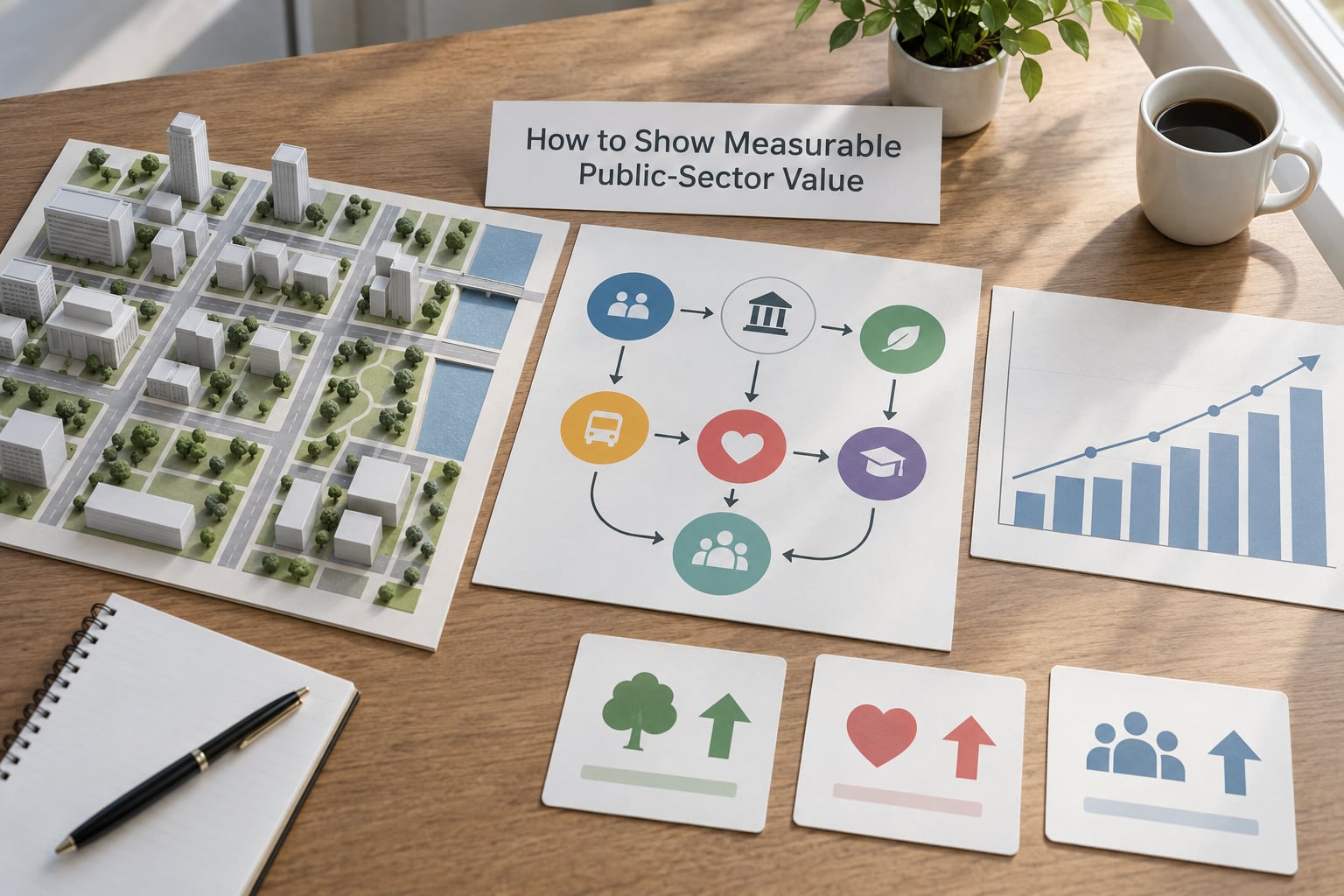
Investors distinguish a useful civic product from a broadly desirable idea by asking for a number that moved. Not a projection, not a benchmark from a vendor’s own marketing page. A number measured in one agency, before and after.
Build the story in this order. Name the problem in the agency’s own language, for example permit review times, not workflow optimisation. Name exactly who uses it, whether a clerk, a plan reviewer, a field inspector or a resident filing online. Then state the baseline condition before you arrived.
From that baseline, pick one primary outcome metric and two supporting ones. The primary metric is the one your champion will put in a council memo. Supporting metrics can cover cost per transaction, staff hours reclaimed, backlog age or abandonment rate.
Equity effects are worth quantifying when they are real. Shorter wait times for a language-accessible service or a drop in the share of applicants who abandon a permit are legitimate public-value measures, and impact investors will ask for them by name.
Pilot evidence beats a projection every time. A paid pilot with a written success criterion, a named agency and a date is the cleanest asset a pre-seed company can own. Say plainly whether the pilot was paid, and at what amount relative to your list price.
What Makes the Government Market Opportunity Credible?
A credible government market looks specific enough that an investor could name the next three buyers without asking you. “We sell to government” is not a market. Cities with populations between 40,000 and 90,000 in the Midwest with a permitting backlog over a certain age is a market.
Five things make the opportunity legible. The named agency type and size band. The budget owner, which is usually a department head rather than an IT lead. The procurement pathway, whether purchase order authority, a cooperative contract vehicle or a formal RFP. The pilot status for each named opportunity. And the implementation capacity you have, since a public-sector rollout consumes more of your team than the contract value suggests.
Be precise about the difference between interest, a contract and a repeatable customer base. Interest is a conference conversation. A letter of intent or memorandum is a step that rarely survives diligence scrutiny as revenue. A signed contract is real, but one contract is not a base. A repeatable base means you can name several agencies with the same profile, similar scope and a path to renewal.
The question I like to watch a founder handle well is this: what would this company look like in 24 months if only your existing customers re-signed? If the answer is a recognisable business, the opportunity is credible. If the answer depends on three new agencies that have never heard of you, it is a plan, not a market.
How Investors Assess Product-Market Fit in Govtech
Product-market fit in public sector shows up as depth of use, not breadth of logo. A dozen departments that log in twice a quarter is weaker evidence than one agency where staff use the product every day and the department owns the process.
The evidence investors ask for falls into five buckets. Adoption, meaning active departments against total contracted. Retention, meaning what fraction of agencies are still live after their first contract year. Usage depth, measured in transactions, cases or records handled rather than logins. Willingness to pay, shown by a signed order at list price rather than a heavily discounted pilot. And expansion, where a second department or a second site within the same agency appears without a new sales cycle.
Willingness to pay deserves extra weight. A discount granted to win a reference customer is a reasonable trade, but it should be labelled as one in the model. Investors can forgive a strategic discount; they cannot work out a number they cannot trust.
Density beats coverage. Government agencies talk to each other through professional associations and regional peer networks, which is why a win inside an association chapter such as GFOA, ICMA or NIGP creates a referral path to dozens of comparable agencies. Scattered wins across unrelated states look like coverage in a pitch deck and behave like nothing in practice.
And expect the first question in nearly every government conversation, which then shows up in diligence: who else like us is using this. If you cannot name a comparable peer agency with a measurable outcome, expect the question to sit unanswered in your materials.
Why Security, Privacy, and Trust Are Investment Criteria
Public-sector software handles information about residents, and sometimes about vulnerable residents. Investors treat security posture as a gate rather than a scoring bonus, because a single serious incident can end a small vendor’s access to an entire segment.
The baseline questions are unglamorous and specific. What is collected, and why. Where it is stored and who can reach it. How access is granted, reviewed and revoked. What the audit trail records. How long data is kept and how deletion requests are handled. What happens when a records request or a public disclosure law reaches your data.
Investors also look for maturity signals rather than certificates alone. A security policy that names an owner, an incident response process that has been rehearsed, a documented process for reviewing access logs, and clear accountability for operational failures. Where a formal attestation such as SOC 2 is in progress, investors want to see the scope and the timeline, not just the intention.
If your product uses machine learning on public data, expect specific questions. Which groups could be disadvantaged by an error, how decisions are reviewed by a person, what the audit trail records, what the training data was, and how outputs are explained to someone who has been affected. Government buyers flag these before signature, and investors read the same notes.
Bounded claims win. Founders who describe a model as assistive, with a human approving the outcome and a defined error rate, get further than founders who say the product is AI-powered. The second claim invites a security review that the first one quietly passes.
How to Make Procurement and Implementation Readiness Visible
Procurement is a qualification gate, not a formality. An agency that wants your product but cannot buy from you through a valid route loses the fiscal year regardless of how well the evaluation went. Investors check whether you know that.
Make the basics visible. Registration on SAM.gov, active vendor status in the states you sell in, and cooperative purchasing vehicles where your buyer profile demands it. TIPS, NASPO ValuePoint, OMNIA Partners and E&I are the names that come up most, because they let an agency purchase without running its own solicitation. Onboarding to one of them commonly runs three to six months, which is a runway line, not a back-office task.
Where your customers manage federal or state grant money, familiarity with 2 CFR 200 is a genuine signal, because it affects what documentation your customer must maintain and therefore what they will demand from you.
Implementation is where margins quietly die. Public buyers expect data migration, configuration, training, change management and support during a rollout that runs longer than a commercial deployment. Investors want to see the implementation modelled honestly: who does the work, how long a typical deployment takes, and what the margin looks like after it.
The failure mode to avoid is a plan that only works because you customise for every customer. Unfunded implementation work is revenue with a cost attached, and it does not survive an acquirer’s diligence. The plan investors back is one where a second agency of the same type gets live in weeks rather than months, and where the work is documented rather than remembered.
What Investors Look for in Revenue Quality and Sales Potential
Public-sector revenue is stickier than commercial revenue and slower to convert. Investors know both things, so they read a government contract very differently from a commercial one.
Start with what a number actually means. Booked backlog is contracted revenue you have a signed order for. Qualified pipeline is a conversation with a budget owner. A letter of intent, memorandum or unpaid pilot is interest with paperwork, and it belongs on its own line, never added to bookings. Mixing those three is the fastest way to lose a room.
Then look at the cash mechanics. Government contracts are often invoiced by milestone or by quarter rather than monthly, and payment arrives after approval. Founders who model a signed contract as immediate cash will be short when the money is late, and a founder who has already experienced that delay is more credible than one who has not.
Sales cycle length is the number investors will test. A mid-market municipality commonly runs six to eighteen months from first contact to signature. Small agencies with purchase order authority under a threshold can close in sixty to ninety days. Counties and state departments with formal solicitation or board approval take longest. State the segment you are describing, because an investor who hears eighteen months and believes the number is better than one who hears a blended average.
Budget timing is the other half. Municipal budget season typically runs from late summer through fall, and federal civilian agencies start their fiscal year on October 1. A deal that has not been budgeted can be lost for a full year no matter how good the evaluation was.
Contract terms get probed too. Multi-year terms with an annual escalator read very differently from a one-year agreement that can be cancelled. So does a change-of-control clause, because it determines whether a later investor or an acquirer can take the contract with the company.
How to Build a Defensible Govtech Business
A feature list is not a moat, and investors in this space are unusually good at spotting one. Defensibility in govtech usually comes from four places that compound over time.
The first is operational data. Every agency that runs a process through your software produces a history of how that process actually behaves, which is different from a policy document. The second is embedded workflow: if your product is where a case lives, leaving means moving data and re-training staff, which is a real switching cost.
The third is integration depth. Systems that connect cleanly to the records, identity and finance platforms an agency already runs are harder to displace than tools that sit beside them. The fourth is domain knowledge, held by a team that has lived inside government rather than studied it from outside.
Trust itself compounds. A known vendor with documented security posture and a track record of clean audits faces a shorter review than an unknown one, and that advantage repeats in every new agency in the same segment.
The path investors look for runs from one agency type to many. The first three customers in a segment are expensive and hand-delivered. Customers four through twenty should cost progressively less to win, because the product is configured for their profile, the references exist, and the associations introduce you. If cost to win never falls, you have a consulting business with software attached.
What Should a Govtech Startup Show in Its Investment Materials?
The deck, the data room and the answers to the awkward questions are the same document viewed from three distances. Here is what I would have ready before the first partner meeting.
What investors look for in a govtech startup pitch deck. The problem in the buyer’s language. One slide on the primary outcome metric with a before-and-after number. The named agency segment with size band and geography. The buying committee you have spoken to, role by role. Procurement status, including vehicle registrations. A runway calculation that explicitly includes procurement onboarding and one full sales cycle. And a milestone plan that lands inside a budget cycle rather than across it.
For the data room, expect to produce: the cap table and its history, contracts rather than summaries, pilot agreements with their success criteria, pipeline by stage with amounts, payment terms and ageing, security documentation, customer references willing to take a call, and a list of every registration you hold.
The red flags below are the ones that stall a govtech round specifically, with a fix that fits in a quarter.
| Red flag | Why it stalls the round | 90-day fix |
|---|---|---|
| More than 40% of revenue from one agency | One election or one departure can erase the base | Sign two more of the same profile and cap single-agency share in the model |
| Every deal runs through one champion | Champions cannot override procurement or fast-track approval | Map and engage procurement, IT, finance and legal directly |
| Answering cold solicitations as the main channel | Solicitations often signal a decision already made | Move spend to named accounts and association networks |
| No contract vehicle registration | Many agencies legally cannot buy from you | Start onboarding now, even without a logo, and treat it as runway cost |
| Consumption or per-transaction pricing | Budgets are hard to shape around unpredictable usage | Move to per-agency or population-based pricing with a committed floor |
| Deep first-year discounts on every deal | Reads as not enterprise-grade, and compounds into margin | Trade list price for a reference case, then return to list |
| Implementation omitted from the model | Margin and delivery date are both wrong | Model deployment effort per agency type and price the change |
What changes by stage is mostly a question of which proof is required.
| Stage | What they underwrite | The one metric that matters | Typical check range |
|---|---|---|---|
| Pre-seed | That the problem is real and the team can reach an agency | Signed pilot or design partner with a written success criterion | 250K-500K |
| Seed | That the same profile of agency buys again | Pilot-to-contract conversion and early gross margin | 500K-3M |
| Series A | That the model repeats without founder-led selling | Net revenue retention across the agency base | Investor and company specific |
On who actually writes these cheques, dedicated govtech funds are the most direct read, generalist B2G funds bring a broader portfolio view, impact investors underwrite public value explicitly, and corporate and strategic investors from utilities, telecoms and major contractors underwrite distribution. Non-dilutive capital is worth stacking in parallel rather than after: SBIR and STTR awards, government accelerator placements, and direct pilot programmes, which historically include the Defense Innovation Unit’s pilot contracting and accelerator awards in the six-figure range. Combining those with a venture round often buys the extra months the procurement clock demands.
Frequently Asked Questions
What are investors looking for in a startup?
In any startup, investors look for a large and growing market, evidence that customers pay and stay, a team that has built something before, and a clear path to enough growth to justify the round. The specific form changes by stage: early investors buy the team and the signal, later investors buy the numbers. A weak market or a team that cannot explain who signs the cheque ends the conversation before anything else gets discussed.
What do govtech investors look for that general VCs do not?
Public-sector investors add three tests a general software investor never asks. Can you survive a six to eighteen month procurement cycle on current capital. Are you registered on the contract vehicles an agency can actually buy from this fiscal year. And can you name agencies of the same profile as your customers, with measurable results. Security posture and change-of-control terms also carry far more weight in govtech than in commercial software.
How long does a government software sales cycle take?
For a mid-market municipality, expect six to eighteen months from first contact to signature. Small agencies with purchase order authority under a stated threshold can close in sixty to ninety days. Counties and state departments with formal solicitation or board approval take longest, and a buyer without budgeted funds can lose a full fiscal year. Add three to six months if you still need to complete cooperative contract vehicle onboarding before an agency can purchase.
How much runway does a govtech startup need?
Most founders raise eighteen months of runway, which is short for this market. Contract vehicle and vendor registration can take three to six months, and the first material contract can take another six to eighteen months to sign. That points to a twenty-four month planning horizon, funded before you need it, with non-dilutive awards and pilot contracts used to stretch it. Run the calculation with your own burn rate and pipeline dates rather than a generic benchmark.
What are red flags for angel investors in a govtech deal?
The most common ones: most revenue from a single agency, a pipeline built on unsigned letters of intent rather than orders, a founding team with no public-sector experience, a business that only works through one champion, and a cost of implementation that is nowhere in the financial model. Angels also hesitate when the founder treats an unpaid pilot as traction. Each of these is fixable, but each has to be addressed before the round rather than explained during it.
Do govtech investors care about mission and public value?
Impact investors underwrite it explicitly and will ask how you measure it. Generalist funds want the same evidence reframed as risk reduction, because a product with a documented public benefit is easier to champion inside a department and easier to keep funded through a budget cycle. A stated mission with no measurement does not move either kind of investor. An outcome metric attached to a named agency does.
Conclusion
What investors look for in a govtech startup comes down to a sales motion as much as a product: a measurable civic result, named comparable agencies, signed contracts separated from letters of intent, and enough capital to cover procurement from the first meeting to the first invoice. Pick your agency profile, publish one outcome metric, and get your registration paperwork moving this quarter. Everything else in the round is easier once those three are true.