
A public records request is a written ask sent to a government agency for records it holds, filed under a state public records act or the federal Freedom of Information Act. The process runs in seven steps: confirm the law that applies, describe the records precisely, submit in writing, track the statutory deadline, review what comes back, and appeal if the answer is wrong. Most delays trace back to two things — the wrong custodian, or a description too vague to search.
Timing depends on where you are and what you are asking for. A narrow request for a single contract might come back in days; an email search across a large department can run for months. Fees, exemptions and appeal rights all change by country and state, so treat any timeline you read here as a starting point rather than a promise.
Table of Contents
- What You Need
- Step-by-Step
- How to request records under a public records law: confirm the law and agency
- Define the records with enough detail
- Check for narrower alternatives before filing
- Submit a complete written request
- Track the request and clarify any fee estimate
- Review the response and resolve an overbroad redaction
- Request an administrative appeal or judicial review
- Common Mistakes
- Frequently Asked Questions
- Can I request public records from any government agency?
- What if an agency says it does not have the records I requested?
- Are government bodies allowed to charge for public records?
- How long does a public records request usually take?
- What should I do if an agency refuses my request?
- Conclusion
What You Need

Six things. Most requests that stall are missing one of them.
- The jurisdiction. Which country, state, province or city holds the records. This decides which law applies.
- The agency or records custodian. The specific office, department or named officer who holds the records, not the switchboard number.
- The relevant statute. The section number and name of the law you are invoking, so the agency knows which procedure and deadline governs.
- Your request deadline. The date the agency must respond under that statute, counted from when the request was received.
- Your contact information. A working email address or phone number. Most agencies cannot process a request they cannot follow up with.
- A precise record description. Enough detail that a clerk can find the documents without asking you a follow-up question.
Two of those deserve extra attention. First, exemptions: every jurisdiction has its own list of what can be withheld, and a catch-all exemption in one state has no meaning in the next. Second, agency procedures — fee schedules, portal systems, ID requirements, and rules about commercial requesters — are set locally and change without notice.
Step-by-Step
The workflow below runs seven steps, and it works the same way in most jurisdictions even when the deadlines and exemptions differ. Total time depends on the volume of records, how much review the agency has to do, and whether an appeal becomes necessary. Budget for a single narrow request to be quick and a broad multi-year email search to be slow.
How to request records under a public records law: confirm the law and agency
Identify the jurisdiction first, then determine which access statute governs the body you want to file with. Federal agencies answer under FOIA. State and local agencies answer under a state public records act, sunshine law or open meetings law — sometimes several at once.
Next, locate the correct records custodian. Most agencies publish a public records officer or open records coordinator by name, and several states maintain a central roster. Verify the submission method, any fee schedule, whether identification is required, and the response deadline the agency publishes.
How do you confirm the agency actually has custody? Look at the agency’s retention schedule and its prior disclosure log. If the records were transferred to another office, a state archive, or a contractor, filing with the wrong body produces a denial that costs you a whole cycle.
Define the records with enough detail
The single biggest cause of delay is a subject-based description. “All emails about the transit project” cannot be searched. A clerk has no date boundary, no record type, no creator list, and no way to estimate volume.
Build the description from these fields instead: the program or department, the date range, the record type, the creator or recipient, the subject matter, the format, and any distinctive identifier you already have — a contract number, a permit number, a docket reference, a grant number.
A vague request reads: “Records about the parking contract.” A precise version reads: “The bid file, evaluation scoring sheets, correspondence between staff and the bidder, and all amendments for RFP 2025-114, covering March 1 through June 30, 2025, in native electronic format where available.” Both ask for the same thing. Only the second one gets answered on time.
Check for narrower alternatives before filing
Before you submit, check whether the information already exists in published form. Annual reports, adopted budgets, council or board packet archives, open data portals, permit dashboards, and published meeting minutes may already answer your question at no cost and no delay.
It is also reasonable to ask the custodian informally whether a department-level office holds what you want. Records about a program run by a specific division often sit with that division, not with the central office.
The tradeoff is completeness. A narrow request is fast, cheap, and easy to appeal. A broad one is more complete but more likely to trigger a fee estimate you did not expect. Most people do better by splitting one huge request into three dated ones.
Submit a complete written request
Send a written request even when the statute lets you ask orally. Some jurisdictions only start the response clock on written receipt, and a written record gives you a dated document if the deadline passes.
A reusable request structure covers: your name and contact details, the statute or legal basis you are invoking, the exact description of the records, the date range, the format you want, the delivery method, a fee ceiling if the statute allows you to set one, and the name of a contact person who can answer questions. Add a line asking the agency to contact you if clarification is needed before the deadline passes.
Keep a copy of everything you send, with the date, the delivery method, and any confirmation or reference number you receive back.
Track the request and clarify any fee estimate
Open a simple tracking sheet the day you file. Log the date sent, the date received, the reference number, the assigned staff member, the statutory due date, any extension notice, any fee estimate, payment status, and the production schedule.
Fees are where requests quietly die. Many statutes let an agency charge only the direct costs of duplication — a per-page copy charge or a media cost — while others permit recovery of search, review, and programming time at set hourly rates. Ask for a written estimate before authorizing work, and ask it scoped to your specific request rather than open-ended.
If an estimate seems inflated, say so in writing and propose a narrowing: a smaller date range, one record series instead of three, or inspection at the agency with your own camera instead of paid copying. If an item in the estimate is ambiguous, ask what it covers. Do not withdraw and refile the whole request just to clarify one line item — that usually restarts the clock.
Review the response and resolve an overbroad redaction
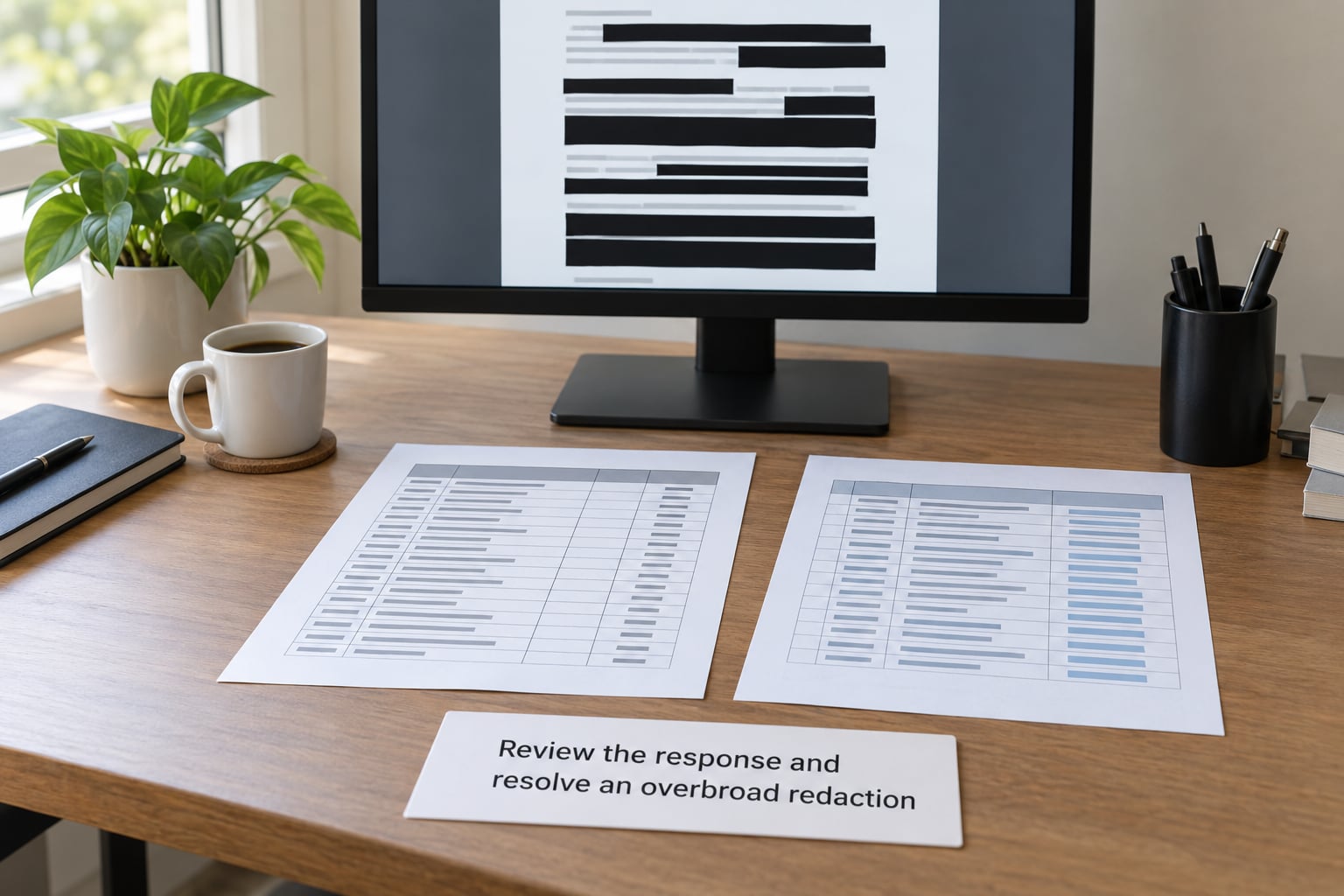
When records arrive, check the inventory against your request. Count the pages. Look for missing attachments, wrong date ranges, metadata stripped from electronic files, and anything you asked for in a format you did not receive. Check whether a spreadsheet came as a flat PDF, which is a common and often curable objection.
Then check the redactions. Most statutes require segregability: an agency must release all non-exempt material in a record and redact only the exempt portion. A black bar covering three paragraphs when one line is exempt is an over-redaction, and you can challenge it.
Ask for a privilege or exemption log listing each withheld item with the exemption cited. Ask for an alternative format. Narrow the date range and resubmit for the portion you still need. Where the statute provides a process, challenge the unexplained withholding on that basis — and note that some jurisdictions treat an unexplained denial differently from a properly cited exemption.
Request an administrative appeal or judicial review
A denial, a missed deadline, an unreasonable fee, or an inadequate search all lead to the same place: an appeal. Remedies differ substantially by country and state, and this is the point where generic advice stops being useful.
The usual sequence runs from an administrative appeal to the agency head, then to an external body — an attorney general, a public records ombudsman, or an audit office — and finally to a court. Some statutes require you to exhaust the internal steps before filing suit. Some impose short appeal deadlines measured in weeks from the date of the determination letter.
Whatever the sequence, preserve the agency’s written decision, including its cited exemptions and stated findings. Appeals are decided on the administrative record, so that document is the case. Note also that fees for an appeal are separate from copying fees and can be substantial.
Common Mistakes
Filing with the wrong custodian. Records for a program usually sit with the office that runs it. Fix: check the agency directory and the retention schedule before sending, and address the request to a named officer.
Describing records by subject only. “Emails about the project” returns nothing useful. Fix: add date range, record type, creator, and any identifier you have.
Omitting the date range. An unbounded request is treated as open-ended and priced accordingly. Fix: give start and end dates, even if the range is wide.
Ignoring format and fee limits. Native electronic data often triggers programming costs. Fix: state your preferred format and set a fee ceiling if the statute allows it.
Missing the statutory deadline. Most appeal windows are short and unforgiving. Fix: diarise the due date the day you file, not when the answer arrives.
Failing to keep proof of submission. Without a date, you have no leverage. Fix: keep the sent email, portal confirmation, or certified-mail receipt.
Assuming silence grants access. It does not. Silence is a missed deadline, not a release. Fix: follow up in writing, then use the escalation path.
Treating every withholding as exempt. Not every redaction is properly cited, and many over-redact. Fix: ask for an exemption log and check segregability.
Filing a question instead of a request. Asking “why did the council approve this” is not a request for records, and agencies will decline to treat it as one. Fix: rewrite it as a request for the documents behind the decision.
Frequently Asked Questions
Can I request public records from any government agency?
You can request records from any government body that holds them, but which law applies and who must respond depends on where the body sits. Federal agencies answer under the Freedom of Information Act, which sets a 20 working-day deadline. State, county and municipal bodies answer under their own state statute, with deadlines and exemptions set locally. Private companies and contractors usually are not covered, though records a contractor holds on an agency’s behalf sometimes are. Some bodies, like courts or legislatures, are exempt or partly exempt in certain jurisdictions.
What if an agency says it does not have the records I requested?
Ask for the search itself, not just the conclusion. A records custodian should be able to describe which systems were searched, which custodians or staff were asked, and the search terms used. If the answer is that the records were never created, ask whether records exist in a different format or system, and whether any were disposed of under a retention schedule. If the search appears inadequate, many statutes let you challenge the adequacy of the search. Keep the written response either way.
Are government bodies allowed to charge for public records?
Usually, but the ceiling varies. Many statutes limit fees to the direct costs of duplication, meaning a per-page or per-media charge, and prohibit charging for the time staff spend searching and reviewing. Others allow recovery of search, review, and data extraction at fixed hourly rates, which is why a large electronic request can carry a substantial estimate. Inspection in place, where you photograph or scan records yourself, is usually cheaper than copying. Ask for a written estimate before authorizing work, and set a fee ceiling where the statute allows.
How long does a public records request usually take?
It depends on the law, the volume, and the review involved. Federal FOIA sets a 20 working-day deadline, extendable by 10 working days for unusual circumstances. Many state statutes set shorter windows, often around 10 business days, and some allow prompt-production standards instead. In practice, a narrow request for a few documents can arrive within days, while an email search spanning several years can take months and is often released in batches. If no acknowledgment arrives within a week, follow up in writing.
What should I do if an agency refuses my request?
Ask for the refusal in writing with the specific exemption cited, then decide whether the exemption actually applies to what you received. You can often ask for an exemption log, an alternative format, or a narrower date range first. If the withholding holds up, use the appeal route your jurisdiction provides, which usually runs to the agency head, then to an attorney general or ombudsman, and then to a court. Appeal deadlines are short, and some statutes require you to exhaust internal steps before suing.
Conclusion
Start by naming the law that governs the body you are filing with and the specific custodian who holds the records. Then send one narrow, dated, written request that identifies the statute, describes the records, states your preferred format, and sets a fee ceiling where the statute allows it.
Keep proof of delivery and diarise the response deadline on the day you file. When the answer arrives, check the inventory against what you asked for, and ask for an exemption log if anything was withheld. Deadlines, fees, exemptions, and appeal procedures vary by country and state, so verify the specifics for your jurisdiction before you rely on them.