
A city, county, or state sells bonds to investors, takes the money raised and drops it into a restricted fund for an approved capital project, spends it down as construction bills arrive, then repays investors with interest over the life of the bonds. That repayment comes either from the government’s taxing power or from the project’s own revenue. Simple chain, a lot of moving parts.
Most of the public infrastructure in the US gets built this way. The Investment Company Institute puts municipal bonds at roughly 90 percent of all US public capital investment, which makes them the main financing tool rather than a fallback. Understanding how municipal bonds pay for infrastructure matters if you build capital plans, review a local ballot measure, or just want to read a city budget without guessing.
Table of Contents
- How Do Municipal Bonds Pay for Infrastructure?
- Why Municipalities Issue Bonds for Infrastructure
- What Can Municipal Bond Money Fund?
- How the Money Moves From Sale to Project
- How Municipal Bonds Pay for Infrastructure
- Who Repays the Bonds?
- How Debt Affects Taxes, Fees, and Future Budgets
- How the Public Protects Bond-Funded Projects
- Municipal Bond Infrastructure Examples
- Common Misunderstandings About Municipal Bond Financing
- Frequently Asked Questions
- Are municipal bonds tax-free?
- Do bond proceeds have to be spent on new construction?
- Can a city use one bond to pay for unrelated projects?
- What happens if a bond-funded project costs less than expected?
- Can residents challenge how municipal bond money is spent?
- Conclusion
How Do Municipal Bonds Pay for Infrastructure?
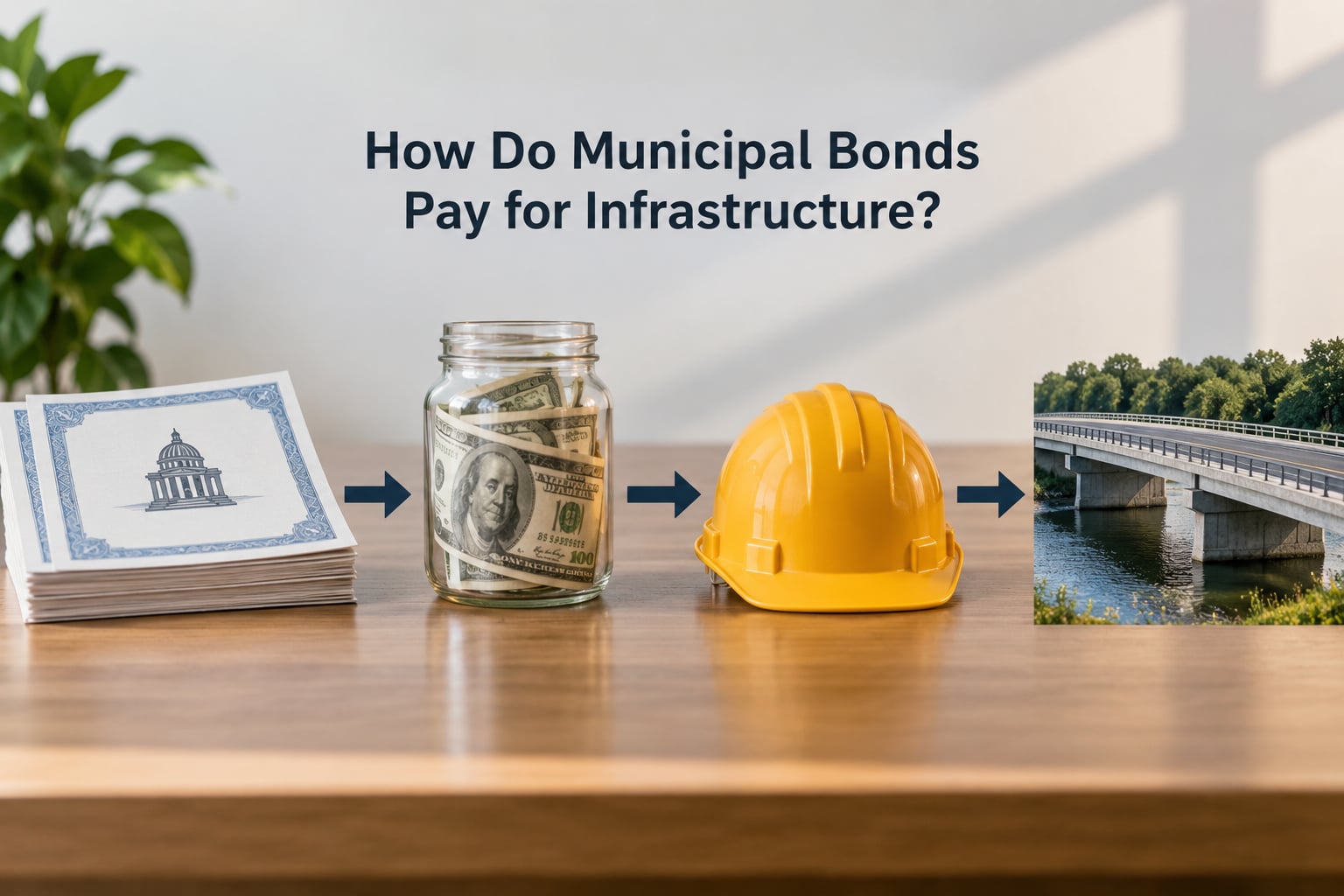
The short version: bond proceeds are not general cash. They land in a fund legally restricted to the projects named in the bond’s official statement, and the issuer pays authorized costs out of that fund until each project is finished. Whatever is left over is returned, rebated, or applied according to the same legal documents.
A bonded project and a cash-funded project differ in one big way. When a city pays for a water main repair out of its operating budget, the money is fungible: it was raised for salaries, fire response, parks, everything at once. Bond proceeds are not. Each dollar is tagged to an approved use, tracked in a separate account, and reported on.
Four parties show up in every municipal financing, and mixing them up is the most common source of confusion. The issuer is the government selling the bond. The bondholders are the investors buying it. The conduit borrower is a private or nonprofit entity whose project gets financed through a government that acts as conduit. The conduit issuer is the government that sells the bonds on that borrower’s behalf but is not ultimately liable for the debt.
Getting those roles straight answers the question raised constantly on finance forums about who issues the bond when a private developer is involved. The government borrows, the developer owes the government, and the developer has no relationship with the bondholders.
Why Municipalities Issue Bonds for Infrastructure
The core reason is timing. A treatment plant, a bridge replacement, or a bus fleet costs a lot on day one and delivers benefits for decades. Charging residents the whole bill in year one means a project that lasts forty years gets funded by the people who happen to live in year one.
Bonds spread that cost across the years the asset is used. The repayment schedule is matched to the useful life of the thing being built, which is why most infrastructure bonds mature in the 20 to 30 year range.
Three practical pressures push cities toward debt. Annually spent capital money competes with fire crews, libraries, and road patching. Interest on tax-exempt debt runs roughly 25 to 30 percent below comparable taxable borrowing, according to the Government Finance Officers Association, because the interest is exempt from federal income tax and is generally exempt from state and local tax as well. And grant money arrives on a reimbursement timetable that can lag two years behind the contractor invoice.
The tax exemption is doing the heavy lifting. It is not a subsidy bolted onto an expensive instrument; it is the reason the instrument is cheaper than the alternative.
What Can Municipal Bond Money Fund?
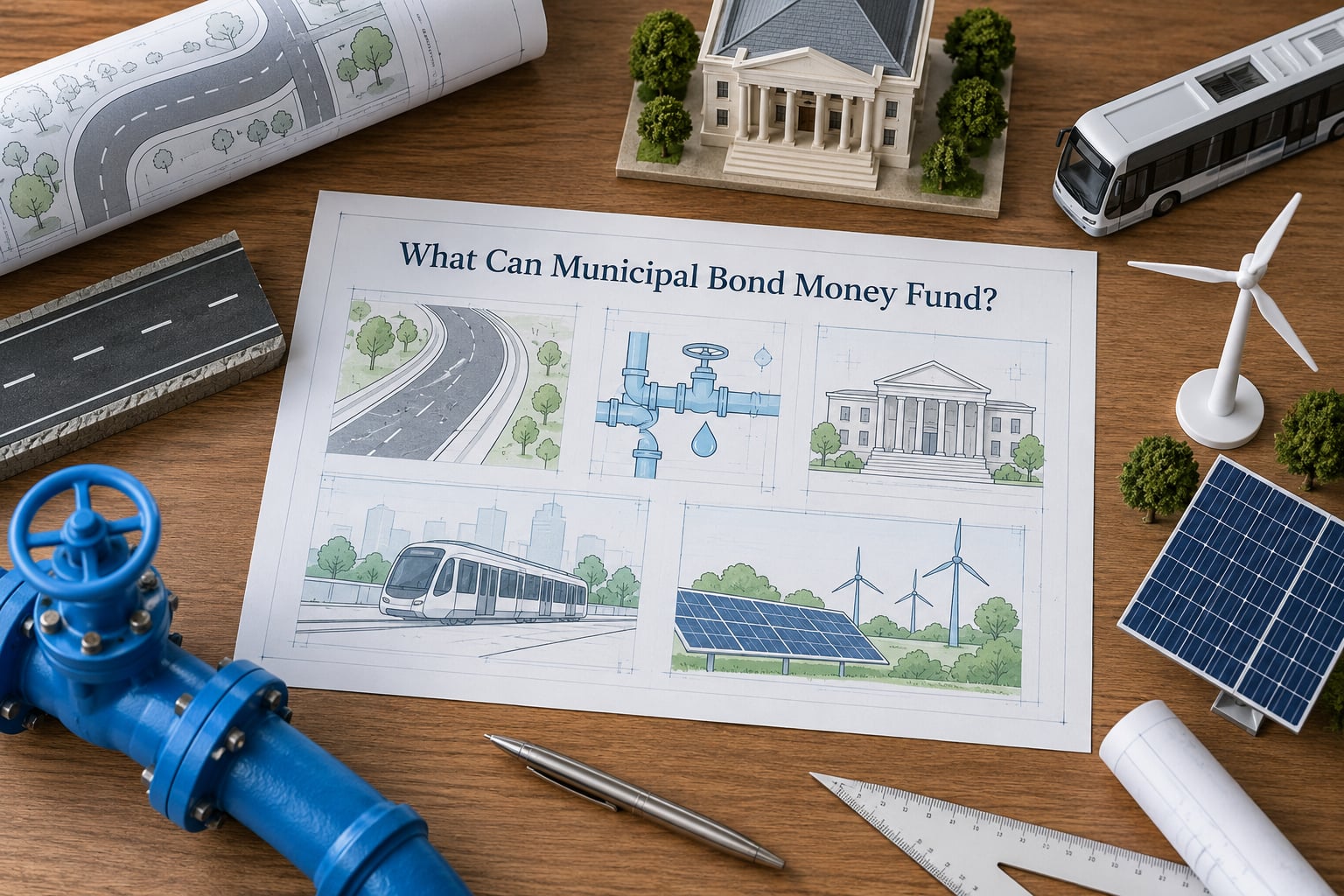
The usual categories cover most capital spending a government approves: highways, bridges and resurfacing; water and wastewater treatment, mains and storm drainage; transit buses, rail lines and stations; airports; schools and community college facilities; hospitals and public health buildings; government offices; parks and recreation; and electric utility and grid upgrades.
Newer money follows newer infrastructure. Broadband buildouts, fiber backbone, electric vehicle charging networks, stormwater and flood resilience work, and sensor networks for smart city programs increasingly get financed with revenue bonds because they generate or save a measurable amount of money.
One caution about categories: what is permissible comes from three places, and all three have to agree. The issuer’s legal authority under state law, the specific resolution and official statement for that bond, and the federal tax rules that define private activity and exempt purposes. A project that fits neatly under a heading is not automatically eligible. If you are checking a specific bond, read the official statement’s project description rather than the press release.
How the Money Moves From Sale to Project
Six steps, in the order they happen.
- Authorization. The governing body votes on the project, the amount, and the repayment source. Public hearings are often required at this stage, and in some states a voter referendum has to approve the issuance before a bond can be sold.
- Pricing and sale. Underwriters buy the bonds and sell them to investors. The pricing sets a coupon rate and maturity that reflect the issuer’s credit and the rate environment that day.
- Proceeds into a restricted fund. The money is deposited into a capital projects fund rather than the general fund. It is earmarked, and every draw from it has to tie back to the approved project.
- Spending against the project. The issuer pays authorized costs: contractor invoices, design and engineering, land acquisition, permits, and sometimes equipment. Bond counsel and auditors review expenditures for eligibility.
- Project goes into service. Construction ends, the asset opens or starts running, and revenue or savings begin if the project was revenue-backed.
- Repayment and reporting. Principal and interest go to bondholders on the schedule set at pricing, and the issuer files annual financial statements and continuing disclosure with the Municipal Securities Rulemaking Board’s EMMA system.
How Municipal Bonds Pay for Infrastructure
In plain terms: investors supply the capital, the issuer converts that cash into restricted project funds, and the government pays authorized costs out of those funds until the financed work is complete. After that, debt service is paid from the source pledged at issuance. That is the whole mechanism, and every variation in municipal infrastructure financing is a variation in who pledged what.
Who Repays the Bonds?
Two models cover most issuance. General obligation bonds are backed by the full faith and credit of the issuer, meaning the taxing power of the whole jurisdiction stands behind the debt. Revenue bonds are backed by a specific stream, and repayment depends on that project or program producing what was promised when the bonds were sold.
| Feature | General obligation bond | Revenue bond |
|---|---|---|
| What is pledged | Full taxing power of the issuer | A specific revenue stream or facility |
| Typical repayment source | Property taxes, or a dedicated tax levy approved at issuance | Tolls, fares, utility rates, rents, fees, or program charges |
| Typical projects | Roads, bridges, general government buildings, parks, any facility with no direct income | Transit systems, water and sewer utilities, airports, toll roads, parking, stadium and convention facilities |
| Credit standing | Usually the higher of the two, since general revenues back it | Rated on the coverage ratio for that project; a weak project means a weaker rating |
| Pressure on budgets | Indirect: repayment competes with other services for tax revenue | Direct: a shortfall shows up as a shortfall in that fund |
| Who bears first loss | General fund and other taxpayers | The project fund first, then reserves, then sometimes the general fund |
Ratings from Moody’s, S&P Global Ratings, and Fitch are assigned here the same way they are for corporate debt, and they influence the coupon. Strong coverage and a healthy reserve fund mean a lower rate, which means a smaller annual bill. Two conduit structures sit on top of these: a conduit issuer can sell bonds for a private hospital, university, or nonprofit that would not otherwise have tax-exempt access, while a private activity bond can fund a project with revenue from private users, though it usually needs a private use test to pass.
How Debt Affects Taxes, Fees, and Future Budgets
Issuing a bond does not by itself raise a tax. The money arrives now, construction gets paid, and repayment starts later. What changes is the shape of the obligation: instead of one large cash expense, the city now carries annual debt service for the term of the bond.
Debt service and construction are different line items with different consequences. Construction ends when the ribbon is cut. Debt service runs for the full term, and it is the line that a later council inherits. Interest payments early in the life of a typical 20-year bond are a smaller share of the payment than principal, so early budgets feel lighter and later ones heavier.
This is the point residents on city forums keep raising, and they are not wrong to raise it. Bonding shifts cost from the present to the future. A revenue bond also shifts it to a specific group of users, such as anyone paying a water rate, and that group may not be the same as the group that voted. Rate structures and affordability get debated for that reason.
Pay-as-you-go financing, by contrast, spends current cash and pays for assets out of current revenue with no repayment obligation at all. It is cheaper in interest terms. It also means waiting, because a city that saves for a decade of water main replacement has a decade of breaks in service.
How the Public Protects Bond-Funded Projects
Public money carries oversight, though the shape of that oversight depends on the issuer and the state. Typical layers include a public hearing before issuance, competitive bidding under state procurement statutes, annual financial statements with an independent audit, and a capital projects fund reported separately from general operations.
The transparency layer is the one residents can actually use. The official statement for a bond is the legal document describing the project, the repayment pledge, and the risks, and it is filed with EMMA, the electronic municipal market access system run by the MSRB. Continuing disclosure filings follow through the life of the bonds. In 2026, that public record is far easier to access than it was even a decade ago.
Residents who want to follow the money start with the annual financial report’s capital projects fund and the capital improvement plan, then check whether the expenditures in one matched the description in the official statement.
Municipal Bond Infrastructure Examples
The financing route changes with the asset, mostly because the repayment source has to exist.
| Project | Typical bond structure | Where repayment comes from |
|---|---|---|
| Water main replacement and treatment upgrades | Revenue bond | Water utility rates and connection fees |
| Road resurfacing and bridge repair | General obligation | Property taxes, sometimes with a dedicated fuel or sales tax levy |
| Transit buses and maintenance facility | Revenue bond | Fare revenue, sometimes with a dedicated sales tax or motor vehicle fee |
| New or renovated school buildings | General obligation | Property taxes; some states require a voter approval |
| City hall and public safety buildings | General obligation | Property taxes through the general fund |
| Broadband fiber backbone buildout | Revenue bond or private activity bond | Wholesale lease payments from a provider, or municipal network fees |
| Solar array and grid resilience upgrades | Revenue bond | Utility cost savings and green power sales |
| Stormwater and flood control projects | Revenue bond or special assessment | Stormwater fees, or assessments on parcels that benefit |
Note the pattern: any asset with a measurable income stream usually gets a revenue bond, and anything without one gets general obligation debt. Broadband and solar sit in the interesting middle, since the money comes back as avoided cost rather than cash revenue, which is why those structures get more scrutiny from the rating agencies.
Common Misunderstandings About Municipal Bond Financing
It is free money. It is not. The government pays interest and repays principal for up to three decades, and somebody funds that payment.
The money is unrestricted. Bond proceeds sit in a legally restricted fund. An invoice that does not fit the approved project cannot be paid from it, and a city that tries gets an audit finding.
Tax-exempt means free. Only the interest is exempt, and only for the investor in most cases. The principal is repaid at par, the issuer still pays the coupon, and fees still apply. In the United States, the alternative minimum tax provisions can pull some high-income buyers into tax on the interest.
The government guarantees the project will work. A revenue bond pledge is a promise about a repayment source, not a guarantee of success. A parking structure that draws fewer cars than forecast creates a coverage shortfall, and the general fund may end up absorbing it.
Unspent proceeds vanish. They do not. Lower-than-expected costs typically mean the balance gets spent on other eligible uses in the same project description, refunded to bondholders, or applied to reduce debt, depending on what the official statement allows.
Bonding always raises total cost. Sometimes it lowers it. Financing a 30-year asset over 30 years at a tax-exempt rate is usually cheaper than depleting an operating fund and then borrowing anyway to cover the gap.
Frequently Asked Questions
Are municipal bonds tax-free?
For most investors in the United States, yes: interest on most municipal bonds is exempt from federal income tax, and it is generally exempt from state and local income tax where the bond is issued. The exemption covers interest, not principal, so investors still receive their principal back at face value. Taxable municipal bonds exist for issuers that cannot use the exemption, and high-income investors can owe alternative minimum tax on some exempt interest. State rules differ, so check where the bond was issued.
Do bond proceeds have to be spent on new construction?
No. Tax-exempt bond proceeds pay for the full life of a capital project: design and engineering, land acquisition, permits, demolition, equipment, and sometimes debt service on the bonds themselves. Short-lived assets such as vehicles and computer equipment are sometimes financed through a short-term or taxable note instead, because tax rules require tax-exempt bonds to finance assets with a useful life long enough to match the bond term.
Can a city use one bond to pay for unrelated projects?
Sometimes yes, and the rule is stated in the official statement. An issuer can group related projects, or use a broad category such as transportation improvements, and spend within that category. What cannot happen is using proceeds outside the defined purpose, and that is treated as a serious compliance matter rather than an accounting preference. The original project description and the issuer’s legal authority define the outer boundary of what the money can touch.
What happens if a bond-funded project costs less than expected?
The unused balance follows the terms in the official statement, which typically allow spending on other eligible costs within the same project description, refunding the money to bondholders through a redemption or sinking fund, or holding it for future capital needs. What does not happen is the city simply taking the leftover cash for general operations. Any redirection has to stay inside the legal purpose of the bonds.
Can residents challenge how municipal bond money is spent?
In many jurisdictions, yes, though the route depends on state and local law. Common avenues include public comment at hearings, records requests for capital projects fund detail, and complaints to the state auditor or the fiscal oversight board. Some states give taxpayers standing to challenge the issuance itself in court. The bond documents and the official statement, both filed publicly with EMMA, give residents the baseline they need to argue from.
Conclusion
Understanding how municipal bonds pay for infrastructure comes down to one chain: investors lend, the issuer restricts the money to an approved project, the government spends it down, and repayment follows the pledge. Interest is the price of matching a long-lived asset to a long repayment schedule, and the tax exemption is what keeps that price reasonable.
To evaluate a specific proposal, find four things first: the project itself, the legal authority that allows the issuance, the exact revenue or tax source pledged, and the oversight process that follows the money. Those four answers contain nearly everything else.