Property tax revenue funds city services because local governments levy a tax on the assessed value of land and buildings, collect it through the property tax bill, and are legally required to spend the proceeds on public purposes. In most US cities that money pays for police and fire response, street maintenance, sanitation, parks, libraries and 911 dispatch, with school districts, counties and special districts taking their own legally set share.
The system is more layered than the single number on your bill suggests. Money moves through several distinct funds, each with its own rules about what it may pay for, and the part of your bill that reaches your city is often a minority share. Understanding that flow is the difference between “I have no idea where it goes” and being able to name the document that shows the answer.
This guide covers how property tax revenue funds city services, end to end. Rules, rates and structures differ by state and country, so every example here is illustrative rather than a description of any one city.
Table of Contents
- Where Does Property Tax Revenue Go?
- From Tax Bill to City Budget
- How Property Tax Revenue Funds City Services
- Which City Services Commonly Receive Property Tax Money?
- Why Do Some Services Use Other Revenue Sources?
- How Do Cities Set the Property Tax Rate?
- How Can Taxpayers Track Where the Money Goes?
- What Can Change the Amount Cities Receive?
- Frequently Asked Questions
- Does property tax revenue directly pay for every city service?
- Can I see exactly how much of my property tax paid for police or road services?
- Why can the city collect less property tax revenue than it budgeted?
- Are property taxes used only by the city that collects them?
- How can residents influence property tax-funded city spending?
- Conclusion
Where Does Property Tax Revenue Go?
Property tax revenue goes into the budgets of whichever taxing authorities levy against your property, and each of those bodies decides how to spend its own portion. The money is not earmarked to a single service at the point of collection. It enters a fund structure, council or board members adopt an annual budget, and departments draw against it as they pay salaries, contracts, fuel, road salt and equipment.
One number gets quoted more than any other, and it is worth separating carefully. Property taxes supply roughly 70 to 73 percent of the taxes local governments collect, according to the Tax Foundation and ITEP. Measured against all local general revenue, including fees, transfers and state aid, the Tax Policy Center puts property taxes closer to 30 percent. Neither figure is wrong; they measure different denominators.
For a household, the practical point is narrower: property tax is usually the largest single slice of the taxes you pay to government, and it is the one most directly tied to services delivered where you live. It is also the most predictable. Unlike a sales tax, it does not fall when people stop buying things.
From Tax Bill to City Budget
How property tax revenue funds city services is easiest to see as a sequence. Each step has a different official responsible, and each produces a document you can ask for.
- Levy. A city council, county board or school board votes to set a rate for the coming year. In many states the vote is a levy on a total dollar amount, and the rate is then calculated backward from the assessed value in the district.
- Assess. A city or county assessor determines the assessed value of each property. Some states assess at a fixed percentage of market value, others at market value, others use a mass appraisal model updated on a cycle.
- Bill. The treasurer or collector multiplies assessed value by the combined rate for every taxing authority in your location, applies any exemptions, and issues the bill.
- Collect. Payments arrive, often through an escrow account set up by your mortgage servicer rather than sent directly by you.
- Allocate. The collector’s office splits the money by law among the city, county, school district and any special districts, and remits each share.
- Spend. Each government adopts an annual budget by fund and department, and spending cannot legally exceed those appropriations.
- Report. At year end an audited annual financial report shows what was actually spent, and a performance or program report may explain what came of it.
Because the split happens before any budgeting, a single bill usually funds several governments at once. A plausible pattern in a mid-sized city looks like this, and the proportions change enormously from one address to the next.
| Taxing entity | Illustrative share of the bill | Typical responsibility |
|---|---|---|
| School district | About half | Schools, transportation, district administration |
| County | Roughly a fifth to a quarter | Courts, sheriff, county roads, health, transit |
| City | Often a quarter or less | Police, fire, city streets, parks, libraries |
| Special districts | A few percent each | Water, sewer, fire district, libraries, transit, parks |
Homeowners in community forums ask this question constantly, and the frustration behind it is reasonable: the bill arrives as one figure with no attached explanation of the split. If you want your own numbers, your county treasurer’s office publishes the exact rate schedule by jurisdiction, and that schedule is the cleanest starting point.
How Property Tax Revenue Funds City Services
At the moment the money is remitted, it stops being a tax and becomes budget authority in a named fund. Under the fund accounting rules cities report under, property tax usually lands in the general fund, which is the only fund flexible enough to pay for police, parks and administration. Restricted special revenue funds, enterprise funds, capital project funds and debt service funds each sit beside it, legally ring-fenced for narrower purposes.
Officials then adopt appropriations. The general fund is broken into departments and programs, and the appropriation for each one is a legal ceiling, not a target. When a department underspends, that money generally stays unspent rather than being quietly reallocated mid-year. Mid-year transfers usually require a council action that is itself a public record.
Those separate funds are not accounting trivia. Each one has its own legal source of money, its own set of allowed purposes, and its own balance, which is why a city’s total tax collections and the amount it can actually spend on parks are not the same number.
| Fund type | What it holds | How flexible it is |
|---|---|---|
| General fund | Most property tax receipts, plus sales tax and other general taxes | Flexible. Pays police, fire, streets, parks, administration |
| Special revenue | Money tied to a specific source or program, such as a state grant or a dedicated parking tax | Restricted. Can only be used for the stated purpose |
| Enterprise | Self-supporting operations like water, sewer, transit or utilities | Restricted, and expected to cover its own costs with user charges |
| Capital projects | Money set aside for specific construction projects | Restricted to the named project, often paired with bond proceeds |
| Debt service | Property tax or other revenue pledged to repay bonds | Restricted. Legally unavailable for operating spending |
Spending happens against those limits, and the accounting system records actual expenditures as they occur. The year-end report then compares appropriations to actual results, which is the single most useful document for a curious resident. It is also the document most often confused with the budget itself, and the confusion causes real arguments online: a headline citing budgeted spending is not a record of money that moved.
Which City Services Commonly Receive Property Tax Money?
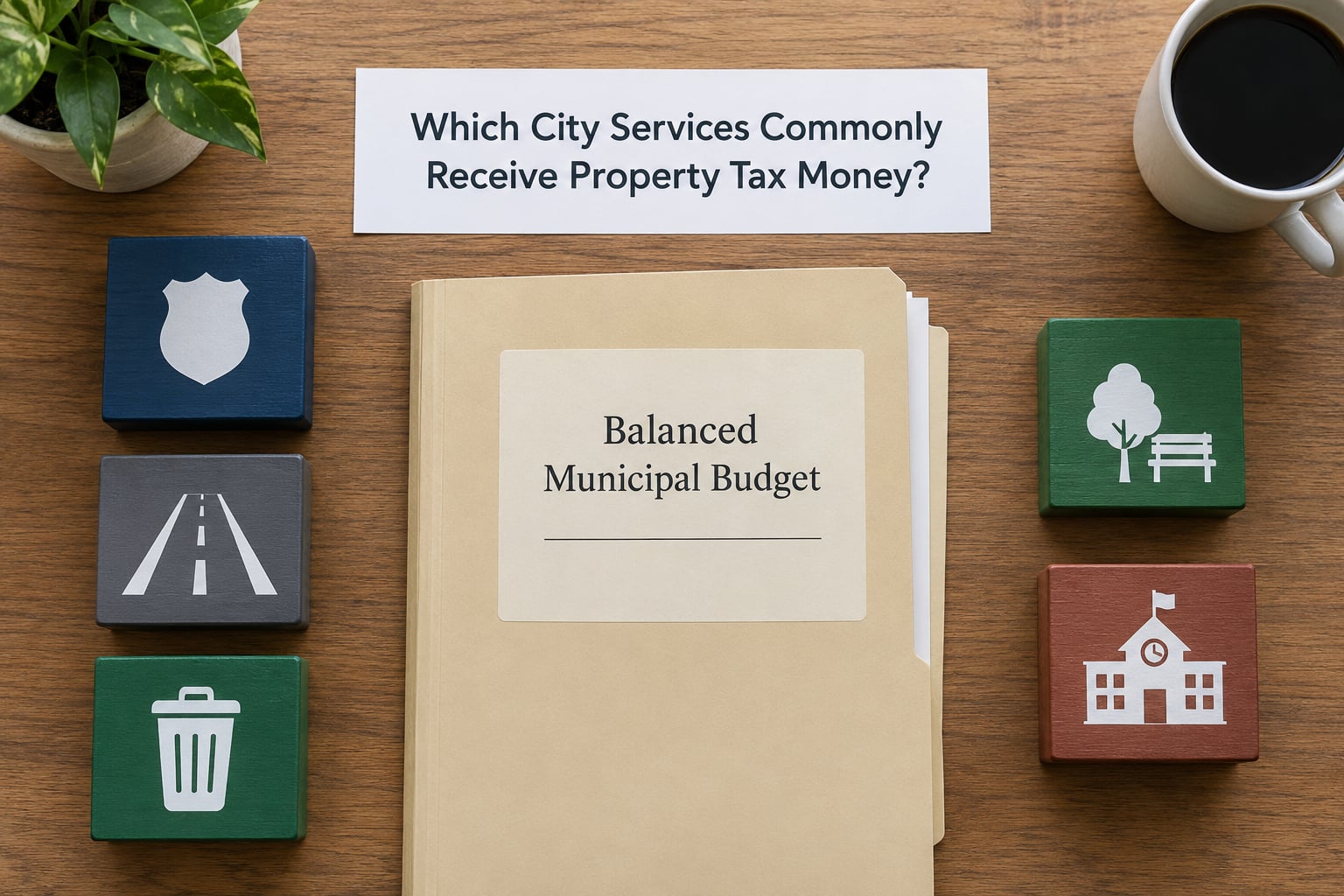
Property tax revenue commonly funds police, fire and emergency medical response, street maintenance and snow removal, solid waste collection, parks and recreation, libraries, 911 dispatch, public health clinics, code enforcement and the administrative offices that run all of it. The mix is local. Some cities run their own transit system out of property tax, some fund it with fares and a regional sales tax, and some states require property tax to support schools while others largely prohibit local property taxes for that purpose.
The general fund usually carries the core services, and the other funds carry the rest.
- Public safety. Police and fire departments, 911 dispatch, emergency management and code enforcement. Usually the largest or second largest block in a city budget.
- Transportation. Pothole repair, resurfacing, street cleaning, signals, snow and ice response, and sidewalk repair.
- Sanitation and utilities support. Solid waste collection, recycling, street lighting, and the administrative side of water and sewer systems.
- Parks, libraries and recreation. Facility operations, programs, aquatics and youth leagues, often partly offset by user fees.
- Health and human services. Public health clinics, senior programs, homelessness response and shelters, which in some cities are partly grant funded.
- General government. City manager’s office, clerk, elections, legal, finance and human resources.
- Capital and debt service. Bond-funded buildings and infrastructure, repaid through a dedicated debt service fund rather than the operating budget.
The share each department takes varies widely, and any single number you read for “your city” is probably describing somewhere else. Urban cities tend to spend more per resident on fire and transit, smaller cities on roads, and regions where state aid is generous leave more of the bill to schools and counties. The table below is a shape, not a rule.
| Department area | Illustrative range of city spending | Notes |
|---|---|---|
| Public safety | Roughly a third to a half of the general fund | The widest spread of any category |
| Transportation and streets | About 10 to 20 percent | Capital spending can swing it sharply year to year |
| Parks, libraries, recreation | About 5 to 15 percent | Partly fee-supported in many cities |
| Health and social services | About 5 to 10 percent | Often grant and intergovernmental revenue heavy |
| General government | About 5 to 12 percent | The category people ask about most and often under-budget |
Why Do Some Services Use Other Revenue Sources?
Because a tax is not the only way to pay for something, and cities mix sources on purpose. Fees charge the person who chooses the service: a water bill, a parking permit, a gym membership. A fine punishes a specific behaviour. A grant comes from another level of government and usually comes with strings attached. A bond borrows against future revenue and must be repaid, often for decades.
That mixing is partly principle and partly accounting. Enterprise funds, which run utilities and transit, are supposed to be self-supporting, so charges cover the cost and property tax covers only a subsidy for the portion the public is entitled to. Capital projects get bond financing so a new fire station does not have to compete with daily operations in the same budget year.
Two other mechanisms change the flow. Payments in lieu of taxes are negotiated payments made by tax-exempt institutions such as hospitals and universities to local governments in exchange for services they would otherwise fund themselves. Tax increment financing districts capture the growth in taxable value inside a defined area and earmark that increment to repay development costs, which means new value in that area does not flow to the general fund at all.
Exempt property is a big deal for the same reason. Property that is not taxed, whether by statute or because of a nonprofit, church or state-agency status, still consumes police response, road maintenance and fire coverage. One Pennsylvania institute estimated that roughly 40 percent of city property there was exempt and that the resulting revenue loss ran into the hundreds of millions a year. Communities have pushed back on this in other states, and the complaint shows up constantly in resident forums.
How Do Cities Set the Property Tax Rate?
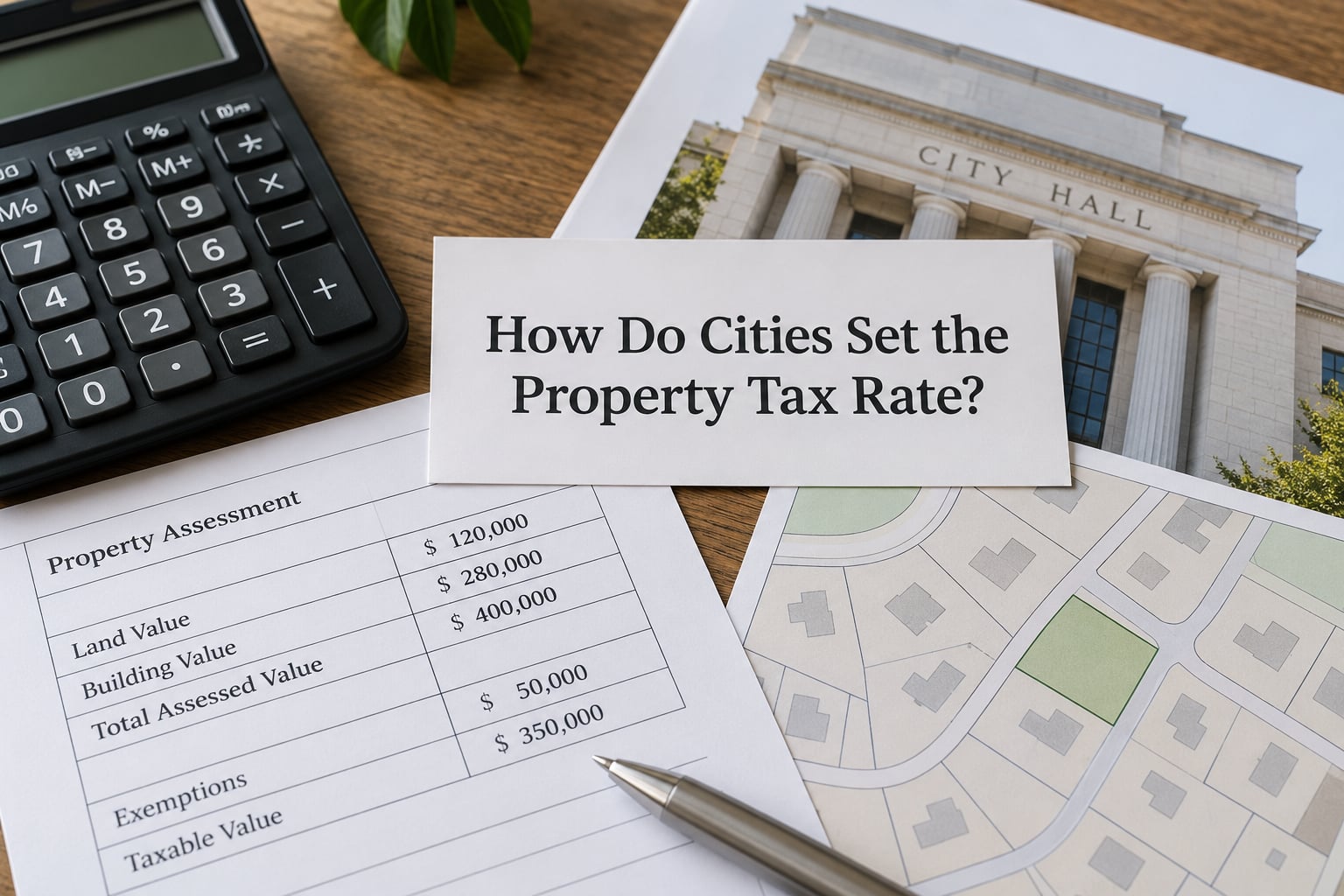
Cities set the property tax rate by voting a rate or a levy, applying it to the assessed value of every property in the district, and letting the resulting bills add up to the target amount. In rate-based states the council picks the millage directly. In levy-based states it sets a dollar total and the rate falls out of it. One mill is one dollar per thousand dollars of assessed value, so a rate of 20 mills on an assessed value of 200,000 dollars produces 4,000 dollars before any exemption.
That last figure is why the approved rate is not the bill every owner pays. Your property is one of many in the base, so the rate sets the total and the distribution follows the value of the properties around you. That is also why a bill can rise in a year your own assessment did not.
State law heavily shapes the process. Many states cap how fast a city can raise its levy, set assessment growth limits, or pre-empt local rates entirely. In some, increases above a threshold go to voters, and bond measures for capital projects almost always require voter approval. Public hearings are typically required before adoption, and the budget document must be available before the vote, not after.
Control is genuinely shared. A city council may set the city’s share while a county board sets the county’s and an elected school board sets the district’s, and the state legislature may cap all three. In consolidated counties the city and county are the same government and the split disappears entirely. A resident in a discussion forum asked who actually decides their rate, and the honest answer is: probably three separate bodies plus the state, and none of them is the person who mails the bill.
How Can Taxpayers Track Where the Money Goes?
Anyone can follow this, and it takes about an hour once you know the document names. Start at step one and work down.
- Get the adopted budget for your fiscal year. Search your city’s finance or budget office site for the adopted budget document, usually a PDF of a few hundred pages published before the fiscal year starts. This is the plan of record: what officials said they would do.
- Find the revenue schedule. Look for a chart of property tax revenue by taxing authority. It shows what the city expects to receive and, often, the rate schedule behind it. Compare that to the county treasurer’s rate sheet for your parcel to see your own share.
- Read the fund summary before the department detail. The summary tells you how much sits in the general fund versus special revenue, enterprise, capital and debt service funds, and how much of each is restricted. Department tables inside a restricted fund are not flexible money.
- Pull the annual financial report for the prior year. This is the audited actuals. It shows appropriations next to expenditures, which is where you learn whether the plan matched reality. Comparing it with the budget is the only honest way to judge spending, and it is the step most public claims skip.
- Use the public record for anything the documents do not answer. Council and budget committee minutes, hearing videos, capital improvement plans and audit findings are all public. A short question to the finance office about a specific line item usually gets a written answer.
Many cities now publish a budget explorer, an interactive tool that breaks property tax dollars into spending categories with a slider for resident equivalents. Residents on local forums ask for exactly this, and a few jurisdictions have built it, so if your city does not have one, that is a legitimate request to make of the finance office. A city’s open data portal is the other place to look, since adopted budgets and expenditures are usually published there as downloadable tables.
One useful habit: keep the adopted budget and the annual report side by side. The gap between them is where the real story lives, and it is the part a social media post almost never shows you.
What Can Change the Amount Cities Receive?
Budgeted property tax revenue is a forecast, and actual collections routinely land somewhere different. Appeals reduce it directly when an owner wins and the assessment is lowered before the levy is finalized, and successful appeals can be large in years when reassessments are contested broadly.
Exemptions and abatements lower it too. Senior exemptions, homestead provisions, disability abatements, abatements for veterans and for new construction or renovation all reduce the taxable base without reducing the cost of the service. Delinquencies matter: an unpaid bill becomes a lien on the property, and the city may never collect the share that was counted in the budget.
Collection timing distorts the picture in a different way. Many jurisdictions bill in arrears, so a fiscal year absorbs a large share of the prior year’s taxes, or in some places a large share of the current year’s. Compare revenue to the fiscal year and it can look like a boom or a collapse that never happened. Appeals and abatements granted mid-year add another layer.
Then there is the tax base itself. New construction, redevelopment and commercial projects raise assessed value, which raises the total collected even when the rate is flat. In a few fast-growing localities, a single large project has generated enough new assessed value to become a political issue on its own. On the other side, a decline in construction, an aging tax base, a state pre-emption of the levy, or a court ruling on assessment practices can push receipts below what the budget assumed. State aid and intergovernmental revenue also move, and a city that budgeted a state grant can end the year short.
None of this means the budget was dishonest. It means a forecast was a forecast, and the annual report is where the outcome shows up.
Frequently Asked Questions
Does property tax revenue directly pay for every city service?
No. Property tax revenue typically funds core city services such as police, fire, streets, sanitation, parks and libraries through the general fund, but other sources carry a lot of the rest. Utilities and transit often run on user fees in enterprise funds, capital projects are often bond financed, and social services programs are frequently grant funded. Some services you receive come from the county or the state, funded without a city property tax at all.
Can I see exactly how much of my property tax paid for police or road services?
Not literally. A city cannot trace one dollar to one call, because money is pooled and spent against budget appropriations rather than earmarked contributions. What you can see is the adopted budget’s department appropriations, the fund structure showing how much is restricted, and the audited annual financial report comparing planned spending to actual. Taken together, they show the share of city spending that went to each service during the year.
Why can the city collect less property tax revenue than it budgeted?
Several ordinary things can cause a shortfall. Successful assessment appeals lower the taxable base, exemptions and abatements remove value, and delinquent owners may never pay what was budgeted. Collection timing shifts revenue between fiscal years, particularly in places that bill in arrears. A slower construction market, a state cap on the levy, or a grant the city counted on not arriving can each produce the same gap.
Are property taxes used only by the city that collects them?
Rarely. A single property tax bill usually funds several taxing authorities, and state law decides how it is split. In many places a school district takes the largest share, the county the next, the city a quarter or less, and special districts take a few percent each. In some states local property tax cannot legally fund schools at all. Your county treasurer publishes the exact rate for each authority on your parcel.
How can residents influence property tax-funded city spending?
Four routes work most often. Vote on the rate and on bond measures, which in most states is the clearest direct lever. Show up at the budget hearing, where public comment is usually recorded and does get read by council members. Ask for written answers to specific questions from the finance office, which creates a record. And read the annual financial report before the next budget cycle, since that is the only document showing whether last year’s promises were kept.
Conclusion
Property tax revenue funds city services through a lawful chain rather than a direct line: a body levies a rate, an assessor values the property, a bill is issued, the collector splits the money among taxing authorities, each adopts a budget, departments spend within it, and an audited report records what happened. Money does not travel to one service, which is why the honest answer to “where does it go” is a budget document rather than a number.
Start with three documents: your city’s current adopted budget, the property tax rate schedule from your county treasurer, and the most recent annual financial report. Read the adopted budget and the annual report side by side, and the gap between them tells you more about how your money is used than any summary you will find online. Then go to the public meeting calendar and watch one budget hearing. It takes an evening, and it changes how the next document reads.