If you want the short version, here is how to manage a remote development team: design for async, optimize for overlap, write decisions down where everyone can find them, reserve three to four hours a day for live work, and measure what shipped rather than who was online. Get that system in place and the rest is maintenance, not heroics.
The hard part of distributed engineering is rarely the code. It is that a decision made in a call at 4pm never reaches the developer who is asleep until their alarm goes off eight hours later, and by then they have already built the wrong thing.
Here is the version of remote team management I would hand a new engineering manager in 2026: a short list of prerequisites, a seven-step operating system, the failure patterns that show up in almost every distributed team, and a few numbers worth agreeing on before anything goes wrong.
Table of Contents
- How to Manage a Remote Development Team: What You Need
- Clear ownership for every outcome
- A workflow that survives a new joiner
- A short tool list with one home per communication type
- Three or four measurable delivery outcomes
- An agreed availability and response-time norm
- Step-by-Step
- Step 1: How to manage a remote development team’s first week
- Step 2: Set measurable outcomes and delivery priorities
- Step 3: Build an asynchronous communication rhythm
- Step 4: Run focused meetings with a clear purpose
- Step 5: Protect focus time and reduce interruptions
- Step 6: Maintain delivery quality and team trust
- Step 7: Review the system and improve it deliberately
- Common Mistakes
- Frequently Asked Questions
- How many hours of overlap does a remote development team need?
- How often should a remote development team meet?
- How do you track remote developer productivity without surveillance?
- Is asynchronous communication enough for a distributed development team?
- How do you onboard a remote developer so they ship in week one?
- When does a remote engineering team actually need in-person time?
- Conclusion
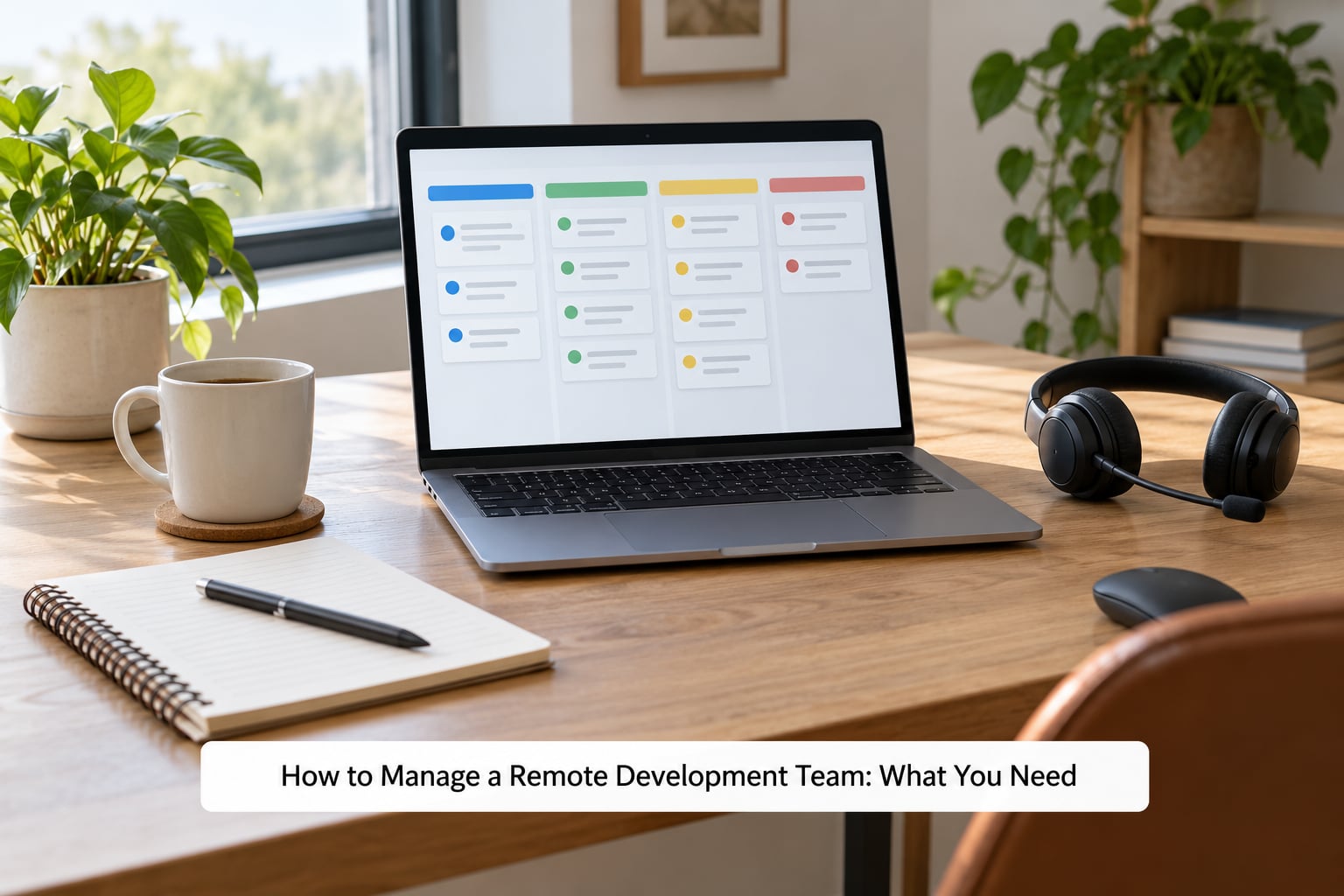
How to Manage a Remote Development Team: What You Need
Most struggling remote teams did not fail on tooling or effort. They failed because the basics were never written down, so each person invented their own way of working.
Before you change a single meeting, confirm you have these five things in place.
Clear ownership for every outcome
One named person owns each outcome for the current cycle. Not a committee, not the team in general. When a question comes in about a target, an API contract, or a slipped date, there is exactly one person who can answer without a meeting.
“The team” owning something means nobody does. Shared ownership is fine for pair work and code review. It is not fine for decisions with a deadline attached.
A workflow that survives a new joiner
Your process should be written well enough that a developer starting on day one could find out how work enters the system, how it gets reviewed, and how it reaches users without asking a single question in a call.
If the only real process is the one in your head, or the one a senior engineer explains verbally while pairing, you do not have a workflow. You have a habit that dies with that person.
A short tool list with one home per communication type
Distributed teams spread context across too many places. The developer who needs the answer is asleep, the answer sits in a direct message, and the decision is technically made.
Pick one home per category: a tracker for tasks, a written doc space for specs and decisions, chat for quick coordination, and a call tool for live conversation. Four tools is usually plenty. Extra tools create the searching, not the clarity.
Three or four measurable delivery outcomes
Pick outcomes the whole team can move, like cycle time from ticket to production, the share of sprint commitments actually finished, the average pull request turnaround, or the share of defects caught before release. Four numbers, reviewed monthly, beat twenty vanity metrics reviewed never.
An agreed availability and response-time norm
Decide in advance what “available” means. Usually it means: online during your core hours, reachable in chat within a working day, and answering anything genuinely urgent within a couple of hours during those core hours.
Publish it. An unwritten norm becomes an assumption, and assumptions become arguments in week three.
Step-by-Step
What follows is the sequence that works. Each step depends on the one before it, so resist the urge to jump to meetings and metrics first.
Step 1: How to manage a remote development team’s first week
Write a one-page team agreement during your first week together, then ask everyone to correct it. It covers the quarter’s goals, each person’s role, working hours in absolute terms, which channel belongs to which communication type, who decides what, and what your escalation path looks like.
Keep it to one page. Longer documents do not get read, and a team agreement nobody opens is just an archive.
How you know it worked: ask a developer to describe, without looking anything up, how a decision gets made and how they would raise a problem. Two or three consistent answers means the agreement is real.
Step 2: Set measurable outcomes and delivery priorities
Turn strategy into three to four outcomes for the cycle. Not fifteen, not one. “Reduce median time from ticket to production by two days” is an outcome. “Improve team velocity” is a wish.
Each outcome needs acceptance criteria written before the work starts. For a civic app that publishes a live bus arrival map, the criteria read more like this: given a feed that returns a stale timestamp, the map shows a staleness notice rather than a position that looks accurate and is not.
Prioritize openly. Put the full list somewhere everyone can see, mark the three items that matter now, and say out loud what is not happening this cycle. Nothing drains a distributed team faster than a backlog nobody is allowed to question.
How you know it worked: every active task in the tracker links back to one of the outcomes, and anyone on the team can explain in one sentence why the current sprint items matter. If half of them cannot, the priorities are wrong.
Step 3: Build an asynchronous communication rhythm
Asynchronous-first means a developer in any time zone can pick up a task, understand it, and unblock themselves without waiting for a conversation. That is the actual goal, not a moral preference for writing.
Map each communication type to a channel and give it a response-time expectation:
| Communication type | Where it lives | Response-time norm |
|---|---|---|
| Task and status tracking | Your tracker (Jira, Linear, Asana) | Update daily before your day ends |
| Decisions and specs | Written doc space (Notion, Confluence, repo docs) | Read before you start work |
| Quick coordination | Chat (Slack, Teams) | Same working day |
| Walkthroughs and demos | Async video (Loom, screen recording) | Watch before commenting |
| Live discussion | Call tool (Zoom, Google Meet) | Invite only, with a written outcome afterwards |
Decide up front which channel means what. A direct message is fine for a quick question, but the moment a decision is made, it moves into the written doc. That single rule kills most of what people call context collapse, where the answer exists but only for the four people who were awake.
Replace the daily standup with a written version. Three lines: what you finished, what you are starting, and anything blocking you. Posted by a set time each morning in a single pinned thread. Most developers are relieved to get twenty minutes of their morning back, and the team gains a searchable record of blockers that nobody has to remember.
Async is also the wrong answer more often than the internet suggests. Debate that has turned three times in writing, a debugging session, and anything emotionally loaded all go faster on a call. Write the question down, book fifteen minutes, and leave a written outcome.
Step 4: Run focused meetings with a clear purpose
Every meeting a remote team keeps needs four things: an agenda written in advance, a named owner, a time limit, and a written outcome with the decisions and the action items. No owner, no meeting. That rule alone cuts the calendar in half.
What most teams actually need is four recurring things and little else:
- Planning. Pick the sprint items, confirm acceptance criteria are written, name an owner per item. Sixty to ninety minutes, weekly.
- Mid-cycle check. Blockers and scope only. Twenty-five minutes. Cancel it when there is nothing to discuss.
- Demo. Working software shown on a call, recorded for anyone asleep. Forty-five minutes, twice a cycle at most.
- Retrospective. What slowed us down, what to change next cycle. Sixty minutes, with two owners and a deadline for each change.
Rotate the inconvenient slot. If your overlap sits at 7am for one region, that region carries the cost every week until you rotate. Fairness here is mechanical, not generous.
And set a budget. If a team of six is spending more than three hours a week in recurring meetings, something is broken, and adding more meetings will not fix it.
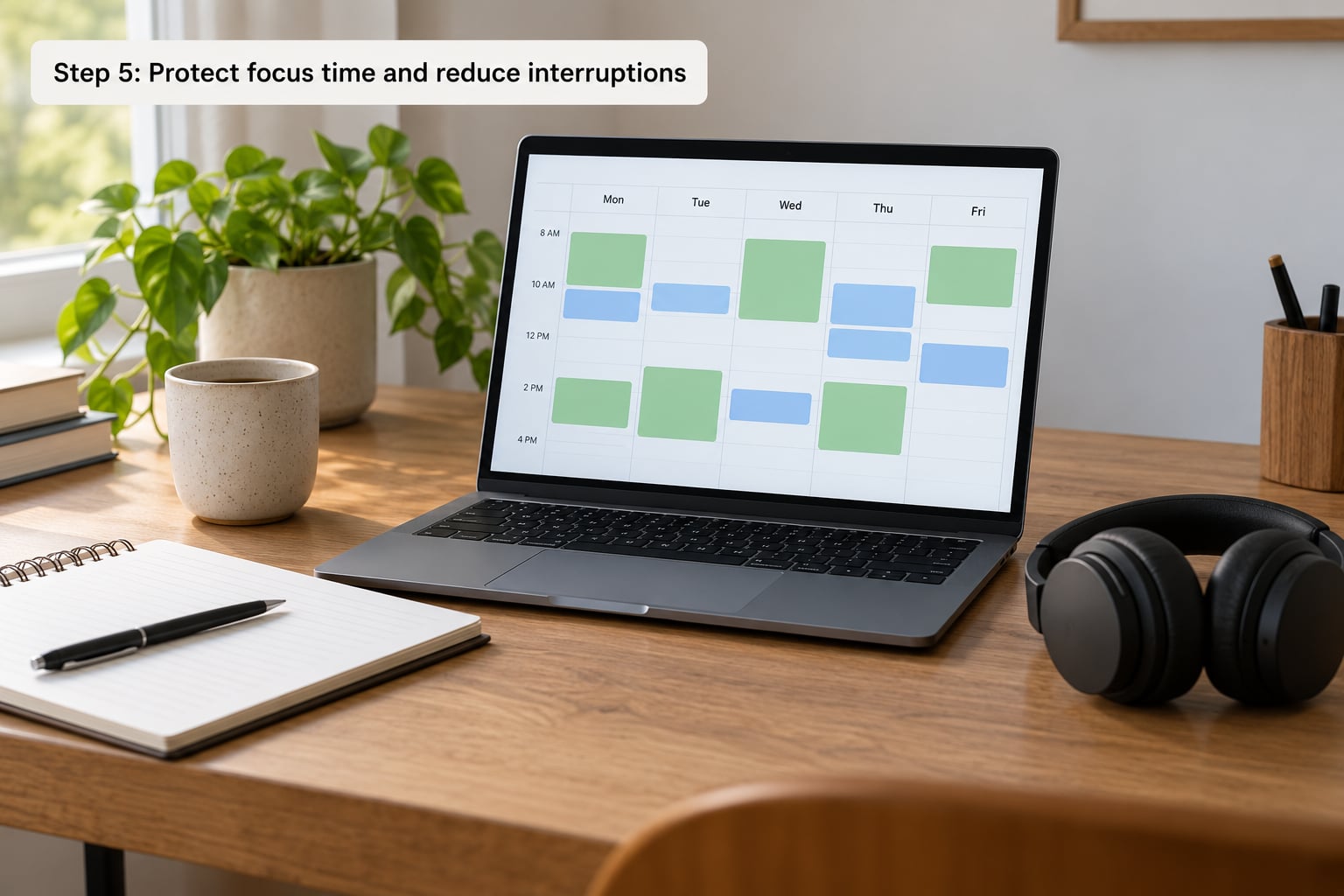
Step 5: Protect focus time and reduce interruptions
Remote work concentrates interruptions that the office used to filter out. Every chat ping, every meeting invite, every “quick question” lands directly on top of deep work, and developers end up doing the hard part of their job at eleven at night.
Set three boundaries and hold them:
- Core hours. Two to three hours a day when everyone is reachable. Outside those hours, nobody is expected to respond.
- Focus blocks. Two or three hours daily, marked as busy, no meetings, notifications off.
- An urgent rule. Urgent means production is broken or someone is fully blocked. Everything else waits. Urgency gets a named channel so the real cases are visible.
Audit context switching rather than assuming. Ask the team how many times a day they get pulled out of a task and how long it takes to get back into it. If the honest answer is more than six, the problem is your calendar and your channel design, not your people’s discipline.
Protect evenings properly. A developer whose messages get answered at 9pm every night learns that async means always-on, and you will lose them.
Step 6: Maintain delivery quality and team trust
You cannot see quality by watching someone type, and you should not try. Verify it with evidence instead: how long reviews take, whether checks pass on the first run, whether releases go out on the day they were planned, and whether anyone is comfortable saying “I am stuck” in writing.
Make code review work across time zones. Small pull requests under roughly 200 changed lines get reviewed faster and with better comments than large ones, and the description should carry the context a reviewer would otherwise ask for in a call: what changed, why, how it was tested, and what the reviewer should look at hardest. A recorded five-minute walkthrough beats a long text thread for anything visual.
Give every developer release ownership for a slice of the system. Ownership plus a clear handoff note is what turns individual contributors into engineers who can be trusted with a service.
When something breaks, say what you know, when the next update is coming, and who is handling it. Remote teams lose trust fastest when an incident goes quiet and people spend six hours wondering whether anyone noticed.
Feedback works the same way it always did, with one difference: it has to be written. A manager who only has these conversations live will accidentally favour the people in their core hours.
Keep one-on-ones on a regular cadence, thirty minutes, weekly, and treat them as the one space where the person talks and you listen. Ask about blockers and about what is slowing them down, not about their ticket count.
Step 7: Review the system and improve it deliberately
A remote operating model decays quietly. Someone joins, a tool changes, a time zone shift lands, and six months later half the team works by a set of assumptions nobody wrote down.
Run a short review every two to four weeks, thirty minutes, with these inputs: the delivery outcomes you agreed in step two, workload signals from the team, and the retro actions from last time. Change one or two things per cycle and write down what you changed and why.
Three questions finish it well: what did we stop doing, what did we start doing, and what did we decide to keep.
How you know it worked: after each cycle you can name the specific change you made and the signal that prompted it. A review with no resulting change is a meeting, not a review.
Common Mistakes
Nearly every time someone tries to manage a remote development team and it goes badly, the cause is one of these patterns. Name them and the fix is usually straightforward.
Adding meetings to compensate for missing visibility. If the written updates are thin, a leader adds a second daily call. Cost goes up and nothing improves. Fix the written artifact first: the spec, the status thread, the decision note. Meetings are for what genuinely needs live conversation.
Vague ownership. The task says “improve onboarding” and three people each read it differently. Fix it by naming one owner and writing acceptance criteria before work starts.
Monitoring activity instead of outcomes. Commit counts, lines of code, and online hours turn into a game everyone can win cheaply by gaming the number. Nobody learned anything real. Fix it by tracking cycle time, review turnaround, commitment versus completion, and escaped defects.
Async context collapse. Decisions live in a private message or a call nobody recorded. Fix it with one rule: if it changes what someone does, it goes in the written doc the same day.
Silent blocking. A developer waits two days on an unanswered question and you find out at the end of the sprint. Fix it with a stated threshold: if you are stuck for more than two hours or blocked by something you cannot resolve yourself, raise it in the blockers channel. Two hours is short on purpose.
Tool sprawl. Context spread across six or seven platforms means nobody can find the current state of anything. Fix it by consolidating. Fewer tools, used consistently, beat a perfect tool nobody adopted.
Unequal meeting burden. The same region wakes up early every week. Fix it with a rotation that nobody has to argue about because it is on a shared calendar.
Urgency becoming routine. If everything is urgent, nothing is. Fix it by auditing what gets flagged urgent for a month. The real count is usually two or three, not fifteen.
Projects stretched across too many time zones. A single feature spanning eight zones means every handoff waits a day. Keep the people on one piece of work inside a workable spread and be honest about which features can be built that way.
To keep momentum: pick one practice and run it properly for a month before adding another. Change one thing at a time, keep the retros visible to the whole team, and protect the calm ones. Distributed engineering teams rarely break from pressure. They break from ambiguity that was never resolved.
Frequently Asked Questions
How many hours of overlap does a remote development team need?
Two hours is the practical floor for a small team doing collaborative feature work, and three to four hours is the better target for most distributed engineering teams. That window is reserved for live work such as design discussion, debugging, code walkthroughs, and decisions that stalled in writing. Everything outside it should work asynchronously. Teams stretched past a five-hour gap usually lose more to waiting than they gain in coverage, which is why it is worth keeping the work itself inside a workable zone spread.
How often should a remote development team meet?
Four recurring calls cover most distributed engineering teams: weekly planning, a short mid-cycle blocker check, a demo, and a retrospective. That works out to roughly three hours a week for a team of six. Add a written standup instead of a daily meeting, and cancel the mid-cycle check whenever there is nothing to discuss. The measure of a good calendar is not how many meetings you kept but how much uninterrupted focus time your developers still have.
How do you track remote developer productivity without surveillance?
Track delivery outcomes instead of activity: cycle time from ticket to production, average pull request turnaround, the share of sprint commitments completed, escaped defect rate, and how quickly blockers get raised and cleared. These come from tools you already run and describe the work, not the worker. Avoid commit counts, lines of code, and online hours, since they measure volume rather than value and give developers an incentive to game them.
Is asynchronous communication enough for a distributed development team?
No, not on its own. Async covers status, specs, code review, and routine decisions well, but it gets slow when a debate has run three rounds in writing, when two people are debugging together, or when a conversation carries tension. The workable pattern is async-first with a protected overlap window of two to four hours for live work. Over-indexing on written updates has a second cost too: when every decision must be written, you can drift into managing a delivery vendor rather than leading a team.
How do you onboard a remote developer so they ship in week one?
Give them a written team agreement, a named onboarding buddy, and one small real task with clear acceptance criteria on day one. Point them at the docs space, the tracker, and the deployment process before anything else, and book short pair sessions rather than long lectures. Reserve overlap hours for the questions that only a conversation answers. Managers who write down the process onboard people faster, because the explanation stops being repeated one person at a time.
When does a remote engineering team actually need in-person time?
In person pays off when a project is genuinely collaborative and the written channel has stalled: complex architecture, a hard incident, or a team that has lost trust after a rough quarter. Two or three focused days a year usually beats a recurring office day nobody wants. For onboarding, a first-week visit works well if you can spare it. Avoid meetings scheduled purely out of habit, and pick a location and length that make the trip worth the cost.
Conclusion
Start with four things this week: write down your three or four delivery outcomes, publish a one-page team agreement covering hours, channels, and escalation, replace the daily standup with a written one, and book your recurring meetings with owners and time limits. Then review the whole system with the team after two weeks and change one or two things.
Managing a remote development team is not constant monitoring. It is a repeatable operating system, agreed once, reviewed regularly, and improved when the numbers or the people say it should be.