
A capital improvement plan is a multi-year budget and schedule that lists a government’s proposed projects, what each one costs, how it will be paid for, and roughly when it gets built. Knowing how capital improvement plans are made matters if you want to follow the money, argue for a project, or understand why the street in front of your house is on the list this year and not the next.
The short version: the plan is built on a repeating annual cycle. Staff inventory the assets and rate their condition, departments submit project requests, a committee scores and ranks those requests against published criteria, finance staff match the winners to real funding, and then the elected body holds a hearing and adopts the result. Year one of that adopted document becomes the capital budget.
What follows walks the whole pipeline, from the first inventory update in the fall through delivery and the annual revision. It also covers the part nobody explains well: how a request from a resident actually gets filtered, scored, and either funded or quietly dropped.
Table of Contents
- What Is a Capital Improvement Plan?
- How Capital Improvement Plans Are Made: The Planning Process
- Step 1: Set the Plan’s Scope, Budget, and Planning Horizon
- Step 2: Collect Project Needs and Community Input
- How Capital Improvement Plans Are Made From Public Input
- Step 3: Forecast Revenue, Costs, and Lifecycle Needs
- Step 4: Evaluate and Prioritize Candidate Projects
- Step 5: Build the Recommended Capital Program
- Step 6: Review, Approve, and Adopt the Plan
- What Happens After the Plan Is Adopted?
- Who Makes Capital Improvement Plans?
- How Cities Keep the Plan Current
- Frequently Asked Questions
- Do residents get a say in a capital improvement plan?
- Does a project in the capital improvement plan guarantee funding?
- Is a capital improvement plan the same as a capital budget?
- How do cities prioritize smart-city and transit technology projects?
- How often do capital improvement plans get updated?
- Conclusion
What Is a Capital Improvement Plan?
A capital improvement plan, usually shortened to CIP, is a multi-year planning instrument that inventories a government’s physical assets — roads, bridges, water mains, buildings, parks, vehicles, technology — forecasts what they will need over the next several years, and lists candidate projects with costs, schedules, and funding sources.
Three terms get mixed up constantly, so it helps to separate them. The capital improvement plan is the strategy: the full multi-year list, including projects that have no money yet. The capital budget is the adopted appropriation, generally the first year of the plan, which is what the city is actually permitted to spend. The operating budget covers salaries, utilities, and routine upkeep, and it is a separate document with a separate vote.
One more bit of confusion worth clearing up. In municipal finance, CIP always means Capital Improvement Plan. In business and quality management, the same three letters usually mean Continuous Improvement Program. In homeland security, they can mean Critical Infrastructure Protection. When you see a city’s acronym, check which one they mean before you go looking for the wrong document.
Every jurisdiction that adopts a CIP does so for the same underlying reason: infrastructure bills arrive whether or not anyone planned for them, and a plan converts a series of emergencies into a schedulable, financeable program.
How Capital Improvement Plans Are Made: The Planning Process
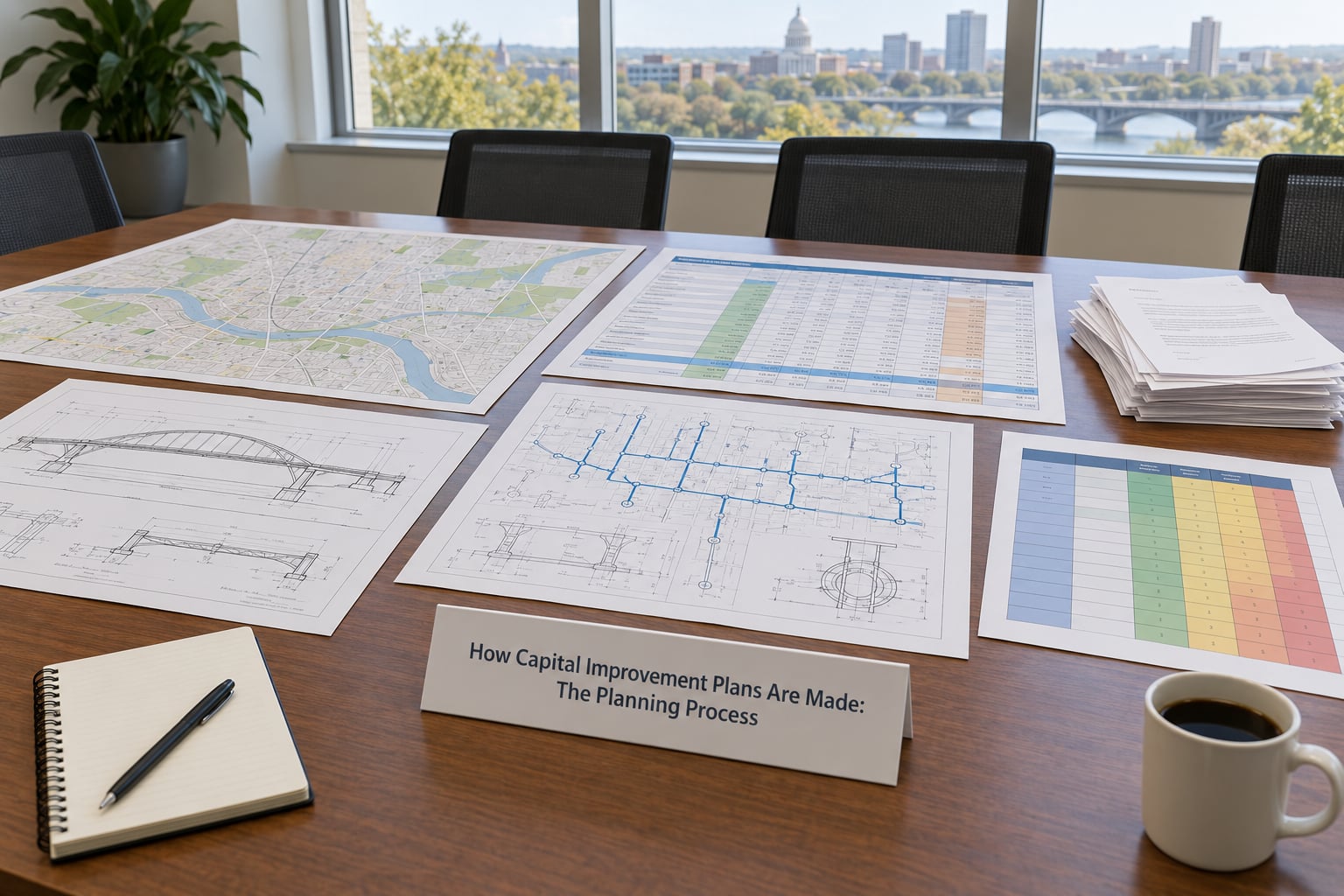
Every city, county, and school district does this slightly differently, but the stages repeat. Knowing which stage a project sits in tells you why it has not moved yet.
| Stage | Who leads | Key input | Output |
|---|---|---|---|
| Asset inventory and condition review | Public works, facilities, engineers | Condition assessments, service standards, failure records | Updated asset register with condition ratings |
| Project request intake | Lead department and CIP committee | Department submissions, public comments, regulatory mandates | Unranked candidate project list |
| Cost and revenue forecasting | Finance and budget staff | Estimates, inflation assumptions, debt capacity, grant calendars | Cost ranges and funding scenarios per project |
| Evaluation and prioritization | CIP committee or scoring panel | Published criteria and weights | Ranked list with scores attached |
| Program construction | Budget staff and lead department | Ranked list, annual spending targets, legal obligations | Phased six-year capital program |
| Public review and adoption | Elected body, often with a hearing first | Staff recommendations, amendments, resident testimony | Adopted CIP and capital appropriation |
| Delivery and closeout | Project managers | Design, bids, permits, contracts | Completed assets and updated registers |
The calendar usually runs from fall to spring. Condition data and project requests land in the fall, scoring and financial modeling happen over the winter, and hearings plus adoption happen in the spring ahead of the new fiscal year. A jurisdiction on a calendar-year budget has more room in that window than one that had to close its books in June.
Step 1: Set the Plan’s Scope, Budget, and Planning Horizon
Before anyone collects projects, someone has to define what counts. Most jurisdictions write a short eligibility rule that separates capital work from operating work, usually based on two tests: a capitalization threshold (the minimum dollar amount that must be spent before the purchase is booked as an asset) and a useful-life test (how many years the improvement is expected to last).
A practical example. A jurisdiction with a threshold in the low tens of thousands and a ten-year useful-life standard might treat a roof replacement on a public building as capital, because the building is already an asset and the roof extends its life. Replacing one interior door on the same building is almost certainly operating, because it falls under the threshold and does not extend the asset’s life. Staff apply that test constantly, and it is where a surprising number of requests quietly disappear before scoring even starts.
Then there is the planning horizon. Five years is common for smaller cities; six is the most widespread convention; ten appears in long-range documents and state-required comprehensive plans. The horizon should extend past the useful life of the assets being replaced so that the replacement of a project funded today is visible before the first one wears out. Some jurisdictions also publish an aspirational list beyond the funded horizon, clearly labeled as unfunded, so residents can see where a project sits on the waiting list.
Finally, roles get assigned. One department is named the lead, usually public works or finance, and it owns the document. Every other department is a submitting body with a defined deadline. Some places route submissions through a standing CIP committee; others have the city manager or an appointed chief administrative officer arbitrate. Elected officials set the overall policy direction — usually a set of stated priorities the scoring criteria then reflect — but they rarely pick individual projects at this stage.
Step 2: Collect Project Needs and Community Input
Needs come from somewhere concrete, and the stronger the source, the higher a project tends to score. The usual inputs:
- Asset inventory and condition assessment. A defensible count of every bridge, mile of road, main, building, and vehicle, with a condition rating and an estimated remaining life.
- Service standards. The locally adopted target for each asset class, such as a pavement index that says a street should be resurfaced below a certain score.
- Growth and development forecasts. Population, housing starts, and permitted development translated into added demand on water, sewer, schools, and roads.
- Safety and compliance records. Crash data, inspection failures, permit violations, boil-water notices, and mandates with statutory deadlines.
- Maintenance history. Repair costs climbing year over year on the same asset, which often signals that replacement is cheaper than continued repair.
- Resident surveys, workshops, and hearings. Which services people feel are failing, and where.
Planners regularly point out that a well-maintained asset inventory does more than justify spending — it stops deferred maintenance from being a political casualty. Resurfacing an existing street looks modest next to a new civic building, and a scored condition program is one of the ways a city keeps showing up for the unglamorous work.
How Capital Improvement Plans Are Made From Public Input
Public comment shapes what gets studied, not necessarily what gets built. Comments from hearings, surveys, and online request forms usually land in one of three buckets: a project that already exists in the asset data and gains support, a project that enters the needs inventory as a new candidate for future scoring, or a request that the jurisdiction records without carrying forward.
The honest way to describe that last bucket is that it was not a funding commitment. Most cities make clear that a request form is not a promise, and staff are candid about that when they can. On community.esri.com local government boards and in r/urbanplanning threads, the same frustration surfaces repeatedly: residents cannot tell whether their submitted request is sitting in a queue, scored and rejected, or simply lost. Publishing the score of every submitted project, funded or not, is the single change that would fix most of that frustration.
Step 3: Forecast Revenue, Costs, and Lifecycle Needs
Step 3 is where planning meets arithmetic, and where the gap between what a jurisdiction needs and what it can pay for becomes visible. That gap is the central fact of capital planning, and any good CIP shows it rather than hiding it.
On the cost side, early planning-stage estimates carry wide ranges because they are based on concept-level designs, not bids. Staff typically publish low, high, and expected values, apply a design and construction contingency, and note which projects lack engineering behind them at all. Experienced finance staff also apply an escalation assumption; construction costs that rose sharply in the early 2020s turned many multi-year programs into underestimates within a single budget cycle, and the more honest plans now show the escalation line item instead of burying it.
On the revenue side, the question is not what could theoretically be raised but what is legally and practically available in each year. That list usually includes pay-as-you-go spending from current revenues, general obligation bonds against the city’s own credit, enterprise fund revenue from water or sewer rates, dedicated local sales taxes approved by voters, state and federal grants with their own match requirements, developer impact and system development fees, and occasionally a public-private partnership structure. Debt capacity is a hard constraint — state constitutions and state statutes cap how much a jurisdiction may borrow, usually as a percentage of assessed value or against a debt service ratio — so the borrowing room in any given year is finite and often already spoken for.
Life-cycle cost is the piece most often left out. A project that looks cheap in year one can be a bad investment if nobody has budgeted the maintenance, staffing, or eventual replacement. Plans that carry an annual operating and maintenance estimate alongside each capital line are considerably more useful to the department that inherits the asset, and a growing number of scoring frameworks now treat an unfunded operating burden as a reason to demote a project rather than promote it.
Step 4: Evaluate and Prioritize Candidate Projects
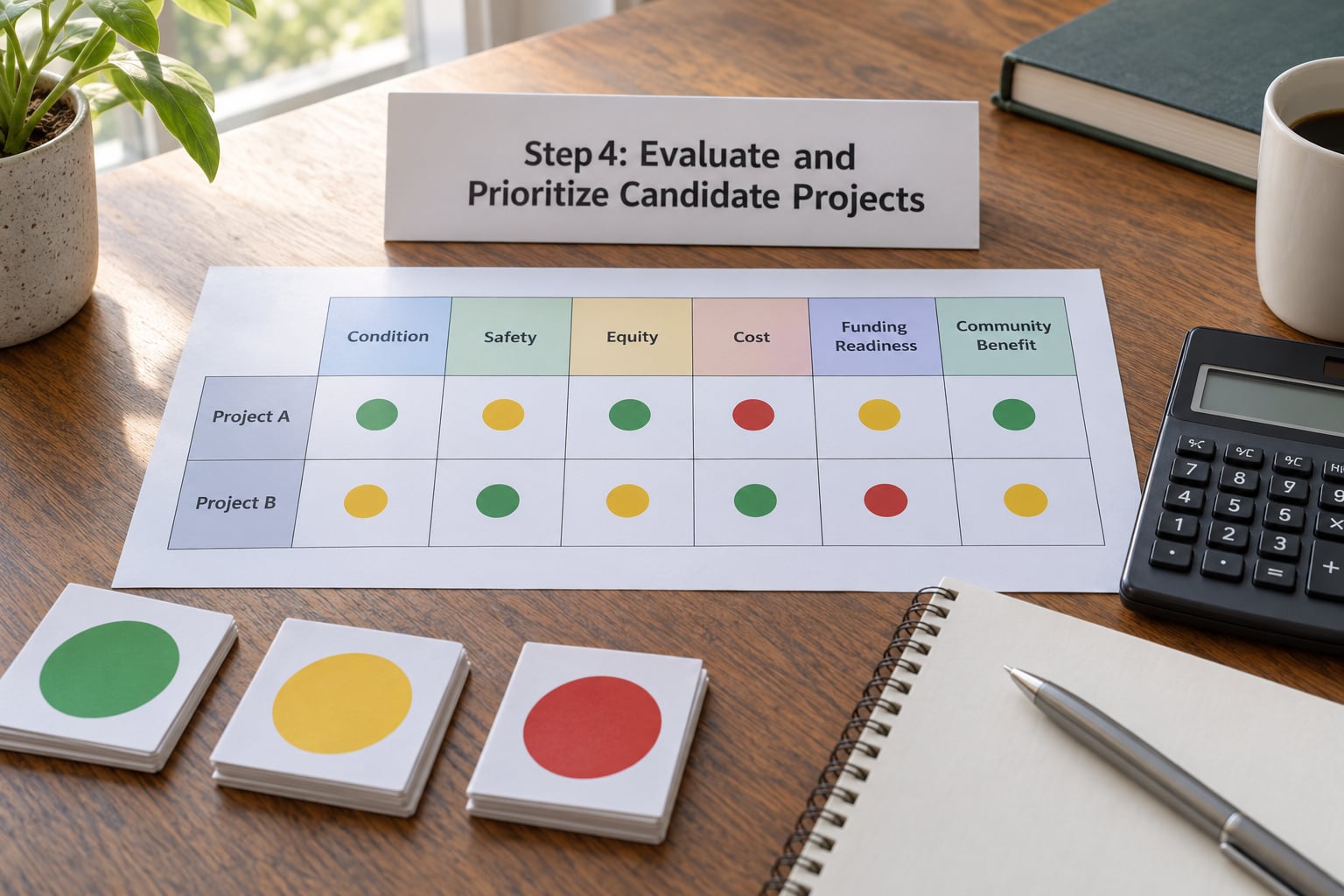
Scoring is where the real filtering happens, and it is the least visible part of the process. Most jurisdictions publish the criteria and the weights in advance, which means the arguments are supposed to happen in public before the scoring starts rather than in a closed room afterward.
The common criteria, and roughly what each one measures:
| Criterion | What it measures | Typical weight |
|---|---|---|
| Safety and regulatory compliance | Risk to life, or a statutory deadline that cannot be missed | Highest tier, often treated as a gate rather than a score |
| Asset condition and remaining life | How far past serviceable the asset already is | High |
| Regulatory or court-ordered obligation | Mandates with deadlines from state agencies or consent decrees | High, sometimes mandatory inclusion |
| Community benefit and equity | Served population, benefit to disadvantaged areas, access to essential services | Medium, rising |
| Benefit-cost or cost-effectiveness | Benefit delivered per dollar spent, or avoided cost | Medium to high |
| Network and system completeness | Whether the project only works if a companion project is built too | Medium |
| Project readiness | Whether design, permits, and easements are in hand | Medium |
| Operating budget impact | New annual cost the operating budget must absorb | Medium |
Not every jurisdiction uses a numeric score. Plenty still use a three-tier framework: projects required by law or immediate safety hazards, projects that protect existing assets from further deterioration, and everything else competing on merit. The tiered version is blunt and defensible; the scored version is more transparent but only as honest as the weights behind it.
Two cautions about any scoring system worth knowing. A safety criterion treated as a high weight rather than a threshold can be traded away when a popular project outranks it, so jurisdictions that mean it as non-negotiable implement it as a gate. And readiness scores, useful as they are for scheduling, tend to quietly reward whatever a department already has staff assigned to it.
Step 5: Build the Recommended Capital Program
The ranked list does not become the plan directly. Staff assemble it into a phased program that fits what the jurisdiction can actually spend in each year, and the assembly usually produces four kinds of line.
Baseline commitments are obligations already binding: debt service on issued bonds, contracts with completion dates, and projects under construction. These come first and they are not really optional.
Funded projects are the highest-scoring candidates with a confirmed funding source in a specific year. These are the ones residents see described by name and date.
Aspirational or unfunded projects are the top-ranked candidates with no money attached yet. Listing them matters: it shows the public the real size of the shortfall and gives the jurisdiction a defensible answer when a project is asked about year after year. They are still aspirational, and staff should label them that way clearly.
Dependency chains are projects that only function alongside another — a new road that needs a connecting segment, a water main replacement that requires a planned reservoir upgrade. Scoring has to respect these, or the program contains line items that cannot be delivered on their own.
On top of the list, staff add annual spending targets per fund, a contingency reserve, and a rough fund balance policy so that the program does not promise to spend money the jurisdiction does not yet have. That last check, sometimes called a fund balance analysis, is what stops a plan from being a wish list with dates attached.
Step 6: Review, Approve, and Adopt the Plan
The recommendation travels through four checkpoints. Technical staff in the lead department verify that the projects are deliverable and the costs are defensible. An oversight body — a CIP committee, a planning commission, or a finance committee — reviews the program against the published criteria and can question individual scores. The executive, often a city manager or an administrator, confirms it fits the broader budget and the adopted strategic priorities. Then the elected body acts.
The elected step usually includes a public hearing, and in many jurisdictions it happens more than once: a work session where members question staff and a committee can still amend the list, then a formal meeting where amendments are voted on separately and the plan is adopted as a whole. The distinction is worth noting because residents often report that the meaningful filtering happened in the work session, long before the public meeting everyone was told to attend. If you want to see how capital improvement plans are made in practice, read the work session agenda and minutes, not just the televised vote. Urban planning forums make this point constantly — the council work session, not the final vote, is where the real cuts get made.
Adoption has legal effect. It sets the capital appropriation for the coming fiscal year, and in some states it triggers bonding authority or a debt-incurrence test. It also does not freeze the list, and most adopting resolutions say so explicitly.
What Happens After the Plan Is Adopted?
Adoption is a funding decision, not a construction order. The delivery lifecycle that follows is a separate chain of approvals with its own checkpoints, and it is the part that determines whether a listed project actually happens.
Typically the sequence runs: programming and design authorization, schematic design, design development, construction documents, permitting, a public hearing where required, bid solicitation, award to the lowest responsive responsible bidder, contract modifications during construction, substantial completion, and final financial acceptance. Retainage, a percentage of the contract value held back until the work is accepted, gets released at the end. Change orders during construction are normal and are usually reported publicly with their dollar values and reasons.
Projects get moved, descoped, or dropped after adoption for ordinary reasons. Costs come in above estimate, a permit is denied, a grant that was assumed in the funding stack does not arrive, a bid comes back high, or the condition that justified the project turns out to be less urgent than the field assessment suggested. The plan reflects the best information available when it was adopted, and it gets revisited when the information changes.
Who Makes Capital Improvement Plans?
The document is written by a small team, but the decisions inside it come from a wide group.
Finance and budget staff own the document, the fund balance assumptions, and the revenue forecast. Public works, facilities, and engineering departments own the asset inventory, the condition data, and the cost estimates. Planners tie the capital program to the comprehensive plan and to growth forecasts. Transit, water, sewer, parks, police, fire, and school departments submit the projects that sit within their service areas. The CIP committee or lead department runs the scoring and produces the recommended program.
Residents and advocacy groups shape the needs inventory through comments, hearings, and request forms. Elected officials set policy priorities, review the recommended program, and adopt the appropriation. Council work sessions, where members question individual projects and staff, are the most common place a project’s ranking actually gets challenged.
How Cities Keep the Plan Current
Because the adopted plan is a living document rather than a printed record, keeping it current takes a specific set of habits. Annual updates roll the program forward one year, drop the completed year, and add a new sixth year. Rolling forecasts update revenue assumptions as actual collections come in, since a plan built on an optimistic sales tax line will quietly stop adding projects once the line misses. Amended plans adjust the adopted program mid-cycle when a major cost change or funding shift occurs, usually with a public hearing attached.
Reconciliation between the plan and the capital budget closes the loop: comparing what was listed against what was actually spent tells staff which departments under-deliver and which projects keep sliding, and that pattern feeds straight back into the next scoring cycle. Performance monitoring tracks output rather than dollars where it can — lane miles resurfaced, water mains replaced, inspections completed. Closeout updates the asset register so next year’s condition assessment starts from reality rather than from a file listing a bridge that was replaced six years ago.
Triggers for reconsidering priorities are usually specific and written into policy: a facility condition assessment that returns a failing score, a facility that closes unexpectedly, a new state or federal funding program with a matching requirement, a major development approval, or an emergency failure. A city with published triggers is more credible than one that claims its priorities never change.
There is a practical reason all of this matters to anyone who builds civic software or watches open city data budgets. A plan published only as a large PDF or a spreadsheet download is functionally invisible to most residents, which is precisely the complaint that shows up across planning forums. Publishing scores, statuses, and schedule changes as structured open data turns a black box into something a resident, a journalist, or a developer can actually check.
Frequently Asked Questions
Do residents get a say in a capital improvement plan?
Most jurisdictions invite public input before selecting a preferred program, but the amount of influence varies by law and government structure. Residents may comment at hearings, serve on advisory committees, submit written requests, or vote on a dedicated local sales tax measure that funds the program. Where no vote is required, input usually shapes the needs inventory more than the final ranking.
Does a project in the capital improvement plan guarantee funding?
No. Inclusion usually indicates that a project has been identified or studied, not that every listed cost is guaranteed. Funded projects may be approved for design, land acquisition, or construction, while aspirational entries have no money attached at all. A published plan commonly separates those categories into distinct lists, so check which list a project appears on before treating it as committed.
Is a capital improvement plan the same as a capital budget?
They are related but serve different purposes. A capital improvement plan is typically a multiyear strategy that identifies needs, establishes priorities, and forecasts projects and costs. A capital budget is the appropriation for a single year, usually the first year of that plan, which the governing body actually authorizes. The plan guides several years of sequencing; the budget authorizes spending for one.
How do cities prioritize smart-city and transit technology projects?
Cities usually evaluate technology proposals against the same core questions applied to physical infrastructure: what problem is being solved, who benefits, what evidence supports the need, and can the operating budget sustain it afterwards. Software and sensors are typically judged on useful life, ongoing licensing and maintenance cost, interoperability with systems already owned, and cyber and procurement risk rather than on novelty.
How often do capital improvement plans get updated?
Most are updated annually and adopted on a yearly cycle, with the program rolling forward so the adopted window keeps moving. Larger jurisdictions sometimes revise quarterly to reflect project closeout and cost changes. Amendments happen between cycles when a major funding shift or cost change requires the adopted program to be adjusted, usually with a public hearing attached.
Conclusion
A capital improvement plan is where evidence, public priorities, legal obligations, and limited money meet. The pipeline that produces one runs from an asset inventory in the fall, through published scoring criteria in the winter, to a public hearing and adoption in the spring — and it starts again the next cycle.
If you want to follow along in your own jurisdiction, the first move is simple: find the adopted CIP document and the capital budget for the current fiscal year on your city or county finance department’s site, then check the scoring criteria the plan publishes. Reading the criteria tells you more about what gets funded than reading the project list does.