Flood sensors give early warnings by measuring water where it should not be — a creek stage, a drainage channel, a sump pit under a road — and turning that measurement into a message a person acts on. The sensor is only the first link. What matters is the whole chain: a reading, a threshold, a transmission path, and a human or automated system that responds before water reaches people and property.
This guide covers the household, municipal, and industrial versions of the same principle, since all three run on the same four steps. It assumes you are evaluating a system or building one, not shopping for a device.
Table of Contents
- How Flood Sensors Give Early Warnings
- What Data Do Flood Sensors Collect?
- How Do Water Level Sensors Work?
- From Sensor Reading to Public Warning
- What Makes a Flood Warning Reliable?
- Which Flood Warning System Fits a City?
- How Accurate Are Flood Sensors?
- How Quickly Can Flood Sensors Issue a Warning?
- How Do Cities Deploy and Maintain Flood Sensors?
- What Are the Limits of Flood Sensor Warnings?
- Frequently Asked Questions
- Can flood sensors predict a flood before it happens?
- How accurate are flood sensors?
- How quickly can a flood sensor send an alert?
- Do flood sensors work during heavy rain?
- What happens if a flood sensor loses power or connectivity?
- How do cities turn sensor data into public warnings?
- Start With a Small, Tested Flood Warning Network
How Flood Sensors Give Early Warnings
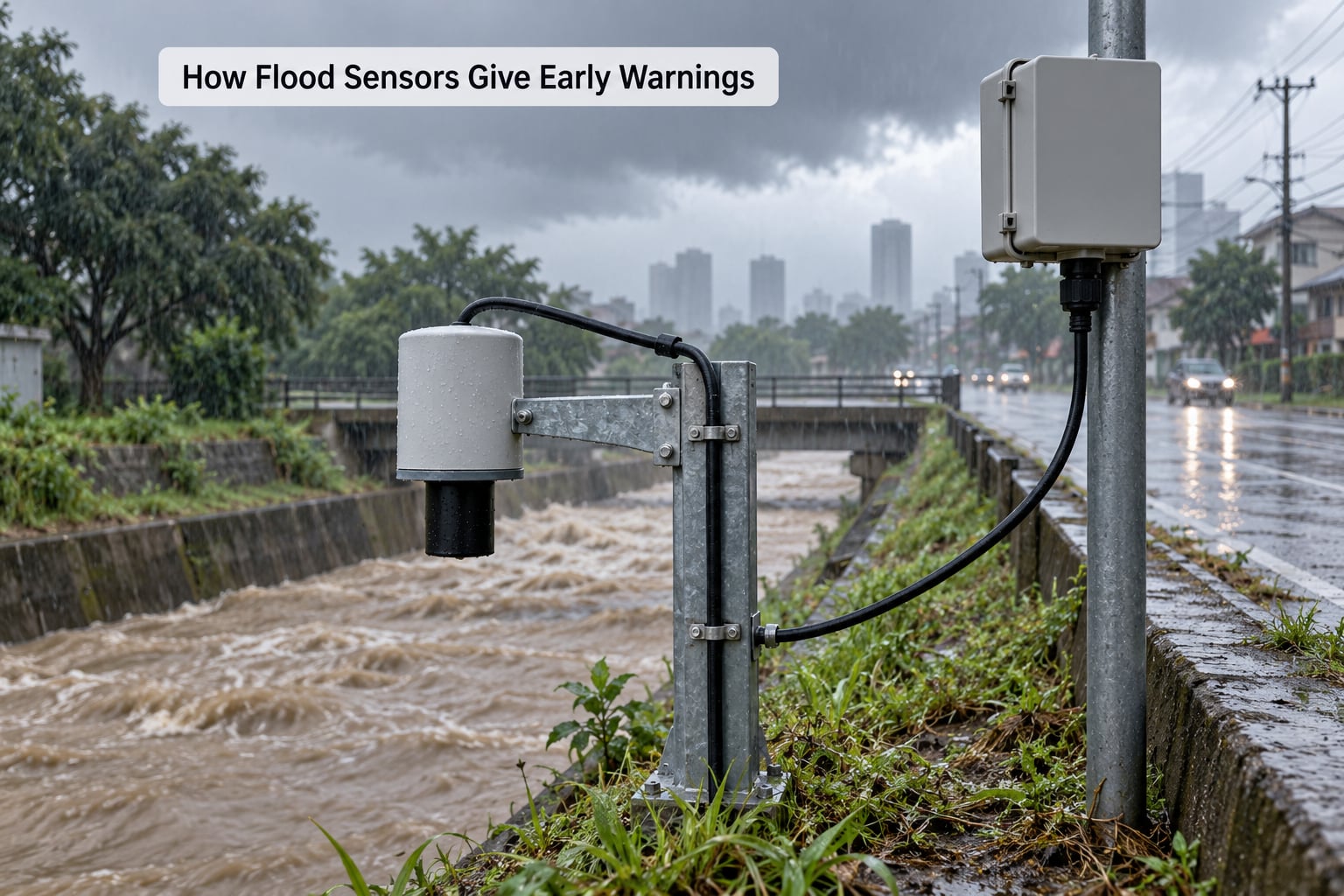
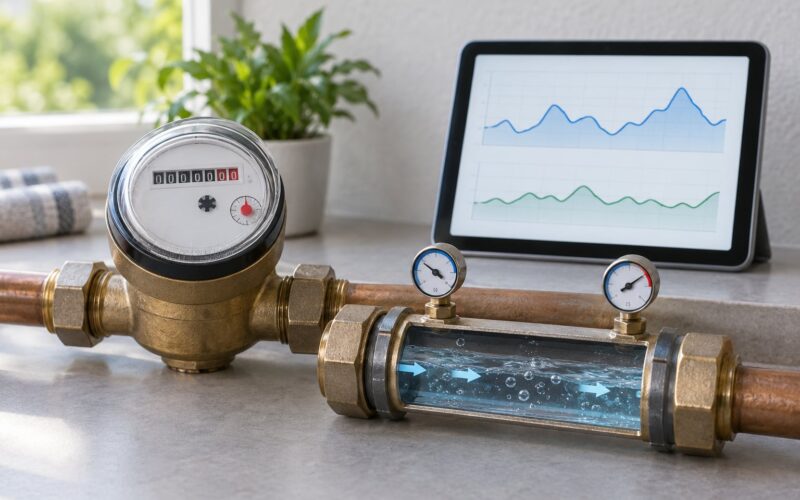
A flood sensor detects water using one of a few physical principles — electrical conductivity, capacitance, an ultrasonic echo, or a moving float — and compares that reading against a configured alarm threshold. If the reading holds above the threshold, a remote unit transmits the alarm by WiFi, cellular, or LoRa to a siren, dashboard, or phone. The value is not detecting water. It is converting a slow physical change into a number that can trigger a decision automatically.
Every early warning system for flood events runs the same four steps, whatever the hardware:
- Detect — a sensor measures the presence or depth of water at one point.
- Compare — the reading is checked against an alarm threshold, usually after a short delay that filters wave action.
- Transmit — the condition travels over a wired or wireless link to a gateway or platform.
- Notify — a siren, sign, message, or app alert tells someone to act.
Most explanations online stop after step one. That is the part every flood sensor already does well, and the least interesting part.
What Data Do Flood Sensors Collect?
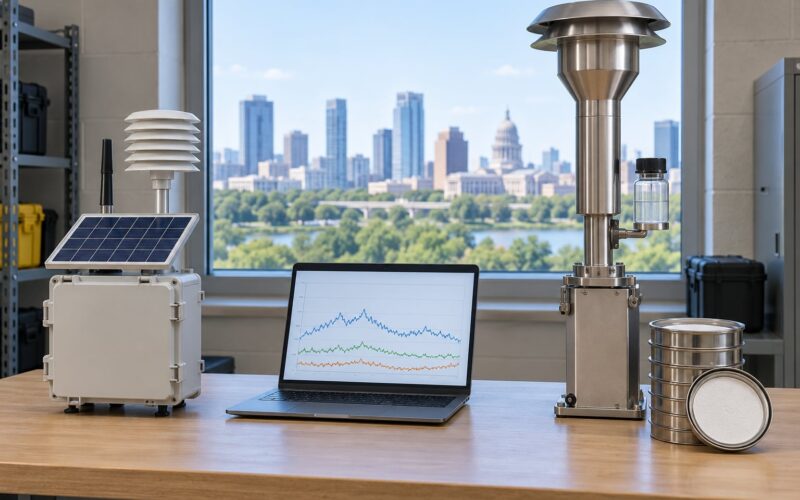
The measurements a network collects depend on the hazard, and mixing them up leads to bad coverage. Here is what each one actually tells you.
- Water level — depth or stage at a fixed point, in a channel, culvert, tunnel, basement, or sump pit. The most direct signal of flood conditions.
- Rainfall — accumulation rate, usually from a tipping bucket rain gauge. This gives anticipation, often hours before water arrives.
- River flow — discharge or velocity in a main channel, used where stage alone is misleading because the channel shape changes.
- Groundwater — saturated depth below grade, useful for slope stability and sewer backpressure risk.
- Soil moisture — the precursor to surface flooding in heavy, sustained rain.
Rainfall and water level are complements, not substitutes. A gauge tells you a storm is coming; a level sensor tells you the storm is here and how deep it has gone. Cities that run both can issue an advisory before the water appears and a closure order after.
How Do Water Level Sensors Work?
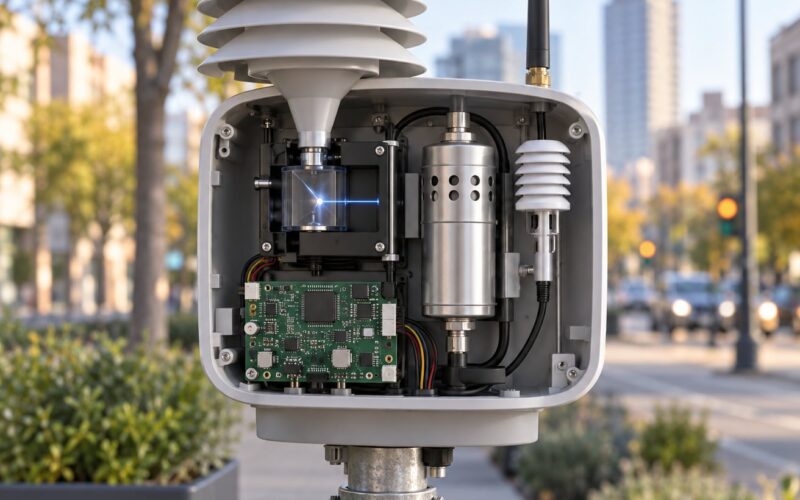
Four detection principles cover almost every installed flood sensor. Each reads the same physical situation in a different way, and the trade-offs show up mainly in response time and how fouling affects accuracy.
| Sensor type | What it measures | Output | Typical response time | Best suited to |
|---|---|---|---|---|
| Conductive / resistive probe | Electrical resistance between two exposed contacts | Binary switch or analog | About 100 ms | Presence detection in sumps, pits, low points |
| Capacitive | Change in capacitance at the sensor surface | Analog level | About 200 ms | Non-corrosive continuous level measurement |
| Ultrasonic | Time-of-flight of a sound echo off the water surface | Continuous distance, 4-20mA or digital | 50-100 ms | Open channels, rivers, tanks, no wetted parts |
| Float switch | Mechanical displacement of a float | Dry contact, normally open or closed | 200-500 ms | Reliable low-cost switching in pumps and pits |
| Optical | Light refraction or obstruction by the water | Binary switch | Varies | Clean water where no metal contacts are wanted |
Conductive probes are the simplest. Two exposed contacts sit just above the surface, water bridges them, and the resistance collapse is the alarm. Cheap, fast, and prone to corrosion and mineral scaling, which is why they are replaced on a schedule.
Capacitive sensors never touch the water. They measure how much charge the water’s dielectric properties can hold near the housing, so they resist corrosion and read continuous level rather than a single point.
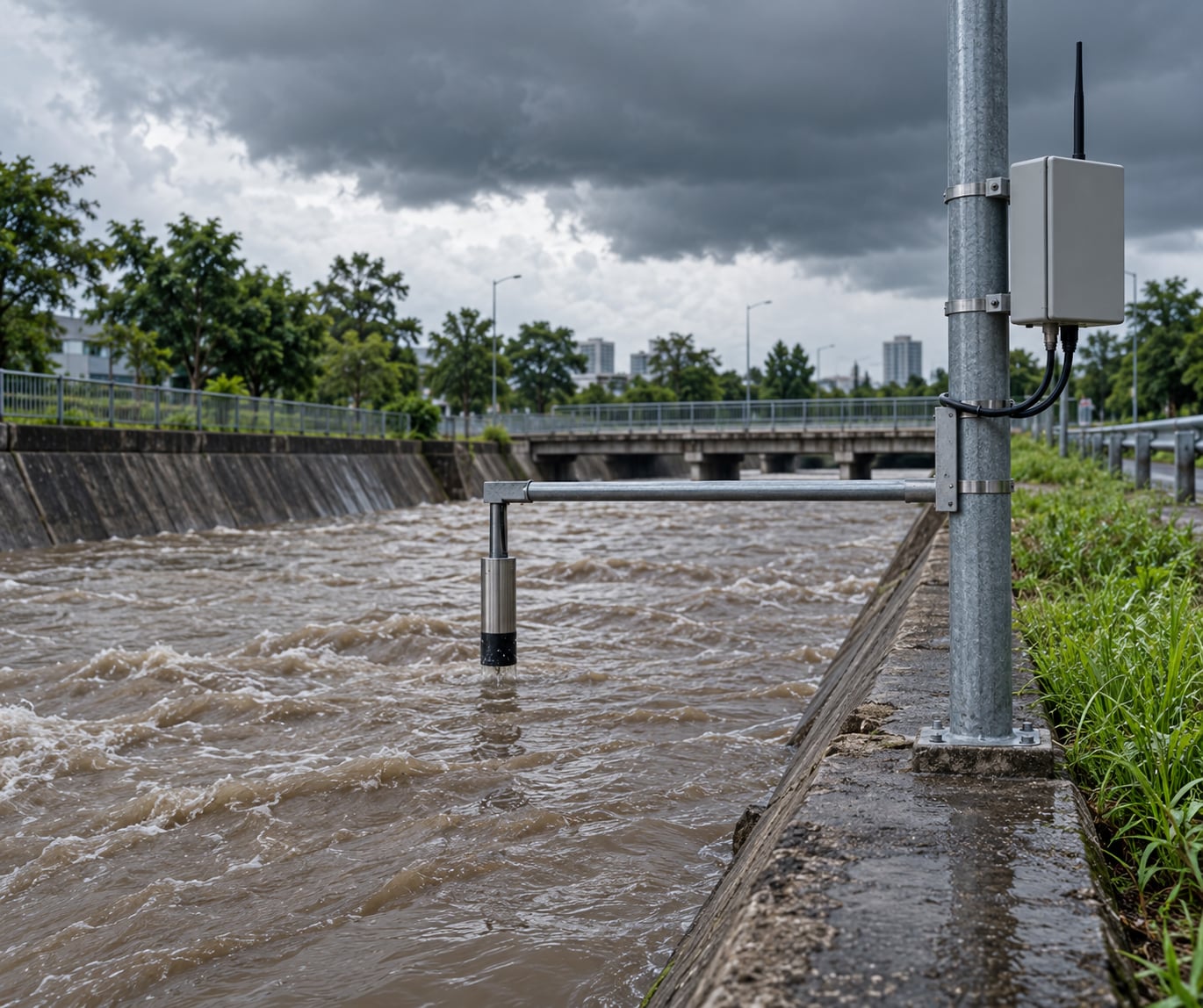
Ultrasonic sensors fire a sound pulse downward, time the echo off the water surface, and divide by the speed of sound in air to get a distance. Nothing is submerged, so there is nothing to silt up, but condensation on the face, foam on the surface, or a low-hanging bridge can distort the reading.
Float switches are mechanical. A float rides the surface and triggers a dry contact at a set point. They are slow compared to electronics, and the moving parts stick, but in a sump pit with an aggressive duty cycle they keep working for years with almost no attention.
From Sensor Reading to Public Warning
This is the step that decides whether a system is useful. A reading in a database protects nobody. The chain has to close.
- Calibration — the sensor is checked against a known reference so the number means the same thing in June as in January.
- Threshold and delay — the reading crosses a setpoint, but the alarm waits. Alarm delays of 5 to 30 seconds are standard in turbulent sumps precisely to suppress false trips from wave action and sloshing vehicles.
- Transmission — the condition travels to a remote monitoring unit over a dry contact, 4-20mA loop, Modbus, WiFi, LoRa, or a cellular link.
- Notification — the platform sends the message to the people and systems that respond.
- Action — a person or an automated control does something about it.
Consider a low underpass on a two-lane road. A level sensor in the sump pit is set to alarm at a stage corresponding to roughly 100 mm of water, with a 20-second delay. On a heavy afternoon, the reading crosses the setpoint, holds, and the alarm escalates: a first-level message closes the lane on the variable message sign upstream and emails the traffic duty officer, while a critical-level message at a higher setpoint dispatches the response crew and notifies emergency services. The water is already over the curb. The public got ninety seconds.
| Alert channel | Who receives it | Typical latency | Works without internet |
|---|---|---|---|
| On-site siren and beacon | People standing near the hazard | Immediate | Yes |
| Variable message sign | Drivers approaching | Seconds | Yes |
| SMS or email | Duty officer, crew, supervisor | Under a minute | Often, via cellular |
| Push notification | Residents with the city app | Under a minute | No |
| Automated control | Pumps, gates, valves, barriers | Immediate | Yes |
| Dashboard and open data feed | Analysts, developers, the press | Continuous | Not fully |
One distinction confuses almost everyone who has installed a household sensor: a triggered sensor usually only notifies. It does not shut off your water. Auto-shutdown exists, but it requires a valve and a controller, and plenty of devices are notify-only by design.
What Makes a Flood Warning Reliable?
Reliability comes from how many things have to go right at once, so it comes down to a handful of things.
- Accuracy at the installed location — a sensor sited beside a cascade or inside a churning outfall reads a different world than a still channel.
- Redundancy — a primary sensor plus an independent secondary, ideally on separate power and separate communications.
- Sampling frequency — faster sampling catches a rising curve earlier and shortens the reaction window.
- Calibration discipline — scheduled checks and post-event verification, since a flood is a convenient excuse to be wrong.
- Telemetry uptime — the failure mode nobody notices until the one event that mattered.
- Local thresholds — setpoints calibrated to the actual geometry of your channels and roads, not to a generic default.
- Human coordination — someone with the authority to close a road has to be on the receiving end.
A system that is accurate but sends its alerts to an unstaffed inbox is not a warning system.
Which Flood Warning System Fits a City?
Matching the deployment to the hazard is worth more than buying a better sensor. A city rarely needs one type; it needs the right set for each kind of flooding it actually has.
| Deployment | Hazard addressed | Where sensors go | Main benefit | Limitation |
|---|---|---|---|---|
| River and canal network | River flooding | Bridges, gauges, levee toes | Hours of lead time | Does not see street-level ponding |
| Rain gauge network | Anticipatory warning | Open ground, rooftops, catchments | Warns before water arrives | Rain does not map neatly to local flooding |
| Urban drainage | Blocked drains, backflow, underpasses | Sump pits, inlets, low crossings | Targets the worst spots directly | Only useful where maintenance keeps drains clear |
| Groundwater | Slope and sewer risk | Monitoring wells, embankments | Early signal of saturation | Slow-moving, needs months of history |
| Community reporting | Unmonitored minor flooding | Resident phones, fixed points | Covers what instruments miss | Uneven participation, needs triage |
If you are building something that residents or third-party apps will consume, publishing the telemetry as open data changes the calculation. A warning that only exists inside a control room helps the control room.
How Accurate Are Flood Sensors?
Accuracy is a property of the installation, not the datasheet. A well-sited ultrasonic sensor in a straight, open channel can be accurate to a few millimetres over its range; the same unit under a bridge or in turbulent flow is not.
The usual error sources:
- Datum and geometry — a sensor moves, a channel is dredged, or a staff gauge is re-surveyed, and the number shifts underneath you.
- Drift — slow calibration loss that only shows up when you compare against something independent.
- Sediment and debris — silt, algae, and leaves on ultrasonic faces, scale on conductive probes.
- Vandalism and tampering — a real cost in unguarded roadside and canal installations.
- Power loss — a flooded cabinet is a sensor that stops reporting at the exact moment you need it.
- Connectivity loss — the reading happens, the message does not arrive.
Redundancy and post-event field validation are what turn a number into a measurement you can defend. Neither removes the uncertainty; they bound it.
How Quickly Can Flood Sensors Issue a Warning?
Three different clocks are often confused, so it helps to separate them.
Detection time is the sensor’s own response, usually measured in milliseconds — 50-100 ms for ultrasonic, around 100 ms for conductive, 200-500 ms for float. Fast enough that it is rarely the bottleneck.
Forecast time is the interval between the reading and the worst conditions, which depends entirely on the hazard. A rising river gives hours. Stormwater ponding in a blocked underpass after 40 mm in an hour gives minutes.
Response time is the gap between the alarm and someone actually doing something. This is usually the longest leg. A 100 ms sensor behind a dashboard nobody is watching until morning has a response time of hours.
Total warning time is the sum of sampling interval, alarm delay, transmission latency, notification latency, and human reaction. The first four are engineering. The last one is policy.
How Do Cities Deploy and Maintain Flood Sensors?
A workable sequence, in the order that avoids expensive mistakes:
- Map the flood-prone locations. Historical flood records, drainage plans, and resident reports beat a generic city map.
- Define the warning objective. Close a road, evacuate a basement, evacuate a district. The objective sets the lead time you need, and the lead time sets the sensor.
- Choose sensors to match the hazard. Presence detection for sumps, continuous level for channels, rainfall for anticipation.
- Place for lead time. Position the trigger upstream or upstream-early enough to buy 15 to 30 minutes of warning before the affected point.
- Install, seal, and calibrate against a local reference, and record the reference value.
- Connect to a platform with historical logging and an API, not just an alarm relay.
- Test the alert workflow end to end before you need it. A monthly test message beats discovering the distribution list is stale.
- Inspect on a schedule — sight glass, probe condition, cabinet seal, battery, antenna, vegetation.
- Revise thresholds after every real event. The flood is the calibration data.
Two things get skipped and should not be. Any device near a public right-of-way needs tamper resistance and safe access for technicians, including lockable enclosures and a safe means of reaching installations in moving water. And any public-facing alert needs to reach people in multiple languages and formats — SMS, push, radio, and a physical sign, because not everyone has the same phone or the same connectivity.
What Are the Limits of Flood Sensor Warnings?
Sensors buy minutes to hours. They do not buy unlimited time, and pretending otherwise is dangerous.
- Flash floods rise and fall faster than a fixed network can reliably sample and communicate, especially in canyons and washes where sensors themselves get swept away.
- Rapidly changing channels break fixed thresholds. A gate closure or a debris jam upstream changes what a setpoint means.
- Outages remove data exactly when it is most needed, and nobody notices until they check.
- Rainfall forecasts beyond a few hours are uncertain, so anticipatory thresholds carry a real false-alarm cost.
- False alarms and alert fatigue are the top reason people stop trusting a system. Every avoidable ping trains people to ignore the next one.
- Cybersecurity — exposed remote monitoring units are an entry point, and a spoofed flood alert has obvious uses.
And the obvious one: a warning is not a defense. Levees, drainage capacity, retention basins, land-use rules, evacuation routes, and a practiced response still do the heavy lifting. Sensors make those things work better; they do not replace them.
Frequently Asked Questions
Can flood sensors predict a flood before it happens?
Not by themselves. A level sensor reports conditions as they happen, so it can warn you when water is already rising. Rainfall gauges and flow models provide the anticipation, converting an incoming storm into a predicted river stage hours ahead. The usual pattern pairs both: a model-driven advisory first, then a sensor-confirmed warning when the water actually arrives at a given point.
How accurate are flood sensors?
Accuracy depends far more on installation than on the model. In a straight, open channel, a calibrated ultrasonic sensor can be accurate to a few millimetres. Near cascades, turbulence, bridges, or moving sediment, the same unit drifts badly. Scheduled comparison against an independent reference, post-event field checks, and a redundant second sensor at high-consequence sites are what make the number defensible.
How quickly can a flood sensor send an alert?
Detection itself is fast: ultrasonic sensors respond in roughly 50-100 milliseconds, conductive probes around 100, capacitive about 200, and float switches 200-500. End-to-end time is much longer, because an alarm delay of 5-30 seconds is often added to suppress wave-action false trips, then transmission, then notification, then a human reacting. On a local siren or automated control the whole chain runs in under a minute; on SMS or email it runs in a couple of minutes.
Do flood sensors work during heavy rain?
Yes, that is exactly the condition they are built for. Two things matter. The enclosure and cabling need an appropriate ingress protection rating, since driving rain, splash and standing water attack the connections first. And power has to hold up: mains sites need a UPS or battery backup, and remote sites need solar with battery reserve, because a flooded cabinet is a sensor that stops reporting at the moment you need it most.
What happens if a flood sensor loses power or connectivity?
The last known reading is held, and the platform normally marks the site as stale rather than reporting a false all-clear. That distinction matters: a silent sensor is not the same as a dry one. Good systems raise a telemetry fault of their own, heartbeat-check the link on a schedule, and fail to a safe state, so a lost device triggers investigation instead of quiet reassurance.
How do cities turn sensor data into public warnings?
The reading is compared against a local threshold set for a specific consequence, after a short alarm delay that filters wave action. The result routes to channels matched to the audience: variable message signs for drivers, SMS and email for crews, push notifications for residents, and automated commands for pumps and barriers. Publishing the same telemetry as open data lets third-party apps and researchers reuse it without waiting for a press release.
Start With a Small, Tested Flood Warning Network
If you are starting now, pick the two or three locations where a missed warning costs the most — a low underpass, a flood-prone garage, a creek crossing — and instrument those first. Match the measurement to the hazard rather than the other way round, install a second independent sensor wherever the consequence is serious, and connect the data to a response workflow with named people in it.
Then test the whole chain on a scheduled basis, because that is where flood sensors give early warnings and where they quietly stop. The next big storm will be heavier than last year’s. The system that has been exercised is the one that works when it counts.