
Why civic apps should have a data retention policy? Because without a published, enforced rule for how long each type of resident data is kept, a city keeps everything it collects, forever. A retention policy turns a vague promise to minimize data into a specific number, a scheduled deletion job, and a record proving both happened.
Most municipal apps were never designed to delete anything. A 311 request from 2017 still sits in the service desk database. The resident’s precise location history from a transit app is still sitting in a warehouse nobody queries. Nobody made a decision to keep that data. It simply never got a deletion date.
That default is the problem. Privacy sets a ceiling on how long data should live, but public records law sets a lawful floor on how long it must stay. A workable policy lives inside that range, and this guide shows how to build one that survives a council meeting, a records request, and an audit.
Table of Contents
- What Is a Data Retention Policy?
- Why Civic Apps Should Have a Data Retention Policy
- How Data Retention Differs From Data Minimization
- What Legal and Public-Interest Duties May Apply
- Why Civic Apps Should Have a Data Retention Policy: Scope and Goals
- How to Choose a Retention Period for Each Type of Civic App Data
- How to Write Clear Retention Rules
- How to Put the Policy Into Practice
- How to Handle Anonymized Data and External Vendors
- How to Publish the Policy Without Overpromising
- What Does a Good Retention Policy Look Like?
- Frequently Asked Questions
- Does a data retention policy conflict with public records law?
- Can a city delete my data when I ask?
- How long should a city keep 311 service request data?
- What happens to data in backups when a retention policy fires?
- Who owns data retention in a city?
- What happens to resident data when a civic app is retired?
- Conclusion
What Is a Data Retention Policy?
A data retention policy is a published rule stating, for each category of data a civic app collects, exactly how long that data is kept and what happens to it when the period ends.
Four things get confused with it constantly, so it helps to separate them.
- Retention period is the clock: three years from case closure for a completed permit application.
- Deletion deadline is the outcome of that clock: what physically happens at year three, in the live database, in replicas, in backups, and in any vendor copy.
- Backup purge cycle runs on a different schedule from live data, because backup sets are read-only and cycle out on rotation.
- Legal hold suspends both. A litigation hold or investigation freezes deletion regardless of the schedule, and it has to be released deliberately or data is held forever by accident.
A retention policy is also not the same document as a privacy policy or a records retention schedule. It sits underneath both, and it is the only one that answers the question residents actually ask: how long do you have this, and who says so?
Why Civic Apps Should Have a Data Retention Policy
Seven reasons, in the order they usually surface.
- It shrinks the blast radius of a breach. A credential stuffing attack against a transit app is bad. The same attack against a ten-year archive of precise trip histories for every user is a different story with a different headline.
- It makes privacy obligations provable. Data minimization is a legal expectation in many jurisdictions. Nobody can demonstrate that you minimized anything unless you can show what you deleted and when.
- It stops storage costs from becoming a budget line nobody planned for. Backups multiply every byte, and replicas multiply again. Growth without an expiry date becomes an unfunded line item.
- It keeps analytics honest. A decade of abandoned accounts and duplicate test records quietly skews demand models and staffing decisions.
- It answers council scrutiny in the room. When a council member asks what the city holds on residents, a schedule is an answer. Vague assurances are a follow-up meeting.
- It reduces the cost of a public records request. Searching five years of data is a project. Searching fifteen is a procurement, and the bill lands back on the department that answers the request.
- It gives the team a defensible answer to a deletion demand. Practitioners describe this exact failure constantly: the policy allows deletion, the request arrives, and then the backup layer quietly blocks the deletion from completing.
The last one is worth dwelling on. Retention without enforcement is a press release. Administrators talk about configuring retention policies that sat completely inert for years, and vendors talk about the same disconnect between what the document says and what the systems do.
How Data Retention Differs From Data Minimization
They solve opposite halves of the problem, and a policy that only covers one of them leaves the other open.
| Control | What it governs | When it applies | Civic app example |
|---|---|---|---|
| Collection limits | Whether a field is captured at all | Before a record exists | A parking app captures the vehicle plate only when a permit is issued, not on every search |
| Use limits | What a collected field may be used for | After collection | Energy meter readings support billing and outage response, never neighborhood profiling |
| Retention limits | How long the record survives | Across the record’s life | Tourism visitor survey responses are aggregated after 24 months and the row-level data is purged |
| Deletion practice | What removal actually removes | At expiry and on request | Deletion covers the analytics warehouse, the data lake copy, and the vendor’s processed store |
Data minimization asks why you have it. Retention asks how long you are allowed to keep it. A team can be excellent at the first and still fail the second, which is the common case: a thoughtfully designed form feeding an app that stores everything forever.
What Legal and Public-Interest Duties May Apply
Requirements vary by country, state, city, sector, and data type, and there is no single global rule to copy.
Some frameworks set an explicit storage limitation principle, such as the General Data Protection Regulation in the European Union. Others, like the California Consumer Privacy Act as amended by the CPRA and the growing set of US state privacy laws, attach duties to specific categories of data rather than to everything a city holds. Public records statutes cut across all of them and usually work in the opposite direction, mandating a minimum retention period for records of government business.
Layered on top of all of it are public-interest duties that are not about personal data at all: the obligation to show how decisions were made, to keep audit trails that explain who changed a permit status and when, and to support research, oversight, and transparency reporting. A city that deletes its decision history aggressively has traded one compliance problem for another.
Treat none of this as individual legal advice. Frameworks like the NIST Privacy Framework are useful for structuring the risk conversation, and the applicable records schedule comes from state or provincial archives rather than from a product team. Municipal counsel and the records officer should own the legal floor before any period is published.
Why Civic Apps Should Have a Data Retention Policy: Scope and Goals
A workable policy states its own boundaries before it states any periods. Name the systems in scope (production databases, replicas, the analytics warehouse, data lakes, support tooling, vendor platforms), the data subjects (residents, applicants, employees, contractors, visitors), the jurisdictions covered, and every data category including inferred and separately controlled records.
Inferred data deserves its own line. Device fingerprints, model scores, and derived household profiles are often more revealing than the fields a resident typed in, and they rarely appear in an inventory built from form fields alone.
How to Choose a Retention Period for Each Type of Civic App Data
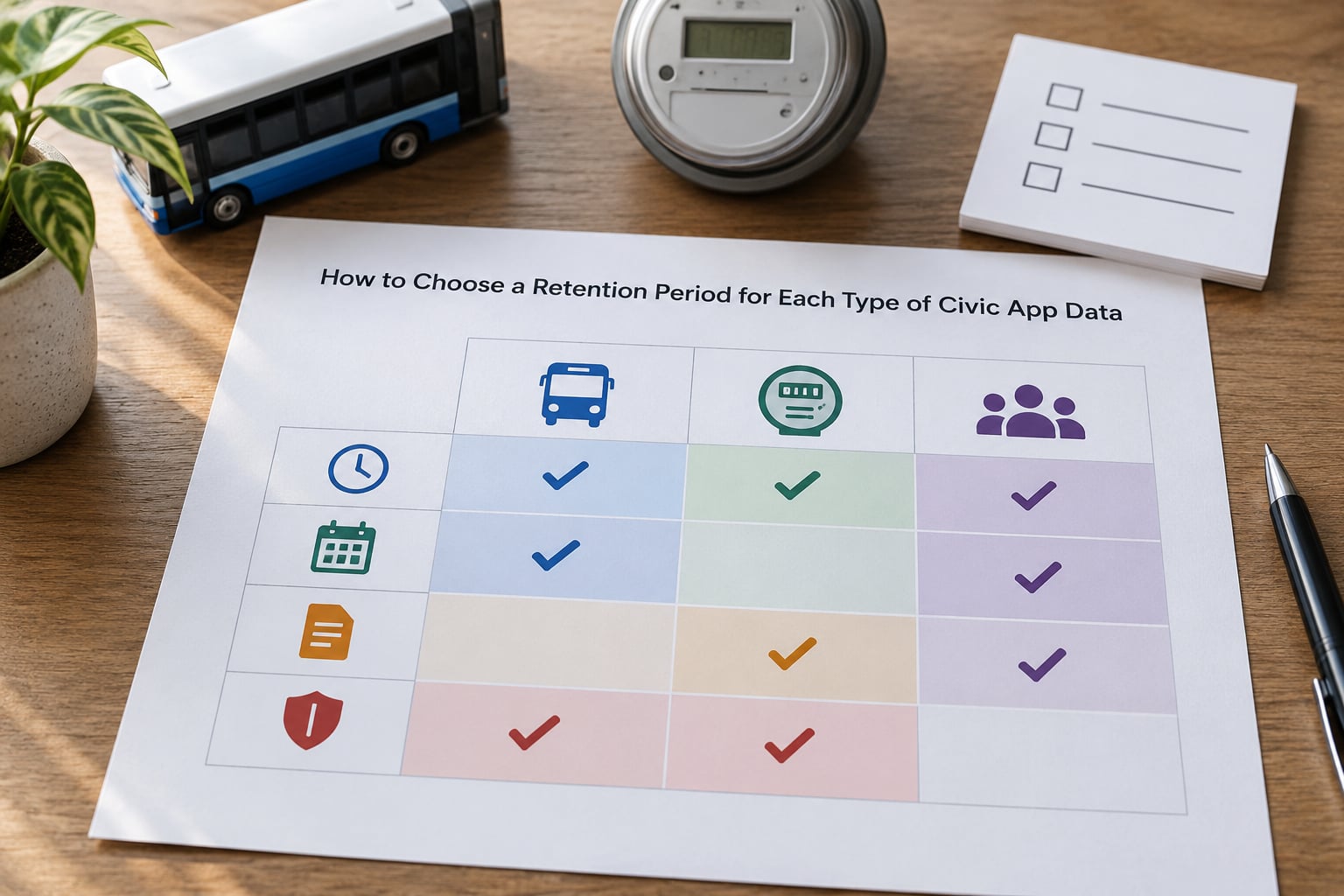
Work through five questions for each category, and the period usually falls out on its own.
- What legitimate purpose does this serve?
- Is there a legal or records mandate that sets a minimum?
- What operational need justifies keeping it beyond that minimum?
- How sensitive is it, and does it describe someone’s home, health, movement, or finances?
- What is the harm if it leaks in five years?
Then assign three operational fields: the trigger event that starts the clock, the review date, and the deletion action. Triggers matter more than most teams expect. Case closed, invoice paid, permit issued, account inactive for twelve months, and report published are all better clocks than date collected, because a long-running case should not have its clock running while nobody is working on it.
| Data category | Common starting default | Clock starts | Why it sits there |
|---|---|---|---|
| 311 service request records | 3 to 7 years | Case closure | Service delivery history plus records and audit obligations |
| Permit and licence applications | 7 to 10 years | Final decision | Property and development records outlive the app |
| Utility billing and payment records | 7 years | Payment settlement | Audit and tax examination windows |
| Precise geolocation and trip traces | 30 to 90 days | Trip completion | Near-zero legal need once the journey is over |
| Utility meter telemetry | 13 to 24 months | Reading interval | Billing, outage response, seasonal analysis |
| Citizen feedback survey responses | 24 to 36 months | Report publication | Enough trend history, then aggregate and purge |
| Abandoned application drafts | 12 months | Last activity | No completed transaction, so no record value |
| System audit logs | 1 to 7 years | Event timestamp | Access history and abuse investigation |
These are starting defaults, not legal answers, and every one of them should be checked against the local records schedule. The value is that they force the conversation onto a number instead of a principle.
How to Write Clear Retention Rules
Each rule needs eleven things, or it cannot be enforced or explained.
- Purpose. The specific reason the data is held.
- Scope. Which system, which fields, which population.
- Owner. One named role, not a committee.
- Start event. The trigger that starts the clock.
- Period. The duration itself.
- Storage locations. Production, replicas, warehouse, data lake, vendor platforms.
- Backup treatment. How expiry reaches backup sets and on what cycle.
- Legal hold behaviour. How a hold suspends the rule and who releases it.
- Vendor treatment. What the city requires of processors under contract.
- Exceptions. Which exceptions exist and who approves them.
- Point of completion. The definition of done for deletion, which is where most policies get vague.
How to Put the Policy Into Practice
A policy that lives only in a PDF is a press release. The rule has to reach the systems.
Set expiry at the storage layer with time-to-live on records and partition drops on tables, so deletion is a scheduled database task rather than a manual cleanup someone remembers. Mirror those settings in object storage bucket lifecycle rules and in the data warehouse, because those are where copies usually survive.
Write the vendor obligations into contracts: retention limits that flow down, written deletion confirmation, audit access, processing locations, and return terms at contract end. Practitioners describe vendor copies as invisible to the agency that owns the policy, which is exactly the gap a contract clause closes.
Log every automated deletion with a record count, dataset, timestamp, and job identifier. That log is the difference between asserting a policy and evidencing one, and it is what an auditor or council member actually asks to see. Name one data custodian responsible for the schedule and a review cadence, at minimum annually.
How to Handle Anonymized Data and External Vendors
Aggregation and anonymization reduce risk; they do not remove accountability. Once individual rows are gone, you can no longer answer a deletion request for a specific resident, which means the anonymization has to be genuinely irreversible and demonstrably so. Derived statistics built on reversible data are still personal data wearing a hat.
For vendors, ask the questions that expose where copies actually live. Which subsidiaries and subprocessors touch the data, where is it stored geographically, can the city audit deletion, what is the purge window after a request, and what is returned at contract end. A city that cannot answer those five questions does not know how long its residents’ data lives.
How to Publish the Policy Without Overpromising
Publishing is where trust is won or lost, and the temptation to overstate is strong. A resident-facing version should state what is collected, why, how long, who receives it, how to exercise applicable rights, and what limits or exceptions may affect deletion.
Be explicit about the records-law floor and about backup timing. Say that a completed deletion request may take a few weeks to fully propagate through backup cycles rather than implying a button exists. Residents have been burned by promises that quietly meant “eventually, if no one objects.” Plain numbers beat abstract commitments, and a schedule a resident can read without a lawyer is worth more than a policy name in a footer.
What Does a Good Retention Policy Look Like?
Use these as review criteria.
- Proportionate. Every period traces back to a purpose or a mandate, not to habit.
- Specific. Real numbers, real triggers, real systems named.
- Enforceable. Expiry exists in the database, the warehouse, and vendor platforms.
- Owned. One accountable role per category.
- Documented. Exceptions and legal holds recorded with approvals.
- Reviewable. A dated review cycle and an annual deletion report.
- Honest about limits. Records-law minimums and backup cycles stated up front.
- Evidenced. Deletion logs a third party could inspect.
If a criterion fails, treat it as a backlog item with a named owner and a date rather than a footnote.
Frequently Asked Questions
Does a data retention policy conflict with public records law?
Not if it is designed from both sides. Public records statutes set a minimum retention period for records of government business, so a policy cannot authorize deletion below that floor. Privacy expectations set a ceiling. A workable civic app data retention policy names the range, cites the records mandate for each category, and publishes the number it actually applies.
Can a city delete my data when I ask?
For most operational data, yes, subject to the lawful floor and to backup cycles. Completed service requests, drafts, and telemetry usually fall outside the records mandate. The request still has to propagate through replicas, the analytics warehouse, and vendor copies, so a real answer includes a timeline and confirmation rather than an instant purge.
How long should a city keep 311 service request data?
Three to seven years from case closure is a common starting default, because the record documents service delivery and often supports council or audit questions. Check your local records schedule, since the mandate may be longer. Whatever the period, it should be a published number with an automatic expiry, not an informal understanding.
What happens to data in backups when a retention policy fires?
Backup sets are usually read-only and cycle out on rotation rather than being edited, so a deletion in the live database will not remove the historical copy immediately. Policies handle this by naming a purge window, such as the backup rotation cycle, and stating it plainly to residents. Quietly omitting backups is the most common failure in published policies.
Who owns data retention in a city?
In practice it splits three ways: the app or department team owns the purpose, the records officer owns the legal minimum, and the named data custodian owns execution and the deletion log. Retention fails when it sits with a privacy committee that cannot change a database setting. Put one accountable role in the policy for each data category.
What happens to resident data when a civic app is retired?
It becomes the most orphaned data a city holds, because nobody owns the schedule anymore. Migration, decommissioning, or acquisition should each trigger an explicit decision per dataset: transfer with the new retention terms, archive under the records schedule with a named custodian, or delete. Review the vendor contract too, since the data may sit in a platform you no longer control.
Conclusion
Start with an inventory, not a policy document. List every dataset a civic app touches, name a purpose and an owner for each one, check which records mandates apply, and then set the shortest period you can actually defend and implement.
A retention policy is not paperwork for its own sake. It is the control that makes data minimization real, and publishing the numbers is what turns a privacy promise into something a resident, an auditor, or a council member can hold you to in 2026 and every year after.