Here is how pedestrian signal timing is decided: a traffic engineer measures the crossing, picks a walking speed, divides one by the other to get the clearance time, and then fits that number into a cycle length that also has to serve turning vehicles, through traffic, transit, and emergency preemption. Nothing about it is automatic, and almost every intersection runs more than one plan depending on the hour.
The part most people never see is the paperwork. Before any number changes, somebody collects counts, models alternatives, and checks the result against accessibility rules. If you have ever wondered why the walk at your corner feels short, or why the flashing hand appears to start before you are even across the first lane, the answer is usually in that process rather than in a broken signal.
What follows is the actual sequence: the inputs, the arithmetic, the people who own the decision, and how a resident or a developer can get a crossing looked at again.
Table of Contents
- What Determines Pedestrian Signal Timing?
- How the Basic Timing Calculation Works
- Who Sets the Timing Standard?
- What Factors Can Increase the Walk Interval?
- How Do Traffic Signals Balance People and Vehicles?
- How Does Pedestrian Signal Timing Work at Demand-Controlled Crossings?
- Why Accessibility and Equity Matter
- How a City Reviews and Adjusts Signal Timing
- Frequently Asked Questions
- Who decides how long the walk signal is?
- What is the minimum walk interval at a crosswalk?
- Is pedestrian signal timing the same everywhere in the country?
- Why does the countdown timer seem to start too early?
- How do cities decide signal timing at different times of day?
- What can I do if a crosswalk signal feels too short?
- Conclusion: Start with the Crossing, Not a Universal Number
What Determines Pedestrian Signal Timing?
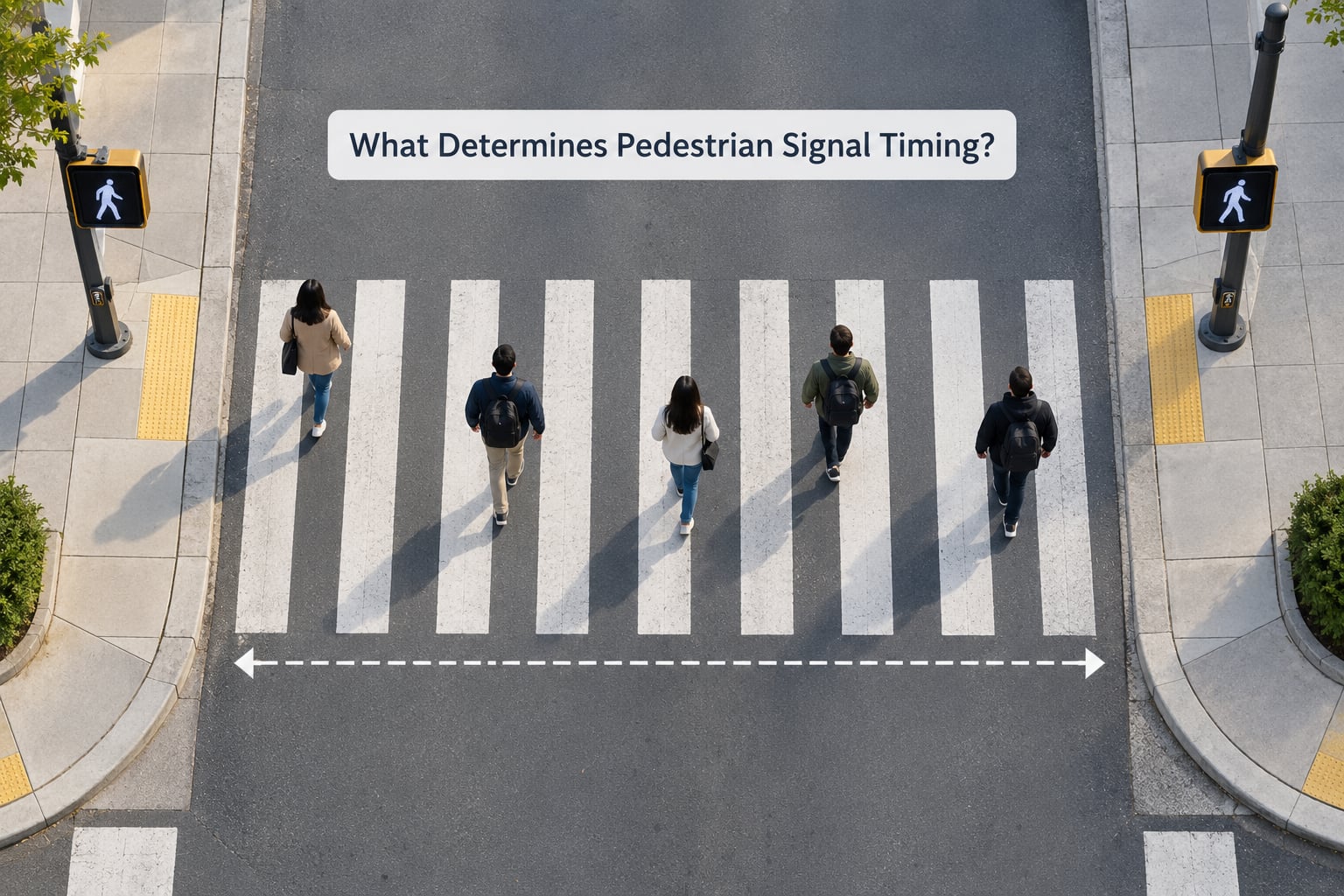
Timing is decided from a short list of measured inputs, not from a fixed universal interval. The same 20 seconds of walk time can be a comfortable crossing on a narrow side street and a reckless one on a six-lane arterial, because the conditions behind it are different.
The five inputs that matter most:
- Crossing distance measured along the actual path a pedestrian walks, including any curb ramp taper and median refuge.
- Walking speed, which the design standard fixes in advance rather than measuring on site.
- Street grade and surface, since slopes and rough pavement slow people down.
- Vehicle volumes and turning conflicts, which decide how much green time is available to give away.
- The people expected to cross, which is where schools, senior housing, and transit stops change the math.
The crossing distance is the one engineers argue about most, because it is frequently not what the paint implies. A crosswalk that looks like 60 feet on the roadway is often longer once you add the ramp, the level landing area, and the diagonal path required to line up with a median.
Time of day sits on top of all of it. The same intersection commonly runs a short cycle and a short walk at 2 a.m., then a longer cycle and a longer clearance during the evening peak when turning volumes spike.
How the Basic Timing Calculation Works
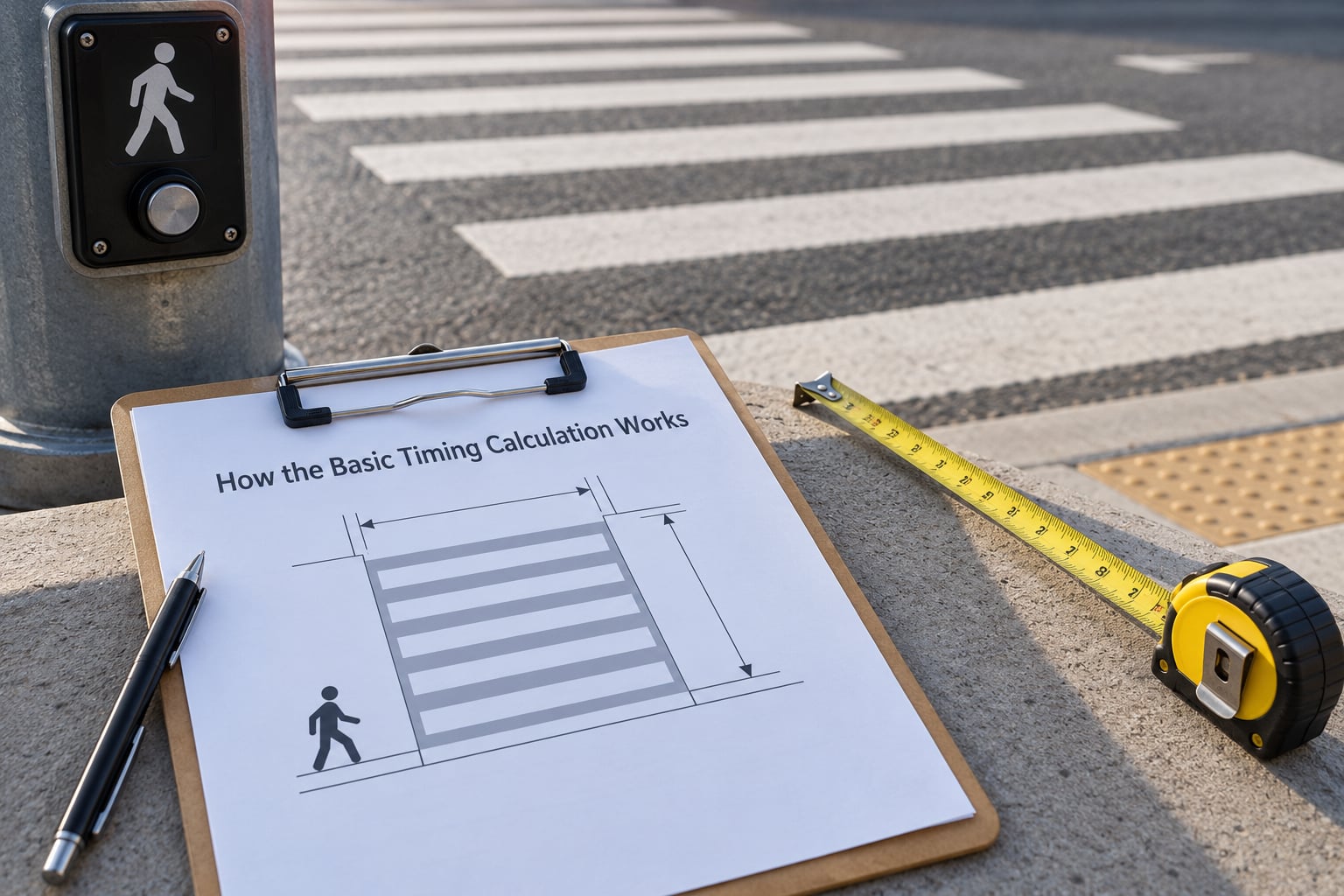
The core calculation is one division: crossing distance divided by walking speed gives the clearance time in seconds. Everything else in the design is a decision about what to do with that result.
Take a 60-foot crossing at the design speed of 3.0 feet per second. Sixty divided by 3.0 is 20 seconds of clearance. At the older 3.5 feet per second assumption, the same crossing comes out at about 17 seconds, which rounds up to 18. That two-second gap is the entire argument behind a lot of retiming requests, because older agency guidance and newer guidance are still being quoted side by side.
Here is the worked chain, in the order an engineer builds it:
- Measure the crossing distance along the pedestrian path. In this example, 60 feet.
- Apply the design walking speed. Current federal guidance uses 3.0 feet per second for the standard crossing calculation, while much older references and many local policies still use 3.5 or even 4.0 feet per second.
- Divide to get the clearance interval. 60 ÷ 3.0 = 20 seconds.
- Add the walk interval, which is the solid white walking figure shown before the flashing hand begins. The walk and the clearance are separate intervals, and many people conflate them.
- Round up to the nearest whole second and record the result on the signal timing sheet.
- Fit the total pedestrian time into a cycle length that the rest of the intersection can support.
The result then gets stored in the controller as a set of three consecutive intervals:
| Interval | What the pedestrian sees | What it does |
|---|---|---|
| Walk Interval | Steady white walking person | Confirms the crossing is legal to start |
| Pedestrian Clearance Time | Flashing raised hand with countdown | Covers the remaining distance at the design speed |
| Pedestrian Change Interval | Steady raised hand | No crossing begins; vehicles have conflicting green |
Quick reference values for the same crossing at different design speeds:
| Crossing distance | At 3.0 ft/s | At 3.5 ft/s | At 4.0 ft/s (older practice) |
|---|---|---|---|
| 40 feet | 14 seconds | 12 seconds | 10 seconds |
| 60 feet | 20 seconds | 18 seconds | 15 seconds |
| 80 feet | 27 seconds | 23 seconds | 20 seconds |
| 100 feet | 34 seconds | 29 seconds | 25 seconds |
Notice how the gap widens as the crossing gets longer. A design speed that was tolerable on a 40-foot side-street crossing produces a serious shortfall on a 100-foot arterial, which is why wide crossings get flagged first when local standards tighten.
Separately, the walk interval itself has a floor. Federal guidance sets a minimum walk interval of 7 seconds, extended when slower pedestrians need more reaction time to start moving. The clearance time is what carries the distance; the walk interval is the cushion at the front.
Who Sets the Timing Standard?
The standard is set at two levels, and they are different levels. The Manual on Uniform Traffic Control Devices, published by the Federal Highway Administration, defines the terms and the rules. The actual number on your corner is set locally, by a municipal or state transportation agency’s traffic operations unit.
Inside an agency, the people involved look roughly like this:
- The traffic engineer or signal operations technician who runs the timing software, builds the plan, and uploads it to the controller.
- The transportation department or public works unit that owns the signals and the maintenance contract.
- An accessibility specialist, often a separate reviewer, who checks that slower pedestrians are served.
- Planners and transit staff who weigh bus clearances and street redesigns against the existing timing.
Who owns signal timing varies more than people expect. In many cities it sits with the city DOT or public works; in others the state highway department owns it because the road is a state route; sometimes a regional authority or a metropolitan planning organization runs a corridor program covering multiple municipalities. On a signal operated by a contractor, the contractor adjusts the timing but the agency still approves it.
Nobody outside that chain sets it. Not the police, not the signal hardware vendor, and not the federal government, despite the federal manual being the reference everyone cites. Most pages still quoting the 2003 or 2009 editions of the MUTCD are also quoting walking speeds that newer editions have moved away from.
What Factors Can Increase the Walk Interval?
Several conditions push a crossing above what the bare arithmetic gives you. Each one is a request from a specific group to a specific engineer, and the engineer has to weigh them against everyone else in the cycle.
Wider roads. Crossing distance is the cleanest case, and the arithmetic is not negotiable once you fix the speed assumption.
Steep grades and poor surfaces. A slope of several percent, or pavement that is rough or wet, moves real walking speed down. Some agencies add a margin when the grade is significant rather than pretending the design speed holds.
An older or mobility-limited population. When a senior facility, a clinic, or a large housing complex sits within walking distance, the agency may adopt a slower design speed for that specific crossing. Community input on this is routinely part of the record.
Schools. A school route adds a predictable surge of children who cross in groups, often with adults, and often at the same two or three times of day. The engineering response is usually a plan change rather than a longer walk.
Transit stops. A bus stop mid-block or near the crossing can add enough time for a person to finish a crossing after the light changes without boarding, which is why bus clearance intervals show up in the same timing sheet as pedestrian intervals.
Median width. A wide enough refuge island can let a crossing be split into two shorter stages. That is not a way to save green time exactly, but it is often the best answer where a single-stage crossing is otherwise impossible.
Unsignalized right-turn lanes. Vehicles turning on red through a splitter island are not controlled by the signal at all. The walk interval sometimes gets extended to give people a margin against those turns, which is a timing response to a geometry problem.
High pedestrian demand. In a downtown core, the binding constraint flips. When several hundred people want to cross per hour, the walk interval is as much a capacity number as a clearance number, and the cycle has to be long enough to move them.
How Do Traffic Signals Balance People and Vehicles?
Every second of walk interval is a second no vehicle is moving through that phase, so the pedestrian decision is really a capacity and coordination decision. The phasing strategy is where that balance gets set.
| Phasing strategy | What it is | Pedestrian benefit | Pedestrian cost | Best fit |
|---|---|---|---|---|
| Concurrent | Pedestrians walk parallel to through vehicle green | Short wait, familiar pattern | Turning vehicles cross your path legally | Low-conflict, low-volume intersections |
| Split | Through and turning movements run separately; each has its own pedestrian interval | Turning conflicts removed during your walk | Longer wait and longer cycle | Arterials with heavy left turns |
| Exclusive phase (scramble) | All vehicles stop while pedestrians cross every leg, including the diagonal | No conflicts at all; diagonal available | Shortest effective green for vehicles, longest wait for everyone | Dense downtown, grid core, heavy pedestrian volume |
| Leading pedestrian interval | Pedestrians get a head start of a few seconds before parallel vehicles are released | You are already in the crosswalk when turning drivers move | Can push later starters to wait a full cycle | Arterials with moderate turning volume |
| Hot response | Pedestrian call served immediately rather than at the next scheduled point | Very short wait at low-volume crossings | Pedestrians arriving later can face a much longer wait | Side streets, quiet residential crossings |
| Two-stage median crossing | Refuge island splits one long crossing into two shorter ones | Each stage is easier to complete | Two calls, two waits, more exposure on the island | Very wide arterials |
Coordination constrains everything else. When a corridor is tuned for a green wave, each intersection’s cycle has to match its neighbours, and a longer cycle at one crossing propagates downstream. Pedestrian opportunities are often sacrificed to keep that progression intact, which is why a request for a longer walk can turn into a corridor conversation rather than a local fix.
Cycle length is the usual point of friction. A widely used rule of thumb in pedestrian guidance is to keep cycles under about 90 seconds, since waiting time rises faster than a person can tolerate long before a signal reaches a capacity ceiling. Long cycles also make a red light unpredictable, and unpredictable red lights are where hurried crossings come from.
How Does Pedestrian Signal Timing Work at Demand-Controlled Crossings?
Not every signal runs on a stopwatch. Whether it does depends on the equipment and the plan the agency installed.
Pretimed operation runs a fixed sequence with no detection at all. Every cycle is identical, phases happen whether anyone is there or not. It is the cheapest to run and the most predictable, which is why downtown cores with heavy and steady pedestrian flow still use it.
Actuated operation lets detectors pull or extend phases. A pedestrian pushbutton places a call, and the controller serves it at the earliest point in the cycle where the conflicting phases can be held. Common terms: recall, which forces the call to be served every cycle even without a new press, and extension, which lengthens the clearance interval when detection confirms someone is still crossing.
Adaptive or responsive systems adjust cycle length and split continuously based on measured demand. Some newer systems also watch pedestrian activity directly, so the walk interval is only called when people are actually there.
Automatic pedestrian detection changes the character of the timing rather than the length of it. With a pushbutton, the walk interval is delivered only after a press, which is why people standing at a corner sometimes see the walk come and go without noticing. With detection, the crossing is served when someone is waiting, and the clearance can extend if somebody hesitates mid-crosswalk. Both approaches are in active use, and the trade-off is reliability against wasted green time.
The limit matters: no system can extend a walk interval past the point where the crossing time genuinely exceeds it. Extension covers a person who dawdled or a person in a wheelchair clearing slowly. It does not fix a walk interval that was calculated at 4.0 feet per second for a crossing where 3.0 was the honest number.
Why Accessibility and Equity Matter
A crossing that serves an able-bodied adult at design speed is frequently unusable for an older adult, a child, or someone using a cane. That is the whole argument for a lower design speed, and it is why accessibility review is a formal step rather than a courtesy.
What gets checked:
- Whether the clearance time is computed at a speed that reflects the local population rather than a healthy young adult.
- Whether an accessible pedestrian signal exists, which provides both an audible and a vibrotactile indication at the pushbutton.
- Whether the pushbutton has a locator tone, so a person who cannot see the pole can find it.
- Whether a tactile arrow points toward the crossing, and toward the correct one, at multi-leg intersections.
- Whether curb ramp geometry forces a slow or diagonal path, which lengthens the effective crossing even where the paint measures the same.
- Whether the median refuge is wide enough to be useful, and whether the audible walk indication is placed where the geometry actually allows someone to hear it.
Equity shows up here in a blunt way. Where a neighborhood has more older residents, more people with disabilities, or more children, the crossing time they get is often lower because those groups were never counted in the demand data used to set the split. The engineering fix is to count them.
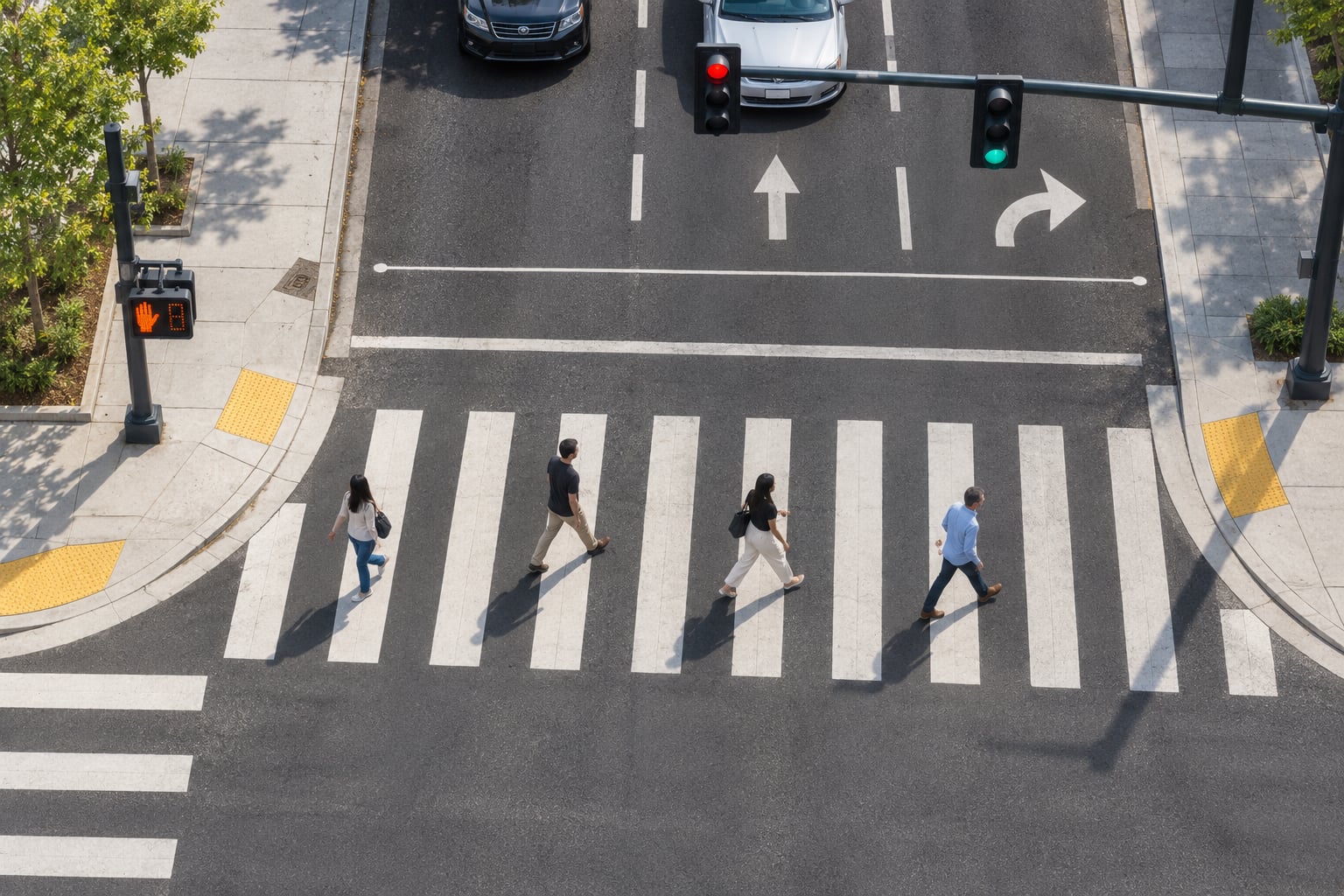
The other recurring complaint is misreading the countdown. The countdown on a modern display runs the clearance interval, not the walk interval. It tells you how long you have to finish, not how long until you can start. People who treat a 3 on the display as a green light to begin walking are starting far too late, which is why the flashing hand feels like it comes on “too early” when it is actually counting exactly as designed.
How a City Reviews and Adjusts Signal Timing
Retiming is a documented cycle, and it is worth knowing the steps because most of them produce records you can ask for.
- Collect data. Turning movement counts, pedestrian counts, and speed data, often from tube or camera counters rather than hand tallies.
- Compare against history. Traffic that never returned to its old volume still gets the old timing unless somebody checks.
- Observe the site. Engineers watch the crossing in person, because counts miss the group of six people who cross together after the light changes.
- Identify the conflicts. Which movements actually conflict, and with which ones.
- Model alternatives. Several phasing options and cycle lengths get run through timing software, usually with a queue and delay model behind them.
- Consult stakeholders. Transit agencies, school districts, accessibility advocates, and the neighborhood association are commonly asked, and their comments become part of the record.
- Implement and monitor. The plan is loaded to the controller, then watched for weeks. Over-coordination or a signal that neighbors complain about gets adjusted again.
Most intersections sit on a routine retiming schedule, and many agencies publish an annual list of planned timing changes. A change made for a school crossing may apply only to a two-hour window on weekdays.
If you want a crossing reviewed, the most productive route is the transportation department or public works traffic signals unit for whichever agency owns that road. Bring specifics rather than a complaint:
- The intersection, the time of day, and the day of the week when it is worst.
- The posted crossing distance and the timing on the countdown display, ideally photographed.
- Who is affected and why, named concretely: a wheelchair user, a school route, a senior housing entrance.
- Whether the problem repeats or is a one-off, and whether the pushbutton seems to register.
For anyone building on open city data, signal phase and timing data is one of the more useful things an agency publishes, when it publishes anything. It enables accessibility audits, crossing-time calculators, and corridor travel-time analysis, and it lets a developer check a real intersection rather than assume.
Frequently Asked Questions
Who decides how long the walk signal is?
A traffic engineer in the agency that owns the road sets it, usually the city transportation or public works signal operations unit, or the state highway department on state routes. The Federal Highway Administration publishes the Manual on Uniform Traffic Control Devices, which defines the walk interval, pedestrian clearance time, and pedestrian change interval, but it does not set the number at your corner.
What is the minimum walk interval at a crosswalk?
Federal guidance sets a minimum walk interval of 7 seconds, lengthened when slower pedestrians need more time to start moving. That is separate from the clearance time, which is the crossing distance divided by the design walking speed. A 60-foot crossing at 3.0 feet per second needs 20 seconds of clearance on top of that walk interval.
Is pedestrian signal timing the same everywhere in the country?
The federal manual provides a common framework, but local agencies apply it with different assumptions, different walking speeds, and different exemptions. Ownership also varies: some cities control their own signals, some state highway departments control them on state routes, and some regional authorities run corridor programs. That is why the same crossing can behave differently in two adjacent towns.
Why does the countdown timer seem to start too early?
The countdown runs the pedestrian clearance interval, not the wait and not the walk. It tells you how long you have left to finish crossing, so it starts as soon as the flashing hand appears. People who read the number as time remaining before starting walk off the curb far too late. The design assumes you stepped off when the solid white figure was showing.
How do cities decide signal timing at different times of day?
Most agencies use several time-of-day plans at one intersection, switching on a clock. A downtown core may run a fixed short cycle all day, while a suburban arterial might use different cycle lengths and splits for the morning peak, midday, evening peak, and night. The switching times are set so drivers do not see a change in the middle of a green, and the plan table is part of the controller configuration.
What can I do if a crosswalk signal feels too short?
File it with the traffic signals unit of the agency that owns the road, and bring the specific crossing, the time of day, the posted distance, and a photo of the countdown. Describe who is affected in concrete terms, such as a school route, a senior housing entrance, or a wheelchair user, rather than saying it feels unsafe. Ask whether a speed assumption change, a plan change, or a phasing change is possible, and request the review in writing so it enters the record.
Conclusion: Start with the Crossing, Not a Universal Number
Understanding how pedestrian signal timing is decided comes down to a measurement with a judgment attached. The engineer measures the distance, divides by a fixed design speed, adds a minimum walk interval, and fits the result into a cycle that has to work for every other movement at that intersection. The judgment sits in the walking speed, the phasing, and the plan that runs at your hour of the day.
So the useful first step is not arguing for a number. Measure the crossing, watch it at the worst time, note what the countdown shows, and name who the change is for. That gets you a conversation with the signal operations unit that can actually change something.