
A city budget document is the legally binding plan of a city’s expected revenues and expenditures for the coming fiscal year. Your council adopts it by ordinance, and it becomes the legal ceiling on what each department may spend in each fund.
Working out how to read a city budget document takes about half an hour once you know the map. Most people give up in the first ten pages because the book opens alphabetically by department, assumes you know what an encumbrance is, and buries the one number most residents care about on page four.
This guide gives you that map. You will learn which five sections of the document matter, why a department’s total almost never matches the general fund line you saw in the news, what fund balance actually means, and how to follow a single dollar from the revenue source to the program that spends it. Then you will know which questions to ask at a council hearing instead of nodding along.
The one habit that separates readers who get value from this: treat the budget as a set of decisions rather than a list of numbers. Every line was chosen, and choices can be questioned.
Table of Contents
- What You Need
- The four stages of the budget process
- Glossary of the terms that block first-time readers
- Step-by-Step
- 1. Confirm Which Budget You Are Reading
- 2. Read the Executive Summary and Budget Message
- 3. Map the Fund Structure
- 4. Compare Totals With the Prior Year
- 5. Follow Money From Source to Use
- 6. Examine the Department and Program Pages
- 7. Read the Capital and Debt Schedules
- 8. Turn the Numbers Into Research Questions
- 9. Check Caveats Before You Draw a Conclusion
- Take part before the vote, not after it
- Two habits that prevent most errors
- Common Mistakes
- Double counting: why the city total keeps changing
- Appropriation versus expenditure
- Reading a restricted fund as available money
- Nominal versus real changes
- Hidden staffing costs
- Misleading capital totals
- Failing to check amendments
- Frequently Asked Questions
- What is the easiest way to learn how to read a city budget document?
- Why does a department have several budget totals in the same document?
- How can I find out how much a city spends on a particular service?
- Does the city budget show what was actually spent?
- How can residents participate in the city budget process?
- Conclusion
What You Need
Assemble the packet before you start. Most cities publish everything below, none of it costs anything, and the process has not changed much in decades, so this guide holds for 2026 as well as earlier years.
- The full adopted budget document — usually a PDF titled “Adopted Budget,” “Budget and Financial Plan,” or simply “Budget Book.” Find it on your city’s finance department or city clerk page, often under Finance, Budget, or Transparency.
- The downloadable spreadsheet version — many portals publish the same numbers in Excel or CSV. It is far easier to compare years than the PDF.
- The prior year’s adopted budget — the single most useful companion document. Almost every question about change needs two numbers, not one.
- The current budget message or council agenda packet — where the proposed version, amendments, and the levy discussion live.
- The capital improvement plan (CIP) — often a separate document from the operating budget.
- A calculator and a spreadsheet — genuinely. You will do a small amount of arithmetic and build your own notes.
Where to find the packet depends on how your city publishes. Three routes cover almost everyone: the city’s own site, usually under Finance or the city clerk’s office; a budget portal operated by a vendor such as OpenGov, Granicus, or CivicPlus, which is often linked from that same page; or your state auditor’s office or municipal league directory, which lists documents for every city in the state when a city’s own site is hard to search.
Search terms that reliably surface the right file: the fiscal year plus “adopted budget,” the word “CAFR” for the audited year-end report, and “budget amendment ordinance” for the midyear changes.
A budget is a policy document that happens to contain numbers. It shows what the city has decided is worth paying for this year, which is why budget documents are written the way they are. Terminology and layout also vary by city: some publish a 90-page reader guide, some publish 400 pages with no map, and the labels for the same fund change across state lines. The categories below are the standard ones, but expect your document’s wording to differ.
The four stages of the budget process
Knowing the calendar helps you read the right document at the right time. Preparation runs from about eight months before the fiscal year starts: departments submit requests and the finance office assembles them against projected revenue. Approval follows, with public hearings and a council vote that adopts the appropriations ordinance. Implementation is the year itself, when departments spend within their limits and council may approve amendments midyear. Evaluation closes the cycle with the independent audit and the published year-end report.
Add three adoption mechanics and you get the seven steps people sometimes count: department submission, finance review and revenue projection, public hearing, council adoption, final levy certification to the county, the implementation year with any amendments, and the audit.
Glossary of the terms that block first-time readers
Define these on first use and nothing else in the document will confuse you.
- Fiscal year — the twelve months the budget covers, which may not match the calendar year.
- Appropriation — the authorized legal ceiling for spending.
- Expenditure — money actually spent.
- Object code — the numbered category an expense belongs to.
- Encumbrance — a purchase order already issued, so the money is spoken for but not yet spent.
- Fund balance — money carried over from a prior year.
- Unencumbered fund balance — carried-over money with no order placed against it.
- Mill — one thousandth of assessed value, the unit property tax rates are quoted in.
- Assessed value — the valuation the tax is calculated on.
- Levy — the rate the city sets and certifies to the county.
- CIP — the capital improvement plan, the multiyear list of construction projects.
- CAFR — the Comprehensive Annual Financial Report, the audited year-end document.
Once the vocabulary is in place, the rest of the document is mostly navigation, and the sections below follow the order a budget book actually uses.
Step-by-Step
1. Confirm Which Budget You Are Reading
Before reading anything else, establish what the document in front of you actually represents. Check the cover page for the fiscal year, the approving body, the version date, and the currency.
A fiscal year is not always the calendar year. Many cities run October through September, or July through June, because tax collection and the audit cycle line up better. Then check the label, because four different documents look similar: a proposed budget (staff’s draft, before council review), an adopted budget (what council approved), an amended budget (adopted plus midyear changes), and a year-end financial report showing actual spending.
Verification: you can state the fiscal year and the version in one sentence without opening the file again. If you cannot, the cover page failed you and you need a different source.
A note on “how to read a city budget document” that saves real time: search the PDF for “adopted” or “amended” before you read a single table. Those two words distinguish the document your council voted on from the version that reflects what actually happened.
2. Read the Executive Summary and Budget Message
The first ten pages are written for you. They are the only part of the document most residents ever read, and they carry the priorities.
Mark as you read: new or expanded programs, staffing changes, any draw on reserves, projected gaps, tax rate assumptions, and references to other plans. A budget message that says the city expects a declining share of assessed value from a commercial property class tells you more about next year’s budget than any table in the document.
Watch the tone. Officials routinely describe flat budgets as stable and describe program reductions as right-sizing. Neither is automatically wrong, but both are framing, and you can only catch it if you read the numbers next.
Verification: you can name the city’s stated top three priorities for the year, in its own words.
3. Map the Fund Structure
Funds are separate pots of money, and each pot has rules about what it may pay for. This is the concept that explains most of the confusion readers report, so it is worth ten minutes of your time.
| Fund | What it pays for | Restricted or flexible |
|---|---|---|
| General fund | Core services: police, fire, parks, libraries, general administration | Flexible — council can adjust it |
| Special revenue fund | Money restricted by law or by the grantor, such as state transportation grants or a parks donation | Restricted — spend it or lose it |
| Capital projects fund | Construction and major renovation, often bond-financed | Restricted to listed projects |
| Debt service fund | Principal and interest on bonds | Fixed by the debt schedule |
| Enterprise fund | Self-supporting services such as water, sewer, transit, or a municipal pool, funded largely by user charges | Restricted — fees must cover the costs |
| Fiduciary funds | Money the city holds or administers on behalf of others, such as pension assets | Held in trust, not spendable |
Here is why the total never matches. A public works department might draw part of its staffing from the general fund, part from a state grant sitting in a special revenue fund, and part from an enterprise fund for the water utility. Add a road project funded by bonds through a capital projects fund, and the department’s total cost can be several times the general fund allocation quoted in a headline.
Formula worth writing down, because it appears in almost every budget and is usually left unexplained:
Ending fund balance + estimated revenues = funds available for appropriation
Verification: pick any department and identify which two or three funds pay for it. If you can name them, the document makes sense.
4. Compare Totals With the Prior Year
Percentages alone tell you almost nothing. Every budget is a series of comparisons, and you need three columns: last year’s actual, this year as adopted, and this year as amended.
Start with the summary financial table near the front. Look at each fund’s total revenue and total expenditure across the three columns, then ask what changed and why. If a department’s spending rose sharply, find out whether it is a new program, a reclassification from another fund, a grant that expires, or a capital project landing in this year.
That last one matters more than most readers expect. Construction money moves in chunks, so a capital-heavy department can swing wildly year to year without any change in staffing or service level.
The revenue side deserves the same treatment, and this is where the local vocabulary gets dense. A property tax levy is a rate expressed in mills, and one mill is one thousandth of assessed value. So a property with an assessed value of 400,000 pays about 400 a year for every mill the city levies. Read the levy in the revenue section, find how many mills it sets, and multiply by your own assessed value. That arithmetic is the fastest way to check whether a proposed increase is real.
Then watch the split between the rate and the base. News coverage often says the mill rate went down, and the bill still went up, because assessed values rose faster than the rate fell. Both statements are true. A rate down is not a bill down, and the budget document is where you can see both halves of that equation. Sales taxes, charges for services, and intergovernmental grants usually make up the rest of a general fund, so read the whole revenue table before assuming property tax is doing the work.
Check the fund balance line while you have the revenue table open. Beginning fund balance is money carried in from last year, and unencumbered means no order has already been placed against it. Councils draw on it to avoid a tax increase, which is legitimate once. Repeating the trick is not, because the money was already spent. A budget that fills a gap from fund balance in the same year it promises flat taxes is structurally unbalanced, and you can see that on the page rather than in a headline.
Verification: for three departments, you can say in a sentence each whether the change is new spending, a one-time item, or a shift in classification.
5. Follow Money From Source to Use
Pick one thing you care about — street maintenance, library hours, a specific park — and trace it end to end. This is the single best exercise in the whole document because it exposes restrictions and overhead that a total hides.
The audit trail runs: revenue source, then fund, then department, then program, then object code, then project. Object codes are the uniform expense categories most cities use, and the numbering is close to standard. Object codes in the 100s are personnel services. Codes in the 200s through 400s cover supplies, commodities, and contractual services. Codes in the 500s are usually capital outlay.
Walk the hypothetical example. Street maintenance in a general fund covers materials and labor. A state grant for road striping sits in a special revenue fund and cannot legally be moved to pothole repair. A transfer from the general fund may cover indirect costs, the share of administration and overhead attributed to the program. And a bond-funded resurfacing project appears in the capital projects fund, not in the maintenance budget at all.
The lesson: one budget line is not a program, and a program is rarely one line.
Verification: you can name at least two funds that touch the program you picked.
6. Examine the Department and Program Pages
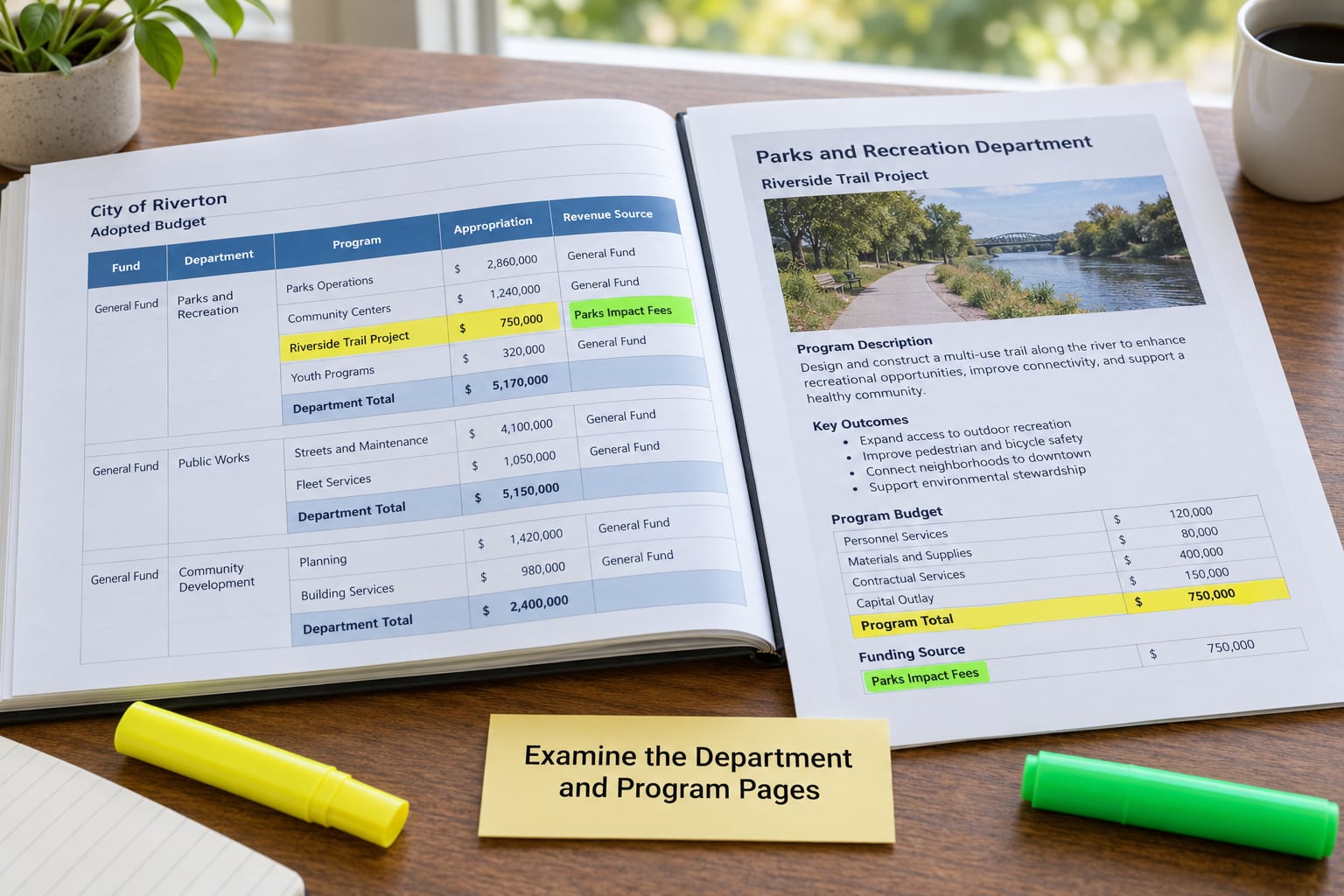
Departmental sections are the meat of the document. Each one usually carries a mission statement, a program breakdown, authorized position counts, and the summary of appropriations by fund.
Look for the personnel table and compare authorized positions with filled positions. A large gap between the two usually means vacancies are budgeted but unfilled, which is why a department’s budget and its actual payroll can differ. Check whether a listed consultant or contract is new, and whether any contract runs multiple years, because multiyear commitments are obligations that stretch beyond this budget.
Separate the categories before you judge a cut. Personnel services behave differently from operating expenses, and capital outlay is not comparable to either. A department with flat spending may still have fewer officers and more contracted security, which reads as a policy decision, not an accounting one.
Verification: you can state the department’s total appropriation, the funds it draws from, and how its authorized positions changed from last year.
7. Read the Capital and Debt Schedules
The capital section lists projects, and the projects carry total costs far larger than any single year’s budget. Read the annual spending line, not the project total. The total is the whole multiyear price; the current-year figure is what was appropriated now.
Then check the financing column. A project funded by bonds creates future debt service in the debt service fund, which competes with services in future budgets. A project funded by grants depends on money you do not control. A project with no funding source listed is a wish, and reading it as a plan is one of the most common errors.
Quick plausibility check: does the project’s annual spending line move smoothly across the years, or does it spike in year one and vanish? Does the schedule match the city’s stated capital plan? Does the debt schedule match the amortization table in the appendix?
Verification: you can name the current-year cost of one project and its funding source.
8. Turn the Numbers Into Research Questions
Keep a running note with six fields: the amount, the source, the trend, the policy purpose, the responsible department, and the question you still have. That last field is the point of the exercise.
Questions that tend to produce real answers: how many positions are funded but unfilled; why did this contract grow faster than the department’s total; what is the reserve policy and what is the current balance against it; why is this project scheduled to start two years from now; and what performance measure tells us whether the spending worked.
Send written questions to the city clerk before the hearing date rather than raising them in the meeting. Written questions create a record, and staff usually respond in writing, which gives you something to check.
Verification: you have one written question with a specific number and a named department.
9. Check Caveats Before You Draw a Conclusion
Almost every real budget carries a footnote that changes the meaning of the number above it. Read the footnotes for the pages you used.
The usual caveats: the budget is on a cash or accrual basis that differs from the year-end report; midyear amendments moved money between departments and programs; some lines are one-time; inflation means a nominal increase can be a real decrease; and reclassifications moved expenses between categories without changing what the city bought.
Before treating a headline number as final, check three later documents: the adopted ordinance, any budget amendment ordinances passed during the year, and the year-end financial report, usually called the Comprehensive Annual Financial Report (CAFR) and issued after an independent audit. That last document is the one that tells you what was actually spent, and it arrives months after the budget does.
| Document | What it tells you | When it appears |
|---|---|---|
| Proposed budget | What staff recommend, before council review | Months before adoption |
| Adopted budget | The plan council approved, with the levy set | Start of the fiscal year |
| Amended budget | Adopted figures plus approved midyear changes | As amendments pass, during the year |
| Year-end actuals / CAFR | What was really spent and received, audited | Several months after year end |
Take part before the vote, not after it
The budget is decided long before most people read it, which is why the participation window matters. Budget hearings are public meetings required by state law, and agendas are posted in advance so you can see what is on the table. Written comment goes to the city clerk, and submitting it early puts it in the record where staff and council have to answer it.
Look specifically for the max-levy hearing. Where the state sets a limit, council must hold a separate, dated public hearing before adopting any property tax levy above that limit, and must explain why it is needed. That is the one meeting where a rate question can actually be asked on the record, and residents often miss it because it is announced with little notice and under a different name.
Residents tracking deficits over several years rather than a single budget cycle tend to be the ones whose comments get answered. Bring the two-year comparison, not the headline, and ask the department to reconcile the change.
Two habits that prevent most errors
Check the fund column header before you add anything up, and check whether the line is personnel, operating, or capital before you compare it to another year. The seven traps that cause the worst misreadings get their own section below.
Common Mistakes
These seven traps cause most bad readings of a city budget, and each one shows up in a specific place in the document.
Double counting: why the city total keeps changing
A fund total, a department total, and a program total can all describe the same spending at different levels of the same hierarchy. When someone adds a general fund total to a department total that already draws from the general fund, the number is meaningless. Read the fund column header carefully to see whether the department figure is fund-specific or all-funds. When in doubt, pick the narrower figure and say so.
Appropriation versus expenditure
Appropriation is authority to spend. Expenditure is spending. Between adoption and year-end they diverge constantly, because some work is contracted but not yet delivered, some projects slip, and some funds carry money forward. When someone claims a city “only spent” a fraction of its budget, that gap is often timing and encumbrances rather than restraint.
Reading a restricted fund as available money
Grant balances and dedicated fund balances look like savings in the summary tables. They are not general money. If a city’s parking fund has a large balance, that balance supports parking operations, not library hours. The correct question is not how large the balance is but what the fund is allowed to spend it on.
Nominal versus real changes
A line that rose has not necessarily grown. Compare the percentage change against the local rate of inflation for the same period, and against the change in the department’s total. A utility line rising while service volume rises faster may mean costs are falling per unit.
Hidden staffing costs
Salary is only one part of personnel services. Health insurance, retirement contributions, overtime, and leave liabilities sit alongside it, and in some years they total more than wages. A department with a flat personnel budget may have lost positions; a department with a rising personnel budget may have gained benefits costs rather than headcount. Read the authorized position table to settle it.
Misleading capital totals
Project totals read as though they are this year’s commitment. They are the whole multiyear price. The appropriation for the current fiscal year is the small number in the annual column, and it is the only one that belongs in a current-year comparison.
Failing to check amendments
Adopted budgets get amended, sometimes several times. Council agendas, minutes, and the clerk’s ordinance index show what changed and when. A number you read in September may no longer be the operative figure in December.
Frequently Asked Questions
What is the easiest way to learn how to read a city budget document?
Start with the reader guide, then the executive summary, then one department you care about. Most cities publish a short guide to the budget written for residents. If yours does not, follow the front summary and the fund tables. Learning how to read a city budget document is mostly about understanding funds first and departments second.
Why does a department have several budget totals in the same document?
Because the department draws money from more than one fund. Core operations usually come from the general fund, grant money sits in special revenue funds, and construction comes from capital projects funds. Each fund has its own rules and its own restrictions, so the city reports the pieces separately and then shows a combined total. Look for the fund breakdown under the department heading.
How can I find out how much a city spends on a particular service?
Search the document for the department name, then read its program breakdown, and note which funds pay for each program. Add the general fund line and any restricted fund lines that support the same program. Use the prior year’s document too, so you can see whether the service grew or shrank rather than only what it costs now.
Does the city budget show what was actually spent?
No. A budget shows what was appropriated, not what was spent. Actual spending appears later in the year-end financial report, usually the Comprehensive Annual Financial Report, issued after an independent audit. In between, the amended budget shows approved changes. For the honest picture of a closed year, go straight to the audited report.
How can residents participate in the city budget process?
Attend the budget hearings, which are public meetings required by state law, and send written comment to the city clerk before the vote so it enters the record. Watch for the max-levy hearing, a separate dated event where the council must explain any proposed property tax increase above the statutory limit. Council agendas and minutes are public and posted in advance.
Conclusion
Start with five actions on your next sitting: confirm you have the adopted budget for the right fiscal year, record the total spending figure from the summary table, identify which fund your concern lives in, compare that line against the prior year, and write down your first policy question. Then follow the document into the amended version and, when it arrives, the audited year-end report.
None of this requires an accounting background. It requires knowing that funds restrict money, that appropriations are ceilings rather than spending, and that the budget is a record of choices rather than a list of obligations. Once you can trace money from a revenue source to a program, you can ask better questions about anything the city does next.