If you want the short version of how roundabouts improve intersection safety, it is geometry rather than signage. The shape of the intersection forces drivers to slow down, cuts the number of points where vehicles can collide, and removes the severe angle crashes that kill people at crossings. The Federal Highway Administration reports an average 82% drop in fatal and injury crashes compared with two-way stop-controlled intersections.
The rest of this guide covers the mechanisms one at a time, the crash research behind them, where roundabouts disappoint, and how a community can check whether a specific one actually worked.
Table of Contents
- What Is a Roundabout and Why Is It Safer?
- How Roundabouts Improve Intersection Safety
- Why Do Vehicles Slow Down in Roundabouts?
- How roundabout design controls speed
- How Do Roundabouts Reduce Dangerous Conflicts?
- Why severe crashes decline at roundabouts
- What Does the Crash Evidence Show?
- Are Roundabouts Safer for Pedestrians and Cyclists?
- Why Can Some Roundabouts Still Have Problems?
- How Can a Community Know a Roundabout Worked?
- How to Improve an Existing Roundabout Safely
- Frequently Asked Questions
- Do roundabouts really improve intersection safety?
- Are roundabouts safer than traffic lights?
- Are roundabouts safer for cyclists and pedestrians?
- Why can a roundabout cause drivers to speed up?
- How long after construction is a roundabout’s safety measured?
- Can an existing intersection be converted into a roundabout?
- Conclusion
What Is a Roundabout and Why Is It Safer?
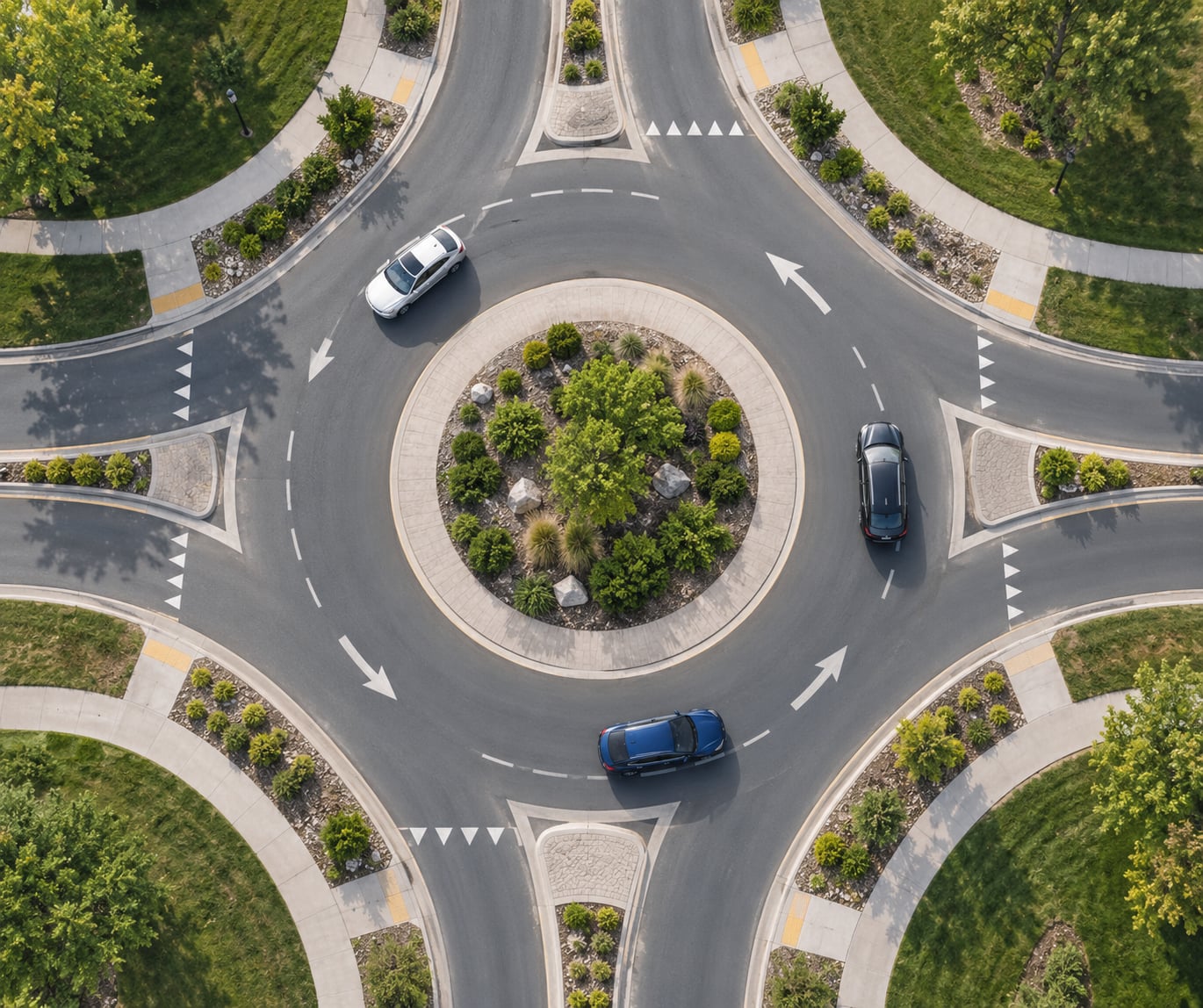
A modern roundabout is a circular, yield-at-entry intersection. Vehicles slow on curved approaches, give way to traffic already circulating counterclockwise around a landscaped central island, and leave through splitter islands that separate the exit from the road they came in on.
Older traffic circles in the United States, built mostly in the 1950s, failed badly. Drivers entered without yielding, circulations were too small for trucks, and crashes were frequent. Today’s designs are deliberately different, and those design rules are what produce the safety record.
The core parts matter to anyone evaluating a site: the central island, the circulatory roadway, the splitter islands between entry and exit, and the truck apron — a mountable inner ring that lets long vehicles sweep the corner without striking the island curb. Each part pulls a different driver behavior into the open.
How Roundabouts Improve Intersection Safety
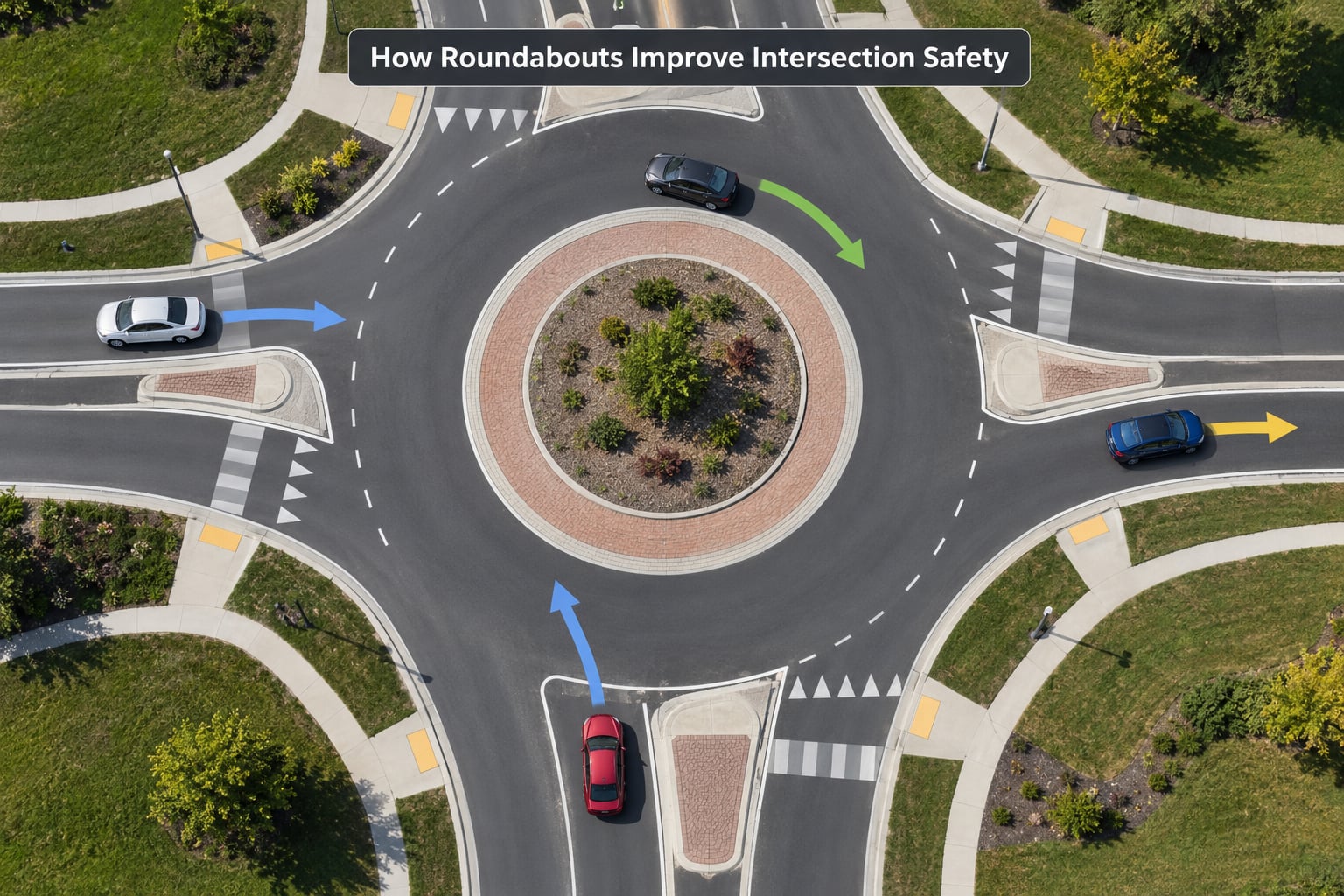
Four mechanisms carry nearly all of the benefit, and they reinforce each other:
- Lower operating speed. Curvature holds vehicles to roughly 15 to 25 mph on average through the junction, well under typical approach speeds.
- Fewer conflict points. A standard four-leg intersection has about 32 vehicle-to-vehicle conflict points; a roundabout of comparable legs has about 8.
- Severe crash types removed. Continuous counterclockwise flow eliminates the crossing and turning conflicts that produce T-bone impacts.
- Simpler crossings for people walking. A pedestrian crosses one direction of traffic at a time, with a splitter island refuge between the carriageways.
The table below sets roundabouts against the three other common control types. Note the last row: a roundabout depends on human yielding far more than a signal does, and that is a real vulnerability. Understanding how roundabouts improve intersection safety means separating what the shape of the road fixes from what it merely asks a driver to do.
| Factor | Roundabout | Signalized intersection | Four-way stop | Two-way stop control |
|---|---|---|---|---|
| Typical operating speed through the junction | 15 to 25 mph | Speed controlled by signal timing, often unchanged | Speed controlled by stops, often poorly observed | Major road speed largely unchanged |
| Dominant conflict type | Merge and exit conflicts at low speed | Right-angle crashes at 45 to 90 degrees | Right-angle crashes at low but variable speed | Right-angle crashes at approach speed |
| Decisions demanded for the driver | Yield, then choose a lane and exit | Watch the signal and the road | Full stop on every approach | Stop only on the minor road |
| Crash severity profile | Lower, mostly low-speed sideswipe and rear-end | Mixed, with a high fatal share from angle impacts | Mixed, with substantial angle crashes | Worst of the four, because speed is highest |
| Dependence on human behavior | High — yielding drives every benefit | Low — the signal enforces flow | Medium — everyone must stop | Medium — only one road must stop |
Why Do Vehicles Slow Down in Roundabouts?
Speed reduction is the hinge of the whole safety case, because impact energy rises steeply with speed. It is also the mechanism most often overstated: drivers slow because the road makes speed uncomfortable, not because a sign asks them to.
How roundabout design controls speed
Designers get the speed reduction from several interacting features. Entry deflection sets the approach path on a curve that the eye reads as a turn, so drivers scrub speed before they reach the yield line. Lane width is set deliberately narrow — wide circulating lanes invite higher speeds. Entry and exit angles are offset so that entering drivers must scan across the circulating stream, a search task that further slows them.
That last point deserves emphasis. A straight, obvious entry produces faster approach speeds than an angled one, because angled entry forces a head turn and a scan of circulating traffic. The distinction matters when judging a site: some roundabouts achieve their target speed purely from geometry, while others rely on drivers obeying a posted limit that is easy to ignore.
Curve radius on the circulatory roadway does the same work at the apex. A tighter radius means a slower path through the circle. Consistency matters too — a driver who experiences a very gentle first roundabout will carry that speed into a tighter one.
How Do Roundabouts Reduce Dangerous Conflicts?
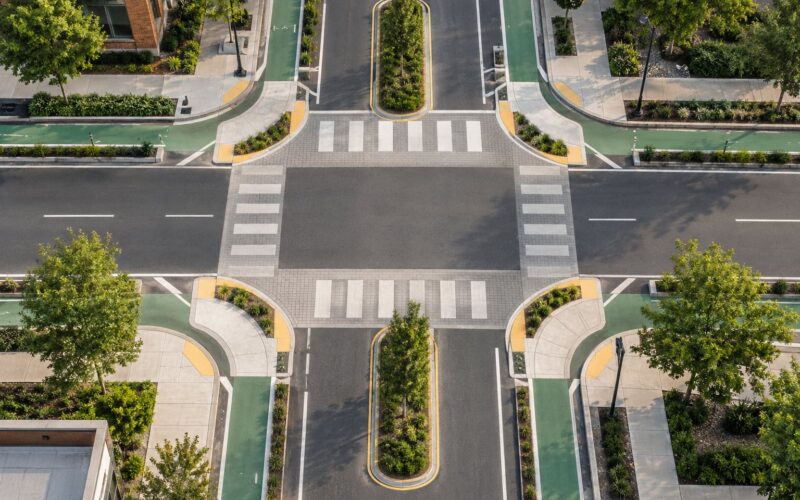
A traditional intersection of two two-way roads is a lattice of crossing paths. Every turn-across-traffic and through movement meets another path at a right angle, at whatever speed the approach carries. Those crossing points are where severe crashes happen.
A roundabout reorganizes the same movements. Every vehicle enters, merges into a single counterclockwise stream, and exits. Turns across oncoming traffic simply disappear, because there is no oncoming stream to cross. What remains is a short merge at each entry and a divergence at each exit, and both occur at circulating speed rather than approach speed.
Pedestrian conflicts drop by the same mechanism. At a conventional crossing, a walker can face vehicles from several directions at once. At a roundabout crossing, they face one direction, step onto the splitter island, then face the other. Vehicle-to-pedestrian conflict points drop from about 24 at a standard four-leg intersection to about 8.
Why severe crashes decline at roundabouts
Two physical effects do the work. First, impact angle: a near-perpendicular hit transfers energy into the occupants far worse than a shallow glancing one, and the roundabout geometry eliminates the perpendicular case almost entirely. Second, closing speed: at 20 mph the crash is survivable for most people; at 45 mph it frequently is not.
This is also why redirecting heavy vehicles changes rather than simply removes crashes. A truck that cannot follow the circulatory path will mount the truck apron, which can produce sideswipes with cars beside it. Roundabouts tend to push heavy vehicles onto designated truck routes, and in doing so they change the mix of crash types at a site rather than deleting crashes wholesale.
What Does the Crash Evidence Show?
The headline numbers are consistent across large American databases, and they come from named authorities rather than advocacy.
- 82% fewer fatal and injury crashes than at two-way stop-controlled intersections (FHWA).
- 78% fewer fatal and injury crashes than at signalized intersections (FHWA).
- Up to 90% fewer fatal crashes and 76% fewer injury crashes (IIHS).
- 30 to 40% fewer pedestrian crashes, but only about 10% fewer bicycle crashes (IIHS).
- 34% fewer injury crashes and 38% fewer crashes involving vulnerable road users in Flanders, Belgium, after roundabouts replaced priority intersections (De Brabander and colleagues, 2005).
- 41 to 61% mean crash reductions in Australia, with further reductions reported in Germany and the Netherlands (FHWA and NACTO synthesis).
So how much do roundabouts reduce crashes overall? The honest answer depends on the comparison. Roughly 80% against stop control, roughly 78% against signals for fatal and injury crashes combined, and a smaller overall reduction — around 39% in IIHS figures — when every crash regardless of severity is counted. The large percentages describe severe crashes, and severe crashes are where the benefit concentrates.
| What the evidence supports well | How it is usually studied | What cannot be generalized |
|---|---|---|
| Large reductions in fatal and injury crashes at treated intersections, reported consistently in the United States and Europe | Before-and-after comparisons at the same junction, using several years of pre- and post-construction data | Whether a specific unbuilt junction will match the average |
| Reductions in right-angle and T-bone crashes of roughly 35%, offset partly by more rear-end collisions | Some studies add a comparison site of similar size and traffic so the local trend can be removed | Total crash counts, since the crash-type shift limits the drop in raw numbers |
| Lower operating speeds of 15 to 25 mph through the junction | Spot speed and travel time studies, plus on-site conflict observation | Crash exposure adjusted for traffic volume, which before-and-after counts rarely handle well |
| Pedestrian crash reductions of 30 to 40% at well-designed sites | Regional crash databases filtered to roundabout locations | Bicycle safety, where reductions near 10% are the weakest of the gains |
Two methodological cautions matter. Installed roundabouts are usually built at high-crash locations, so before-and-after comparisons without a control site overstate the gain — some crashes would have fallen anyway. And frequency and severity must be read separately: a roundabout can hold total crashes nearly flat while cutting fatal and serious injury crashes by a large margin.
Are Roundabouts Safer for Pedestrians and Cyclists?
For pedestrians, generally yes. A person crossing a roundabout faces traffic from one direction at a time, at speeds a design can hold to 15 to 25 mph. Survival prospects at 20 mph are far better than at 45 mph, and the splitter island means you never have to judge two streams at once.
For cyclists, the record is much weaker. Bicycle crash reductions cluster around 10%, well below the pedestrian gains. In multi-lane roundabouts, a cyclist circulating in the outer lane must be passed by vehicles that change lanes on the way out, and circulating drivers frequently fail to yield on a turn.
Design mitigations exist and are worth asking about: off-roadway paths that separate cyclists from the carriageway entirely, adequate deflection so the entry speed is genuinely low, apron width a cyclist can ride on, and truck aprons sized so large vehicles do not occupy that space. Where those are missing, riders are asked to accept a shared lane at speed, which is where most of the remaining risk sits.
Why Can Some Roundabouts Still Have Problems?
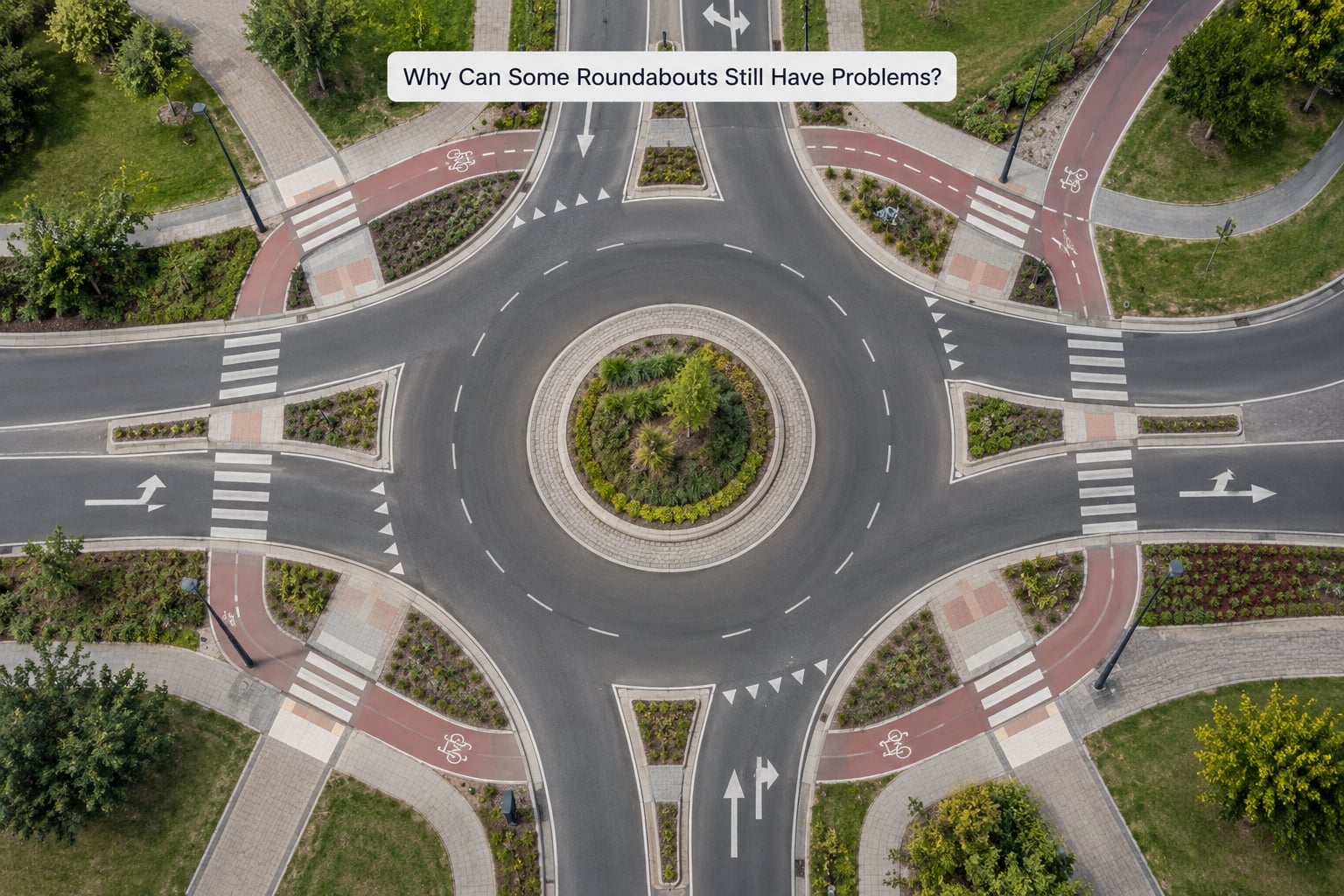
Drivers who complain online about roundabouts rarely object to the concept. The recurring complaints point at geometry and at other people’s behavior, and each has a known response.
- Excessive entry speed. Usually an entry-angle or radius problem. The response is redesigning deflection, not posting a lower limit.
- Hidden or confusing signs. Advance signs that arrive too late leave drivers braking hard inside the junction. Move them upstream and size them for actual approach speed.
- Overly tight geometry. A circle designed too small for the truck fleet forces apron riding and sideswipes. Enlarge the inscribed circle diameter.
- Weaving at busy entries. Entry and exit paths overlapping can force lane changes inside the circle. Separate the paths geometrically, or add spiral lane markings.
- Blocked sight lines. Landscaping, fencing, or parked vehicles on the approach hide circulating traffic. Keep the sight triangle clear.
- Unsafe parking on the circulatory roadway. Where parking is permitted at all, it undermines the entire speed mechanism.
- Transition between treatments. A driver moving from a signalized intersection to a roundabout, or between roundabouts with different priority rules, has to renegotiate right-of-way mid-journey.
- Driver education that never updated. In communities where roundabouts arrived without refreshed guidance, behavior rather than design drives most of the crashes.
Yield violations belong in that last group. When a driver enters too fast, circulating traffic must brake or swerve, and the geometry advantage is lost in a moment. This is the failure mode most visible in driver forums, and it is a behavior problem rather than a structural one.
How Can a Community Know a Roundabout Worked?
Before-and-after crash counts are the obvious check and often the only one offered. They are necessary and they are not sufficient. A useful evaluation pulls several strands together:
- At least three years of crash data on each side of the conversion, ideally five, to smooth out year-to-year variation.
- Severity-weighted counts — fatal, injury, and property damage reported separately rather than summed.
- Exposure: traffic volume over the same period, so a rise in traffic is not mistaken for a rise in risk.
- Observed approach and circulating speeds, which are cheap to measure and often more sensitive than crash counts in the early years.
- Vulnerable road user outcomes reported by mode, since pedestrian and bicycle results diverge sharply.
- Qualitative input from residents, which surfaces complaints a crash file will never record.
Use a comparison site — a nearby intersection of similar size and traffic that was not converted — when the local crash trend has shifted for unrelated reasons. Without it, you are attributing the whole change to the roundabout.
How to Improve an Existing Roundabout Safely
If a roundabout already exists and performs poorly, the useful sequence is short and mostly diagnostic. Commission a road safety audit covering speed, sight distance, signage, markings, pedestrian provision and nighttime visibility. Check the site against the applicable current guidance for inscribed circle diameter, entry deflection and lane width.
Then address what the audit found: refresh markings and advance signs, correct entry geometry or sight distance where warranted, fix pedestrian and bicycle access gaps, and remove parking that encroaches on the circulatory roadway. Instrument the approach so you can measure speed before and after rather than assume the change worked.
Geometry changes need site-specific engineering review against current design standards, not a copy of another jurisdiction’s fix. A modification that helps one approach can create a visibility problem at the one behind it.
Frequently Asked Questions
Do roundabouts really improve intersection safety?
Yes, and the effect is large for severe crashes. The Federal Highway Administration reports an average 82% reduction in fatal and injury crashes compared with two-way stop-controlled intersections, and 78% compared with signals. The gains come from lower speeds and fewer crossing conflicts rather than from enforcement. Total crash counts fall by less, because rear-end collisions rise as right-angle crashes fall.
Are roundabouts safer than traffic lights?
On the evidence, yes, for fatal and injury crashes specifically. IIHS reports up to 90% fewer fatal crashes and 76% fewer injury crashes at roundabouts than at signalized intersections. Signals do hold one advantage: they do not depend on drivers yielding correctly. A signal enforces right-of-way every cycle, whereas every safety benefit at a roundabout rests on a human decision made several times per minute.
Are roundabouts safer for cyclists and pedestrians?
The two groups get very different answers. Pedestrian crashes fall by roughly 30 to 40%, because walkers cross one direction at a time at much lower speeds and have a splitter island refuge. Bicycle crash reductions cluster around 10%, far weaker. Off-roadway bicycle paths and low entry speeds close most of that gap; where cyclists share the circulatory lane, risk is much higher.
Why can a roundabout cause drivers to speed up?
When entry deflection is weak, the approach reads as a straight road and drivers arrive fast. Wide circulating lanes, a large radius, or a posted limit well above the design speed all produce the same result. Counterclockwise flow also invites lane-cutting and side-swiping by drivers treating the circle as a racetrack. These are geometry faults, and the fix is redesign rather than signage.
How long after construction is a roundabout’s safety measured?
Most published evaluations use at least three years of data on each side of the conversion, and five years gives a more reliable picture. Crash counts alone can be misleading early on because severity changes show up faster than frequency. Measured speeds and observed conflicts are usually available within weeks and often give the first useful signal, though they do not replace a full crash review.
Can an existing intersection be converted into a roundabout?
Sometimes. The constraints are space, drainage, right-of-way width, nearby driveways and turning requirements for large vehicles. Rural junctions, ramp terminals, four-way stops and high-speed approaches are frequent candidates. Dense downtown blocks often are not, and a mini roundabout may be the realistic alternative. Only a site-specific engineering study can tell, so treat the conversion as a question to ask, not a budget line.
Conclusion
Roundabouts improve intersection safety by managing speed and reshaping conflicts. Lower approach speeds, one-way circulation and crossings taken one direction at a time remove the conditions that produce fatal angle crashes at conventional intersections.
Design quality decides whether a specific site gets those benefits, and the honest evidence includes a rear-end crash increase and a bicycle result that is much weaker than the pedestrian one. Start by pulling the crash severity breakdown, measured speeds and pedestrian or bicycle experience at the specific intersection before deciding anything, then get a road safety audit on it.