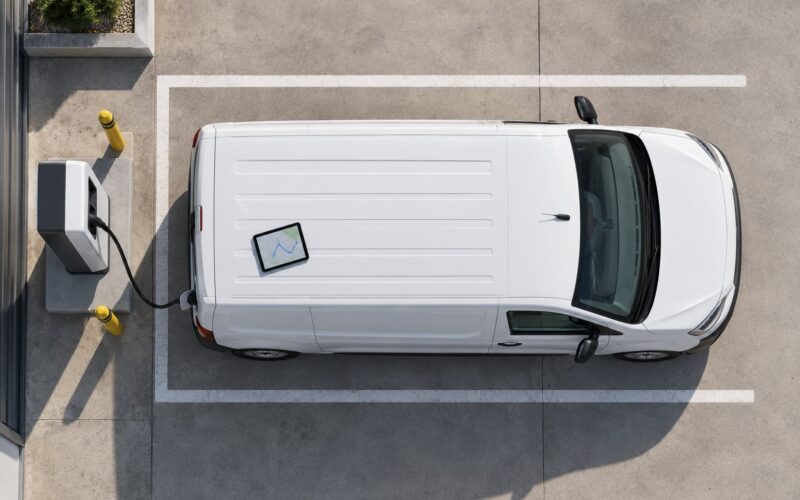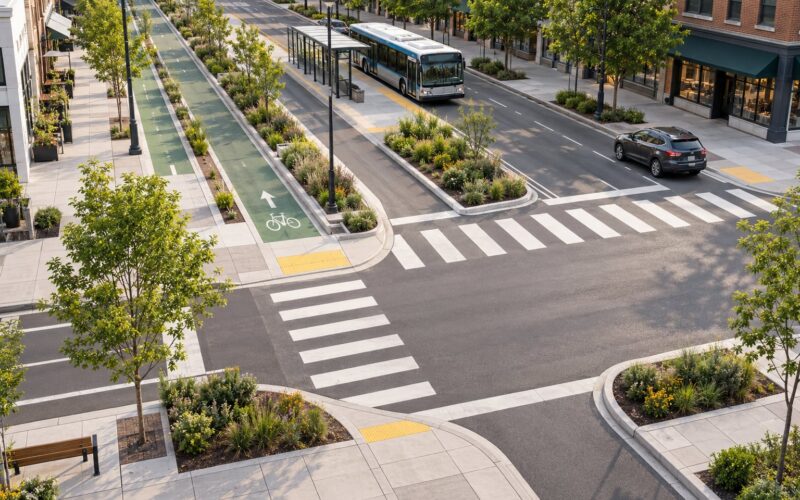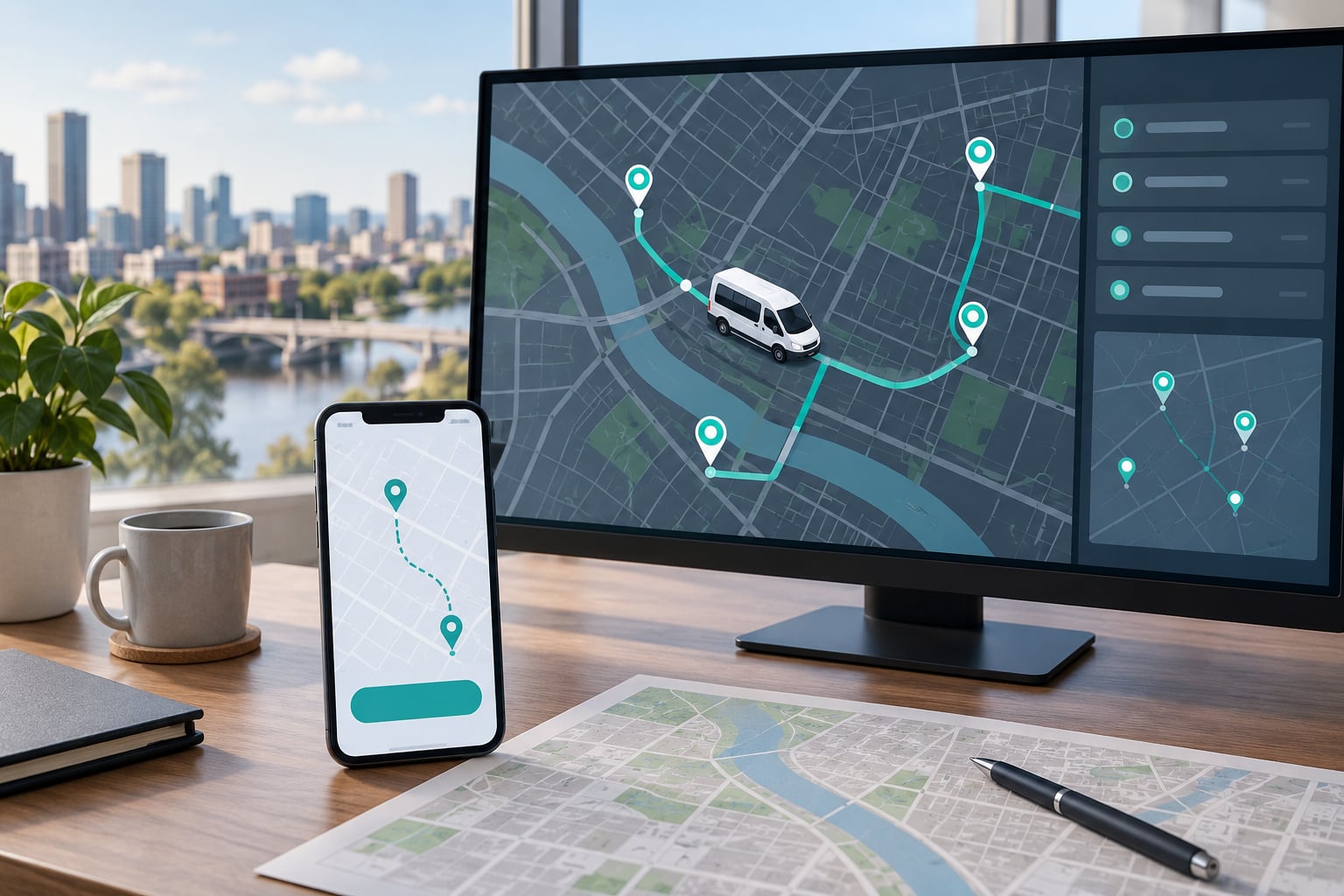
Microtransit services operate as on-demand shared rides in small vehicles, usually 6 to 20 seats, dispatched inside a defined service zone. A rider requests a trip by app or phone, the system matches it to nearby vehicles heading the same way, and one vehicle collects several riders before dropping them at virtual stops. Fares are usually paid in the app or with a transit card, and most rides are subsidized by a city or transit agency. This guide walks the whole operating model, from the moment someone taps request to the metrics a city uses to decide whether to keep the service.
The interesting part of microtransit is what happens between the booking and the curb. Software picks the vehicle, dispatchers watch the exceptions, drivers have rules about who they can pick up and when, and the service boundary decides whether a trip is possible at all. Understanding how microtransit services operate means understanding those rules, not just the app.
Table of Contents
- What Is Microtransit?
- How Microtransit Services Operate From Request to Drop-Off
- How microtransit services operate behind the app
- How scheduling and shared rides differ from on-demand immediacy
- Who Provides and Funds Microtransit?
- How Riders Pay for a Microtransit Trip
- How Vehicles, Drivers, and Dispatchers Are Organized
- How Microtransit Service Areas and Schedules Are Set
- How Accessibility and Rider Eligibility Work
- What Technology Runs a Microtransit Program?
- How Cities Measure Whether Microtransit Works
- Frequently Asked Questions
- How does microtransit work?
- What is the difference between paratransit and microtransit?
- Is microtransit good?
- Can I book a microtransit ride without a smartphone?
- How do you pay for a microtransit ride, and can I use a transit card?
- What happens if my microtransit ride is late?
- Conclusion
What Is Microtransit?
Microtransit is a public or quasi-public mobility service that dynamically routes and schedules 6- to 20-seat vehicles to serve passengers within a defined region. That definition comes from researchers at the UC Irvine Institute of Transportation Studies, and it is the one most planners use because it separates microtransit from ordinary charter buses and from app-based ride-hailing.
The three parts that matter are the small vehicle, the dynamic routing, and the boundary. Vans and cutaway buses of 6 to 20 seats do the work. Routing and scheduling are decided at request time rather than published in advance. And the service only exists inside a drawn zone, during set hours, for riders who meet the eligibility rules.
That last point is the one riders miss. On-demand sounds unlimited, but a microtransit program is a managed service with edges, and the edges are deliberate.
Here is where microtransit sits against the other things people call it:
| Service | Who rides | How it routes | Typical vehicle | How you book |
|---|---|---|---|---|
| Microtransit | Everyone in the service area | Dynamic, per request | 6 to 20 seat van or cutaway | App, web, or phone |
| Fixed-route bus | Anyone | Published timetable and stops | 40 foot bus or smaller | Walk up, no booking |
| Bus rapid transit | Anyone | Fixed corridor, high frequency | Articulated bus or tram | Walk up, no booking |
| Demand-responsive transit | Registered riders, often by referral | Flexible, some fixed patterns | Small cutaway | Advance reservation by phone |
| Paratransit | Riders with qualifying disabilities | Scheduled per passenger | Cutaway or accessible van | Eligibility certification first, then booking |
| Ride-hailing | Anyone with a smartphone | Optimized per ride, rarely shared | Private car | App only |
| Traditional taxi | Anyone | Hail or dispatch | Sedan or accessible cab | Street hail, phone, or app |
The distinction from ride-hailing is the sharpest one. A private ride-hail car takes one party from one origin to one destination. A microtransit vehicle is a shared, public-service asset that pools riders going in roughly the same direction, and that pooling is what makes a public fare possible.
Arlington, Texas runs one of the most-cited examples, and Los Angeles County scaled a countywide version of it. Both are useful reference points, but the operating mechanics are similar almost everywhere.
How Microtransit Services Operate From Request to Drop-Off
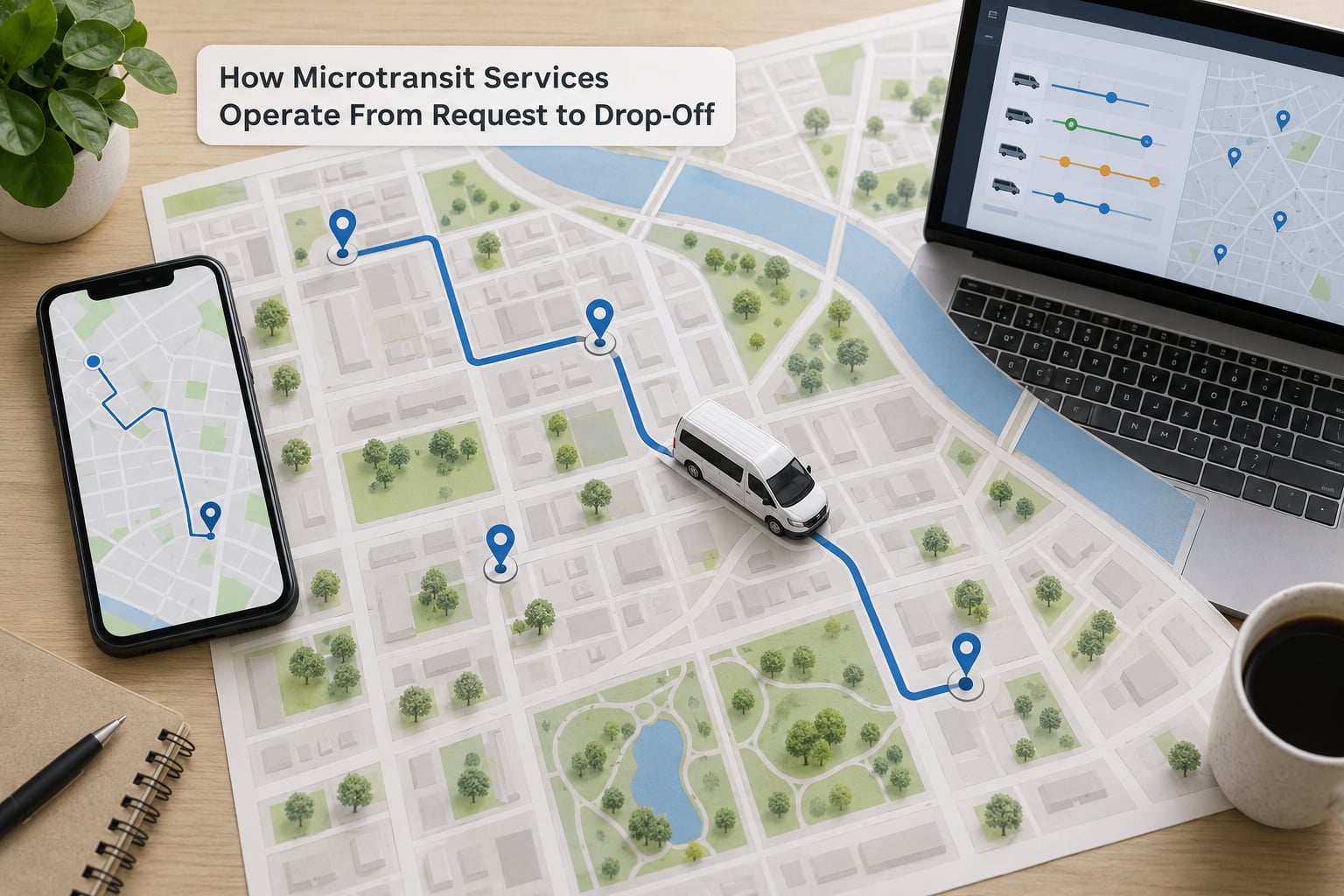
A single trip passes through six stages. Each stage has an owner, a piece of software, and a rule that can send the trip sideways.
1. The request. The rider opens the app, confirms a pickup point, enters a destination, and picks a service time, or calls a phone line and a booking agent does the same thing. The system checks the origin against the service zone before anything else. A pickup outside the zone is usually rejected at that moment, not at the curb.
2. Match and assign. The dispatch engine looks at nearby vehicles, their current load, their remaining shift, and the direction they are already heading. It assigns a vehicle and a pickup point. A rider traveling alone may be given a scheduled time and a specific corner rather than an immediate car, because pooling two riders onto the same leg is far cheaper than giving each one a dedicated trip.
3. The pickup window. Instead of a single arrival time, the rider usually gets a window, often 15 to 30 minutes wide. The app shows a live estimated arrival time and a map that moves as traffic changes. The window is not a promise of precision. It is the trade a rider makes for a shared ride and a lower fare.
4. Pickup. Riders wait at the assigned virtual stop, which is a point on the map rather than a fixed pole. The vehicle identifies the rider by name, pickup code, or app confirmation. No-shows matter, because a vehicle that rolls to an empty corner has burned a paid mile, so many services track and penalize them.
5. The ride. The vehicle may pick up and drop off other riders along the way, and the route reshuffles as new requests arrive. Riders who expect a private ride often find this is the part that takes adjustment, and it is the part that makes the service affordable.
6. Drop-off and close-out. The rider is dropped at the assigned destination point and the trip closes automatically. Payment settles, the rating prompt appears, and the agency logs the trip for its performance reporting.
How microtransit services operate behind the app
The rider-facing app is the smallest part of the system. Underneath it sit a booking platform, a routing engine, a dispatch console, telematics in each vehicle, and a payment processor. The routing engine is what makes a request match or not match, and dispatchers override it constantly. A rider who needs a wheelchair-accessible vehicle, a service animal, a caregiver traveling along, or a multi-stop trip will usually be handled by a person rather than by the automatic match.
Dispatchers work the exceptions queue. A vehicle running late, a rider who cannot find the pickup point, a request inside the zone but outside the service span, a standing rider on a busy evening, or a trip that needs a supervisor approval. In most programs the software handles the routine majority and the dispatcher handles everything unusual, and the ratio between those two categories is a good sign of platform health.
How scheduling and shared rides differ from on-demand immediacy
Microtransit is not one service model. Most programs mix modes, and the mix changes by hour and by zone.
Immediate or app-based dispatch serves walk-up demand in busy zones, usually where the service is running most hours. Scheduled or advance-booked service runs where demand is thinner, where the agency needs to guarantee a connection to a timed train or bus, or where labor is too scarce to keep a vehicle on the road. Pooled and corner-to-corner service drops riders at a nearby hub instead of their exact address, which shortens the route and makes pooling feasible.
A rider who books 90 minutes ahead in a suburban zone and a rider who requests a car right now downtown are using the same brand and getting two different products. The app usually shows the difference at booking time, and it is worth reading.
Who Provides and Funds Microtransit?
Microtransit runs on one of three operating models, and the choice determines who owns the vehicles, who employs the drivers, and who answers the phone at 6 a.m.
Software-only vendor. The agency buys or licenses the platform and runs the service with its own staff and, often, its own drivers. The vendor supplies booking, routing, dispatch, and rider apps, sometimes white-labeled with the agency’s name. This model keeps the most control in public hands and puts the most operational risk there too.
Full-service operator. A company like Via Transportation, RideCo, or MTM Transit supplies the platform, recruits and manages drivers, maintains vehicles, and runs dispatch. The agency sets the zone, the fares, and the service standards. This is the most common model for a city launching quickly without building a transit operations division.
Public agency operation. The transit agency or a municipal department employs drivers directly, owns the fleet, and uses software for booking and dispatch. Arlington, Texas built this model from the ground up rather than contracting it out.
Funding comes from the same shortlist most transit programs use. Federal and state grant programs for mobility management, rural and suburban transit assistance, and paratransit modernization are common. Local funds cover most of the rest, with a farebox that is usually a small share of total cost. Congestion management, parking revenue, and development impact fees show up in some cities. Employers, healthcare plans, and nonprofits sponsor specific programs, most often non-emergency medical transport or job-access service for a defined population.
One more funder deserves its own line, because it appears in city after city. Advertisers. Programmatic ad placements in the rider app and in the vehicle are a real funding stream, and they come with a condition: the rider experience stays clean and the ad never touches a safety, accessibility, or account message.
Nonprofits and community organizations often appear as delivery partners rather than funders. They run the booking outreach, the eligibility certification, and the rider support that make the service usable for people who do not find apps intuitive.
How Riders Pay for a Microtransit Trip
Fare structure matters more than people expect. Riders ask about it constantly on transit forums, and the recurring question is always the same: does my transit card work?
Most programs run account-based fares. The rider creates an account, adds a card to a wallet or to a stored-value account, and the fare settles when the trip closes. Fares usually include a small base plus a per-mile or per-minute component, and many programs cap the fare for a subsidized category so the cost stays predictable.
Several common structures sit underneath that:
- Flat zone fare. One amount for any trip inside the zone, which riders understand instantly and which is easiest to explain at a bus stop.
- Distance-based fare. A base plus a per-mile charge, which matches the cost drivers actually incur.
- Passes and subscriptions. Monthly or weekly passes for regular riders, usually cheaper per trip for people who ride often.
- Cash on board. Less common, and where it exists it may mean exact change, because the vehicle may not carry a fare box.
- Transit card integration. The rider pays with the same card used on the fixed-route network, sometimes with a transfer credit when the trip connects to a bus or train.
- Subsidized or sponsored fares. Reduced or zero-cost trips funded by an employer, a healthcare plan, a nonprofit, or a city equity program, with eligibility certified in advance.
Equity is the pressure point. A rider without a smartphone or a bank account cannot use an app-only, card-only system, so a phone booking line with a booking agent is not a courtesy. It is the access mechanism. Forum discussion around microtransit launch programs in places like Marietta and Los Angeles tends to circle the same worry: riders hear about an app and assume the fare card, the cash option, and the phone line are being cut instead of kept.
Accepted payment options vary by city, and the honest answer to “can I use my transit card” is to check the specific program, because a regional card may work in one zone and not the neighboring one.
How Vehicles, Drivers, and Dispatchers Are Organized
Fleet size is the biggest cost lever and the biggest service lever. Too few vehicles and wait times climb. Too many and empty miles eat the budget. Agencies usually set a baseline fleet for the core service span, then add surge vehicles for weekday peaks, stadium crowds, or shift changes at a hospital or campus.
Vehicles are typically 6 to 20 seat vans and cutaway buses, with a mix of accessible and standard configurations. A wheelchair-accessible vehicle is not a nice-to-have in most programs; it is part of the licensed fleet. Vehicles are usually owned or leased by the agency or the operator, wrapped in agency branding so riders can tell a booked car from a private one at the curb.
Drivers usually need a commercial passenger endorsement on top of a standard license, plus platform-specific training: the booking app, vehicle inspection, wheelchair securement, service-animal handling, and the zone’s rules. Pay structures vary. Some drivers run a fixed shift with hourly pay, others take a per-trip or per-service-hour rate plus a mileage component, and the per-trip model changes driver behavior noticeably because waiting time is unpaid.
Shifts are built around the service span rather than a standard commute. A late-evening program may run two shifts with a break rule that requires the vehicle return to a hub, because a shared vehicle cannot simply be parked mid-zone mid-trip. Maintenance follows the same logic: cleaning, inspection, and refueling sit between blocks, and a vehicle out of service disappears from the pool that dispatch can assign from.
Backups are the quiet difference between a smooth evening and a bad one. A program that holds one or two spare vehicles and has a list of on-call drivers absorbs a breakdown. A program running every vehicle every hour turns one repair into a wait-time spike.
How Microtransit Service Areas and Schedules Are Set
Service zones are usually drawn around a geography where fixed-route service is weak: a suburban district, a rural county, a university campus, a hospital campus, or the area around a transit hub that riders need to reach on time. The zone is enforced in software as a geofence, so a booking that starts outside it fails immediately rather than becoming a complaint later.
Zones can overlap a fixed route. That is normal and intended, and it is the single biggest source of rider confusion. When a bus and a microtransit van cover the same street, the agency has to say which one to use, and riders will ask that question on forums. Riders also ask whether the program replaces their bus route, and the honest answer is usually that it was designed to absorb or complement specific low-ridership trips. Riders in r/transit have been debating exactly this tradeoff between BRT, microtransit, and ordinary bus for years.
Service span is the second boundary. Most programs run roughly 6 a.m. to 9 p.m. on weekdays and fewer hours on weekends, with some pilot programs running only peak periods or only a summer season. Rural deployments such as those referenced in r/vermont often run a narrow span because the demand never justifies a full day of vehicles.
Advance reservation rules are the third. A dense downtown zone may accept a request for right now. A suburban zone may require 30 to 60 minutes of notice, and a rural or late-night service may require booking by a cutoff the previous day. These limits exist because the vehicle has to be positioned before it can serve you, and pooling is only possible if the software knows the whole day’s request list in advance.
Peak demand is where most riders notice the difference. When requests exceed supply, a program can raise the notice requirement, widen the pickup window, cap the number of bookings per vehicle, or close the zone at a capacity threshold. Riders experience those actions as “the app said 45 minutes for 6 a.m. but the phone line said tomorrow.” Both are the same system reacting to load.
How Accessibility and Rider Eligibility Work
Eligibility depends on the program. A general-access microtransit service in a service zone is open to everyone who meets the geographic and account rules. A subsidized program, a senior service, or a job-access service adds an approval step: a proof-of-age, residency, referral from a healthcare provider, or certification from a human services agency. A rider who is denied the subsidy still sometimes has access to the service at the standard fare, which is worth asking about.
Wheelchair-accessible vehicles are requested at booking, not hoped for on arrival. A rider who needs a lift ramp or a kneeling chassis usually gets a dedicated vehicle rather than a shared assignment, and that costs the system more, which is one reason some programs limit how many accessible vehicles run per shift.
Other accommodations include a rider’s own mobility device stowed in the vehicle, a caregiver or companion traveling free as a policy choice of the program, and service animals. Caregiver rules are not universal. Some programs allow a personal care attendant to ride at no charge, some charge a fare, and some limit the number of additional riders on a shared trip, so this is a question to ask before the first booking rather than at the curb.
Language support and booking channels go together. A phone line staffed by agents who speak the neighborhood’s languages removes a barrier that an English-only app cannot. So does a booking channel that works on a basic phone, and so does assistance for riders who cannot read a map.
Coordination with paratransit is the trickiest relationship. A rider certified for paratransit may be required to use paratransit first and use microtransit only for trips that fall outside what paratransit will cover. In practice the two systems often share vehicles, drivers, and dispatch software, and some programs are essentially a modernized paratransit delivery platform serving a broader population.
What Technology Runs a Microtransit Program?
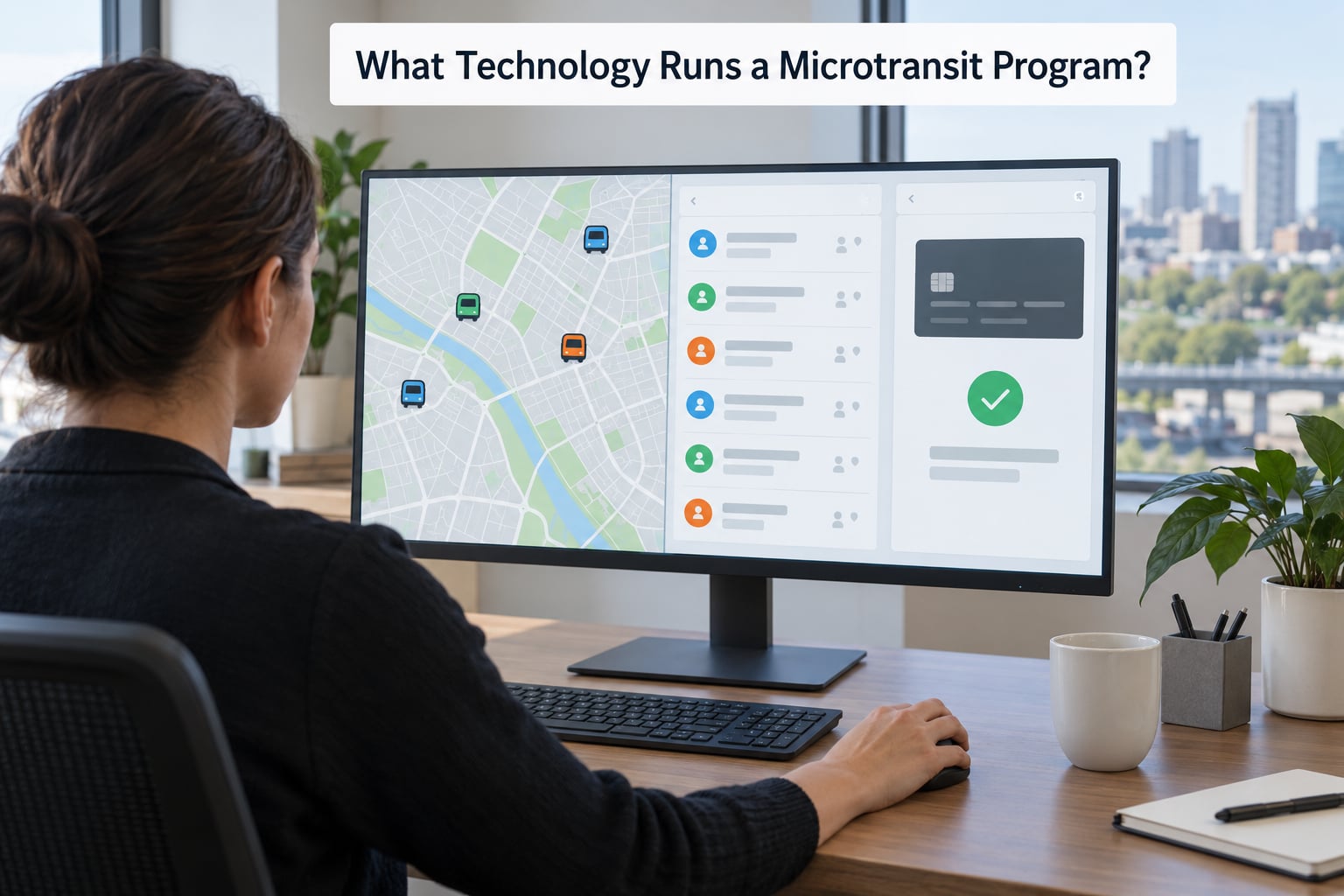
The stack behind a microtransit program has a few recognizable layers, whether it is bought as one product or assembled from several.
Booking channels. A rider app, a web portal, a call center with an agent console, and often kiosk or QR entry at a transit hub. Most programs treat the phone channel as a first-class product, not a fallback, because it serves riders without smartphones and riders who need language support.
The routing and optimization engine. This is the part that decides which vehicle takes which rider, whether to pool with a nearby request, and which virtual stop to assign. It also handles the no-show penalty logic and the pooling rules that keep wait times inside the service promise.
Dispatch software. The console where dispatchers see the zone live, watch ETAs drift, reassign vehicles, approve exceptions, and monitor service against targets. In a small program one dispatcher may cover several zones at once during peak hours.
Telematics and tracking. GPS or AVL in each vehicle, feeding live position, automatic passenger counting, and vehicle health data back into dispatch. Automatic passenger counting is how an agency knows actual boardings rather than assumed ones.
Payments and fare integration. Card processing, stored-value accounts, cash handling rules, fare capping, and a link to the regional fare system so a rider can use one card across buses, trains, and on-demand rides.
APIs and data exchange. Trip data typically flows to the agency’s reporting systems and, often, to a GTFS real-time feed so the microtransit service shows up inside the same trip planner as everything else. That last point matters more than it sounds. A service hidden from the transit app is a service most riders never discover.
Integration with mobility-as-a-service platforms, ride-hailing, bikeshare, and parking systems is a live trend, as is adding autonomous vehicles to a fleet that already has centralized dispatch. Both make more sense once the operational plumbing exists, because the hard part of microtransit was never the app.
How Cities Measure Whether Microtransit Works
A program that does not publish numbers cannot defend its budget. Agencies report a fairly consistent set of operational, financial, and equity measures, and most of them are already sitting in the dispatch system.
| Metric | What it measures | What a healthy result looks like |
|---|---|---|
| Completed trips | Rides delivered, not rides requested | Rising and holding after launch |
| Request-to-pickup time | How long riders actually wait | Inside the advertised pickup window |
| On-time pickup rate | Share of pickups inside the window | High and stable, and improving on repeat |
| First-time booking success | Riders who complete their first trip | Strong growth month over month |
| No-show rate | Trips sent to an empty pickup point | Low and falling after rider reminders |
| Deadhead ratio | Empty miles between paid trips | Falling as pooling improves |
| Vehicle utilization | Paid hours per vehicle on shift | Matched to supply, not maximized blindly |
| Cost per boarding | Total program cost divided by boardings | Trending down as ridership builds |
| Average wait and detour | Rider time lost versus a direct trip | Bounded, and published honestly |
| Coverage and equity | Who is served, by zone and by income | Service reaches beyond existing transit users |
| Canceled trips | Requests the system could not serve | Few, and clustered at known peak bottlenecks |
| Rider satisfaction | Post-trip ratings and complaints | Trending up alongside repeat use |
Cost per boarding deserves a word of caution. A microtransit program with a low fare and high subsidy will show a higher cost per boarding than a bus, and that is often the correct trade. The comparison that matters is cost per boarding against the alternative for the same riders, which is usually no service at all, a long drive, or a paratransit trip the rider was not eligible for.
Equity measurement is newer and less settled. Agencies increasingly look at travel time and wait time by neighborhood income, vehicle utilization in low-density zones, and whether riders without smartphones can complete a trip at all. A service that looks excellent on ridership and poor on first-time booking success is probably fine for the people who found it and useless for the people who did not.
Forum riders raise one more question that agencies rarely publish: what happens when a ride does not arrive. Riders planning around a stadium shuttle or a medical appointment need to know the fallback, because a missed pickup on a pooled trip with a 30-minute window is the failure mode people actually fear.
Frequently Asked Questions
How does microtransit work?
A rider requests a trip in an app, web portal, or by phone. The dispatch system checks the request against the service zone, then matches it to a nearby vehicle heading a similar direction. The rider gets a pickup window at a virtual stop, the vehicle makes shared pickups and drop-offs along the way, and the fare settles when the trip closes.
What is the difference between paratransit and microtransit?
Paratransit is for riders certified as having qualifying disabilities, is booked far in advance, and is individual rather than pooled. Microtransit is generally open to anyone in a defined zone, accepts more last-minute requests, and shares rides between several passengers. Some programs are hybrids, offering subsidized microtransit fares to certified riders.
Is microtransit good?
It works well in low-density suburbs, rural counties, late-evening periods, and first-mile and last-mile gaps to a transit hub. It struggles where demand is high and evenly spread, because pooling adds wait and detour time that a fixed route avoids. Judge it against the realistic alternative in your area, which is often no service at all.
Can I book a microtransit ride without a smartphone?
In most mature programs, yes. A phone line with a booking agent is normally a core channel, not a courtesy, and it exists because a large share of riders depend on it. Kiosks and QR booking at transit hubs appear too. What varies is how far ahead each channel can book and which payment methods the agent can take.
How do you pay for a microtransit ride, and can I use a transit card?
Most programs charge through an account in the app or through the regional fare system, so a standard transit card often works directly. Some accept cash, some require exact change because the vehicle has no fare box, and subsidized programs often need a sponsored account with eligibility approved in advance. Options differ by city and by zone.
What happens if my microtransit ride is late?
The app updates the estimated arrival time and the pickup window as the vehicle moves, so check it before heading out. If the vehicle does not arrive, calling the dispatch number is far more effective than re-booking in the app, which can create two trips. Riders with a fixed appointment can often ask for a priority flag.
Conclusion
How microtransit services operate comes down to a managed system with visible edges: a defined zone, a service span, a small fleet, software that matches and pools requests, dispatchers who handle the exceptions, and payment that works through more than one channel. Riders get a shared ride inside a pickup window, and the agency gets a service it can measure and adjust.
Before a city launches anything, the first thing to assess is fit. Does the service design match the density of the area, does the coverage solve a real connection problem, does the technology support a phone channel and a regional fare card, and does the funding cover the gap between the farebox and the cost of the ride. Get those four answers right and the operational details follow fairly easily. Get them wrong and no amount of software rescues the program.