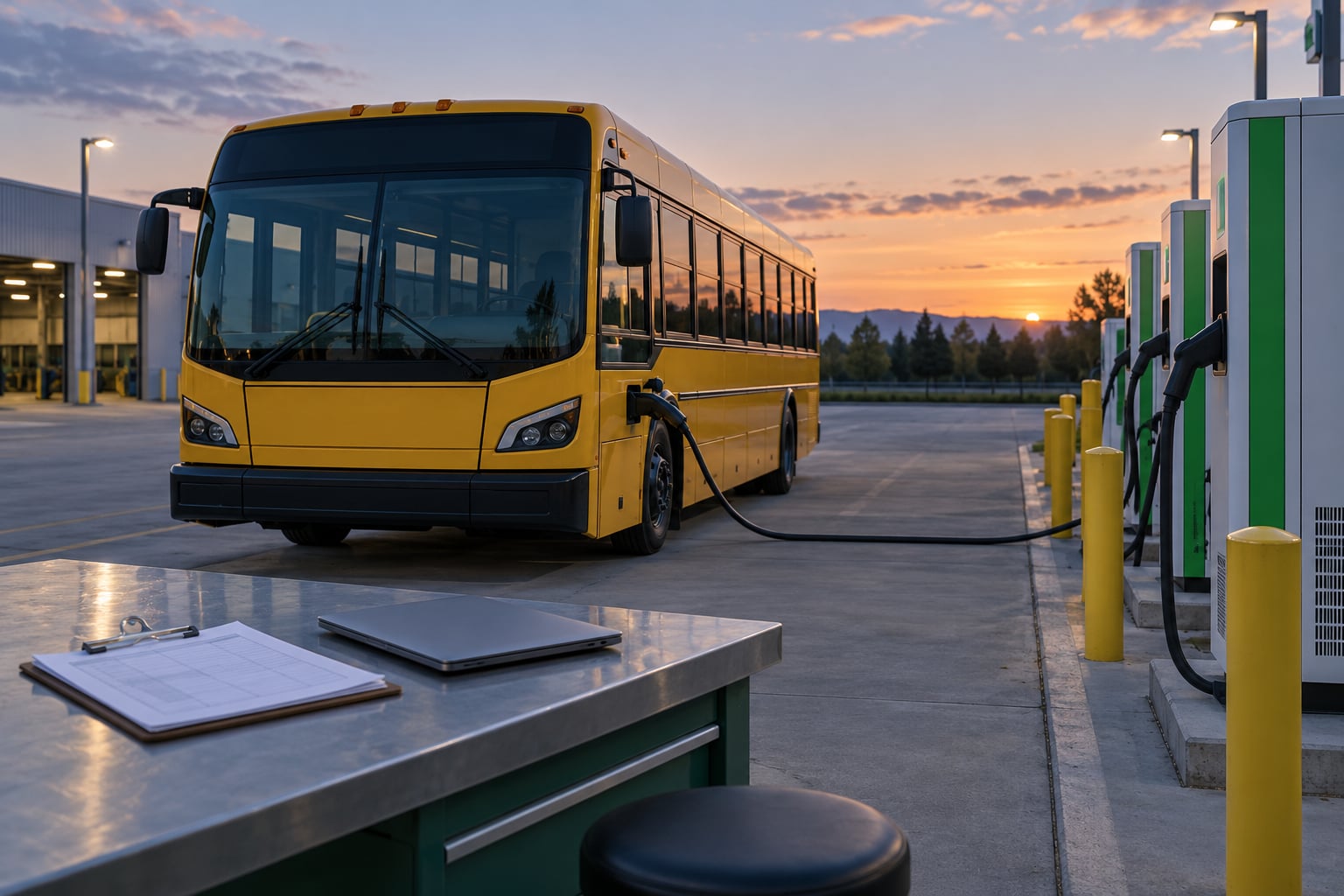
A school bus electrification program is a funded, multi-year effort that replaces a district’s diesel buses with zero-emission electric buses and the charging infrastructure that serves them. It is coordinated across the district, its bus contractor, the electric utility, state agencies and federal grant programs, which is what separates it from an ordinary bus purchase.
Diesel buses still make up roughly 90 to 95 percent of the US school bus fleet, so most districts considering electrification are starting from zero. The programs that move fastest are the ones that treat it as a planning exercise with a construction project attached, not as a vehicle purchase with a grant application attached.
Table of Contents
- What Is a School Bus Electrification Program?
- How School Bus Electrification Programs Work From Start to Finish
- What Do Districts Need Before Electrification?
- Real route and duty-cycle data
- Electrical capacity at the depot
- A replacement schedule that lines up
- Staffing, approvals and data
- How Are Electric School Buses Charged?
- Who Pays for School Bus Electrification?
- The federal layer
- The state layer
- The utility and manufacturer layers
- How Does Electrification Change Bus Operations?
- What Are the Benefits and Trade-Offs?
- How Can a District Launch a Successful Program?
- Start small: how school bus electrification programs work in year one
- Frequently Asked Questions
- How long does it take to start a school bus electrification program?
- Do electric school buses need special charging stations?
- Can a school district replace all its buses with electric models?
- How much does a school bus electrification program cost?
- Can electric school buses handle cold or hot weather?
- What happens if an electric school bus runs out of charge?
- Conclusion
What Is a School Bus Electrification Program?
The program replaces diesel buses with zero-emission buses, builds the charging capacity to run them, and funds both through a stack of public money. It usually runs three to seven years from first planning meeting to a meaningful share of the fleet converted.
Four parties do the work, and each one controls a different piece:
- The school district or its bus contractor owns the buses, the routes, the drivers and the depot. They decide which routes convert first.
- The electric utility controls interconnection, make-ready infrastructure, rate design and managed load programs.
- State agencies run voucher and rebate programs, award planning money and set fleet purchase rules.
- Federal agencies, principally the EPA, fund replacement through the Clean School Bus Program.
Every one of those four has to say yes. That is why a district with a strong grant application and no utility cooperation still cannot put a bus in service.
How School Bus Electrification Programs Work From Start to Finish
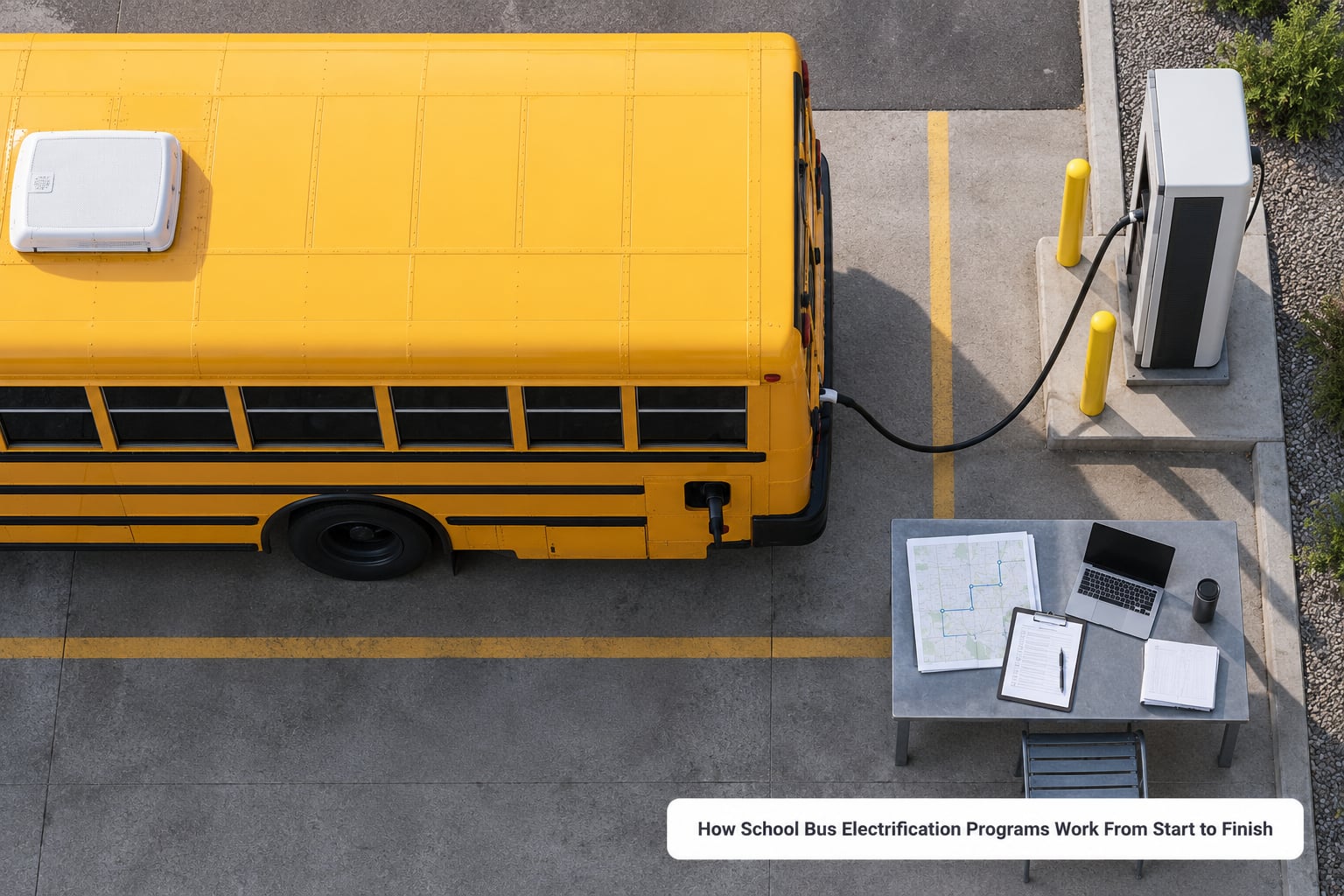
The program runs in a fairly predictable nine steps. Skipping ahead to procurement is the most common mistake, because step six can add two years on its own.
- Set a goal. Districts write down a target number of buses, a target share of routes and a deadline. A specific number, like 12 buses on 8 routes by the 2028-29 school year, is easier to fund than an ambition to go electric eventually.
- Profile the fleet and routes. Every route gets logged for length, hills, idle time, weather exposure and duty cycle. Federal technical assistance tools and state clean bus planning awards help here.
- Model energy needs. Route data turns into kilowatt-hours per bus per day, which turns into charger count and charger power. This is where cold-weather range loss shows up, before any money is committed.
- Talk to the utility early. The utility reviews the depot’s existing electrical capacity, available service, interconnection queue position and rate options. This conversation can take six to eighteen months.
- Build the funding stack. Federal grants, state vouchers or rebates, utility make-ready support, manufacturer incentives and district capital funds each cover a different slice. Which instruments you use changes the cash flow more than the total.
- Upgrade the depot. Service panels, transformers, conduit and charger pedestals are designed and installed. Civil work and utility upgrades are the usual schedule driver.
- Procure buses and chargers together. Matching equipment to chargers, and ordering chargers with enough lead time, matters more than squeezing a slightly better bus price.
- Train staff. Drivers get electric-specific route and charging procedures. Mechanics get high-voltage safety training, usually manufacturer-provided. Local fire departments get orientation too.
- Deploy in phases and measure. Convert a few routes, run a full school year, compare actual energy, fuel and maintenance numbers against the model, then scale.
The whole sequence, realistically, runs one to two years for a first bus and four to seven years to a substantial fleet share. Districts that promise faster usually have not yet met their utility.
What Do Districts Need Before Electrification?
Districts that skip preparation end up with chargers they cannot use. Four things need to exist before a purchase order goes out.
Real route and duty-cycle data
One to two years of telematics or fuel-card records beats assumptions. You need route mileage, drive time, idle time, hills, and how long the bus sits between runs. A route with long idle stretches needs a different charging plan than a steady 40-mile loop.
Electrical capacity at the depot
Ask the utility for a capacity study before you promise anyone a charger count. Adding ten buses can require a new service, a transformer upgrade or a second meter depending on what is already on the property. Feasibility studies are cheaper than surprises.
A replacement schedule that lines up
Most buses are bought on a replacement cycle rather than all at once. Districts that schedule electrification against that cycle spread cost naturally; districts that rush end up retiring serviceable buses early or stacking capital requests in one year.
Staffing, approvals and data
Someone has to own the program. That usually means a facilities or transportation manager backed by the finance office, the board and the bus operator’s union. Decide early how energy, fuel and maintenance data gets collected, because grant closeout reporting depends on it.
How Are Electric School Buses Charged?
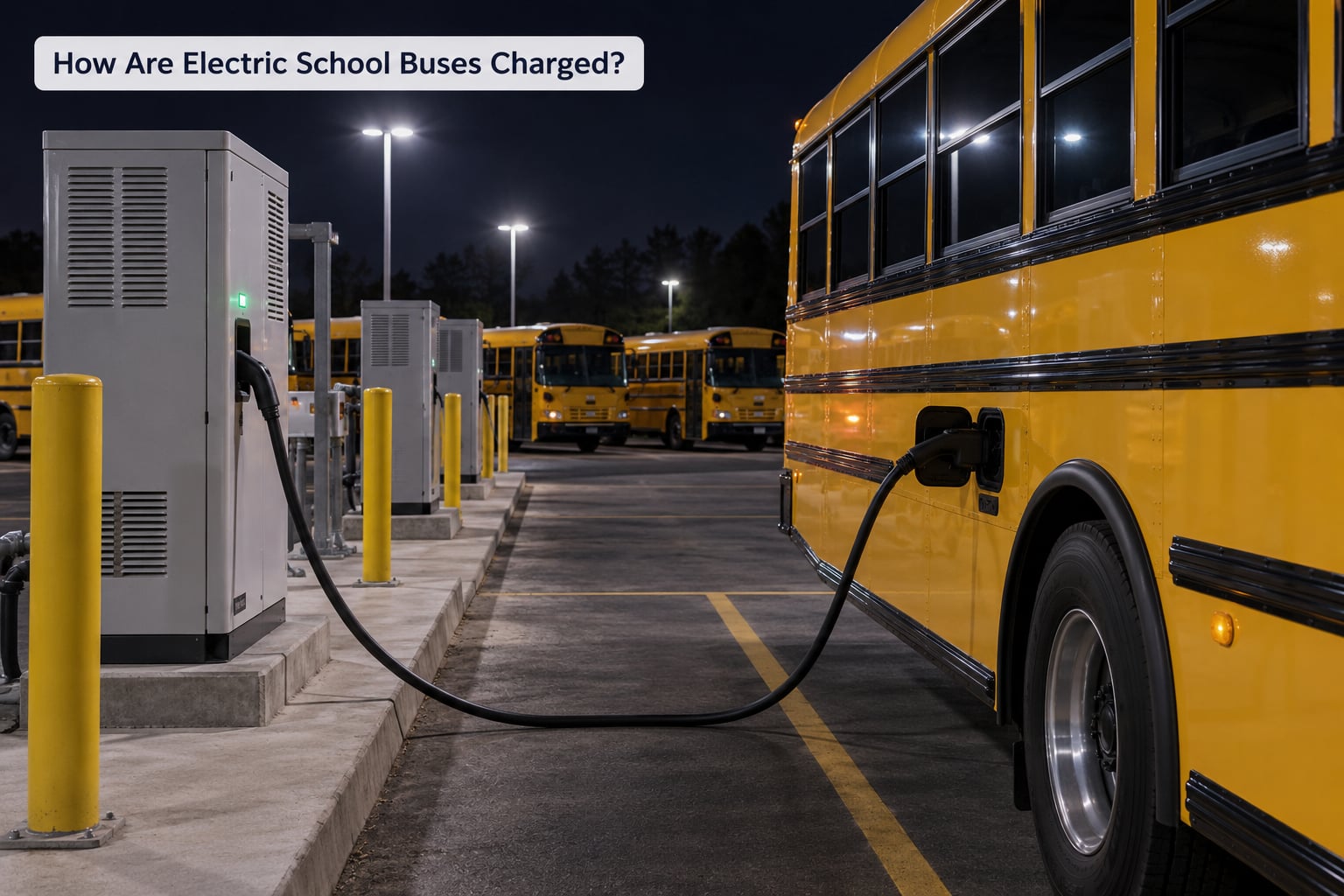
Charging happens where the bus already lives, overnight, because the district pays far less for electricity off-peak and the bus needs those idle hours anyway. Overnight depot charging covers the majority of school routes without any change to the schedule.
| Option | Typical charge time | Best fit | Relative cost |
|---|---|---|---|
| Level 2 AC | 5.5 to 13 hours | Short routes, overnight depot charging, phased rollout | Lowest |
| DC fast charging | 1 to 4.5 hours | Long routes, mid-day returns, extra duty such as field trips | Highest |
| Mixed Level 2 and DCFC | Varies by assignment | Fleets with a mix of short and long routes | Medium to high |
Opportunity charging, plugging in during the day between runs, is what makes the longest routes work. Salt Lake City District runs routes near 92 miles and handles it with mid-day charging, which no overnight-only plan could serve.
Make-ready is the electrical work that gets a charger to the point where a bus can plug in: service panel, conduit, transformer, permit. Who pays for it varies. Often the utility covers it under a make-ready program, sometimes the district does, and increasingly the split is negotiated per project. Managed load or load management lets the utility control charging times in exchange for a lower rate, which matters once a depot pulls serious power overnight.
Districts also plan for the backup case: what happens during an outage, a charger failure or an unplanned route change. Spare buses, a cold-weather reserve in the route plan and a dispatch rule for partial charge are all cheaper than an emergency diesel contract.
Who Pays for School Bus Electrification?
No district pays for a full fleet conversion out of its operating budget. The money comes in layers, and the four funding instruments behave very differently in practice.
| Instrument | Who pays | How the money arrives | Typical use |
|---|---|---|---|
| Grant | Federal or state agency | Awarded after a scored application; district matches sometimes | Bus purchase, infrastructure, planning |
| Rebate | Utility or program administrator | Paid after the bus is purchased and eligible | Vehicle cost, sometimes charging equipment |
| Voucher | State program | Pre-approved before purchase, applied at the dealer | New vehicle purchase, often with scrappage conditions |
| Loan or financing | District repays | Debt service across the life of the bus | Bridging a grant gap or covering a cost no grant covers |
The federal layer
The EPA Clean School Bus Program provided 5 billion USD across fiscal years 2022 through 2026 for replacement of diesel buses with zero-emission models. Recent funding rounds tilted heavily toward zero-emission vehicles for heavy-duty classes, and awards have often covered a large share or all of replacement cost for eligible applicants. Some rounds were oversubscribed, which is the most common reason a qualified district applies and receives nothing.
The state layer
States run voucher incentive programs, and the mechanics differ in ways that matter. New York’s Truck Voucher Incentive Program, for example, requires scrappage of a pre-2009 vehicle, so a district holding an older bus gets a far better deal than one holding a newer one. New York also funded a 200 million USD school bus incentive program through its Bond Act, and states have used Volkswagen settlement funds for one-time purchases that still need a replacement source. Clean bus planning awards, often delivered through national laboratory technical assistance, fund the studies rather than the buses.
The utility and manufacturer layers
Utilities offer make-ready support, managed load programs and, in some states, distribution-level rate design that rewards charging off-peak. The public utility commission is where those programs get approved, which is why a regulator-facing argument matters more to a district than a manufacturer conversation does. Manufacturers add purchase incentives and training support on top.
How Does Electrification Change Bus Operations?
The buses are quieter, which riders and neighbors notice immediately, and the maintenance workload shifts rather than disappears. Diesel engines, exhaust systems, transmissions and oil changes go away; tires, brakes, steering, doors, HVAC filters and high-voltage diagnostics arrive. Regenerative braking cuts brake wear substantially on stop-and-go routes.
Scheduling changes less than people expect, because overnight charging fits inside the existing idle window. It changes more for long routes and for any duty that starts before a full night of charging.
Training is the part districts underestimate. Drivers need procedures for charge planning, plug-in handling and what to do when a bus arrives low. Mechanics need high-voltage safety certification and manufacturer-specific diagnostics, which is why the training line in a grant budget is worth treating as real money. Emergency responders near the depot need orientation on a high-voltage pack.
Weather matters operationally. Cold temperatures reduce available range and increase charge time, so winter route plans usually carry a reserve. Communication with families is straightforward and tends to be positive, since quieter rides are noticed.
What Are the Benefits and Trade-Offs?
The case for electrification is built on air quality, operating cost and noise. The case against it is built on upfront cost and schedule risk. Both are real.
| Bus type | Electric upfront price band | Typical operating delta vs diesel |
|---|---|---|
| Type A | 263,000 to 429,000 USD | About 7,000 USD per year in fuel and maintenance savings |
| Type C | 339,000 to 524,000 USD | Over 100,000 USD in lifetime fuel and maintenance savings |
| Type D | 375,000 to 556,000 USD | Fewer mechanical systems to maintain |
On benefits: tailpipe emissions go to zero at the curb outside the depot, where children and waiting residents actually are. Lifecycle greenhouse gas emissions typically land two to four times below diesel once you account for the electricity mix. Fuel and maintenance savings run around 7,000 USD per bus per year, with over 100,000 USD accumulated over a typical service life. Operating noise drops sharply at low speeds, which matters most in neighborhoods.
On trade-offs: the upfront premium over a comparable diesel bus is real and it hits the capital plan first. Charging time and route range need active management in cold weather. Depot construction and utility interconnection drive the schedule. Grant programs are competitive, so a plan that depends on a single award is fragile. And the buses still carry a lithium-ion battery pack, which has its own lifecycle and end-of-life questions.
How Can a District Launch a Successful Program?
Start small: how school bus electrification programs work in year one
A pilot of two to ten buses on routes with predictable duty cycles is the standard starting move. It produces real energy data within a school year, spreads the training and civil work thinly enough to manage, and gives the district evidence it can use in the next grant round.
Then follow a phase structure. Phase one is study and utility engagement, which produces route data, an energy model and a capacity assessment. Phase two is a funded pilot with one depot and a handful of buses. Phase three is measurement against the model, published openly. Phase four is scale-up, where grant applications get much stronger because the district now has operating numbers rather than vendor projections.
Watch for four failure modes. Utility interconnection queues stretch past a year in some territories. Depot civil work gets scheduled after the buses arrive, which is backwards. Procurement sequencing puts a bus order in before the charger design is approved. And grant rounds undersubscribe or shift eligibility mid-cycle, so a stack built on one award collapses. Build each phase so it survives the loss of any single funding source.
Success metrics worth tracking from day one: energy used per bus per route mile against the model, uptime and missed-trip rate, fuel and maintenance spend versus the diesel baseline, average state of charge at return to depot, and training completion for drivers and mechanics. Board-level reporting on those five numbers is what turns a pilot into a program.
Frequently Asked Questions
How long does it take to start a school bus electrification program?
Plan for one to two years before the first electric bus carries students, and three to seven years to convert a meaningful share of the fleet. Route analysis and utility engagement take most of the first year. Depot electrical upgrades and charger procurement set the schedule for the buses themselves.
Do electric school buses need special charging stations?
They need a dedicated 240-volt Level 2 outlet or a DC fast charger, plus whatever electrical service supports it. That upstream work is called make-ready: panel, conduit, transformer and permit. Overnight depot charging at Level 2 covers most school routes. Long routes usually need DC fast chargers or mid-day opportunity charging.
Can a school district replace all its buses with electric models?
Technically yes, but most districts convert in phases over several years. Replacing an entire fleet at once strains depot electrical capacity, maintenance staffing and capital budgets at the same moment. Staggered phases let you spread construction, retrain technicians gradually and expand as grant cycles open.
How much does a school bus electrification program cost?
It depends on fleet size and how much infrastructure each bus needs. Electric buses run roughly 263,000 to 556,000 USD depending on type, before charging infrastructure. Funding stacks typically combine federal grants, state vouchers, rebates and utility support, which can cover most of the vehicle cost for eligible applicants.
Can electric school buses handle cold or hot weather?
They can, with planning. Cold temperatures reduce available range and slow charging, so districts model winter routes with a reserve and size charging accordingly. Heat mainly affects cooling load and battery thermal management. Most programs handle weather successfully by using route data rather than nameplate range for planning.
What happens if an electric school bus runs out of charge?
The bus is designed to avoid this. Route energy modeling, state-of-charge monitoring and a charge reserve are built into the plan before deployment. If it happens anyway, the bus is not stranded in the diesel sense: it holds power for auxiliary systems, dispatch contacts a spare bus, and the failed run is covered by backup capacity.
Conclusion
Understanding how school bus electrification programs work comes down to five moves, in order. Model your routes honestly. Confirm the depot’s electrical capacity with the utility, in writing. Model total cost of ownership against the diesel baseline. Stack funding across federal, state, utility and district layers rather than one grant. Then run a measured pilot and publish the numbers, because that is what earns the next round of funding.