
A product roadmap is a document that shows which problems your product will solve, in what order, and how you’ll know it worked. Writing one takes about ninety minutes for a first honest draft, and the process is repeatable every quarter once you’ve done it.
The version I’ve seen fail most often isn’t the one written badly. It’s the one written as a feature list, dated eighteen months out, and never touched again. Fix that and the rest is mostly detail.
Below is the order I use when a team asks how to write a product roadmap: gather inputs, set direction, collect evidence, define outcomes, group themes, prioritize, build horizons, attach ownership, then publish and review on a cadence. A copy-paste template and a filled-in example are included so you can see what finished work looks like.
Table of Contents
- What You Need
- Step-by-Step
- How to Write a Product Roadmap Starting with Outcomes
- Step 1: Set the product direction
- Step 2: Gather user and stakeholder evidence
- Step 3: Define outcomes and success measures
- Step 4: Identify themes and candidate initiatives
- Step 5: Prioritize what matters most
- Step 6: Build phases and milestones
- Step 7: Add ownership, measures, and decision points
- Step 8: Review and communicate the roadmap
- Common Mistakes
- Frequently Asked Questions
- Can ChatGPT create a product roadmap?
- What are the 7 stages of product development?
- Should a product roadmap have firm dates?
- What is the difference between a roadmap and a product backlog?
- How far out should a product roadmap plan?
- How often should you update a product roadmap?
- Conclusion: What to Do First
What You Need
Six inputs. If you don’t have all six, you’ll produce a roadmap that falls apart the first time someone asks why an item is on it.
- Product strategy in one paragraph. What this product exists to do, for whom, and how it differs from the alternatives.
- A ranked list of user problems. Not solutions. “Riders can’t plan a multi-leg trip across three operators” is a problem; “build a trip planner” is a solution wearing a disguise.
- Two to three measurable outcomes. Two to three per quarter is a workable number; more than that and nothing gets prioritized.
- Known constraints. Regulatory requirements, data access agreements, hardware dependencies, team capacity, anything with a procurement lead time.
- A realistic delivery horizon. How much of the future you are willing to plan against.
- A named owner. One person accountable for the document and its updates.
Your team size is the one variable that changes everything else. A solo founder can defend a twelve-month view because there’s no one else to renegotiate with. A cross-functional team of twenty needs horizons rather than dates, because coordination cost grows faster than headcount.
Step-by-Step
How to Write a Product Roadmap Starting with Outcomes
Start from outcomes, not features. Write three to five measurable results the product should produce within two quarters, name the audience each one serves, and only then decide what to build. If you can’t state what “better” looks like in a number, the item isn’t ready for a roadmap.
Here is a rewrite that shows the difference. Feature: “Add real-time arrival cards.” Outcome: “Cut the average share of riders who abandon a trip plan because information arrives too late, measured as a drop in support tickets tagged arrival-info.” The second version can be argued with, traded off, or dropped when something better shows up.
Step 1: Set the product direction
Write a product context statement in three sentences: who you serve, what problem you exist to solve, and what changes if you succeed. For a civic mobility app that might read: riders moving between bus, bike-share, and rail across one metropolitan area; today’s trip planning breaks at transfers; within a year, most riders can plan a full multi-leg journey without opening a second app.
Then list your assumptions, because they are what will break first. Note which are validated and which are guesses. “Assumes transit agencies will publish real-time feeds within six months” and “assumes riders will accept a recommendation rather than build their own route” are both load-bearing.
This is also the moment to decide what the roadmap is not. It is not a project plan, not a contract, and not a feature list with dates on it. Product managers routinely conflate roadmap with strategy, which is the single most common failure on this list.
Step 2: Gather user and stakeholder evidence
Collect from four directions and keep them separate so you can see where they disagree. User interviews give you problems in their own words; support and help-desk tags give you problems at volume; analytics gives you where people actually drop off; community and partner feedback gives you what people want you to do, which is not the same thing.
Five to ten interviews per quarter is enough to spot the recurring problems, and it is a number teams actually hit. On a public-sector project, add operational evidence: call centre logs, permit timelines, and whatever your open data partners can realistically publish this fiscal year.
Turn the raw notes into a ranked problem list with a confidence mark on each one. Anything nobody mentioned, nobody observed in data, and no partner has raised should start at the bottom, regardless of how much the loudest person wants it.
Step 3: Define outcomes and success measures
Write each outcome so it links to a user or organisational result, not an activity. Use the OKR shape: an objective in plain language, then two or three measurable key results with a baseline and a target you would defend.
Good measures usually fall into a few families. Adoption covers sign-ups, retention, and repeat use. Satisfaction covers task completion and support volume. Accessibility covers the share of key flows usable with a screen reader or at high zoom. Performance covers load time and failure rate. Operational coverage covers how much of the service area or population the product actually reaches.
One outcome per key result, three key results maximum. Beyond that, teams start trading measures off against each other and the conversation stops being about users.
Step 4: Identify themes and candidate initiatives
Group related problems into three to six themes, such as “first trip is confusing” or “data quality blocks confident advice.” Themes are the bridge between evidence and prioritization; without them you end up scoring forty individual features, which is exhausting and mostly theatre.
Under each theme, describe candidate initiatives as problems again. For a smart-city app, a theme like “transfer gaps” could hold multimodal trip planning across modes, a service-access map showing which routes run past clinics and schools, or community issue reporting that feeds back into the data layer.
Two or three candidates per theme is plenty. This step deliberately avoids committing to features, because feature decisions made before prioritization are the ones nobody reverses.
Step 5: Prioritize what matters most
Rank initiatives with a framework rather than with seniority. Pick one, write down the inputs before you score, and record the scores so a future reader can see why an item beat another.
| Framework | Scores on | Best for | Cost to run |
|---|---|---|---|
| RICE | Reach, Impact, Confidence, Effort | Comparing items with very different sizes | Medium |
| MoSCoW | Must, Should, Could, Won’t | Forcing a hard scope cut for a fixed horizon | Low |
| Value vs effort | Benefit against build cost | Teams with mixed skill levels and a small queue | Low |
| Kano | Expected vs performance vs basic needs | Separating table stakes from differentiators | Low |
| Weighted scoring | Custom criteria with weights | Comparing against a mission, regulation, or budget rule | Medium |
For civic and grant-funded work, weighted scoring earns its cost. You can weight regulatory compliance and public-equity access above raw demand, and the trade-off becomes visible instead of hidden in one person’s judgement.
Guard against false precision. A RICE score of 82 versus 77 is not a real difference; it’s noise from estimates made an hour earlier. Use the score to break ties and to surface missing information, not to pretend the future is known.
Step 6: Build phases and milestones
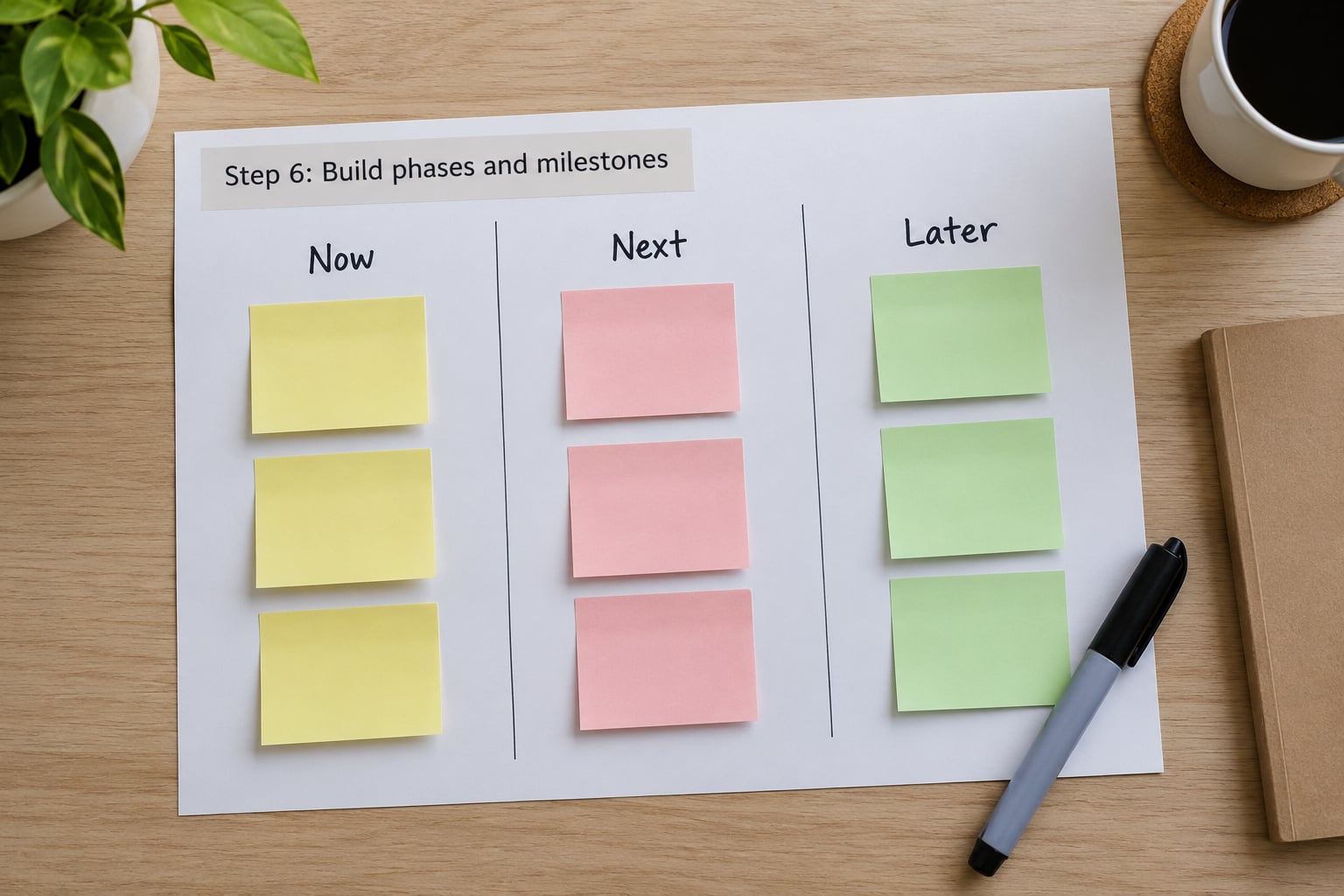
Group the ranked initiatives into Now, Next, and Later horizons. Now is roughly the next quarter and is close enough to commit. Next is one to two quarters out and directional. Later is everything further out, kept deliberately vague.
Leave room for discovery. Most roadmaps that break promise did so because they assumed every assumption held for six months, which it never does.
Here is the template, filled in with a smart-city mobility example so you can see the level of detail that works:
| Horizon | Problem | Initiative | Owner | Success measure | Confidence |
|---|---|---|---|---|---|
| Now | Riders cannot judge transfer waiting time | Live arrival data on the four busiest routes | Data lead | Support tickets tagged arrival-info down 40% | High |
| Now | Trip plans fail at mode changes | Multimodal planner across bus, rail, bike-share | Product manager | Share of trips crossing two or more modes up from 9% to 20% | Medium |
| Now | Key flows unusable with assistive tech | Accessibility audit and remediation of planner and map | Engineering lead | All primary flows pass keyboard-only and screen reader audit | High |
| Next | Users cannot tell which services reach them | Service access map for clinics, schools, and food support | Product manager | Monthly active use in two pilot districts | Medium |
| Next | Community problems go unrecorded | Community issue reporting with public response status | Partnerships lead | Median time to first agency response under 3 days | Medium |
| Next | Partner data arrives late or unused | Open data quality dashboard | Data lead | All feeds pass a freshness check; unused feed count to zero | Low |
| Later | Low-income riders plan less far ahead | Multilingual and low-bandwidth modes | Unassigned | Share of non-native speakers completing a full trip plan | Low |
| Later | Residents see infrastructure planned but not delivered | Delivery transparency layer for announced projects | Unassigned | Not set, measure in discovery | Low |
Note the unassigned owners in Later. Leaving them blank is honest and useful; filling them in with a guess is how a roadmap turns into a promise. This horizon table is usually the point where teams stall on how to write a product roadmap, because the blank cells feel like gaps. They aren’t. They are the honest state of a six-month view.
Step 7: Add ownership, measures, and decision points
Every Now and Next item needs one accountable owner, one success measure, a confidence level, and a decision date. Confidence usually reads high, medium, or low, and it should drop automatically when an item depends on something outside your control.
Label each item as committed, discovery, or aspirational. Committed work goes into the backlog and gets built. Discovery work is a research spike with a question attached. Aspirational items are on the roadmap for hope and trust-building, and nobody should plan a launch around them.
Write down your triggers: the specific conditions that would move an item up, push it out, or kill it. “If the second agency feed slips past Q3, push the dashboard initiative to Later” beats deciding in the moment, when the loudest opinion wins by default.
Step 8: Review and communicate the roadmap
One document does not serve every reader, so the same source produces several views. Executives want outcomes, sequencing, and risk. Developers want dependencies and technical readiness. Municipal partners want compliance and procurement timing. Community groups and residents want what changes for them and when they’ll hear more.
Run the review meeting as a working session, not a presentation. Forty-five minutes: ten on outcomes and what moved, twenty on changes and the reasoning behind them, fifteen on the decision log and next horizon’s candidates. Publish the decision log afterwards, even if it’s three lines.
When someone asks for a firm date eighteen months out, say what you can commit to instead: the horizon, the dependency, the decision date, and the measure. “I can’t promise August, but I’ll confirm scope after the partner data review in Q2” usually ends the conversation with trust intact.
Roadmaps for civic and grant-funded teams carry one extra constraint worth naming. Your delivery calendar is partly set by budget cycles and approval boards rather than by your capacity, so write those in as first-class dependencies. A roadmap that ignores the fiscal year is a roadmap that breaks every September.
Common Mistakes
It became a feature list. Every row is “build the thing,” nothing explains the problem. The fix is to require one problem sentence and one measure per row; if you can’t write them, the item isn’t ready.
Goals got confused with tasks. “Improve onboarding” sat next to “change the button colour” on the same list, so they competed. Keep outcomes above the horizon line and tasks below it, in the backlog where they belong.
It promised dates too precisely. Dates far out are guesses wearing a suit. Use horizons, and publish exact dates only for the Now column.
Dependencies were invisible. A partner feed, a procurement rule, or a hardware lead time should sit on the roadmap as a risk next to the item it threatens. Teams that skip this discover the constraint during delivery.
It measured output instead of outcome. “Shipped three features” says nothing about whether anything improved. Every item needs a measure a user or the organisation would actually feel.
Nobody owned the document. With no named owner and no cadence, roadmaps go stale within a quarter and stop being trusted. Put a name and a review date on the first page.
It was never revised. The first version should be marked as a draft with a date. The second version, produced after a quarter of real evidence, is usually a better argument than the first, and the change log is the proof the document is alive.
Frequently Asked Questions
Can ChatGPT create a product roadmap?
Yes, as a first draft. Give it your product context, interview notes, and a list of candidate initiatives, and ask it to group them into themes, propose three outcomes, and lay them out across Now, Next, and Later. It has no idea about your engineering capacity, your users, your data agreements, or your budget cycle, so the output needs a product manager to rewrite and rank. Use it to break a blank page, never as the source of truth.
What are the 7 stages of product development?
The commonly cited seven are idea and concept, discovery and validation, planning and roadmap, design, development and build, testing and QA, then launch and growth. The roadmap is produced at the planning stage, then maintained through the rest: it keeps holding sequencing and measures while design and development change the shape of the work. Treat it as a living artifact rather than a stage gate you pass once.
Should a product roadmap have firm dates?
Only for the Now horizon, roughly the next quarter. Everything beyond that should carry a horizon label like Next or Later, because the further out you place a date, the less credible it becomes. When a stakeholder demands a date far ahead, offer what you can actually commit to: the horizon, the dependencies, the decision date, and the measure that will trigger a move.
What is the difference between a roadmap and a product backlog?
A roadmap is a strategy document: the problems you intend to solve, their order, and the outcomes you expect, organised by horizon and understandable to people outside the team. A backlog is an operational list of specific work items the team has committed to build, maintained at a much finer grain and changed constantly. The roadmap decides what and why; the backlog decides the exact task and when it ships.
How far out should a product roadmap plan?
Plan in detail for one to two quarters, keep a directional view about six months out, and hold a loose theme list beyond that. Longer views are useful for showing direction and for funding conversations, but detailed planning past two quarters reliably produces broken promises. Revisit the far horizons at every quarterly review rather than defending them.
How often should you update a product roadmap?
Review it monthly at a minimum, and formally re-prioritise every quarter. Put the review date on the document itself so staleness is visible to everyone reading it. Publish a short change note after each review explaining what moved and why, since the reasoning is what stakeholders actually lack, not the list of items.
Conclusion: What to Do First
Open a blank document and write one paragraph of product context, then three outcomes with a number in each. Everything else in how to write a product roadmap follows from those four lines, and if you cannot fill them in today, another week of research will not fix it.
Keep the first version visibly imperfect. Mark it a draft, put a review date on it, and let the evidence from the quarter change it. That is the whole trick.