Freemium app monetization works by giving everyone a functional version of the app at no cost, then earning from the small share who upgrade, buy extras, or generate ad impressions. A good free tier pulls people in, delivers real value, and makes the paid tier the obvious next step.
That is the whole idea, and it is harder to run than it sounds. Most of the work sits in two places: deciding what stays free, and measuring whether enough people pay to cover the cost of serving everyone else.
This guide walks through the money flow end to end, the revenue models you can layer on top, how pricing decisions get made, and the handful of metrics that tell you whether the model is working or quietly leaking money. Updated for 2026.
Table of Contents
- What Is Freemium App Monetization?
- How Freemium App Monetization Works in Practice
- How the Freemium Business Model Works Step by Step
- Which Freemium Features Should Stay Free?
- What Freemium Revenue Models Can You Use?
- How Do You Price a Freemium App?
- Which Metrics Show Whether Freemium Monetization Works?
- How Do You Increase Conversion Without Damaging Trust?
- What Can Go Wrong With a Freemium Model?
- Frequently Asked Questions
- What percentage of freemium app users should pay?
- Is a freemium model the same as a free trial?
- Should a freemium app show ads?
- What is a good freemium conversion rate?
- How long should a freemium app remain free before users are asked to pay?
- Can a small app use subscriptions successfully?
- Conclusion: Start With Value, Then Add the Paywall
What Is Freemium App Monetization?
Freemium app monetization is the practice of shipping a functional but limited version of an app for free, then earning revenue from the minority who upgrade to a paid plan, buy one-off items, or generate advertising revenue, after the app store takes its commission. The free tier is a permanent product, not a countdown timer.
That last part is what separates freemium from a free trial. A trial is temporary by design: you get full access for a set number of days, then the clock runs out. Freemium users can stay free forever and still get a genuinely useful product, usually with usage caps or a smaller feature set.
The exchange is simple. The company absorbs the cost of serving free users in exchange for a much larger audience, and a few percent of that audience pays. Here is the quick comparison:
| Model | What the user gets | How money arrives |
|---|---|---|
| Freemium | Free forever, capped or gated | Subscriptions, upgrades, ads from the paying minority |
| Free trial | Full access for a fixed window | Subscription that starts when the window ends |
| Paid upfront | Everything, after a one-off purchase | Download fee, sometimes upgrades |
| Ad-supported | Free, usually with interruptions | Ad impressions across the whole user base |
The best-known examples span categories: Slack and Zoom gate collaboration and admin controls, Spotify limits free listening, Canva locks premium templates and brand kits, Candy Crush Saga sells boosters, and Duolingo gates the deeper language paths.
How Freemium App Monetization Works in Practice
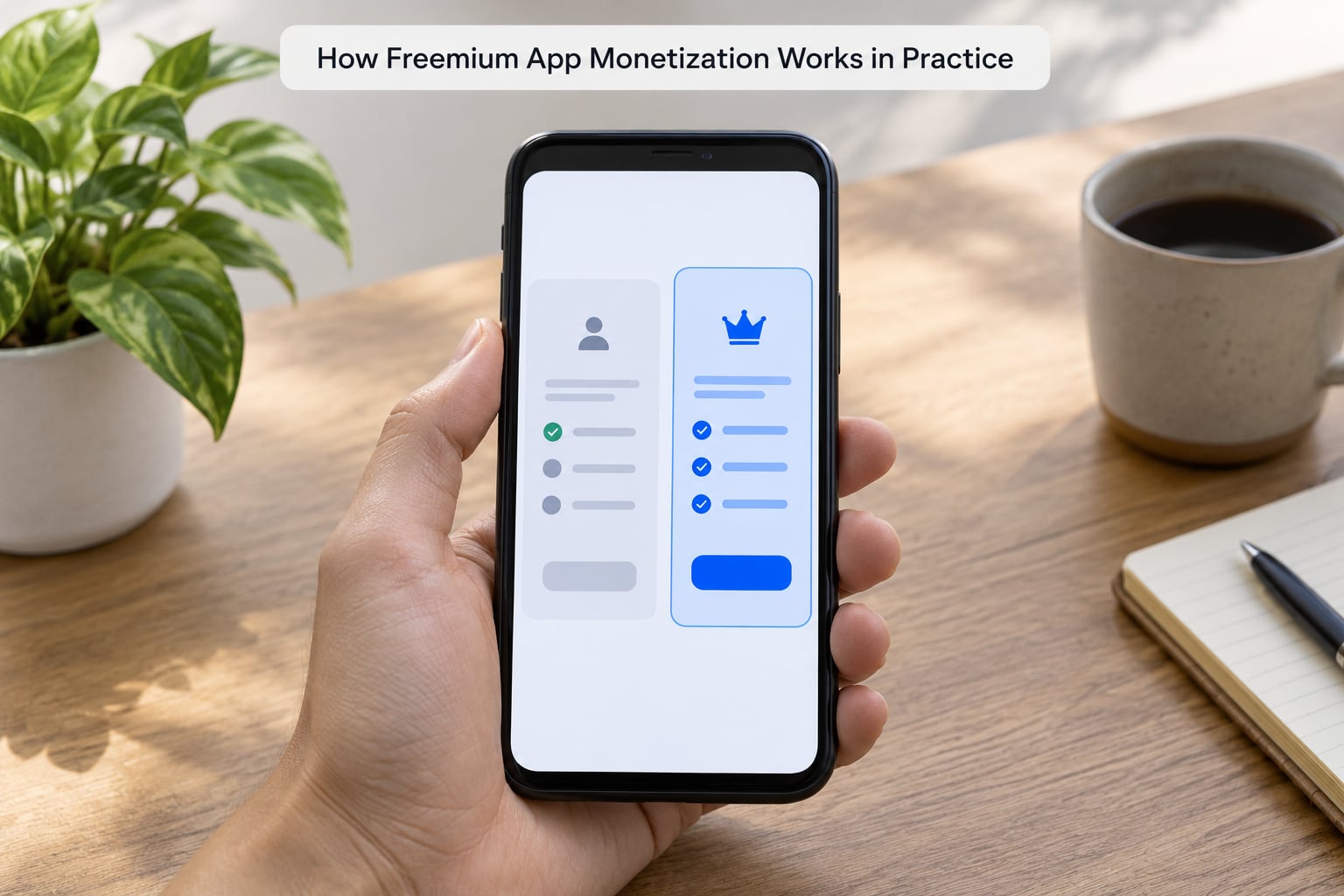
Picture a city mobility app. Someone finds it through an app store search, installs it without typing a card number, and lands on a map showing live transit arrivals for their neighbourhood. That first useful screen is activation, and everything the company does afterwards is built around it.
Here is how the model behaves once that first value moment lands. This is an illustration of a common pattern rather than a case study of one company.
How the Freemium Business Model Works Step by Step
- Acquisition. A store listing, an ad campaign, or a referral loop brings the install. The metric is cost per install, and the signal that matters is which source produces users who stick, not which source is cheapest.
- Free usage. The user does something real without paying. If this stage drags on with no progress, nothing downstream works, so onboarding should push toward a first result within a couple of minutes.
- Value delivery. The free tier keeps its promise. Weakening it to push an upgrade converts users into people who leave.
- The upgrade trigger. A usage cap or a gated feature creates friction exactly where the free product has already proven itself. The user hits the limit after wanting more, which is the moment a paywall carries the most weight.
- Conversion. A paywall presents the paid plan, usually with a monthly option, an annual option, and a short trial where it makes sense.
- Recurring revenue. Billing retries automatically through the store, and failed payments go into a dunning flow so a lapsed card does not become a permanent cancellation.
- Store commission. Apple and Google each take their cut and remit the rest, so revenue planning works backwards from what lands in the account, not from the shelf price.
The order matters more than people expect. Conversion is the least interesting stage to optimise when the stage before it is broken.
Which Freemium Features Should Stay Free?
Free features should do three jobs: get the user into the product, get them to a real result, and make them want more. Anything that fails those three jobs can sit behind the paywall.
Start with acquisition: the feature that gets someone to install at all stays free, because it has to. Then activation: the first useful outcome has to be reachable without paying. Then habit: features that drive repeat use usually belong on the free side, because retention is what builds the upgrade pool.
Operators report the same failure repeatedly: a free tier that is too generous leaves users with no reason to pay. One founder described running a product where roughly 85 percent of the functionality stayed free and only the edge was paid, and reaching positive monthly recurring revenue on exactly that balance.
| Feature area | Free tier | Paid tier |
|---|---|---|
| Core search and browse | Unlimited | Unlimited |
| Save and organise | Limited items | Unlimited |
| Export, sharing and collaboration | Locked or watermarked | Included |
| History and data retention | Recent only | Full archive |
| Offline access | Not available | Included |
| Admin and team controls | Single user | Multi-seat |
| Ad experience | Ads shown | Ads removed |
The safe rule: gate the edge, never the spine. Gating something a user needs to get any value at all reads as a broken free product, and it pushes them straight to a competitor.
What Freemium Revenue Models Can You Use?
Most apps combine two or three of these. The mistake is picking one and hoping it carries the whole business.
| Model | Best fit | Revenue pattern | Main risk |
|---|---|---|---|
| Freemium subscription | Productivity, content, civic tools, streaming | Small steady recurring revenue | Churn outruns new subscriptions |
| One-time purchases | Games, creative tools, utility add-ons | Lumpy, front-loaded spikes | No recurring base to fall back on |
| Usage-based upgrades | Data-heavy tools, AI products, API callers | Grows with customer success | Cost per free user can quietly exceed revenue |
| Advertising | Casual games, short-session utilities, media | Scales with sessions, not value | eCPM varies wildly by region and format |
| Paid add-ons and upsells | Most mature freemium apps | Raises revenue per paying user | Feature sprawl confuses the pricing page |
| Hybrid | Large consumer apps | Several streams offsetting each other | Reporting gets muddy without clean attribution |
Advertising deserves its own caution on iOS. App Tracking Transparency and privacy-preserving attribution have reduced targeting, so rewarded video and in-app placements generally beat a stack of interstitials. A developer running a form builder kept responses unlimited on the free tier and still made serious money selling the paid plan, which is a good argument for keeping the ad tier light.
How Do You Price a Freemium App?
Price from the value of the outcome, not from a competitor’s shelf. What does a saved hour, an avoided fine, or a kept subscription actually worth to the buyer, and which of your features delivers that outcome?
From there, several levers matter. Competitor references give you a range to test against, but they describe a market rather than a price. Willingness to pay shows up in behaviour: how far a user scrolls past a paywall, which plan they hover, and whether they start a trial and abandon it.
Structure does as much work as the number. Offering an annual plan at roughly half the monthly price times twelve gives most subscribers a clear discount in exchange for twelve months of commitment, and it improves cash flow and retention at the same time.
Set the free-tier boundary on purpose. A cap that is too loose removes the reason to upgrade, and one that is too tight blocks the value moment that creates the upgrade in the first place. Regional pricing matters too, since a single global price in a low-purchasing-power market converts almost nobody. Test in stages: change one element, measure for long enough to see a real signal, then move on.
Which Metrics Show Whether Freemium Monetization Works?
Track a small set of numbers and read them together. Any one of them alone will mislead you.
| Metric | Why it matters | Ask this question |
|---|---|---|
| Free-to-paid conversion | Revenue share of your user base | Is it moving when the paywall changes? |
| Trial start and trial-to-paid | Trial start alone can look healthy while nobody pays | Of the users who start a trial, how many finish paying? |
| Activation rate | Measures whether the free tier delivers | What share of installs reach the first value moment? |
| Engagement and retention | Retention is the upgrade pool | Do users come back weekly or once and vanish? |
| Churn | The main leak in recurring revenue | What percentage of subscribers cancel each month? |
| Customer acquisition cost | Sets the ceiling on what you can pay | Is acquisition cost rising faster than revenue per user? |
| Average revenue per user | Blended income across all users, free included | Does revenue per user cover the cost of serving free users? |
| Lifetime value to CAC | Whether growth is worth funding | Can the ratio survive a worse month than average? |
| Paid share of active users | The headline freemium number | Is the paying minority big enough to fund the rest? |
Operators who quote a paying share of roughly 3 to 8 percent of monthly active users are describing a functioning freemium business, but treat that as a range to test against rather than a rule. Categories differ sharply: one publishing analytics set showed trial starts around 14 percent on average for utility apps and near 11 percent for photo and video apps, with top performers well above both.
The clearest diagnostic is not a benchmark at all. If conversion is weak, the cause is usually the path to value or the paywall itself, not a lack of advertising budget. That is also why the advice that recurs in operator forums is to fix the path to value first, then measure conversion only among the users who actually reached it.
How Do You Increase Conversion Without Damaging Trust?
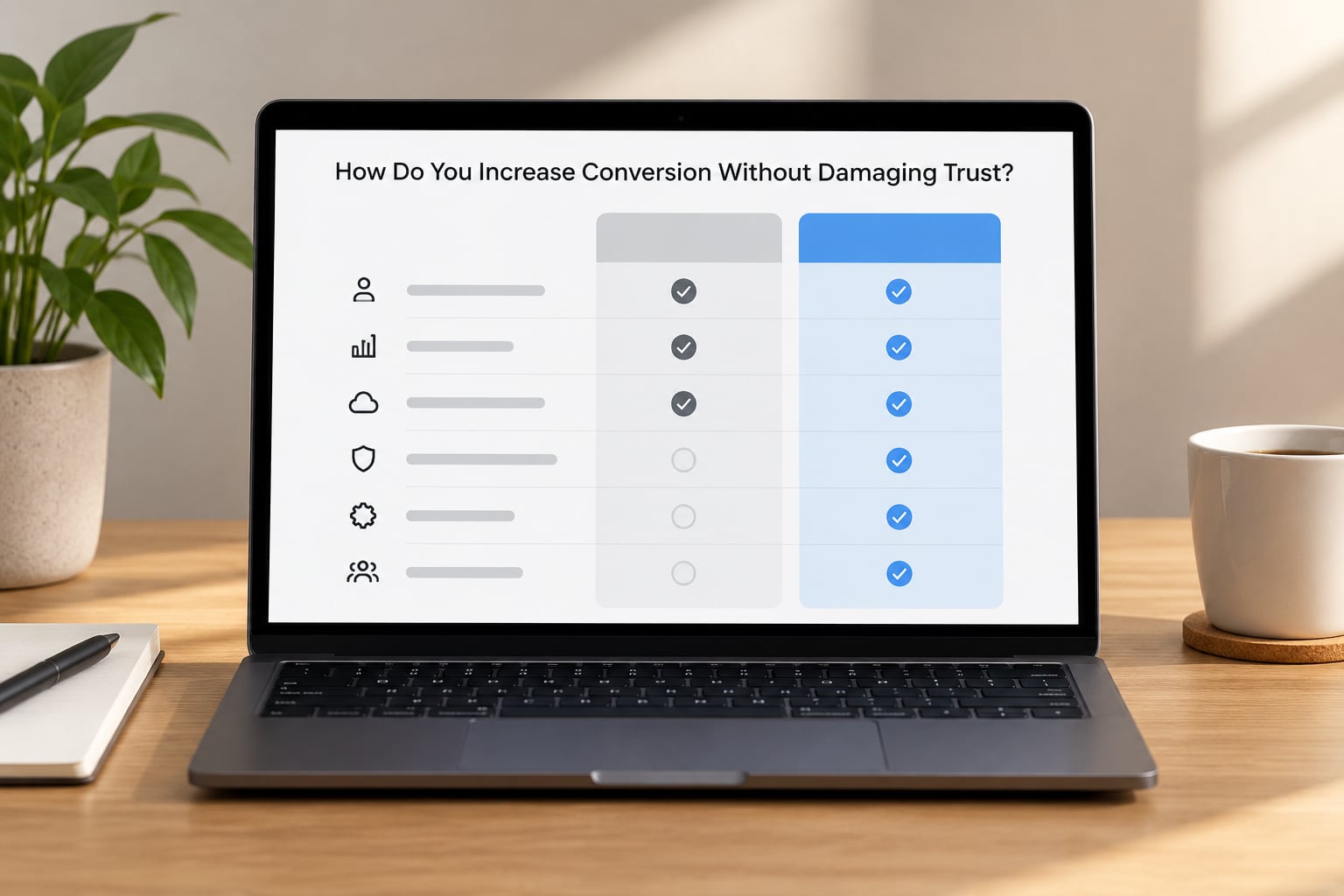
Conversion improves when the upgrade prompt appears at a moment the user already understands. A limit reached after a successful run of the free product is a helpful signal. A pop-up on the first launch is noise.
Some tactics hold up well. Ask for the upgrade contextually, right where the gated feature lives. Make the pricing page legible, with one primary plan and a clear annual option. Demonstrate the value with something concrete, such as a before and after export. Show an honest free-tier summary at signup so nobody discovers the limits late. Remind users gently before a trial ends, and offer a way to pause instead of cancel.
What does not hold up: repeated prompts on every screen, hard paywalls placed before the user has had a result, and countdown timers that restart. Users recognise them, and the reaction is a bad review rather than a subscription.
There is always a trade-off between short-term conversion and long-term retention. Cutting the free tier can lift conversion this month and cost you the audience that feeds next month’s cohort. Test one change at a time, and judge it on retained subscribers rather than on plan selections.
What Can Go Wrong With a Freemium Model?
Most freemium failures are design failures, and most of them repeat. Here are the ones worth naming, each with the fix.
The free tier gives away too much. Fix: move the highest-effort features behind the paywall and leave the spine intact.
Free users cost more than they are worth. Servers, support and inference compute all scale with volume. AI products hit this hardest, and one SaaS discussion put it plainly: inference cost has changed what a generous free tier can cost the person offering it. Fix: cap the expensive action, queue it, or reserve it for paid accounts.
The paywall arrives before the value moment. Users churn before they ever see the upgrade. One developer covered a fitness logging app with a hard paywall and saw conversion improve once users hit the wall only after building routines. Fix: delay the wall until after the first result.
Churn runs faster than subscriptions arrive. Fix: look at cohort retention by plan and month, not at a blended average.
Acquisition cost keeps climbing. Fix: judge spend against lifetime value by channel, and cut the sources that only produce installers.
One revenue stream carries everything. Fix: add a second stream deliberately rather than by accident, and keep the reporting clean enough to tell them apart.
Pricing is set once and never revisited. Fix: schedule a pricing review, and watch competitor moves.
Frequently Asked Questions
What percentage of freemium app users should pay?
Most freemium businesses that work land somewhere around 3 to 8 percent of monthly active users paying. That range is a sanity check, not a target to copy: utility, media and gaming categories behave very differently, and the paying share matters less than whether revenue per user covers the cost of serving the free majority. Measure your own ratio monthly and watch whether it holds when acquisition scales.
Is a freemium model the same as a free trial?
No. A free trial is temporary: the user gets full access for a fixed window and loses it unless they subscribe. Freemium is permanent, with a free tier that stays useful indefinitely while certain features or usage levels sit behind the paywall. Trials work best for products with one obvious paid outcome; freemium suits products where people use a small slice of the value for free and never intend to pay.
Should a freemium app show ads?
It depends on session length and audience. Short-session utilities and casual games often support ads well, while productivity and professional apps usually lose more from irritating users than they gain in impressions. If you do show ads, rewarded video and native placements convert better than stacks of interstitials, and removing ads is one of the cleanest paid benefits to sell. Check the effect on retention before scaling any ad format.
What is a good freemium conversion rate?
A workable free-to-paid conversion rate usually sits in the low single digits as a share of all active users, and in double digits when measured only against users who hit a paywall. The more useful question is whether that revenue covers your serving costs and acquisition spend. If conversion looks weak, the fix is usually the path to value or the paywall, not more advertising budget.
How long should a freemium app remain free before users are asked to pay?
Ask as soon as the user has had a genuine result, not on a fixed day count. A prompt before the value moment reads as a trick and pushes people away; a prompt right after a successful free run feels useful. If your model uses a free trial instead, two weeks is a common starting point for products with recurring value, and one week for lighter tools. Test against your own retention data rather than copying that.
Can a small app use subscriptions successfully?
Yes, and plenty do. Subscriptions suit small apps when the product delivers an ongoing outcome, such as monitoring, planning or record keeping, rather than a one-off result. The risk is not size but predictability of value: if a user cannot see the next month of benefit, they will not renew. Several independent developers report reaching solid recurring revenue from small free apps with one well-chosen paid feature.
Conclusion: Start With Value, Then Add the Paywall
Wrapping up, how freemium app monetization works comes down to four checks. Confirm the free tier gives real value on its own. Find the single feature that delivers more than the user already has. Test what people will actually pay for it, and prove the recurring revenue covers both serving costs and acquisition.
Do those four in order. Adding a paywall to a product that has not earned trust is the fast way to lose the audience that made the model worth building.