
Customer lifetime value is the total profit one subscriber generates from first payment to cancellation, and the calculation comes down to three inputs: average revenue per user, gross margin and churn rate. The master formula is LTV = ARPU x customer lifespan, which simplifies to LTV = ARPU / churn rate once you have a stable churn number. Do it for a single civic mobility subscriber and you get a defensible acquisition ceiling in about fifteen minutes.
The hard part is not arithmetic. It is deciding which churn definition to use, whether to discount future cash, and refusing to average away the customers who actually pay.
Table of Contents
- What You Need
- Step-by-Step: How to Calculate Lifetime Value of a Subscription Customer
- 1. Define the Customer and Revenue Scope
- 2. Calculate Average Revenue per Customer
- 3. Determine the Gross Margin Percentage
- 4. Estimate Customer Lifetime
- 5. Calculate Simple and Discounted Lifetime Value
- 6. Validate the Result With a Civic App Example
- 7. Use the Result for Better Business Decisions
- Common Mistakes
- Frequently Asked Questions
- Should subscription customer lifetime value use revenue or gross profit?
- How do I convert monthly churn into an average customer lifetime?
- Is customer lifetime value the same as customer acquisition cost?
- Should I discount future subscription cash flows when calculating lifetime value?
- How should a company calculate lifetime value for a customer segment?
- How often should subscription lifetime value be recalculated?
- Conclusion
What You Need
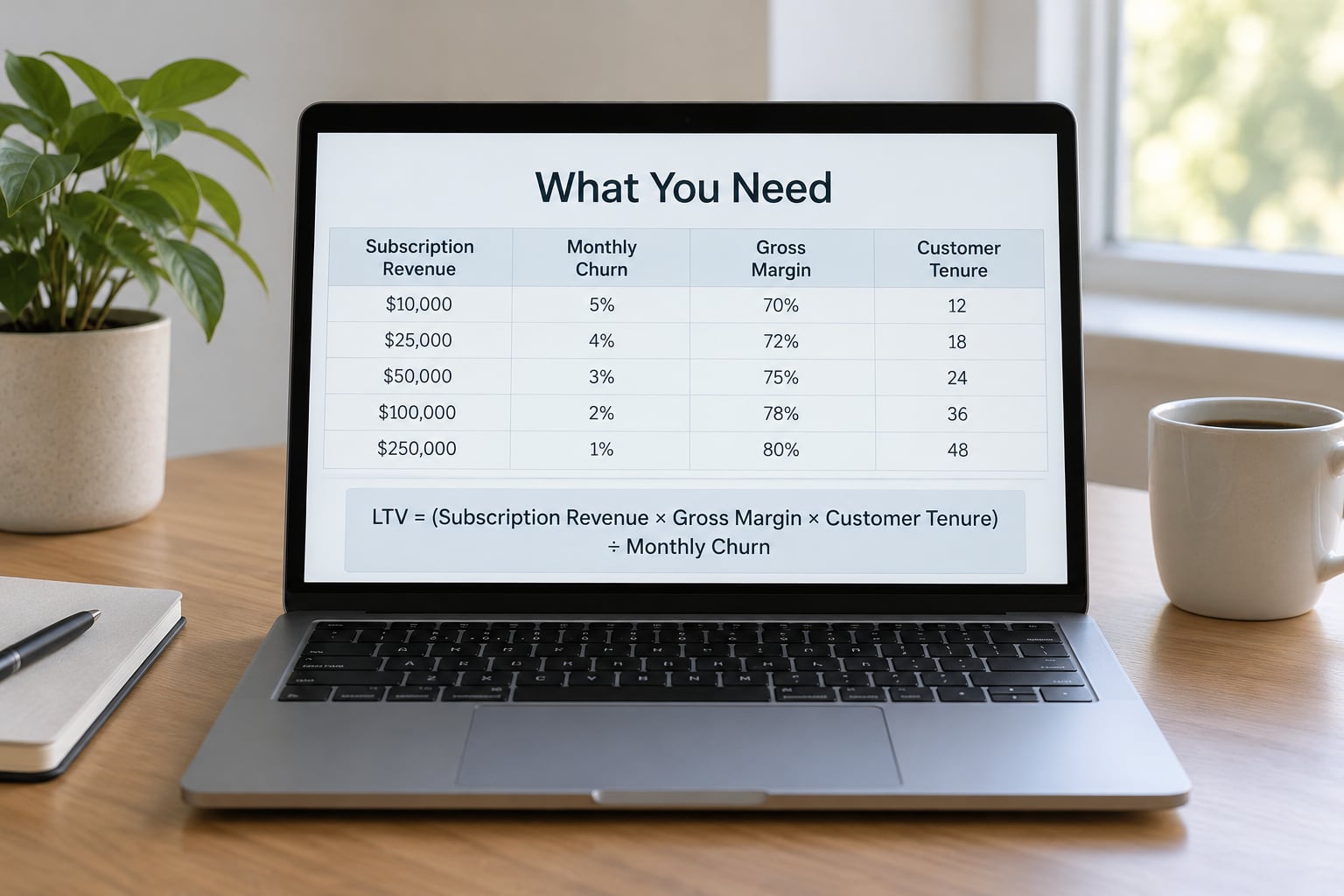
Pull these together before you touch a spreadsheet. Most teams are missing one of them, usually the cost side.
- Customer start and cancellation dates. These give you observed tenure, which is the only measured input that beats an assumption.
- Recurring revenue per billing period. Plan price, seat count and billing frequency, before and after discounts.
- Variable costs per customer. Infrastructure, payment processing, support time, service delivery.
- Refunds, credits and failed-payment records. Realised revenue is lower than invoiced revenue in most programmes.
- A churn series. Monthly cancellations and subscriber counts by cohort, at minimum six months deep.
- A defined calculation period. Decide whether you are reporting LTV in months or years, and hold that choice constant.
Customer-level records are ideal because each subscriber gets a real tenure and a real margin. When records are thin, cohort-level averages work fine as long as you publish the subscriber count behind the average.
Step-by-Step: How to Calculate Lifetime Value of a Subscription Customer
Here is every formula in one place. Each row is one line of work, and the order matters because each output feeds the next input.
| Formula | What it needs | Output |
|---|---|---|
| ARPU = recurring revenue / active customers | MRR and active subscriber count for the same period | Average revenue per customer |
| Monthly churn = cancellations at start / active customers at start | Cancellations and subscriber counts for one month | Churn rate, same period as revenue |
| Customer lifespan = 1 / monthly churn | A verified monthly churn rate | Expected months of subscription |
| LTV = ARPU x customer lifespan | Revenue-based figure | Lifetime revenue per customer |
| Margin-adjusted LTV = ARPU x margin x lifespan | Gross or contribution margin percentage | Lifetime profit per customer |
| Discounted LTV = sum of each future period’s value / (1 + rate)^period | A discount rate and a retention curve | Present value of lifetime profit |
| LTV:CAC = LTV / customer acquisition cost | Blended or segment-level acquisition cost | Efficiency of growth spend |
1. Define the Customer and Revenue Scope
Write the scope down before you calculate anything, because the answer changes completely depending on what you include. A single customer, a plan tier, an acquisition channel and a signup-month cohort are four different questions with four different answers.
Decide next which revenue counts. Subscription revenue is the base. Usage fees, in-app transactions, add-ons and one-time setup charges can be added as expansion revenue, but never fold them into the recurring base or your ARPU stops meaning anything.
2. Calculate Average Revenue per Customer
Divide recurring revenue by active customers for the same period: ARPU = MRR / active subscribers. Matching periods is not a technicality. Annual revenue divided by monthly churn inflates your LTV by roughly twelve times, and that mistake shows up constantly.
Subtract what you did not keep: promotional discounts, refunds, prorated downgrades and free trial months. For seat-based plans, ARPU is revenue per account, so define whether you are valuing a seat or a whole organisation before averaging.
3. Determine the Gross Margin Percentage
Margin is the difference between revenue and the costs that disappear when the customer leaves. That usually means infrastructure, payment processing, support and service delivery, plus any onboarding cost you carry per account.
Contribution margin keeps variable costs in the calculation. Use it when support or infrastructure costs scale with usage, which is the norm for a mobility pass or a utility-style civic programme. Exclude fixed overhead, because it does not disappear with a single cancellation.
4. Estimate Customer Lifetime
Customer lifespan is the least honest-looking input, because for anyone still paying it is a forecast. Two sources work: observed tenure for customers who have already cancelled, or a validated churn rate applied to everyone.
Churn definition changes the answer more than any other choice you make here.
| Churn measure | How it is calculated | Effect on LTV |
|---|---|---|
| Customer (logo) churn, monthly | Cancelled customers / active customers at month start | The standard choice for subscriber counts |
| Revenue (MRR) churn, monthly | Lost MRR / MRR at month start | Falls below 5 percent sooner as small accounts leave; gives a longer lifespan |
| Annual churn from monthly | 1 – (1 – monthly churn) raised to 12 | Use for annual reporting; 5 percent monthly is about 46 percent annual |
| Annual churn directly | Cancelled customers over 12 months / active customers at year start | Matches annual revenue, so keep it paired with annual ARPU |
| Cancellation rate | Cancellations / renewal or billing opportunities | Measures renewal risk, not base decay |
Lifespan then follows directly: 4 percent monthly churn gives roughly 25 months, 5 percent gives about 20. Practitioners treat anything under 3 percent monthly as an unusually durable base.
5. Calculate Simple and Discounted Lifetime Value
Start simple. Multiply margin-adjusted monthly revenue by lifespan: LTV = ARPU x margin x (1 / churn). That number is a revenue forecast in disguise, and treating it as guaranteed cash is the most expensive error in this whole exercise.
Discounting brings it back toward money you could actually realise. Sum each month’s margin value and divide by (1 + r) to the power of the month number. A common shortcut multiplies the simple result by 0.75 to absorb the fact that early subscribers churn sooner than the average implies.
6. Validate the Result With a Civic App Example
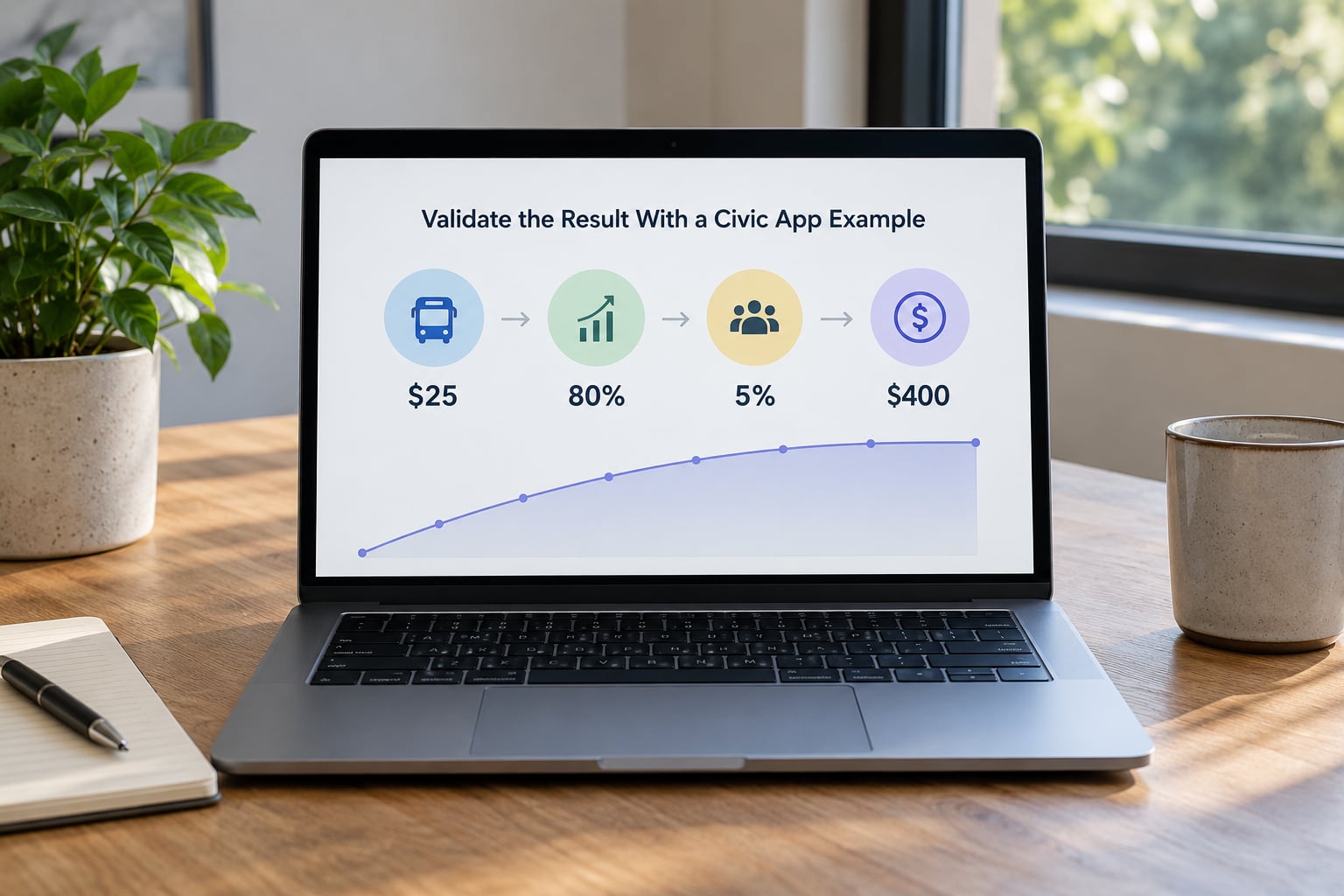
Take a city mobility app charging USD 25 a month with 1,200 subscribers and 5 percent monthly churn. The full calculation runs in five lines.
| Step | Input | Calculation | Result |
|---|---|---|---|
| Monthly recurring revenue | 1,200 subscribers at USD 25 | 1,200 x 25 | USD 30,000 |
| ARPU | Revenue and subscriber count | 30,000 / 1,200 | USD 25 |
| Contribution margin | Infrastructure, processing, support | 25 x 0.80 | USD 20 |
| Customer lifespan | 5 percent monthly churn | 1 / 0.05 | 20 months |
| Simple margin LTV | Margin per month and lifespan | 20 x 20 | USD 400 |
| Discounted LTV | Flat 0.75 conservatism factor | 400 x 0.75 | USD 300 |
Cross-check against cohorts before you publish that figure. If customers who signed up six months ago show a realised value of USD 110 and the early-month curve implies roughly that, the lifespan assumption is holding. If realised value runs far below it, your churn rate is averaging away a fast-churning first-month group.
Recalculate when churn moves more than a point, when you change pricing or billing frequency, when you add or remove an add-on, and at least every quarter regardless. For a funded or near-zero-ARPU membership programme, drop the revenue frame entirely and report cost per retained user instead.
7. Use the Result for Better Business Decisions
LTV is useful because it sets a ceiling on acquisition spend. Divide by three and you have the maximum justifiable customer acquisition cost at the 3:1 ratio that most operators treat as the healthy floor.
Payback period is the companion number finance teams gate on: CAC divided by monthly ARPU, expressed in months. If payback runs longer than twelve months and cash is tight, the ratio alone will not save you.
Then segment. Cheap channels frequently produce the highest-value subscribers, and cheap plan tiers churn faster than premium ones, so a blended LTV hides both signals. Pricing experiments, support staffing and win-back campaigns all get easier to justify once each has its own lifetime value.
Common Mistakes
- Using revenue instead of margin. Fix: apply contribution margin before multiplying by lifespan, or your LTV overstates profit several-fold.
- Mixing churn definitions or periods. Fix: decide logo or revenue churn, monthly or annual, and keep revenue and churn on the same period for the whole calculation.
- Blending every subscriber into one average. Fix: publish LTV by plan tier, channel and signup cohort, and compare within segments only.
- Ignoring discounts and refunds. Fix: work from realised collections, not invoiced amounts, and state whether trial months are included.
- Treating LTV as guaranteed cash. Fix: discount future periods or apply a conservatism factor, and label the result an estimate.
- Comparing LTV to a CAC from another segment. Fix: match channel, plan and period on both sides of the ratio before drawing a conclusion.
One tip for cohort comparisons: align cohorts by customer age, not by calendar month. A cohort’s first-year LTV is only comparable when every cohort has had the same time to churn.
Frequently Asked Questions
Should subscription customer lifetime value use revenue or gross profit?
Use gross profit. Revenue-based LTV tells you what billed, not what you kept, and it usually runs several times higher once infrastructure, payment processing and support costs are subtracted. Revenue LTV still has a place as a gross figure for quick comparisons, but any decision about acquisition spend should run off the margin-adjusted number.
How do I convert monthly churn into an average customer lifetime?
Divide one by the monthly churn rate. At 5 percent monthly churn the average lifespan is 20 months, at 4 percent it is 25 months, and at 3 percent about 33 months. Keep the churn figure measured over the same period as your revenue input, and sanity-check the result against the observed tenure of customers who have already cancelled.
Is customer lifetime value the same as customer acquisition cost?
No, they measure opposite ends of the same decision. Acquisition cost is what you spend to win a customer; lifetime value is what that customer is expected to return. The useful output is the ratio between them: divide LTV by CAC, and treat 3 to 1 as the healthy floor, with payback period in months as the second check.
Should I discount future subscription cash flows when calculating lifetime value?
Yes, if you are comparing customers acquired at different dates or making a present-value decision such as setting a CAC ceiling. Sum each future period’s margin value and divide by one plus your discount rate to the power of the period number. Many teams skip the full calculation and multiply the simple result by a 0.75 conservatism factor instead.
How should a company calculate lifetime value for a customer segment?
Calculate each segment independently, keeping revenue, margin and churn from the same segment only. A useful minimum split is plan tier, acquisition channel and signup cohort, with tenure measured from the segment’s own first payment. Blended figures hide the fact that cheaper plans typically churn faster, and blended averages are what cause teams to argue about the number instead of the trend.
How often should subscription lifetime value be recalculated?
Recalculate whenever churn moves by more than a percentage point, when you change pricing, billing frequency or plan structure, and at minimum every quarter. With few subscribers, monthly churn swings are noisy, so a quarterly cadence avoids rewriting the number for the wrong reason. Keep the definition fixed between recalculations so changes reflect retention, not methodology.
Conclusion
Start by writing down the scope, then collect realised recurring revenue, contribution margin and a churn series measured over a single consistent period. Run the seven steps, and cross-check the result against the observed value of one signup cohort before anyone builds a budget on it.
Lifetime value stays an estimate. It moves whenever your retention evidence moves, so keep the definition fixed, track the quarterly delta, and treat a rising number as a reason to check, not as a victory.