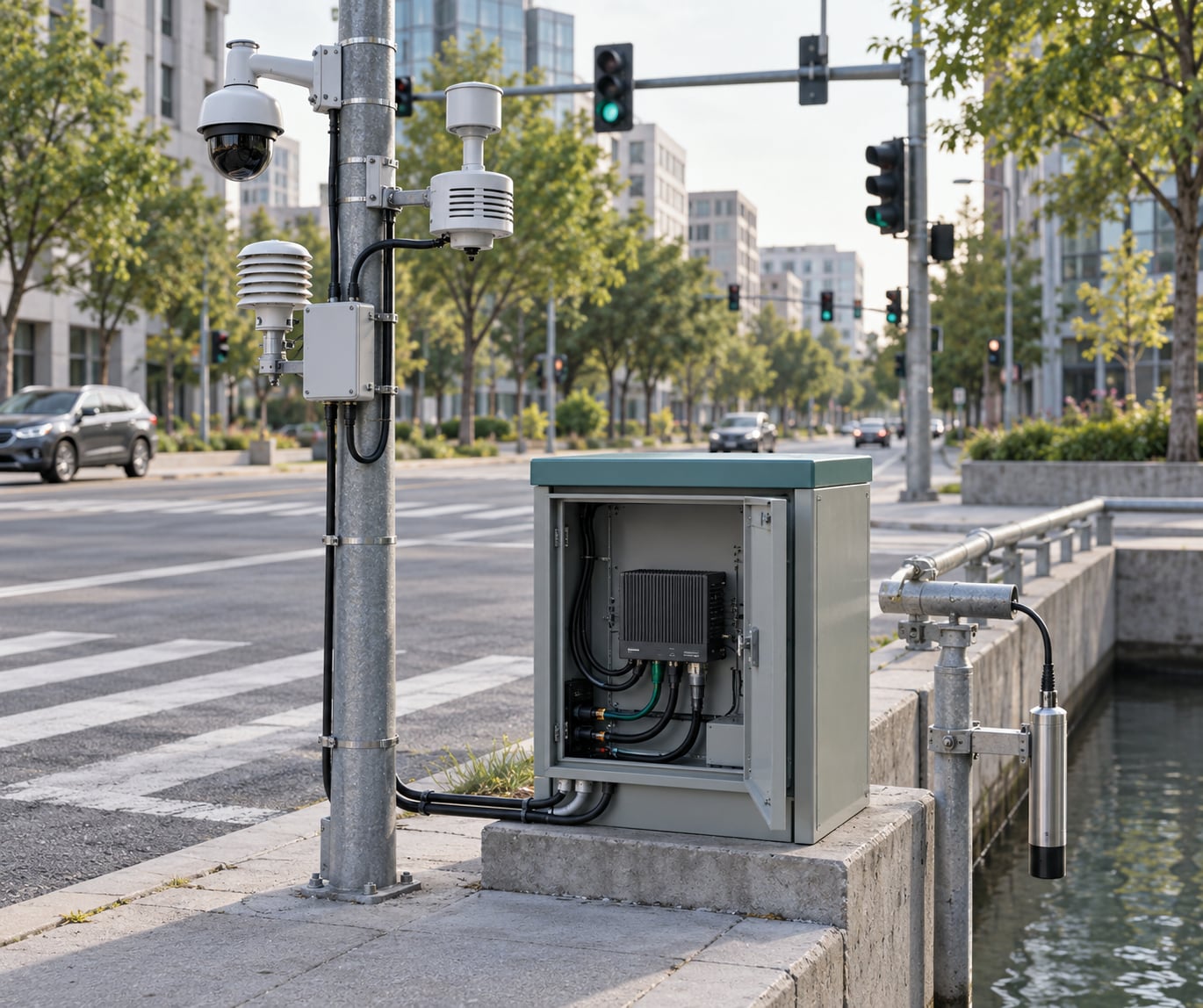
Edge computing works for city sensors by moving the processing that turns raw readings into decisions onto small computers located near the sensor, in a street cabinet or a gateway on a pole, instead of shipping every reading to a distant data center. The sensor measures, the nearby node decides in milliseconds, and only a small summary travels onward. That is the whole idea: sense locally, decide locally, archive centrally.
This guide is written for civic technology teams, public works staff and the engineers who build for them. If you are evaluating where to put compute in a municipal sensor network, the sections on node tiers, connectivity and failure behavior will save you an expensive redesign later on.
Table of Contents
- What Is Edge Computing in a City Sensor Network?
- How Does Edge Computing Work for City Sensors?
- What Happens at the Sensor Layer?
- What Happens at the Edge Gateway?
- What Happens After a Local Decision?
- Edge Computing vs. Cloud Computing for City Sensors
- What Makes a City Sensor Edge System Useful?
- What Hardware and Software Does an Edge Sensor System Need?
- How Do City Sensor Networks Stay Connected?
- How Do Cities Secure and Manage Edge Sensor Data?
- What Are the Main Challenges of Edge Computing for City Sensors?
- How Would a City Deploy an Edge Sensor Network?
- Frequently Asked Questions
- Does edge computing replace cloud computing for city sensors?
- When does a city need edge computing instead of cloud-only processing?
- Can edge sensor systems work when the internet is down?
- Should raw city sensor data always be stored in the cloud?
- How does a city choose between an edge gateway and a microcomputer?
- Conclusion
What Is Edge Computing in a City Sensor Network?
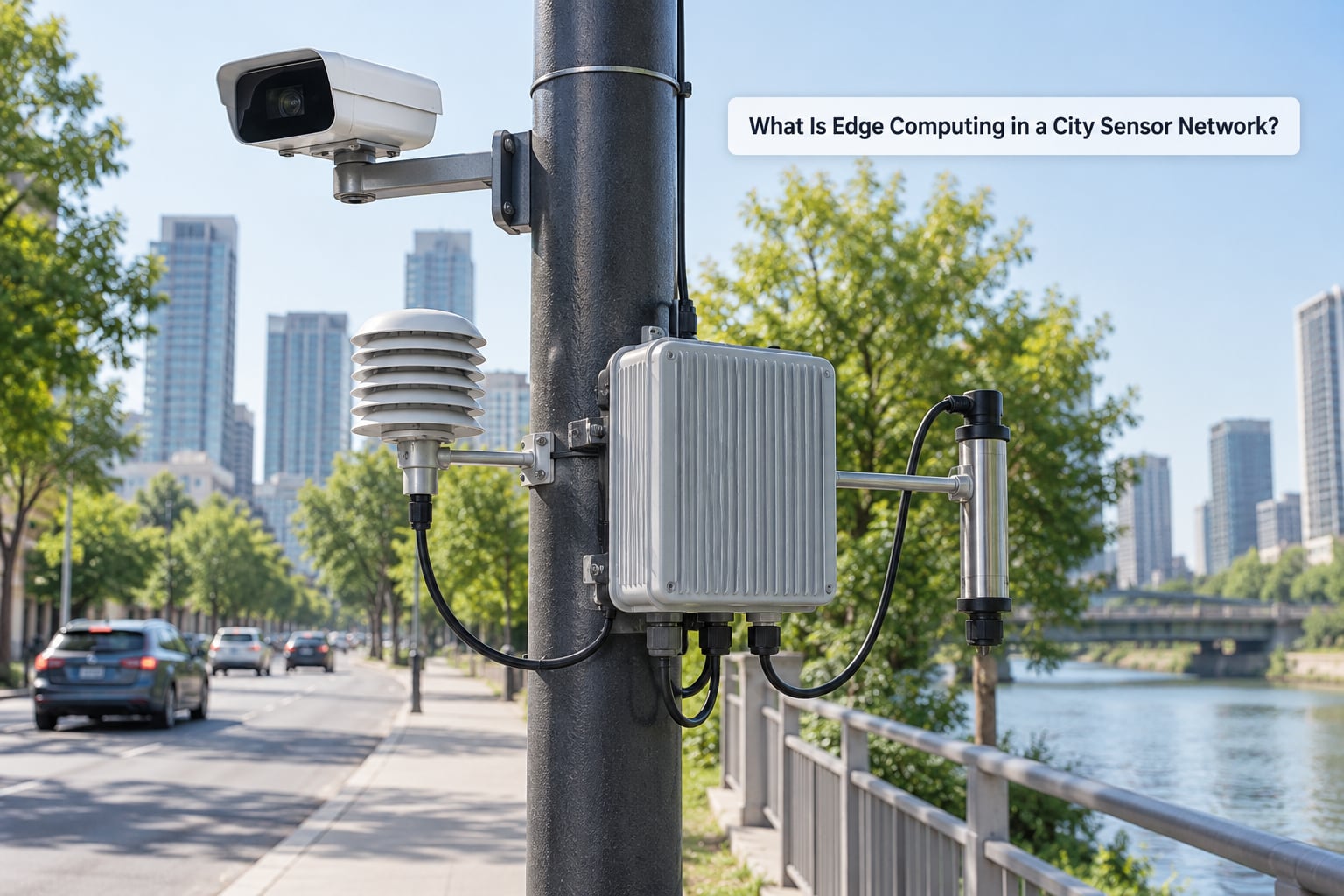
Edge computing means running data processing on hardware close to where the data is created. In a city sensor network, that hardware is usually a small computer in a traffic signal cabinet, a pole-mounted gateway, or a cabinet on a bridge, not a data center across the country.
The difference is not academic. Consider a storm drain that silts up and floods a residential street. A sensor sitting in the drain detects rising water level, and something has to decide whether this is normal rain or an emergency. If that decision waits on a round trip to a cloud data center, the delay is measured in hundreds of milliseconds, and sometimes much longer if the backhaul link is congested or down.
Processing that at the edge means the local node compares the reading against a threshold and pushes the alarm itself, without asking permission from a server 50 miles away.
Cities use local gateways and microcomputers because a street cabinet is a place where power, wiring and network drops already exist. The hardware is already in the cabinet next to the signal controller, so putting a small computer there costs far less than pulling new fiber to every device.
How Does Edge Computing Work for City Sensors?
A reading travels through five stages: collection at the sensor, preprocessing, local analysis, an alert or control action, and selective synchronization to the cloud. Most readings never leave the area. Only the events someone needs to see in a control room, or the long-term history needed for analysis, get forwarded.
What Happens at the Sensor Layer?
A physical sensor converts a condition into an electrical signal, and a small controller turns that signal into a number. Temperature sensors report degrees, vibration sensors report acceleration, water level sensors report height, air quality sensors report particulate counts or gas concentrations, and occupancy or motion sensors report counts and movement.
Every reading gets stamped with the time it was taken and the identifier of the device that took it. Without those two fields, you cannot line up two sensors from different intersections later, and troubleshooting a broken device becomes guesswork.
The sensor layer also does a basic quality check. Flatlined readings, values outside the physical range of the instrument, and sudden jumps get flagged rather than passed on as fact. This matters because a failed sensor is far more common than a failed decision, and a corrupted stream quietly poisons everything downstream.
These devices have very little compute, storage and memory. They are not making decisions; they are reporting faithfully and cheaply, often for years on a battery.
What Happens at the Edge Gateway?
The edge gateway is where the interesting work happens. It receives readings from several sensors, filters noise, converts formats into a common structure, and applies rules or runs a small inference model.
Filtering is not the same as deciding. Removing duplicate packets and smoothing jitter is housekeeping. Deciding that the objects in a LiDAR point cloud are a truck and a cyclist is a classification, and that classification is what triggers a signal change.
Gateways also buffer. If the backhaul drops for ten minutes, the node keeps collecting and deciding the whole time, then stores what it needs and forwards it when the link returns. It also enforces local thresholds, so an alert fires even when nothing is watching the dashboard.
What Happens After a Local Decision?
Once the node decides something is wrong, the decision travels through a real workflow, not a direct wire. The alert goes to a message broker or an API endpoint, an acknowledgement comes back, and if there is no acknowledgement the node retries with backoff rather than flooding the channel.
Duplicates are deduplicated by event identifier, because a sensor that reconnects will often resend the last few readings. Escalation rules decide when a field alert becomes a dispatch. And an audit log records what was seen, what was decided and what was sent, because municipal decisions need to be explainable after the fact.
In parallel, the node sends a small summary upward: a count of vehicles, a peak water level, a device health heartbeat. The cloud stores history, retrains models across the whole city and cross-references districts against each other. The raw feed stays local unless someone asks for it.
Edge Computing vs. Cloud Computing for City Sensors
| Criterion | Edge computing | Cloud computing | Hybrid design |
|---|---|---|---|
| Where processing happens | Street cabinet, pole gateway, nearby server | Centralized data center | Realtime decisions local, history and training central |
| Response time | Milliseconds, often under 50 ms | Round trip typically hundreds of milliseconds | Milliseconds for control, seconds to minutes for reporting |
| Bandwidth demand | Summaries and events only | Continuous raw streams | Raw high-rate data filtered before it leaves the site |
| Connectivity dependence | Works during an outage | Degrades or fails without the link | Degrades to local-only behavior |
| Data retention | Short buffer on the node | Long-term searchable history | Hot data local, archived data central |
| Compute capacity | Modest; accelerator-sized models | Large, flexible, elastic | Small models local, heavy models central |
| Maintenance | Field access to cabinets and poles | Remote, centralized | Split, with edge patches scheduled in windows |
| Privacy exposure | Raw data stays near the device | Raw data leaves the site | Minimized payload central, retained locally |
| Best suited to | Signals, floods, safety interlocks, device health | Historical analytics, planning, model training | Almost every real municipal deployment |
Treating edge and cloud as mutually exclusive is the most common architectural mistake. The two are not competing tiers; they are two stages of the same system, and most working deployments are hybrid.
What Makes a City Sensor Edge System Useful?
The practical value comes down to a handful of things. First, response time: a signal that must change in under a second cannot wait on a distant server. Second, bandwidth: filtering locally turns thousands of raw readings into a handful of useful events, and that difference decides whether a deployment fits the city’s existing network budget or does not.
Third, continuity. A node with local logic keeps detecting floods and switching streetlights on even when a fiber cable gets cut, which is exactly when the data matters most. Fourth, data control: keeping raw video or high-resolution point clouds on site shrinks the privacy problem, because data that never leaves the cabinet was never exposed.
Fifth, scale. Once the decision logic is packaged, adding another intersection means mounting hardware and provisioning a device, not rewriting software. Sixth, locality. Traffic at a school crossing in the morning is not the same problem as traffic at a stadium exit at night, and thresholds set on site can reflect that.
These are engineering benefits, not financial promises. Whether a system actually saves money depends on bandwidth costs, field visit rates and how much infrastructure the city already has.
What Hardware and Software Does an Edge Sensor System Need?
An edge sensor system is a stack, and each layer has its own constraints.
At the bottom sit the sensors themselves: temperature probes, accelerometers for vibration, water level and flow meters, particulate and gas sensors, cameras and LiDAR units, and presence or occupancy detectors. Above them come radios and connectivity hardware, then the gateway or edge server, then storage, then the management and analytics software.
That server tier ranges widely. A gateway may run a low-power single-board computer with a radio and a few gigabytes of flash. An intersection with LiDAR and multiple video streams needs a machine with an AI accelerator, considerably more memory, and active cooling. A citywide deployment may add a regional edge server in a municipal data centre that aggregates many sites.
Public space sets harder limits than a server room. Equipment sits in unheated cabinets that can swing from freezing to hot, on poles exposed to vibration, and behind locks that a determined person can defeat. That drives four requirements: wide temperature tolerance, secure physical mounting, remote power and health monitoring, and a documented lifecycle with firmware support you can actually rely on for the life of the deployment.
On the software side you need a device management platform, a messaging layer, an analytics layer that does not care which hardware vendor made the node, and dashboards plus alerting for the people on call.
How Do City Sensor Networks Stay Connected?
Connectivity choice shapes the architecture, because it decides how much data can leave a site and how long a device stays asleep between transmissions.
Wi-Fi suits short range inside a building or a transit shelter. Cellular, including 5G, handles wide areas and high bandwidth but costs more per device and depends on coverage. LPWAN options such as LoRaWAN send small packets over long distances on very little power, which fits water meters, parking sensors and air quality units, though they cannot carry video. Bluetooth is a local tool, useful for maintenance crews and commissioning rather than citywide coverage. Wired connections remain the most dependable for anything in a cabinet, where power and conduit already exist.
These choices are collaborators, not competitors. LoRaWAN covers a hundred low-rate sensors cheaply, and cellular or fiber carries the aggregated result back to the city network.
Two engineering details get skipped too often. The first is store-and-forward: nodes buffer locally, tag each record with a sequence number, and replay missed records once the link returns, so nothing is silently lost. The second is clock synchronization, because a flood alert and a traffic count that disagree by two seconds are hard to correlate later. Both should be designed in from the start rather than added after the first outage.
Radio planning deserves the same attention, since buildings create urban canyons that block and reflect signals. Practitioners treat gateway placement and redundancy as a first-order design decision, not a detail for the installer.
How Do Cities Secure and Manage Edge Sensor Data?
Street-level hardware is exposed in a way data centre hardware is not. It sits on poles, in unlocked cabinets, near people who are curious and sometimes hostile, and each device is a potential entry point into the network it reports to.
Give every device its own identity and credentials rather than a shared password, so one stolen key does not unlock a thousand sensors. Encrypt data in transit and at rest, sign firmware so unsigned software cannot be installed, and use secure boot where the hardware supports it. Apply least privilege: a street lighting node has no reason to query a water management system.
Segment the network so traffic cabinets sit apart from office systems, run backups and certificate authorities where updates can be staged before they roll out, and rotate keys on a schedule you actually keep. Limit retention so raw high-resolution data expires quickly while derived summaries persist.
The biggest practical risk is a compromised device being used as a launch point rather than for its own sensor data. Local processing limits that blast radius, because the device holds one task, one identity and a narrow set of permissions. Physical tamper detection matters too, and so does a plain inventory of what is deployed where.
What Are the Main Challenges of Edge Computing for City Sensors?
Connectivity is the first problem. Links fail, and urban RF behaves unpredictably, so buffer aggressively, design for store-and-forward, and treat the network as unreliable by default.
Power comes next. Street cabinets have mains power, but many remote assets run on batteries or solar, so budget the transmission rate against the duty cycle, and consider energy harvesting where the site allows it.
Hardware fails in ordinary ways. Enclosures fill with water, connectors corrode, antennas get damaged, and batteries run down. Remote health monitoring with a per-device heartbeat catches these faster than a monthly site visit, and knowing a node died matters as much as keeping it alive.
Clock drift quietly ruins correlation across a fleet, so use time synchronization and log the offset. Model drift is subtler: a detection model tuned last spring degrades as seasons, roadworks and camera positions change, so schedule revalidation against labelled events rather than assuming it holds.
Inconsistent data formats block integration between departments, so standardize on open schemas and keep analytics hardware-agnostic. Physical tampering is partly technical and partly policy, and both need an owner. Maintenance cost is a real budget line, not an afterthought, because every cabinet visit is a truck, a crew and a traffic control plan. Finally, coordination across departments decides whether the data is usable at all, and that is a policy decision rather than a technical limit.
How Would a City Deploy an Edge Sensor Network?
Start with the civic outcome, not the hardware. Write down one decision you want to make better, and the person who will make it. A flood warning that nobody receives is a data collection project with no value.
Then survey the site. Power, connectivity, radio coverage, physical access, existing cabinets and backhaul all constrain what is possible. Map the latency budget for the decision, and put the compute where it fits inside it.
Choose sensors and connectivity that meet the outcome with the least power and the least radio traffic. Prototype the decision logic before you install anything at scale, then test the failure modes deliberately: unplug the backhaul, kill a sensor, desynchronize the clock, and confirm the system degrades the way you designed.
Secure the system as part of the build rather than after it, then deploy a limited pilot at one or two sites. Measure detection quality, response time, uptime, bandwidth per site and field visits per month. Compare those numbers to the outcome you named at the start, and only then scale.
Frequently Asked Questions
Does edge computing replace cloud computing for city sensors?
No. Edge computing handles the work that has to happen immediately: reading a sensor, filtering the signal, classifying an event and triggering a control action. The cloud keeps what edge cannot do well, namely long-term storage, historical queries, model training across the whole city and comparisons between districts. Municipal deployments that work are hybrid, with fast decisions local and archives central.
When does a city need edge computing instead of cloud-only processing?
You need local processing when the decision has a deadline shorter than a cloud round trip and shorter than your worst connectivity outage. Adaptive signal timing, flood alarms, emergency vehicle pre-emption and street lighting are the clear cases. A water meter that reports once an hour needs none of this. Ask one question: if the backhaul dropped right now, would the wrong outcome be dangerous or expensive? If yes, the logic belongs at the edge.
Can edge sensor systems work when the internet is down?
Yes, provided you design for it. Local nodes keep collecting, filtering and deciding from their own power and processing, and they buffer results until the link returns. That is why store-and-forward delivery, sequence numbers and local alerting belong in the first version of the design rather than the second. What you lose during an outage is the wider view, since no one can see the dashboard until the connection is restored.
Should raw city sensor data always be stored in the cloud?
Usually not. High-rate feeds such as video or dense point clouds are expensive to move and rarely need to be retained in full. Keep the raw stream on the node or a short local buffer, forward a filtered summary or event upward, and retain only what analysts actually use. Keeping raw data local also reduces privacy exposure, since data that never leaves the cabinet was never exposed.
How does a city choose between an edge gateway and a microcomputer?
Choose by workload and by how the compute gets to the site. A gateway with a low-power single-board computer fits low-rate sensors and threshold logic such as water levels or parking bays. A microcomputer with an AI accelerator fits intersections running LiDAR or video classification. Then check the physical constraints, because thermal range, power, secure mounting and field service access decide more deployments than the specification sheet does.
Conclusion
Edge computing for city sensors is a selective local-processing layer inside a wider city data architecture, not a replacement for it. Sensors report, a nearby node decides in milliseconds, and the cloud keeps the history and does the heavy analytics.
Pick one civic decision and build the minimum that makes it well. Identify which readings genuinely have to be processed locally, filter everything else, then test the design against three realities: connectivity that will drop, hardware that will need a truck, and credentials that will be stolen. Start there, measure the outcome, and scale only when the pilot earns it.