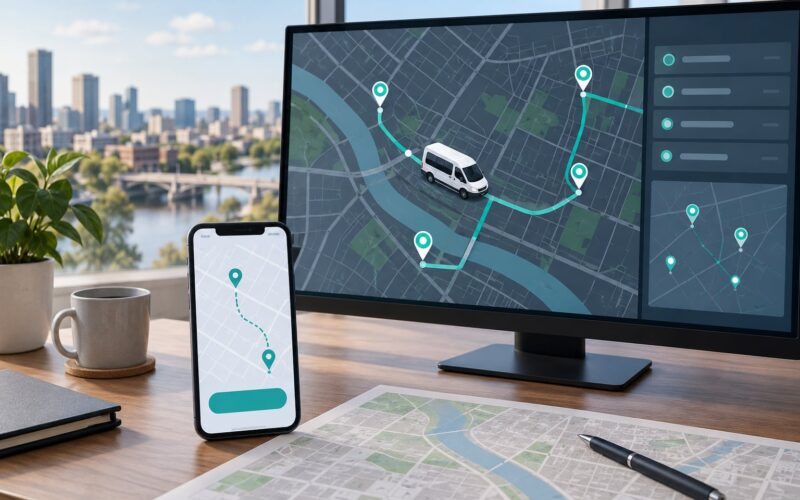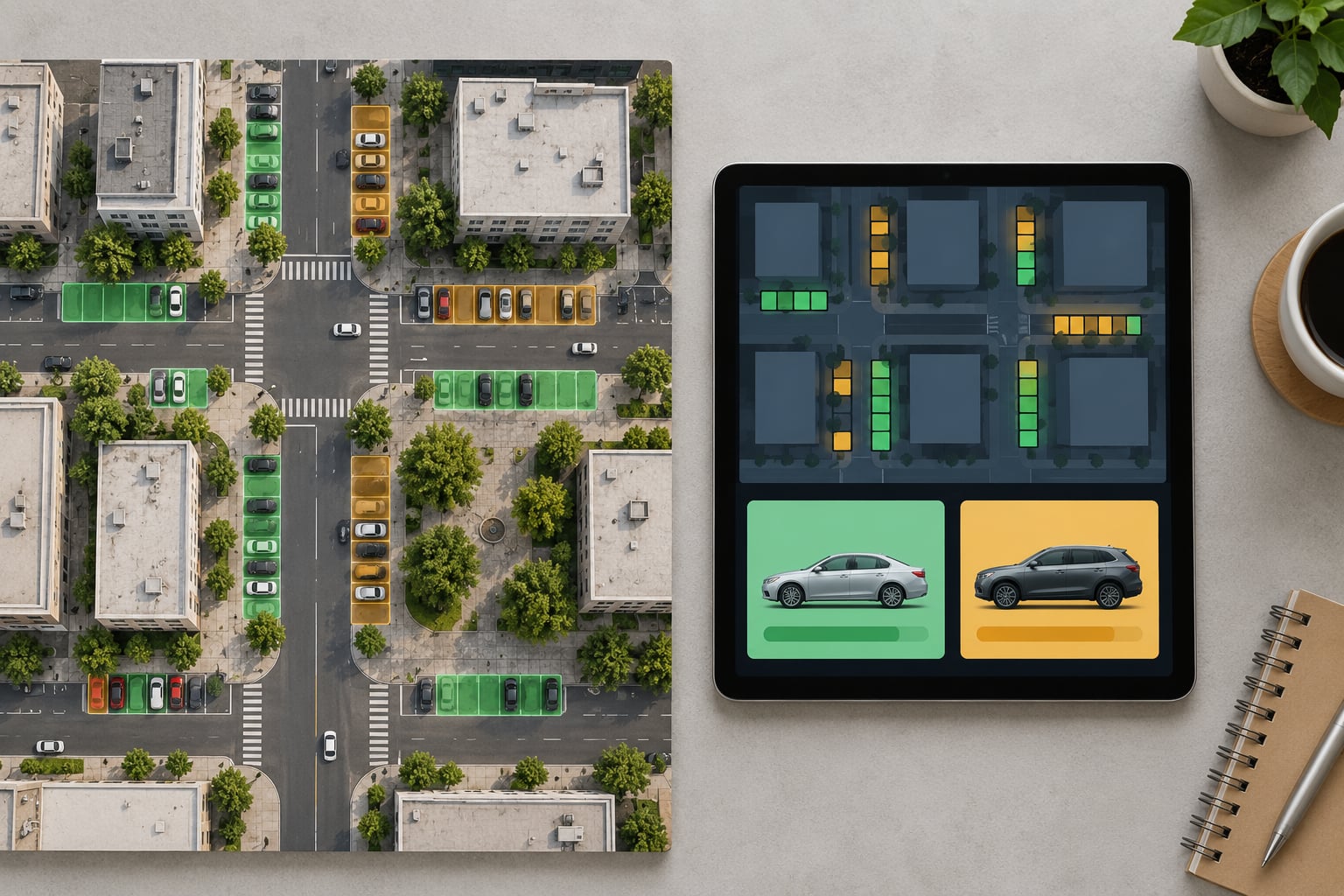
Dynamic parking pricing works by measuring how full each block or lot is, comparing that occupancy against a target range, and then raising or lowering the rate in fixed increments inside an approved floor and ceiling. A pricing engine does the comparing, the meters, apps and signs publish the result, and the whole cycle repeats every few minutes.
That is the whole idea, and the rest of this guide unpacks it: which data feeds the engine, what the rules look like in a real program, how a single parking session runs from detection to payment, and where cities get the policy wrong. If you are building a curb management system or a civic app on top of one, the interesting part is not the rate itself but the guardrails around it.
Table of Contents
- How Dynamic Parking Pricing Works
- Dynamic Pricing vs. Fixed Parking Rates
- What Data Does a Dynamic Parking System Use?
- How Does a City Set the Price?
- How Does Dynamic Parking Pricing Work in Practice?
- When Do Parking Prices Change During the Day?
- Dynamic Pricing for a Busy Event or Unexpected Demand
- What Happens When Parking Availability Increases?
- How Do Cities Measure Whether It Works?
- How Do Cities Build and Manage a Dynamic Pricing System?
- Benefits, Risks, and Equity Concerns
- Frequently Asked Questions
- Does dynamic parking pricing change by the minute?
- Can a parking price change after I start my session?
- How do parking apps show dynamic rates and expected prices?
- What happens if sensors report the wrong parking occupancy?
- Can a city use dynamic parking pricing without installing sensors?
- What to Do First
How Dynamic Parking Pricing Works
Dynamic parking pricing works by sensing how many paid spaces are occupied, comparing that number to a target band such as 60 to 80 percent, and moving the posted rate up or down by a set increment whenever the block sits outside the band. Every adjustment is capped by a minimum and maximum rate, limited in how often it can change, and published so drivers see the price before they park.
Think of a downtown block on a Tuesday. At 11am the block hits 84 percent occupancy, above the band, so the engine adds 25 cents an hour. Twenty minutes later a garage two streets over posts a lower rate, and occupancy slides back to 72 percent, inside the band, so nothing changes. At 6pm the block empties to 35 percent and the rate comes down again.
The mechanism runs in five steps, and every demand-responsive program on the street today follows the same sequence:
- Sense occupancy. In-ground magnetic sensors, camera and vision models, or payment-app telemetry report how many of a block’s paid spaces are taken.
- Compare to the target band. The engine checks whether measured occupancy sits inside the range the city wants to hold, typically 60 to 80 percent on-street.
- Apply a fixed increment. Above the band the rate goes up by a small step, below it by a small step. Big jumps are rare; the system nudges rather than shocks.
- Rate-limit and bound the change. A floor and a ceiling stop runaway rates, a minimum interval between changes stops churn, and a human can override any step.
- Publish the rate. The new price goes to meters, payment apps, and rate signage, so a driver sees it before committing to the space.
One detail drives the whole design: the target is not full occupancy. The goal is a steady supply of open spaces so drivers rarely circle, which means the system deliberately accepts some empty spaces at the top of the band and some searching pressure at the bottom.
Dynamic Pricing vs. Fixed Parking Rates
Dynamic pricing changes rates according to defined conditions. Traditional meters use a fixed tariff or one an operator sets by hand on a schedule. Both can work; they suit different places and different goals.
| Criterion | Dynamic pricing | Fixed or scheduled rates |
|---|---|---|
| Rate basis | Measured occupancy against a target band | Time of day, zone or a single posted tariff |
| Response to demand | Automatic, within minutes or hourly windows | Only when an operator changes the schedule |
| Driver predictability | Lower, unless the entry rate is locked for the session | High, everyone sees the same price |
| Management effort | Higher up front: sensors, software, rule tuning, monitoring | Low: collect and change tariffs occasionally |
| Enforcement | Rate applies at payment time, so audit logs matter | Same rate throughout, simpler to explain in disputes |
| Best fit | Busy mixed-use districts, event areas, garages near a peak | Suburban residential streets, small towns, low-demand zones |
Two related terms cause more confusion than anything else in this topic. Congestion pricing charges you for driving on a road or into a zone; dynamic parking pricing charges you for leaving a car standing in a space. Performance-based parking pricing is the older, academic name for the same occupancy-target idea, and it is the phrase used in most published evaluations. Time-of-day rates look similar on the street but follow a published schedule, not live demand.
What Data Does a Dynamic Parking System Use?
Occupancy is the headline input, and it is the one that decides the price. Everything else either improves the estimate of future demand or supplies a rule the engine must obey.
| Input | What it tells the system |
|---|---|
| Paid-space occupancy | How full the block or lot is right now, from sensors, cameras or payment records |
| Arrival and departure times | How quickly the block is turning over, which separates short stays from a full day |
| Expected arrivals | Forecast demand for the next interval, used by predictive rather than reactive engines |
| Nearby garage availability | Whether an alternative exists before the curb rate moves at all |
| Reservations and permits | Spaces held back for a different price or a different population |
| Event calendars | Stadium release times, theater schedules, conventions and their expected draw |
| Weather and traffic | Rain days, holiday weekends, road closures and construction that shift demand |
| Historical patterns | Typical occupancy by hour and day, which sets the baseline and the starting rate |
| Neighborhood policy | Zones, exemptions, caps, protected hours and rate floors set by local rules |
There is a line a city should not cross. Pricing decisions belong to the space, not to the person, so systems should not use individual driver data, license plate histories or travel patterns to charge someone more. Using those signals to predict block demand is a different activity from using them to set a personal rate, and the distinction is worth writing into the ordinance.
How Does a City Set the Price?
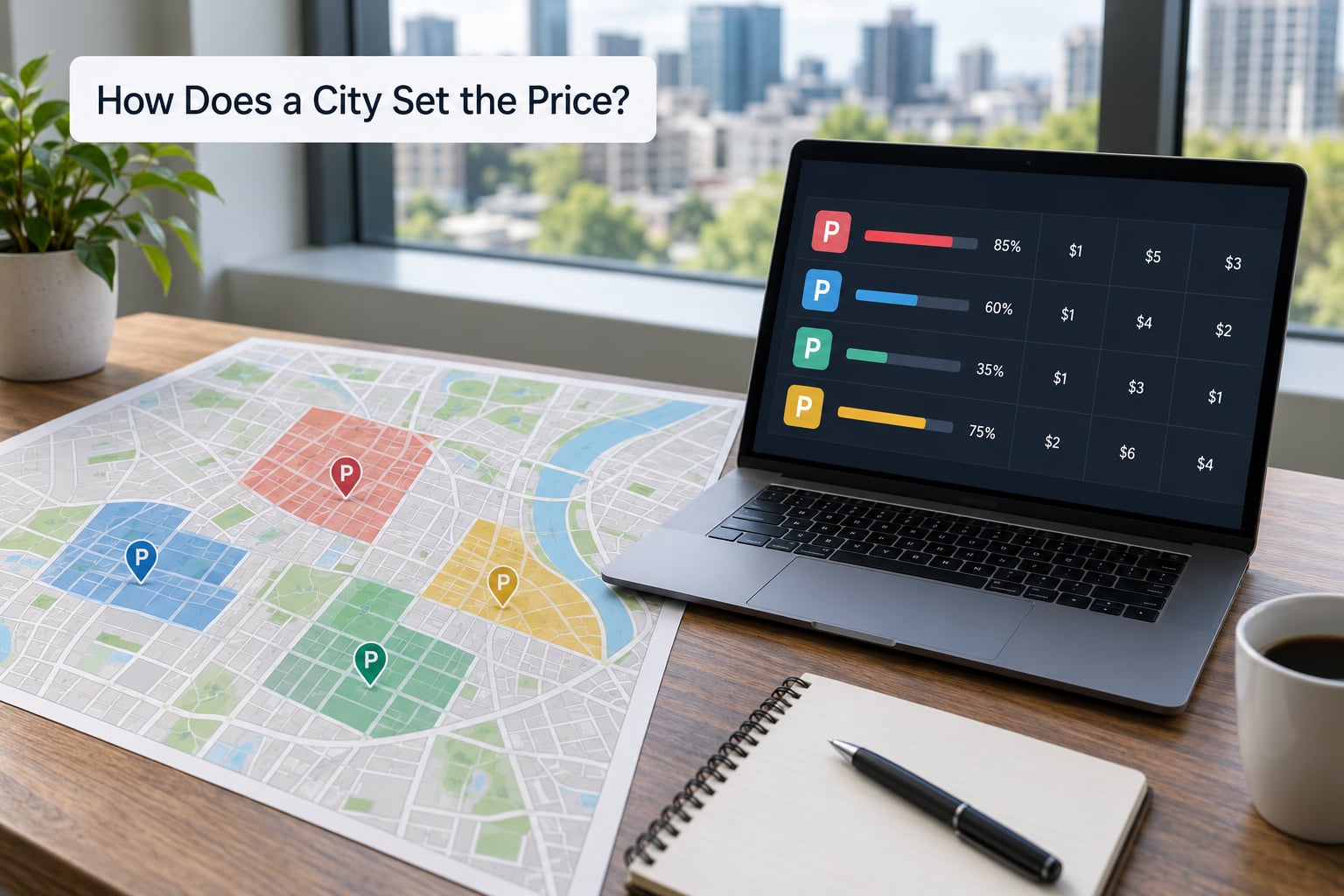
A city sets the price with a rule set, not with a formula that tries to be clever. The rule set has about nine moving parts: a target occupancy band, a floor and a ceiling, an increment size, an evaluation interval, a reset schedule, geographic zones, exemptions, a change-frequency limit and a manual override.
The target band is the heart of it. The common on-street target is 60 to 80 percent occupancy, and the reasoning is a search-distance heuristic: if roughly one in five to one in three spaces is open, a driver usually finds one within a block or two. Seattle runs its paid areas against a 70 to 85 percent band. Setting the target higher leaves a driver hunting; setting it lower wastes curb space and pushes parking into neighbouring streets.
Here is how published rules in three real programs compare. These are the reference numbers most city teams start from.
| Program and area | Occupancy at or above upper band | Occupancy inside the band | Occupancy below lower band | Ceiling |
|---|---|---|---|---|
| SFpark, on-street | 80 percent or more: rate up by 25 cents an hour | 60 to 80 percent: no change | 30 to 60 percent: rate down by 25 cents an hour | 6 dollars an hour maximum |
| SFpark, off-street garages | 80 percent or more: larger step, about 50 cents | Inside the band: hold | Below the band: step down | Program maximum applies |
| Seattle paid areas | Above 85 percent: step up | 70 to 85 percent: hold | Below 70 percent: step down | Set by ordinance, reviewed on an annual cycle |
Now trace one block. At 11:02am on a Tuesday, sensors report 18 of 24 spaces occupied, which is 75 percent. That sits inside the 60 to 80 percent band, so the rate holds. At 11:17am the count is 20 of 24, or 83 percent, above 80. The engine schedules the next evaluation, sees the same result, and adds 25 cents to the hourly rate, moving it from 2.50 to 2.75 dollars. At 11:32am occupancy falls to 17 of 24, or 71 percent. The rate holds at 2.75 dollars, because a program that falls the moment one car leaves never converges. The next decrease has to wait until occupancy is below 60 percent, and the rate cannot drop below the floor or rise above the ceiling at any point.
How Does Dynamic Parking Pricing Work in Practice?
One parking session runs like this. A sensor or the payment platform registers that a car is occupying space 14. The engine updates the block’s occupancy and, if the rule set calls for it, publishes a new rate to signage and apps. The driver opens the parking app, sees the rate for that block at that moment, and pays. The app records the rate as a transaction quote.
The important part is what happens next. The next adjustment does not ordinarily change an already completed payment. Cities lock the entry rate for the duration of a session, so a driver who enters at 2.75 dollars an hour pays that rate for the whole stay even if the block fills and the posted rate moves to 3 dollars an hour ten minutes later. That lock is the most requested mechanic from drivers, and it also keeps enforcement simple: the rate at the start of the session is the rate at the end.
Most drivers are quoted the rate when they pay, sometimes with a small buffer applied automatically to cover the session without a second transaction. Anything else surprises people. A mid-session rate change with no notice is the single biggest complaint, and it is avoidable by design.
When Do Parking Prices Change During the Day?
Most curbs see a defined daily rhythm: a morning shoulder period, a business peak, an afternoon plateau, an evening falloff, an overnight block and a weekend pattern that can invert entirely. Programs express that rhythm two ways, and it helps to keep them separate.
Recurring schedules are published ahead of time. They cover the things a city knows months in advance, such as lower overnight and weekend rates on residential streets, a higher event-day rate on blocks near a stadium, or protected hours where no adjustment is allowed at all. Drivers can look these up and plan around them.
Live demand adjustments sit on top. These react to measured occupancy at evaluation intervals, usually hourly, and move the rate within the floor and ceiling for that zone. A city can run one, the other, or both. Residential streets usually get the schedule only, because the churn that variable pricing is designed to prevent is not something most neighbourhoods want on a Sunday afternoon.
Minimum parking durations matter more than people expect. If a driver can enter and leave in under an hour, the block’s occupancy keeps flipping and the rate can oscillate with it, which looks random from the sidewalk. A one-hour minimum, or a rule that occupancy is sampled at a fixed interval rather than continuously, keeps the published rate steady.
Dynamic Pricing for a Busy Event or Unexpected Demand
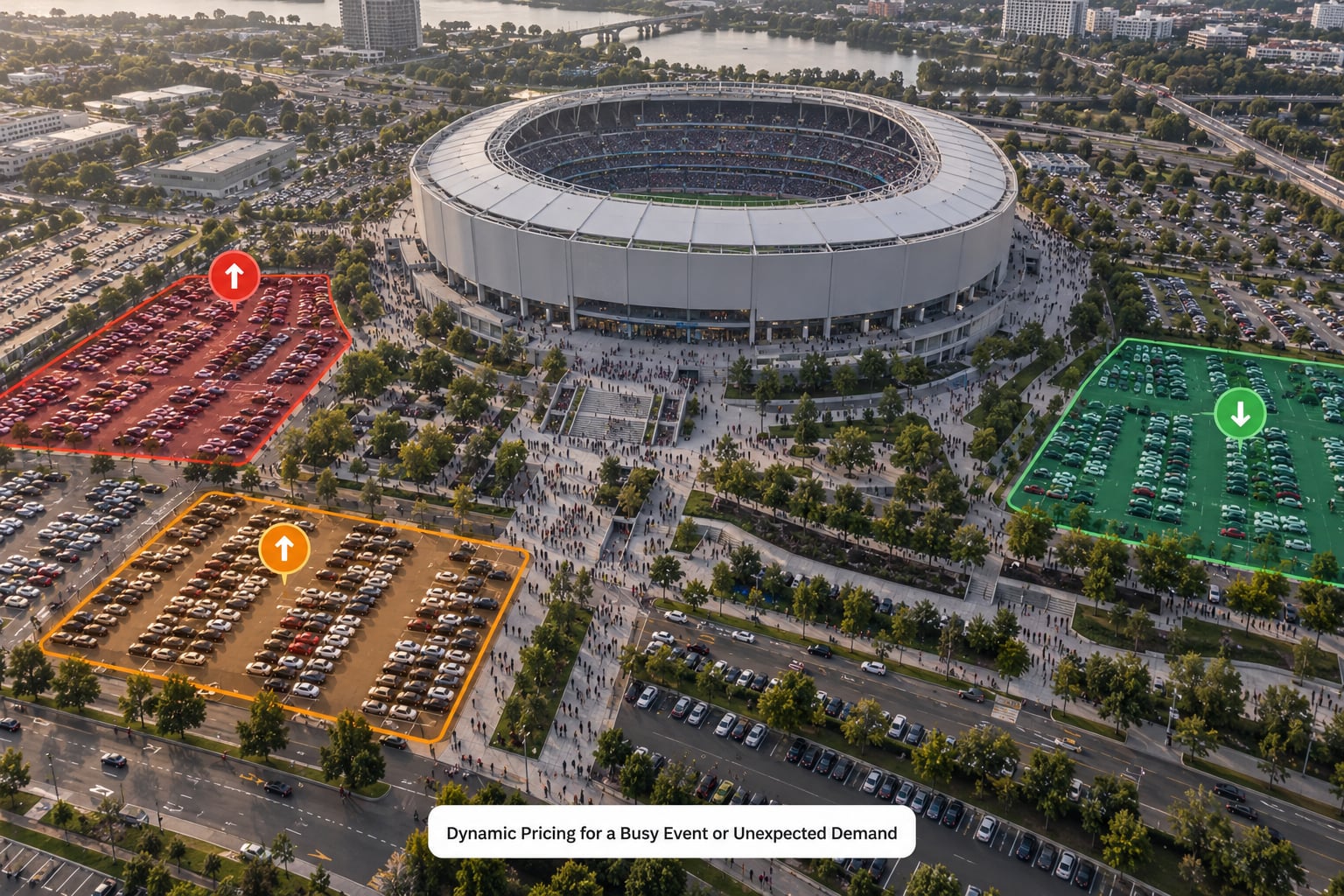
Picture a 7pm stadium event in a district with roughly 2,000 on-street paid spaces and no new supply arriving that night. Doors open at 7, the crowd arrives between 5:30 and 7, and by 6:20 the blocks nearest the venue are effectively full. If the rate stays flat, the response from drivers is to keep circling and to push into residential streets two blocks over.
A sensible response has five parts. Raise rates gradually rather than in one jump, using the same increment used on an ordinary day, so the system looks like it is doing what it always does. Hold lower rates in the peripheral zones, since the supply problem is a distribution problem as much as a volume problem. Cap the maximum increase for the event window, so a driver who decides late does not meet a shock rate with no explanation. Publish expected return times where the system supports them, because a driver choosing to circle is a driver who would rather have parked ten blocks away at a known rate. Revert to normal pricing as soon as the post-event release clears, and say publicly when that happened.
Road closures and transit disruptions produce the same pattern without an event on the calendar. A two-mile closure can push thousands of trips onto streets that were quiet an hour earlier, and the block-level rates there will climb within one evaluation interval whether or not anyone planned for it.
What Happens When Parking Availability Increases?
Availability rising faster than expected is the same loop running downwards. When spaces open quicker than new cars arrive, occupancy falls below the lower bound, and after the next evaluation the engine steps the rate down by the same increment it steps up. A block that empties quickly after a theatre let-out can drop several increments over an hour, which is how a well-run district ends an evening cheaper than it began.
The effect on behaviour is direct. Lower rates bring drivers back to a block that was being avoided, turnover rises because short stays become economically sensible again, and the search traffic that a full district generates drops. Rate decreases also tend to be politically quieter than increases, which is a real advantage of a symmetric rule set.
The failure mode is setting the target band too low. If a city aims for 40 percent occupancy on a busy retail street, rates fall until the curb is half empty, drivers learn that those blocks are cheap but unreliable, and they circle anyway when they need certainty. Every open space you create with a low price is an invitation to keep looking for a cheaper one.
How Do Cities Measure Whether It Works?
A program that launches without a baseline cannot be defended at the next budget hearing, let alone the next election. Measure before the switch flips, and measure the same way afterwards.
- Average time to find a space. The core indicator. Count it from payment records or from curb sensor vacancy data.
- Curb turnover. Spaces freed per space per hour. If turnover does not rise, the system is not doing its main job.
- Payment compliance. The share of vehicles that pay. A rate that rises faster than compliance leaks money into the illicit market.
- Vehicle miles travelled and traffic speed. Fewer circling trips show up here, and this is where the congestion case is won or lost.
- Transit ridership and mode shift. Useful when the program is bundled with a reason to take the bus.
- Emissions. Emissions follow vehicle miles travelled closely enough that most evaluations report the two together.
- Complaints and dispute volume. A leading indicator of trust problems, and the fastest way to catch a misconfigured zone.
- Revenue. Report it last and report it honestly, because it is the number most easily turned into an accusation.
- Distribution of impacts. Who pays more, by neighbourhood and by income band. Skipping this one is how equity arguments get made for you.
Two design choices make the numbers readable. Establish a before-and-after baseline on comparable streets that were not converted, and publish the evaluation even when it is unflattering. The published SFpark evaluation found occupancy moved closer to the 60 to 80 percent target range after implementation, with the largest effects on weekday peaks, which is the kind of finding that survives public scrutiny.
How Do Cities Build and Manage a Dynamic Pricing System?
The order of operations matters, and buying hardware first is the most common mistake. Cities that rush to sensors end up with an expensive system answering a question they never defined.
- Define the curb-management goal. Fewer circling trips, higher turnover, more turnover for delivery access, or revenue for a specific project. Pick one primary goal; it decides every later tradeoff.
- Design zones. Group blocks with similar demand. Zone boundaries should follow real activity, not property lines, and should be reviewed as land use changes.
- Get the policy approved. Set the target band, floor, ceiling, increment and change frequency in ordinance, not in a vendor contract. Publish the rules in plain language before launch.
- Choose the data layer. In-ground magnetic sensors are reliable but cost money to install and maintain; camera and vision models cover a lot of kerb cheaply but need cleaning, lighting and a privacy review; payment-app telemetry costs nothing but only sees paid spaces.
- Write the pricing rules. Bands, increments, evaluation intervals, reset schedules, exemptions, protected hours and a manual override with a named approver.
- Build the payment and disclosure layer. Card, cash and app options, the rate shown before payment, and signage drivers can read from the sidewalk.
- Lock the entry rate for the session. Write it into the rules and the ordinance so it is a guarantee rather than a feature.
- Set up enforcement with audit logs. A dispute over a rate needs a record of what the block showed, when it changed, and which rule fired.
- Run an equity review. Shift-worker access, exemptions, low-income permits, and where the revenue goes.
- Pilot on a few blocks. Publish the rules in advance, hold a public review period, then stage the rollout district by district.
Planning guidance exists and is worth using. The Institute of Transportation Engineers publishes parking management guides, the National Academies Transportation Research Board has examined performance-based curb pricing in depth, and Portland’s pricing parking best-practices memo sets out the policy questions in plain terms. Cities in this space rarely invent the model from scratch, and they should not.
Benefits, Risks, and Equity Concerns
Dynamic parking pricing is a management tool, not a cure for a parking shortage. Where supply is genuinely fixed and demand is rising, raising rates mostly decides who does not park, which is a policy choice rather than an engineering one.
On the benefit side, turnover usually improves because a priced-but-empty space attracts a driver while a congested block does not. Cruising falls when vacancy is predictable, and the emissions and traffic-speed effects follow from that. Prices become legible, because a published rule beats an operator’s private judgment. And revenue rises, with vendors estimating increases in the 15 to 30 percent range for typical municipal programs and 40 to 60 percent near airports and stadiums. Those are vendor figures, so treat them as a hypothesis to test, not a promise.
On the risk side, unpredictability erodes trust. Drivers who arrive expecting one rate and meet another describe it as rate shock, and the frustration lands hardest on shift workers and low-income drivers who cannot choose when they travel. App dependence excludes people without a smartphone or a bank card. Sensor errors create disputes that erode confidence in the whole system. Cheaper peripheral zones pull parking into residential streets, which is spillover, and it is a political problem the moment a neighbour calls. Some cities discover the revenue is treated as general fund money rather than the transit or street project they promised, and trust does not survive that.
The safeguards are practical and known. Lock the entry rate for the session, disclose the rate on signage as well as in the app, keep changes to hourly or slower, publish the band and the increment in advance, run a working dispute process with audit logs, exempt caregivers and shift-based access where you can, reinvest a stated share of revenue in the affected district, and set an explicit affordability program such as low-income permits. Publish your evaluation whether it helps you or not.
Frequently Asked Questions
Does dynamic parking pricing change by the minute?
Almost never. The standard pattern is an evaluation interval of about an hour, with a minimum time between changes so the posted rate stays readable from the sidewalk. Minute-by-minute changes exist in some private garage systems, but drivers largely reject them because a price that moves every few minutes is not a price anyone can plan around.
Can a parking price change after I start my session?
Your session rate should be locked at the moment you pay, and most municipal programs do this by ordinance. The block’s posted rate can still move after you park, but your transaction keeps the rate you were quoted. If you are charged at a higher rate than the one shown before you entered, keep the receipt and the screenshot, because that is a dispute your city should resolve.
How do parking apps show dynamic rates and expected prices?
A good parking app shows the current rate for the exact block before you commit, plus the block’s availability if sensors are available, and it tells you whether that rate is locked for your expected stay. The transaction quote it returns is the amount you are billed. Apps that only display a district average leave drivers guessing, which is the most common source of the complaints about these systems.
What happens if sensors report the wrong parking occupancy?
Most systems fall back to a safe default, typically the posted rate or the last confirmed rate, rather than continuing to adjust on bad data. Audit logs record the sensor readings behind every rate change, which is how a driver disputes a charge and how a city finds a failed sensor. Cities should also publish how long a block has been on fallback, because silent fallback erodes trust faster than a flat rate would.
Can a city use dynamic parking pricing without installing sensors?
Yes, with limits. Payment records alone give you session duration and turnover but not real-time occupancy, so the system is usually predictive or hourly rather than reactive. Camera and vision-based occupancy detection avoids digging up the kerb and covers long stretches at lower cost, though it needs cleaning, lighting and a privacy review. Cities that pilot with app telemetry first often find it is enough to start.
What to Do First
Before anyone specs a sensor or signs a software contract, write down the curb-management goal, the target occupancy band, the zone boundaries, the floor and ceiling, the change frequency, the equity safeguards and the measurement plan. That single page is the actual deliverable of a dynamic parking pricing project, and everything else is a way of delivering it.
Then pilot on a handful of blocks, publish the rules in plain language before the switch flips, lock the entry rate for the session, and publish the evaluation whatever it shows. Programs that do this are the ones drivers accept, and 2026 is a good year to check your city’s current published rules rather than assuming the examples above still apply in your district.