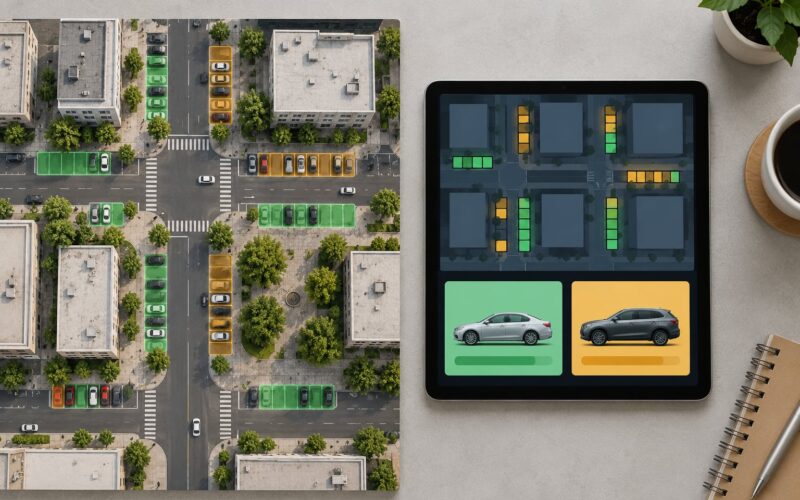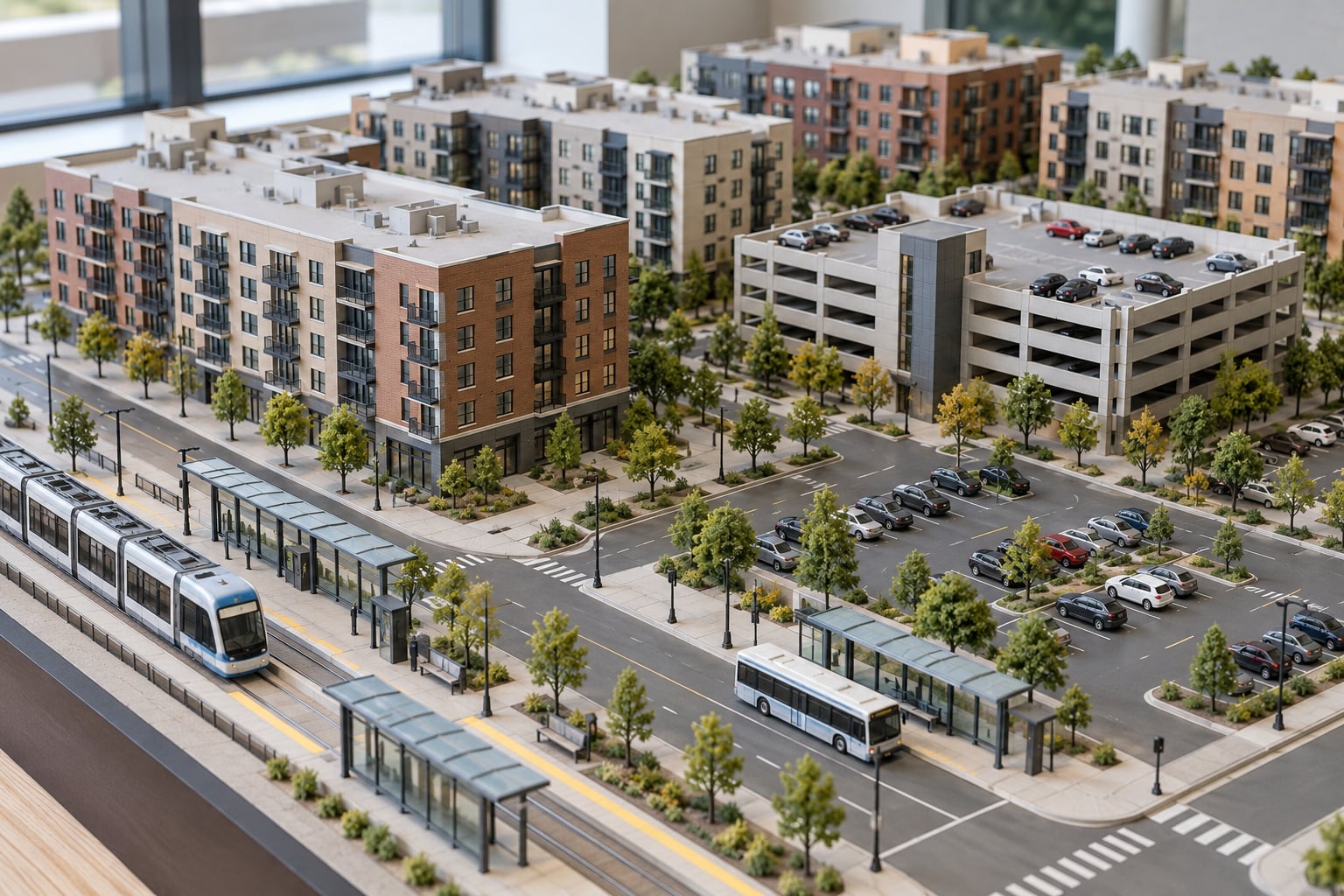
Parking minimums raise the cost of housing in two separate ways. They add hard construction cost to every apartment that has to come with a space, and they take land and building volume away from homes that could otherwise be built. A required off-street space often runs somewhere between 35,000 and 100,000 US dollars depending on how it is built, and the most-cited studies put the rent effect at about 12.5 percent for a project that requires one space per apartment, and closer to 25 percent when it requires two.
That is the short version of how parking minimums affect housing cost. This guide walks through the mechanism, separates what happens during construction from what happens in the rental market afterward, and ends with the specific things to look up in your own zoning code.
Table of Contents
- What Is a Parking Minimum?
- How Parking Minimums Affect Housing Cost
- What Does the Research Say About Parking Costs?
- Why Do Parking Minimums Matter Most in Expensive Neighborhoods?
- How Parking Minimums Affect Rents and Home Prices
- Which Housing Projects Experience the Biggest Effects?
- What Can Cities Do to Reduce the Housing Impact?
- How Parking Minimums Affect Housing Cost in Practice
- Frequently Asked Questions
- Do parking minimums directly cause higher rents?
- Are parking costs the same thing as housing costs?
- Do parking minimums affect existing homeowners’ property values?
- What happens to parking when cities remove minimums?
- Can cities reduce parking requirements without creating parking problems?
- Are there arguments in favor of parking minimums?
- Conclusion
What Is a Parking Minimum?
A parking minimum, usually called a minimum parking requirement or MPR, is a zoning rule that sets the smallest number of off-street parking spaces a developer must provide for a given amount of housing. The most common form is one space per apartment. Some codes require more for larger floor plans, and some require fractional spaces, such as 0.5 per unit near a rail station.
Most minimums trace back to mid-20th-century American zoning, when cities were growing outward and auto ownership was climbing fast. Planners of that era assumed every household needed a car, and the rule was designed to keep parking out of the street so it would not clog it.
It helps to separate four things people often mix together when they talk about parking rules.
- Parking minimums are the floor: you cannot build fewer than the code says, even if you can show there is no demand.
- Parking maximums are the ceiling: you cannot build more than the code allows, which caps oversupply in oversupplied places.
- Residential permit districts govern the use of existing public street spaces by residents of a neighborhood, which is a different lever entirely.
- Transit-oriented development overlays usually reduce or waive minimums near frequent transit, because residents there have less reason to own a car.
Minimums are also not the same thing as parking maximums, and the difference matters for anyone arguing for reform. Removing a floor lets a developer build less. Adding a ceiling forces a developer to build less in a place where spaces sit empty. Cities that have done both, such as San Francisco, generally report that the ceiling is what stops oversupply, while removing the floor is what makes small projects possible.
How Parking Minimums Affect Housing Cost
Parking minimums raise housing costs by making it more expensive per home to build the same amount of housing: required spaces consume land, raise construction and financing costs, and reduce the number of homes a lot can hold. When that cost cannot be absorbed, it shows up as higher rents, fewer homes, or projects that never get built.
Here is how that plays out, step by step. First, land. A surface space eats roughly 300 square feet of lot, and a garage or underground structure eats far more because it has to be built vertically. Every square foot of lot surrendered to parking is a square foot that cannot hold a dwelling, and on expensive land that trade is brutal.
Second, hard costs. Surface stalls are the cheapest form, structured garages sit in the middle, and underground parking sits at the top end. Add striping, lighting, drainage, ventilation and the excavation needed for a below-grade level, and the per-space number climbs quickly in dense or expensive places.
Third, financing. Lenders size a loan against a project’s cost basis and its expected rent. When required parking inflates the cost basis and the pro forma, the debt gets larger, the return on that debt gets thinner, and projects that would have cleared a feasibility test now sit close enough to the margin to get redesigned, deferred, or shelved.
Fourth, supply. This is the effect that matters most over a decade. Fewer homes per lot means fewer homes per year for a growing population to absorb, and any policy that removes homes from the pipeline eventually shows up in rents.
| Cost channel | What happens during construction and financing | What happens over time in the housing market |
|---|---|---|
| Land consumption | Lot area goes to stalls and garages instead of dwellings | Fewer homes delivered in the same neighborhood |
| Hard construction cost | Structure, excavation, lighting and drainage add per-space cost | Cost is baked into the rent or sale price |
| Financing | Larger cost basis inflates the loan and lowers projected return | Projects near the feasibility line get cancelled or cut |
| Land use efficiency | Floor area ratio drops once parking is counted against the lot | Long-run supply grows slower than demand |
| Bundled pricing | Parking is folded into the lease instead of priced on its own | Renters pay for spaces they never use |
The bundled-pricing row deserves more attention than it usually gets. When a space is required but the lease price does not itemize it, a one-car household pays for two. Renters describe this constantly in forums, and one apartment dweller put it plainly: paying monthly for a stall they had never parked in. Unbundling, where the space is priced and leased separately or offered as an opt-out cash-out, is the usual fix.
What Does the Research Say About Parking Costs?
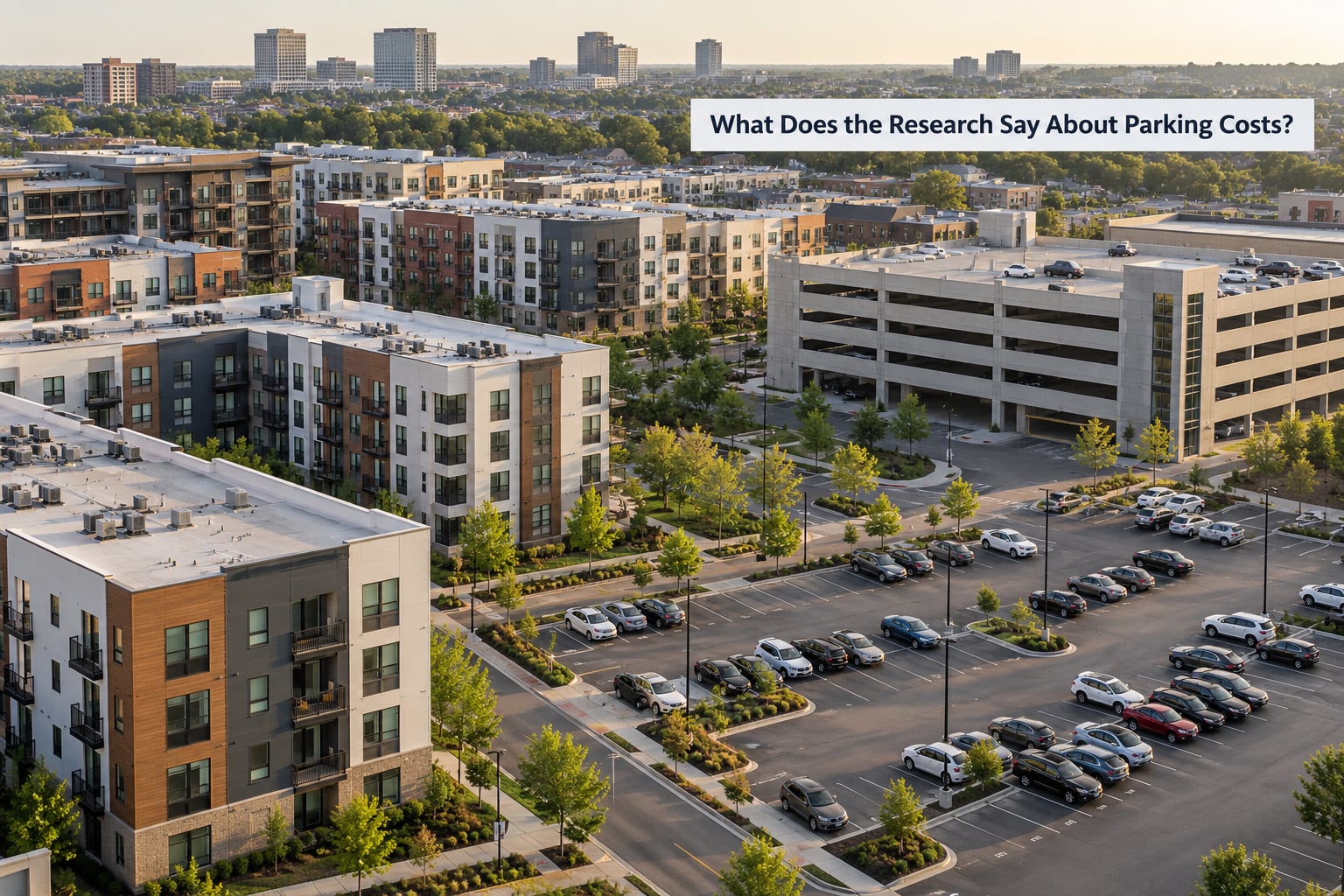
The short version: per-space costs vary widely, and any single national figure is a rule of thumb rather than a measurement. Industry and news coverage frequently cites a range of roughly 35,000 to 100,000 US dollars per structured space, while people discussing local projects in forums share much smaller numbers, often in the 15,000 to 40,000 range for surface parking in cheaper markets. Both can be right. The same stall costs very different amounts depending on labor, land, excavation conditions, and local development patterns.
The academic literature is more cautious than the advocacy headlines, and the caution is useful. Reviews of minimum parking requirement studies generally find that parking is real, bundled cost, but that the pass-through to rent varies by project. A project in a high-cost city with expensive structured parking will feel it far more than a suburban town building surface stalls on cheap land.
Two findings show up repeatedly and are worth keeping in mind.
The first is oversupply. Counts of privately parked buildings in American cities have repeatedly found peak utilization well below full capacity, with published surveys landing in the 56 to 72 percent range at the busiest hour. Those buildings are paid for and maintained for a demand that never arrives.
The second is supply elasticity. A 2025 study using a residential development simulator estimated that cutting minimum-parking requirements in Denver would have raised housing construction by roughly 12.5 percent, which works out to a few hundred additional homes a year in that city alone. That is a modeled estimate rather than an observed count, and it is best read as a direction of travel. But it lines up with what advocates in reformed cities report: in St. Louis, local organizers have argued publicly that eliminating minimums worked and invited others to ask them about it.
One confusion deserves a clean correction, because it comes up constantly and almost nobody gets it right: a city mandate and a lender requirement are different animals. The city mandate is a legal requirement you cannot build without. A lender expectation, such as a project needing a one-to-one ratio to look financeable, is a commercial judgment that lenders have relaxed considerably over the past two decades. Many projects that people assume are parking-mandated are actually just being financed conservatively.
If you are checking a specific project, the fastest way to find out which force is in play is to look at the zoning district and unit count. If a code table lists a required ratio for your unit size, that is a mandate. If no such table exists and the number appeared only in a lender memo, it is a market choice, and developers renegotiate it more often than the public assumes.
Why Do Parking Minimums Matter Most in Expensive Neighborhoods?
Because the cost of parking scales with the value of the land it displaces. The same one-space rule is a rounding error in a low-cost rural town and a major line item on an infill lot in an expensive city. This is why the housing effect is uneven across markets, and why cities with serious affordability problems tend to have the strictest minimums.
| Market type | Land pressure | Viable density | Likely supply effect | Policy response that fits |
|---|---|---|---|---|
| High land value, dense urban core | Very high; parking competes with homes for every foot of lot | Severely reduced, since parking counts against allowable density | Largest reduction in homes delivered per lot | Eliminate minimums, cap oversupply with maximums, price the curb |
| Medium value, inner suburb or regional center | Moderate; surface parking still removes usable lot area | Reduced enough to matter on small and infill parcels | Meaningful effect on small projects and missing middle housing | Context-based requirements, reductions near frequent transit |
| Low land value, rural or small town | Low; surface stalls are cheap relative to the house | Largely unaffected at typical unit counts | Small effect on housing supply, mostly on small projects | Leave ratios alone if transit is thin, focus on safety and access |
The last row is the one reform advocates sometimes skip, and skipping it costs credibility. Where transit is thin and households genuinely need a car to reach work, a minimum of one space is not an unreasonable rule, and residents will say so. In rural and small-town discussions, that is exactly the disagreement that shows up in planning forums: the mandate is often harmless in places where most people drive everywhere.
The middle row is where most of the practical action is. Inner suburbs are where missing middle housing and small lot projects get killed, because a two-unit cottage development suddenly has to provide two off-street spaces on a lot that barely fits two houses. That is the project type most often described as priced out by parking construction.
How Parking Minimums Affect Rents and Home Prices
Two effects get confused here. The first is the project-level effect, where a required space adds directly to the cost of one specific building. The second is the market effect, where slower supply growth across many buildings eventually shows up in every rent in the region. The first is measurable in a pro forma. The second is slower and harder to isolate, because land prices, interest rates, and labor costs all move at the same time.
On the project side, the outcomes are usually one of three. Developers add the parking cost to rents and sale prices. Or they shrink the building, so the same lot produces fewer, larger homes instead of more apartments. Or the project loses its financing margin and stops moving, which is the outcome that hurts the housing supply most and is the easiest for the public to miss.
For renters, the burden depends entirely on how the lease is written. Where parking is bundled into rent, everyone pays whether they drive. Where it is unbundled, households can decline it, take a cash-out credit, or choose a cheaper building without off-street parking. That single change in contract structure can matter to a car-free renter more than any citywide zoning change.
For buyers, the effect shows up in two places. Condo purchase prices often bundle the cost of a reserved space, so a buyer who does not need one still pays for it. Older owner-occupied houses in a rezoned neighborhood are a different case: they usually do not lose value because of minimums, and in some cities appreciation has been faster after reform, because new supply arrives where it was previously blocked.
I would not tell anyone that minimums are the whole story of affordability. Construction labor, interest rates, land, and insurance all matter enormously. But minimums are one of the few housing policies a city controls on its own, and that is why they keep coming up in affordability conversations.
Which Housing Projects Experience the Biggest Effects?
Project type matters more than project size. Two 100-home developments on different land can be affected very differently, because what binds is the ratio of required parking to lot capacity, not the total number of homes.
| Project type | Why minimums bind hardest here | Typical response by developers |
|---|---|---|
| Small apartment and infill buildings | Lot area barely covers the dwellings, so every required stall displaces a home | Shrink the project, convert to fewer and larger units, or abandon it |
| Mixed-use and transit-oriented buildings | High land value plus a code ratio that predates the transit investment | Seek density bonuses, use a waiver, or move the project farther out |
| Missing middle and small lot housing | Two to four homes per lot, where surface parking covers most of the site plan | Convert to single-family-style layouts or walk away |
| Accessory dwelling units and garage apartments | Often required to add a parallel on-street space per new dwelling | Skip the project, or seek an exemption that many codes already allow |
| Suburban developments with abundant surface lots | Land is cheap, so the per-space cost is comparatively low | Build parking cheaply and keep the unit count high |
| Adaptive reuse of older buildings | Historic or narrow sites often lack room for added off-street stalls | Leave the building underused rather than convert it to housing |
Senior housing, student housing, and micro-unit projects run into the same wall for a slightly different reason. Their residents have lower average car ownership, so the required ratio is loosest exactly where demand is weakest, and several cities have adopted targeted exemptions on that basis.
What Can Cities Do to Reduce the Housing Impact?
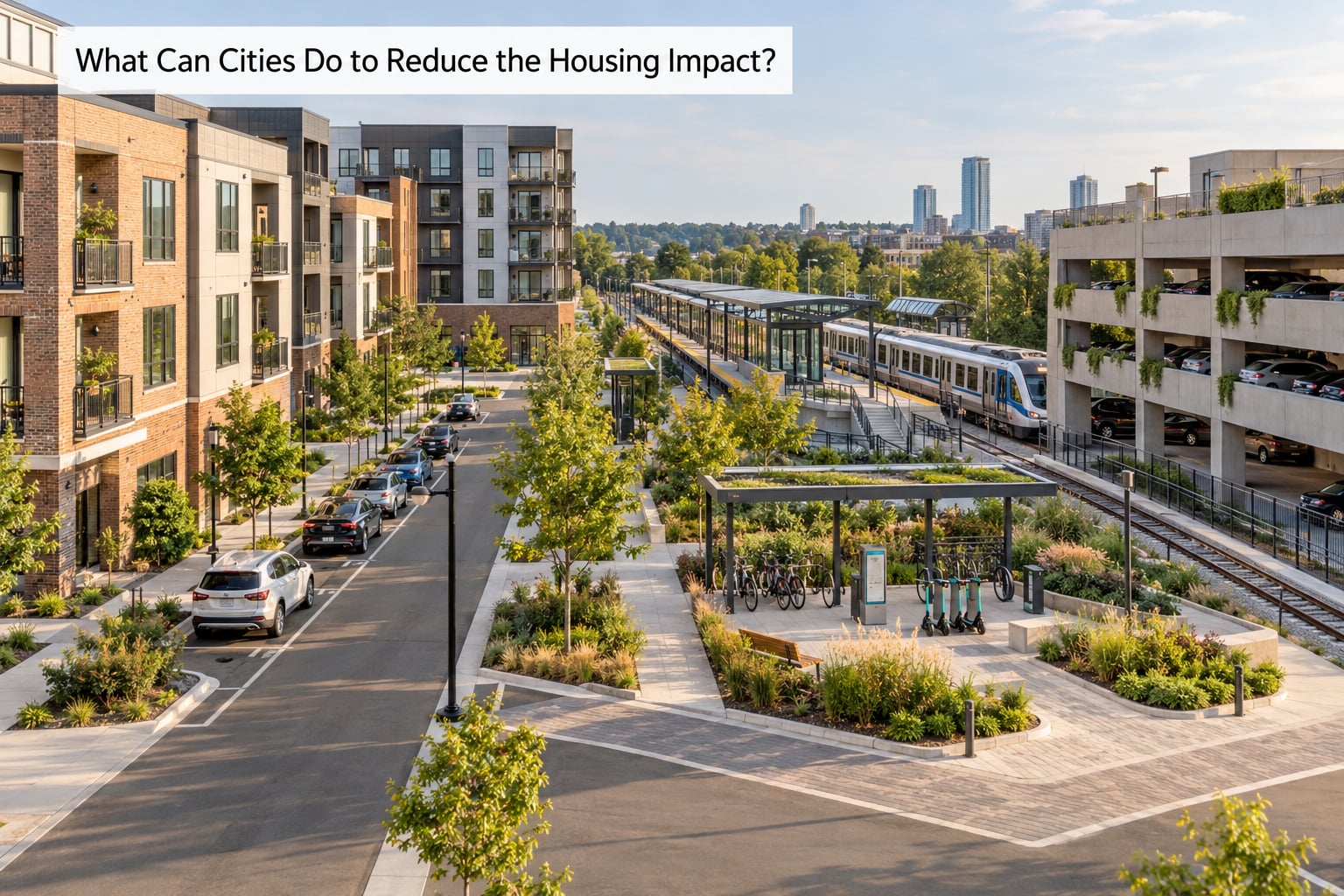
There is no single fix, and the useful reforms stack. Here are the main ones cities use, roughly from strongest to most incremental.
- Eliminate minimums and set maximums instead. The floor goes away, and a ceiling in high-demand districts stops a developer from trading excessive parking for extra floor area.
- Reduce requirements near frequent transit. A half-space or no-space rule within a short walk of high-frequency rail is the most targeted version of reform, because it targets places where residents demonstrably drive less.
- Use context-based rules. Requirements reflect the observed parking demand of that block rather than a citywide default.
- Exempt small and affordable projects. Projects below a size threshold, or those with a portion of income-restricted homes, get relief. This is where the affordable housing case is strongest, because low-income households have the lowest car ownership of any group.
- Charge an in-lieu fee. Developers who do not build the required spaces pay into a fund that finances shared parking districts or transit improvements. Politically this is often the compromise that passes, because it preserves a payment while removing the construction.
- Unbundle the price. The space is priced separately from the home, can be declined, and can sometimes be cashed out as a monthly credit.
- Let tenants substitute. Some codes already let a buyer or renter substitute a shared space, a nearby leased space, or a transit pass for a required off-street stall.
Every one of these has a tradeoff, and anyone presenting reform without one is selling something. Removing a minimum shifts parking demand toward the street, which means cities need real curb management: priced parking, permit districts with time limits, and enforcement that actually turns cars over. Landlords need to be clear that unbundled parking cannot become a mechanism for denying applicants or evicting tenants. And in places where demand genuinely exceeds supply, parking pricing does more for housing than zoning does, which is why cities that remove minimums usually pair the change with demand-based pricing rather than treating it as a standalone fix.
How Parking Minimums Affect Housing Cost in Practice
Take a hypothetical 100-home project on a lot where 30 percent of the area would go to parking under the current code, and walk through it without assuming any typical numbers, because the real figures depend on that city’s land, labor, and structure costs.
Replace the requirement with nothing. The developer loses the parking area and has a choice about what to do with it: build the 100 homes planned, shrink the building to fit the leftover footprint and build fewer homes, or add floor area and build a more expensive product that earns a better return per foot. Which path gets taken depends on the market, and each one lands differently for the people who live there.
Leave the requirement in place, and you get three common outcomes. Build fewer homes, so the same lot produces less housing than the zoning envelope technically allows. Add more expensive housing, so the land value gap gets recovered through rents and prices that only a segment of the market can pay. Or reduce project feasibility, so the financing math no longer clears and the parcel stays as it was, which from a housing-supply standpoint is the same as never having been zoned for apartments at all.
The planning lesson is straightforward. How parking minimums affect housing cost depends less on the number of spaces than on who is allowed to decline them, and on whether the land freed up goes to more homes, bigger homes, or a project that never happens.
Frequently Asked Questions
Do parking minimums directly cause higher rents?
Partly. When a required space is bundled into the rent, every tenant pays for parking whether they use it, and per-space construction costs get spread across the household. The broader rent effect comes through supply: if minimums reduce the number of homes a lot can hold, fewer homes reach the market over time, which pushes rents up across the area rather than in one building.
Are parking costs the same thing as housing costs?
No, and the distinction matters. Parking is one component of a project’s cost basis, alongside land, labor, materials, and financing. But minimums also change how much housing fits on a lot, so they affect the supply side of housing costs as well. A project can absorb some parking cost, pass some to tenants, and cancel some by building fewer homes.
Do parking minimums affect existing homeowners’ property values?
Usually not directly. Minimums regulate new construction, so an existing owner-occupied house does not change because of them. Where reform has allowed new supply in a constrained area, appreciation for existing homes has often continued rather than reversed, since more homes reduce pressure on prices instead of adding competition for buyers in a shrinking market.
What happens to parking when cities remove minimums?
In practice, developers in most reformed cities have not simply stopped building parking. They build what the market supports, which in places like London still included a substantial share of spaces after minimums were repealed. What changes is the distribution: fewer oversized developments, more shared and leased spaces, and parking costs that can be priced separately or declined.
Can cities reduce parking requirements without creating parking problems?
Yes, if the change is paired with curb management. Cities that remove minimums usually price street parking, set time limits, manage residential permits, and enforce turnover, so the spaces that do get built get used. Reform without street management invites spillover, which is the most common objection raised at hearings and the one cities have to answer.
Are there arguments in favor of parking minimums?
Yes. Supporters point to places with weak transit and long commutes, where a one-space requirement matches real car ownership and gives non-drivers access to housing they can reach. Others argue that guaranteeing a space protects residents in areas with poor transit, and that a minimum is a reasonable default where parking is scarce and alternatives are thin.
Conclusion
Parking minimums raise housing cost through land, construction, financing, and supply, and the effect is strongest where land is expensive and the code requires the most. Removing a floor without adding a ceiling, pricing the curb, and unbundling the space from the lease is what turns a zoning change into an affordability change.
Start where this article should have started: with your own jurisdiction. Look up the parking ratio table in your zoning code, check whether small or affordable projects are exempt, find out what your city charges for an in-lieu fee, and look at recent housing production data for your neighborhood. Those four documents will tell you more than any national average, and they are usually public.